-
Today’s Fed Policy Statement
Posted by Eddy Elfenbein on March 21st, 2018 at 2:01 pmThe Fed raised rates by 0.25%. The new range for Fed funds is 1.50% to 1.75%.
Information received since the Federal Open Market Committee met in January indicates that the labor market has continued to strengthen and that economic activity has been rising at a moderate rate. Job gains have been strong in recent months, and the unemployment rate has stayed low. Recent data suggest that growth rates of household spending and business fixed investment have moderated from their strong fourth-quarter readings. On a 12-month basis, both overall inflation and inflation for items other than food and energy have continued to run below 2 percent. Market-based measures of inflation compensation have increased in recent months but remain low; survey-based measures of longer-term inflation expectations are little changed, on balance.
Consistent with its statutory mandate, the Committee seeks to foster maximum employment and price stability. The economic outlook has strengthened in recent months. The Committee expects that, with further gradual adjustments in the stance of monetary policy, economic activity will expand at a moderate pace in the medium term and labor market conditions will remain strong. Inflation on a 12-month basis is expected to move up in coming months and to stabilize around the Committee’s 2 percent objective over the medium term. Near-term risks to the economic outlook appear roughly balanced, but the Committee is monitoring inflation developments closely.
In view of realized and expected labor market conditions and inflation, the Committee decided to raise the target range for the federal funds rate to 1-1/2 to 1-3/4 percent. The stance of monetary policy remains accommodative, thereby supporting strong labor market conditions and a sustained return to 2 percent inflation.
In determining the timing and size of future adjustments to the target range for the federal funds rate, the Committee will assess realized and expected economic conditions relative to its objectives of maximum employment and 2 percent inflation. This assessment will take into account a wide range of information, including measures of labor market conditions, indicators of inflation pressures and inflation expectations, and readings on financial and international developments. The Committee will carefully monitor actual and expected inflation developments relative to its symmetric inflation goal. The Committee expects that economic conditions will evolve in a manner that will warrant further gradual increases in the federal funds rate; the federal funds rate is likely to remain, for some time, below levels that are expected to prevail in the longer run. However, the actual path of the federal funds rate will depend on the economic outlook as informed by incoming data.
Voting for the FOMC monetary policy action were Jerome H. Powell, Chairman; William C. Dudley, Vice Chairman; Thomas I. Barkin; Raphael W. Bostic; Lael Brainard; Loretta J. Mester; Randal K. Quarles; and John C. Williams
Here are the new economic projections.
For the rest of this year, six FOMC members see two more hikes while another six see three more hikes. Two members see no increases while one sees four more increases this year.
The median Fed voter sees two more hikes this year, plus another three next year, plus two more in 2020.
-
Bad Day for Packaged Goods
Posted by Eddy Elfenbein on March 21st, 2018 at 12:53 pmGeneral Mills (GIS) is getting clocked today thanks to a lousy earnings report. GIS is the worst performing stock today in the entire S&P 500.
The problem for us is that this is bringing down two of our stocks, Hormel Foods (HRL) and Smucker (SJM). Wall Street assumes that if one company in a sector is having problems, then they all must be. SJM is currently down 4.3% while HRL is off by 2.3%.
Both companies are still doing well. A few weeks ago, Hormel met earnings and raised both their guidance and their dividend. That was their 52nd annual dividend increase. Smucker beat earnings and raised guidance.
-
Morning News: March 21, 2018
Posted by Eddy Elfenbein on March 21st, 2018 at 7:05 amChina Newspaper Calls for Curbs Against U.S. Soybean ‘Dumping’
Fed Set to Raise Rates, Issue New Economic Projections
How Trump’s Protectionism Backfires
Facebook’s Lax Data Policies Led to Cambridge Analytica Crisis
The End for Facebook’s Security Evangelist
We Fear What We Can’t Control About Uber and Facebook
Amazon is Now Second Most Valuable U.S.-Listed Company, Tops Alphabet
Google Is Creating Its Own Amazon Right Under Our Noses
Salesforce Buys MuleSoft for $6.5 Billion in Expansion Quest
China Pushes Qualcomm to Protect Local Companies in NXP Deal
Bayer Wins EU Approval for $62.5 Billion Monsanto Buy
Toyota to Temporarily Halt Driverless-Car Testing in U.S.
Michael Batnick: The Easy Pickings
Ben Carlson: This Year’s Stock Market Losses Are Normal
Joshua Brown: Some Alternatives to Evidence-Based Investing & The Real Reformed Broker
Be sure to follow me on Twitter.
-
Now It’s Fiserv’s Turn to Split
Posted by Eddy Elfenbein on March 20th, 2018 at 9:57 amThis morning, Fiserv (FISV) split 2-for-1. Our Buy Below price drops to $72 per share share. In our tracking portfolio, I’m adjusting the starting price to $65.565 per share. The number of shares doubles to 610.0816.
-
Morning News: March 20, 2018
Posted by Eddy Elfenbein on March 20th, 2018 at 7:05 amU.K. Inflation Slows More Than Expected as Pound Shock Fades
U.S. Plans Heavy China Tariff Hit as Soon as This Week
The Fed Is Signaling More Than 3 Rate Hikes This Year
Four Charts That Show the Tech-Stock Tumble May Not Last Long
Crash Marks 1st Death Involving Fully Autonomous Vehicle
Alex Stamos, Facebook Data Security Chief, To Leave Amid Outcry
Here’s What Wall Street Analysts Are Saying About Facebook’s Data Scandal
Facebook’s Content Issues Are Creating a ‘Tailwind’ For Amazon’s Ad Business
Weinstein Co. Files for Chapter 11 Bankruptcy
Why More Than Just the AT&T-Time Warner Deal Is on Trial
Apple and IBM Unveil Artificial Intelligence Service That Coca-Cola Is Testing
VW Plans $340 Million Expansion at Tennessee Plant
Cullen Roche: Why Are Money Managers Paid So Much?
Howard Lindzon: Momentum Monday…Will Facebook’s Faceplant Carry Over?
Be sure to follow me on Twitter.
-
S&P 500 Plunges -1.42%
Posted by Eddy Elfenbein on March 19th, 2018 at 5:44 pmToday was a rough day for Wall Street. The S&P 500 lost -1.42%. That’s it’s biggest drop since February 8. In the Dow, only Boeing was up. The 29 others were down.
Today was particularly hard for tech. The tech sector lost 2.19%. Facebook was the big loser with a loss of close to 7%. The defensive sectors fared much better. In fact, in terms of relative strength, this was an outstanding day for our Buy List. We beat the S&P 500 by 68 basis points today. Hormel, Smucker, C&D, Ross Stores, ADS and Carriage were up for the day.
Today was a classic countertrend day. A lot of the high-beta, high volatility names that had been doing well got hit hard. On the other side, many of the lagging names did OK.
-
AFLAC Splits 2-for-1
Posted by Eddy Elfenbein on March 19th, 2018 at 9:56 amShares of AFLAC (AFL) split this morning 2-for-1. This means you now have twice as many shares and the share price has fallen in half. Our Buy Below splits as well, so now AFLAC is a buy up to $47 per share.
We’re also adjusting AFLAC’s starting price this year. The year-end closing price was $87.78 per share. Now it’s $43.89 per share. Also, the number of shares in our $1 million tracking portfolio will double from 455.6847 to 911.3694.
-
Morning News: March 19, 2018
Posted by Eddy Elfenbein on March 19th, 2018 at 7:11 amCan China’s New Central Banker Restart Reforms?
Xi Taps Harvard-Educated Adviser to Tighten Grip on China’s Economy
Powell Jumps in Driver’s Seat as Fed Weighs Speed of Rate Hikes
Hedge Funds Suffer Worst Month in Two Years
Alibaba Bets Another $2 Billion on Southeast Asia
Google to Convert Product Searches Into Cash
Push to Settle McDonald’s Case, a Threat to Franchise Model
FedEx Follows Amazon Into the Robotic Future
Micro Focus Shares Collapse After Sales Warning and CEO Exit
Claire’s Becomes Latest Retailer to Go Bankrupt
StanChart Fined in Singapore for Money Laundering Breaches
Jeff Miller: A New Direction for the Fed?
Lawrence Hamtil: Oil’s Evolving Role in the Dow Transports
Joshua Brown: Nine Rules for Managing a Creative Culture
Be sure to follow me on Twitter.
-
RPM Downgraded
Posted by Eddy Elfenbein on March 16th, 2018 at 3:43 pmThis morning, JPMorgan downgraded RPM International (RPM) from Neutral to Underweight. The shares gapped down at the open but have rebounded some.

-
CWS Market Review – March 16, 2018
Posted by Eddy Elfenbein on March 16th, 2018 at 7:08 am“Individuals who cannot master their emotions are ill-suited to profit from the investment process.” – Benjamin Graham
In recent issues, I’ve struck a cautious note to investors. After the brief correction of a few weeks ago, the market rebounded very quickly. Perhaps too quickly.
I still think there’s danger out there. The S&P 500 has now fallen for four days in a row. That’s hardly a disaster, but I’m noticing a few troubling trends just below the surface. I’ll explain more in a bit.
The economic news continues to be mostly positive. We got a very good jobs report last Friday. This week’s inflation report was quite tame, which is reassuring after the surprise from last month.
The big issue ahead is next week’s Fed meeting. The consensus is that the Fed will raise interest rates again. This would be the sixth rate hike of this cycle. But what comes next? That’s not so clear. I’ll lay out what it means for us, but first, let’s look at some of the cracks showing up in the bull market’s foundation.
Tech Has Dominated This Market and It Can’t Last
I have to be up front. This is going to be a rather slim issue because, well…there’s not much going on in the market right now. But that will change very soon.
What has me concerned recently is the divergence between growth stocks and value stocks. The expected relationship is that growth leads value during a bull market, and value grabs the upper hand during a bear market. This time, growth has been giving value a super-atomic wedgie almost nonstop since the middle of 2007.
Value shone briefly in late 2016, after the election. But since the beginning of 2017, growth has been tearing up value. We can see this effect in a few other areas. For example, while the S&P 500 is still well below its all-time high from January, the NASDAQ Composite recently powered its way to a seven-day winning streak and it struck a few new all-time highs.
When we look at classic safe-haven sectors like Utilities, REITs and Consumer Staples, they’ve been left behind. On our Buy List, we can see this in the performance of stocks like Hormel Foods (HRL) and Ingredion (INGR). Meanwhile, the Tech Sector ETF (XLK) seems like it never goes down. Don’t be lured in (note today’s epigraph). Tech has done much of the heavy lifting for this market. The chart below shows the tech sector in red and the consumer staples in blue. Excluding a few high-profile stocks, the overall rally hasn’t been as impressive as it appears.
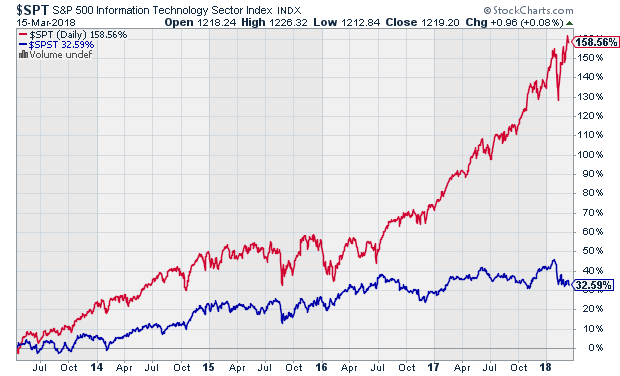
This trend can’t last. I don’t know when it will end, but we’re closer to the end than to the beginning. I’m not predicting a crash or market blowup, but I do think we may soon see a change in market leadership.
What to do now? Investors should continue to focus on high-quality stocks. On our Buy List, I especially like some of the names that have lagged recently. Ross Stores (ROST) looks quite good especially after its earnings report and dividend hike. JM Smucker (SJM) is going for less than 14 times next year’s earnings. That’s a good deal. Another Buy List stock that’s looking good here is Alliance Data Systems (ADS). In January, ADS creamed earnings, raised guidance and hiked its dividend.
About technology, I was also struck by two key news stories this week. The first is that the government blocked Broadcom’s attempt to buy Qualcomm. Let’s skip over the debate over whether it made business sense or if it’s the right government policy. The fact is that they did it, and this is a big change. Twenty years ago, this kind of merger would have barely raised an eyebrow. Those days are gone.
The other news was that President Trump is planning to impose tariffs on up to $60 billion worth of Chinese imports. I’m not sure how firm the administration is on these plans. I know some people think this is the president’s “opening bid” in an effort to gain concessions later on.
I highlight these stories because I think they quietly signal the end of the post-war consensus on economic issues. For over 25 years, the global economy has moved toward free trade and relaxed regulations. Sure, there have been bumps and bruises along the way, but the free-market orthodoxy has held the higher ground. These two events of this week show that the old conventional wisdom no longer holds.
Preview of Next Week’s Fed Meeting
The Federal Reserve meets again next week. This will be the first meeting with Jay Powell as chairman. The central bank is expected to raise interest rates again. However, what comes next is the big question.
Powell will hold a post-meeting press conference, and the Fed will release updated economic projections. This is what I’m most interested in. In previous projections, the Fed has said it will raise interest rates three times this year. Wall Street seems to buy that. However, there’s a growing belief that they may raise rates a fourth time before the end of the year. That’s quite extraordinary.
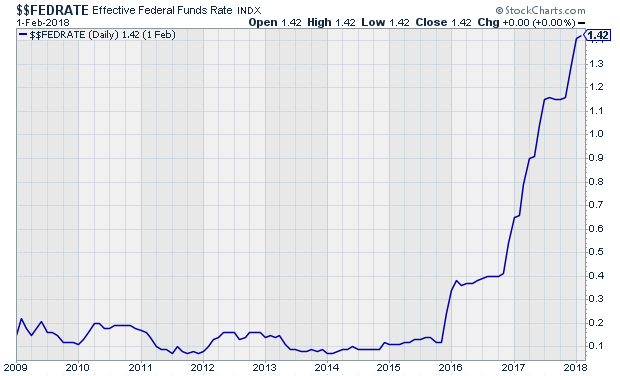
Personally, I think the chances of four hikes are remote, but the futures markets currently put the odds at 33%. Seven months ago, the odds were at 0.05%. There are a few factors driving this thesis. The first is that inflation might heat up. There was some concern that the inflation report for January might come in hot. Fortunately, this week’s CPI report showed that inflation was much more subdued in February. I still don’t think inflation is an issue.
There’s also a chance that the economy could be revising up, and that may require elevated rates. It’s possible, but I don’t see the hard evidence just yet. I should note that last Friday’s jobs report (+313,000) was quite good.
There’s also a concern that the budget deficits are unusually high for this point in the cycle. That’s certainly true, but foreign investors seem quite happy to finance our spending. I had a little concern this week when investors weren’t particularly enthusiastic about the recent Treasury auctions. In the bond market, they like to watch the “bid to cover ratio.” That’s simply how much interest there is in the Treasury auction. This week’s auction had some of the weakest ratios in years.
I think of this as an early test of the Trump administration’s fiscal policy. If China, Japan and other countries still gobble up our bonds, then it’s no problem. If not, that’s going to mean higher interest rates. In turn, that means tougher competition for the stock market. It’s not a major issue now, but there’s a chance it could become one down the road.
There hasn’t been much in the way of Buy List news recently. Our next Buy List earnings report will come from FactSet Research Systems (FDS) on March 27. The one after that is RPM International (RPM) on April 5.
We also have two stock splits coming up. AFLAC (AFL) will split 2-for-1 on March 16, and Fiserv (FISV) splits 2-for-1 on March 19. So don’t be alarmed when you see the lower share prices. Our Buy Below prices will split as well.
I should also mention that on Tuesday, AFLAC made a new all-time high. If you recall, the shares plunged 7.4% on January 12 after a negative article appeared. As usual, the long term works to the advantage of superior companies.
That’s all for now. The big news next week will be the Federal Reserve meeting. This will be a two-day affair (Tuesday and Wednesday). Also on Wednesday, we’ll get the latest report on existing-home sales. Then on Friday, the government reports on durable goods. Be sure to keep checking the blog for daily updates. I’ll have more market analysis for you in the next issue of CWS Market Review!
– Eddy
Syndication Partners
I’ve teamed up with Investors Alley to feature some of their content. I think they have really good stuff. Check it out!
Sell These 3 Stocks as Amazon Takes Over Banking
Executives across the world are asking themselves the same question: is there no end to the ambitions of Jeff Bezos and Amazon.com (Nasdaq: AMZN)?
A good question since it looks like the company nicknamed the “Death Star” (after the moon-sized, planet-killing weapon from Star Wars) is set to take aim at another industry. Just recently, Amazon seemed to be setting its sights on the freight delivery industry then on the healthcare industry and now its seems to be getting ready to target the financial industry. Although as with healthcare, Amazon is in talks with possible established partners in the sector.
Now Amazon has its sights set on the banking industry. Find out what three financial stocks you need to sell right now to avoid the wrath of the Death Star!
3 REITs Increasing Dividends in April
With a pending interest rate increase from the Fed, I have been receiving questions on whether REIT values will be hurt by rising interest rates. It is a widely held – but inaccurate – belief that REIT values must fall if interest rates continue to increase. The fact that many REITs increase their dividends over time tells us that these are businesses with the potential for growing dividends and share values even in a rising rate environment.
Recently, I read an article that looked at the history of REIT values and interest rates. Since 1995, there has been 15 periods of significantly rising interest rates. Out of those 15, REIT values increased 12, or 75% of the time. In the period from June 2004 through August 2006 the Fed increased rates 16 times. During that period REITs outperformed the S&P 500, 59% to 22%.
The fact is that REIT results are driven more by economic conditions, rising commercial real estate values, and the ability of REITs to increase the rental rates on their properties. We can monitor how well a REIT is performing from its history of dividend growth. Most REITs announce any dividend increases once a year, in the same month each year.
Across the sector there are increase announcements in almost every month in the calendar. You can often get a nice share price gain by buying shares before a dividend increase announcement hits the news wires. I maintain a database that covers about 140 REITs. I use the database to track dividend rates, yields and increases. Of the 140, about 90 have histories of regular dividend increases. Here are three REITs that should announce a dividend increase in April.
-
Archives
- November 2026
- October 2026
- September 2026
- August 2026
- July 2026
- June 2026
- May 2026
- April 2026
- March 2026
- February 2026
- January 2026
- December 2025
- November 2025
- October 2025
- September 2025
- August 2025
- July 2025
- June 2025
- May 2025
- April 2025
- March 2025
- February 2025
- January 2025
- December 2024
- November 2024
- October 2024
- September 2024
- August 2024
- July 2024
- June 2024
- May 2024
- April 2024
- March 2024
- February 2024
- January 2024
- December 2023
- November 2023
- October 2023
- September 2023
- August 2023
- July 2023
- June 2023
- May 2023
- April 2023
- March 2023
- February 2023
- January 2023
- December 2022
- November 2022
- October 2022
- September 2022
- August 2022
- July 2022
- June 2022
- May 2022
- April 2022
- March 2022
- February 2022
- January 2022
- December 2021
- November 2021
- October 2021
- September 2021
- August 2021
- July 2021
- June 2021
- May 2021
- April 2021
- March 2021
- February 2021
- January 2021
- December 2020
- November 2020
- October 2020
- September 2020
- August 2020
- July 2020
- June 2020
- May 2020
- April 2020
- March 2020
- February 2020
- January 2020
- December 2019
- November 2019
- October 2019
- September 2019
- August 2019
- July 2019
- June 2019
- May 2019
- April 2019
- March 2019
- February 2019
- January 2019
- December 2018
- November 2018
- October 2018
- September 2018
- August 2018
- July 2018
- June 2018
- May 2018
- April 2018
- March 2018
- February 2018
- January 2018
- December 2017
- November 2017
- October 2017
- September 2017
- August 2017
- July 2017
- June 2017
- May 2017
- April 2017
- March 2017
- February 2017
- January 2017
- December 2016
- November 2016
- October 2016
- September 2016
- August 2016
- July 2016
- June 2016
- May 2016
- April 2016
- March 2016
- February 2016
- January 2016
- December 2015
- November 2015
- October 2015
- September 2015
- August 2015
- July 2015
- June 2015
- May 2015
- April 2015
- March 2015
- February 2015
- January 2015
- December 2014
- November 2014
- October 2014
- September 2014
- August 2014
- July 2014
- June 2014
- May 2014
- April 2014
- March 2014
- February 2014
- January 2014
- December 2013
- November 2013
- October 2013
- September 2013
- August 2013
- July 2013
- June 2013
- May 2013
- April 2013
- March 2013
- February 2013
- January 2013
- December 2012
- November 2012
- October 2012
- September 2012
- August 2012
- July 2012
- June 2012
- May 2012
- April 2012
- March 2012
- February 2012
- January 2012
- December 2011
- November 2011
- October 2011
- September 2011
- August 2011
- July 2011
- June 2011
- May 2011
- April 2011
- March 2011
- February 2011
- January 2011
- December 2010
- November 2010
- October 2010
- September 2010
- August 2010
- July 2010
- June 2010
- May 2010
- April 2010
- March 2010
- February 2010
- January 2010
- December 2009
- November 2009
- October 2009
- September 2009
- August 2009
- July 2009
- June 2009
- May 2009
- April 2009
- March 2009
- February 2009
- January 2009
- December 2008
- November 2008
- October 2008
- September 2008
- August 2008
- July 2008
- June 2008
- May 2008
- April 2008
- March 2008
- February 2008
- January 2008
- December 2007
- November 2007
- October 2007
- September 2007
- August 2007
- July 2007
- June 2007
- May 2007
- April 2007
- March 2007
- February 2007
- January 2007
- December 2006
- November 2006
- October 2006
- September 2006
- August 2006
- July 2006
- June 2006
- May 2006
- April 2006
- March 2006
- February 2006
- January 2006
- December 2005
- November 2005
- October 2005
- September 2005
- August 2005
- July 2005
 Eddy Elfenbein is a Washington, DC-based speaker, portfolio manager and editor of the blog Crossing Wall Street. His