-
Morning News: May 24, 2017
Posted by Eddy Elfenbein on May 24th, 2017 at 6:51 amOPEC, Non-OPEC Hold Informal Talks To Nail New Oil Cuts
Moody’s Downgrades China Credit Ratings For First Time in 30 Years As Debt Mounts
Net Neutrality Ideals Are Already Dead
Obama’s Fiduciary Rule, After a Delay, Will Go Into Effect
The U.S. Wins the G7 Unemployment-Improvement Race
Trump’s Path to a Balanced Budget Paved With Accounting Gimmicks
Economists See Little Magic in Tax Cuts to Promote Growth
Fiat Chrysler Stumbles Into U.S. Regulatory Crosshairs Again
Biggest Threat to Ford? Not GM, but Silicon Valley
Amazon Sets Up Shop in the Heart of the Publishing Industry
Uber to Repay Millions to Drivers, Who Could Be Owed Far More
Startup Carmaker Faraday Future Says It’s Unaffected By Job Cuts At Partner LeEco
‘Food Revolution’: Megabrands Turn To Small Start-Ups For Big Ideas
Ben Carlson: Barriers to Entry in the Markets
Jeff Carter: Risk and Startups
Be sure to follow me on Twitter.
-
HEICO Earns 53 Cents per Share
Posted by Eddy Elfenbein on May 23rd, 2017 at 5:34 pmAfter the bell, HEICO (HEI) reported fiscal Q2 earnings of 53 cents per share. That was three cents better than Wall Street’s estimate. The details look pretty good. Net sales rose 5% to $368.7 million. For the first half of the year, net sales are up 8%. I was pleased to see HEICO’s operating margin edge up from 19% a year ago to 20.8% for this year’s Q2.
Laurans A. Mendelson, HEICO’s Chairman and CEO, commented on the Company’s second quarter results stating, “We are very pleased to report record quarterly results in consolidated net sales, operating income and net income driven by record net sales and operating income at both operating segments. Our outstanding performance principally reflects increased demand and operating efficiencies within both of our operating segments, as well as the excellent performance of our well managed and profitable fiscal 2016 acquisition.
Best of all, HEICO raised their full-year guidance. This was the second increase this year. Unfortunately, the company doesn’t guide for EPS, but they do for a few other metrics.
HEICO now sees net sales rising this year by 8% to 10%. The previous forecast was 6% to 8%. For net income, HEICO projects growth of 12% to 14%, up from 9% to 11%. HEICO also projects cash flow from operations of $270 million. That’s up $10 million from the previous forecast.
Last year, HEICO earned $1.86 per share last year. If we assume no change in shares outstanding, that implies 2017 EPS of $2.08 to $2.12. Wall Street had been expecting $2.05 per share.
-
The Rebound in Cognizant
Posted by Eddy Elfenbein on May 23rd, 2017 at 3:07 pmOne of the lessons of investing is that periodically, the market freaks out. Sometime the reasons are good, many times, they’re not.
Last September, shares of Cognizant Technology Solutions (CTSH) plunged after the company said that an internal investigation revealed that the company may have violated the U.S. Foreign Corrupt Practices Act. Cognizant notified the SEC and DOJ. The same day, the company’s president resigned.
That day, the stock got crushed. At one point, CTSH dropped down to $45.44, which was a loss of 17.4% for the day. By the closing bell, the stock had shed 13.3%.
We waited the mess out, and today CTSH is at a new 52-week high. Today’s high was $66.30 per share.
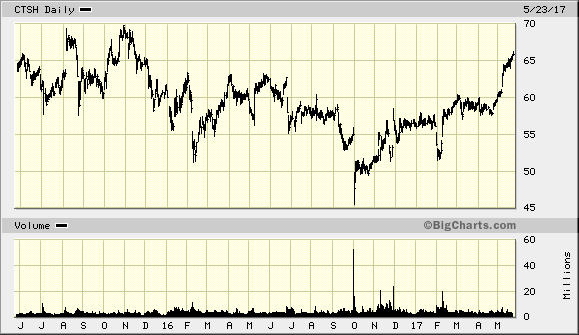
To quote Warren Buffett, “the stock market is designed to transfer money from the active to the patient.”
-
Morning News: May 23, 2017
Posted by Eddy Elfenbein on May 23rd, 2017 at 7:11 amOPEC on Verge of 9-Month Cuts Extension After Iraq Gives Backing
Merkel’s Weak-Euro Complaint Has Two Goals
Greek Deal on Debt Relief Founders as Talks Stretch to June
Supreme Court Limits Locations of Patent Lawsuits
The Case That Could Doom Elizabeth Warren’s Wall Street Watchdog
CEOs Of Target, ADM To Square Off On U.S. Border Tax At Hearing
Ford Taps Former Office Furniture Executive To Be New CEO
Here’s Why Tesla’s Elon Musk Just Called Himself an ‘Idiot’ on Twitter
Puma Biotech Shares Are Roaring On An FDA Review. Here’s What Could Still Go Wrong
The Future of Whole Foods Isn’t About Groceries
Apple and Nokia Settle Patent Dispute And Sign New Deal
Even Harley-Davidson Can’t Resist the Tug of Overseas Factories
Cullen Roche: Why I Am An Optimist
Roger Nusbaum: Political Volatility Catches Up To Markets (Kind Of)
Be sure to follow me on Twitter.
-
The Quants Are Taking Over
Posted by Eddy Elfenbein on May 22nd, 2017 at 3:43 pmThe WSJ runs a story today on the emergence of quant funds:
Up and down Wall Street, algorithmic-driven trading and the quants who use sophisticated statistical models to find attractive trades are taking over the investment world.
On many trading floors, quants are gaining respect, clout and money as investment firms scramble to hire mathematicians and scientists. Traditional trading strategies, such as sifting through balance sheets and talking to companies’ customers, are falling down the pecking order.
“A decade ago, the brightest graduates all wanted to be traders at Wall Street investment banks, but now they’re climbing over each other to get into quant funds,” says Anthony Lawler, who helps run quantitative investing at GAM Holding AG . The Swiss money manager last year bought British quant firm Cantab Capital Partners for at least $217 million to help it expand into computer-powered funds.
Guggenheim Partners LLC built what it calls a “supercomputing cluster” for $1 million at the Lawrence Berkeley National Laboratory in California to help crunch numbers for Guggenheim’s quant investment funds, says Marcos Lopez de Prado, a Guggenheim senior managing director. Electricity for the computers costs another $1 million a year.
Algorithmic trading has been around for a long time but was tiny. An article in The Wall Street Journal in 1974 featured quant pioneer Ed Thorp. In 1988, the Journal profiled a little-known Chicago options-trading firm that had a secret computer system. Journal reporter Scott Patterson wrote a best-selling book in 2010 about the rise of quants.
Prognosticators imagined a time when data-driven traders who live by algorithms rather than instincts would become the kings of Wall Street.
That day has arrived. In just one sign of their power, quantitative hedge funds are now responsible for 27% of all U.S. stock trades by investors, up from 14% in 2013, according to the Tabb Group, a research and consulting firm in New York.
Quants have almost caught up to individual investors, which outnumber quants and collectively have 29% of all stock-trading volume.
At the end of the first quarter, quant-focused hedge funds held $932 billion of investments, or more than 30% of all hedge-fund assets, estimates HFR Inc. In 2009, quant funds held $408 billion, or 25% of all hedge-fund assets.
Quants got $4.6 billion of net new investments in the first quarter, while the overall hedge-fund business saw withdrawals of $5.5 billion.
The computers are outperforming humans at picking investments. In the past five years, quant-focused hedge funds gained about 5.1% a year on average. The average hedge fund rose 4.3% a year in the same period.
This is a good article and I recommend you give it a read. My only quibble, and it’s a small one, is that it seems late by about ten years. These trends have been building for a long time.
-
New High Today for Stryker
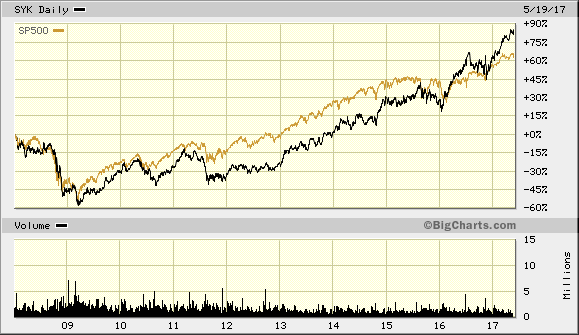
Posted by Eddy Elfenbein on May 22nd, 2017 at 2:21 pmI noticed that Stryker (SYK) is at a new all-time high today. I added the stock to the Buy List in 2008. It promptly crashed with the bear market and underperformed for more than four years. We held on and have done quite well. Good investing takes patience.
-
Incentives Matter
Posted by Eddy Elfenbein on May 22nd, 2017 at 12:01 pmJosh Brown noticed that Steven Russolillo is winding down the WSJ‘s stock-picking column. Why? Simply put, hunting for cheap stocks has become a dying art.
Josh sees this as part of a long-term decline for active investing, and he highlights AllianceBernstein’s new incentive-based pay structure for active managers.
Later on, Josh talks about my venture into exchange-traded funds:
I gave some money to my old friend Eddy Elfenbein when his Crossing Wall Street ETF launched last fall. He did well and I will probably give him some more.
He’s got the first actively-managed ETF with a variable management fee built into it (his product was launched through Noah Hamman’s AdvisorShares fund family). He’s doing between 20 and 30 of his favorite stocks, which will either be very good or very bad in different market environments. But overall, he’s not snuggling up to the Russell 3000 or the S&P 500. I have no way of knowing whether or not what he’s trying to do will work, I only know that it won’t look exactly like an index fund I can buy for approximately zero dollars.
Here’s Voss and Howard again on concentration:
Studies show that buy-side analysts are quite good at security selection: Take, for example, the high levels of accretive alpha of their highest conviction/largest positions, as measured by ex-ante relative portfolio weights. Moving down the relative weights, performance worsens, with holdings beyond the top 20 generating negative alpha. In other words, most portfolios are overdiversified and research shows that hurts performance.
What’s interesting is that, because Eddy doesn’t focus on the benchmark in terms of how he talks about his approach, I have never even once looked at CWS’s performance against it, only absolutely. There’s a benefit to this sort of reframing that I should probably think more deeply about.
There should be more attempts at innovation like what we’re seeing from Eddy and AB. Something will eventually click.
-
Mark Fields is Out at Ford
Posted by Eddy Elfenbein on May 22nd, 2017 at 9:48 amMark Fields has been fired as CEO of Ford. That’s a tough break for him and I feel bad. The company is making a decent profit but the stock has gone nowhere.
Last year, I finally decided to ditch Ford from our Buy List after holding on for too long.
During Mr. Fields’s three-year tenure — a period when Ford’s shares dropped 40 percent — he came under fire from investors and Ford’s board for failing to expand the company’s core auto business and for lagging in developing the high-tech cars of the future.
The change came less than two weeks after Mr. Fields was sharply criticized during the company’s annual shareholders meeting for Ford’s deteriorating financial results.
(…)
As recently as last week, Mr. Fields, 56, had been trying to strengthen Ford’s bottom line by cutting 1,400 salaried jobs. But, unable to reverse the stock decline, he ran out of time to carry out his strategy to slash costs and expand Ford’s lineup of trucks and sport utility vehicles, while also investing in autonomous and electrified vehicles.
Despite spending heavily on self-driving research, Ford was struggling to keep pace with larger automakers such as General Motors and tech giants like Google, both of which have been testing self-driving vehicles. Ford is promising to have a fully autonomous vehicle on the road by 2021.
I think this is a good example of a CEO getting blamed for things that weren’t entirely his fault. The new CEO is Jim Hackett. He was in charge of Ford’s efforts in autonomous vehicles.
The shares are back up over $11. At last week’s low, Ford was yielding 5.6%.
-
Morning News: May 22, 2017
Posted by Eddy Elfenbein on May 22nd, 2017 at 6:35 amFarming the World: China’s Epic Race to Avoid a Food Crisis
Saudi Arabia’s $20 Billion Wager With Blackstone is Record-Sized Bet on U.S. Infrastructure
Saudi Arabia and Russia Are at Odds on Almost Everything, Except Oil
Swiss Voters Back Plan to Phase Out Nuclear Power
Ford Fires CEO Mark Fields; Former Steelcase Chief Jim Hackett To Take Over
Cathay Pacific Is Cutting 600 Jobs in Its Largest Restructuring in Decades
Huntsman, Clariant Agree to Merge
LafargeHolcim Poaches Sika’s Jan Jenisch For Chief Executive
Move Over Tesla, Europe’s Building Its Own Battery Gigafactories
At Warner Bros., Former Disney Exec Leads New Charge on Merchandise
SoftBank’s Son Chases Boyhood Dreams With $100 Billion Fund
`The Internet Is Broken’: @ev Is Trying to Salvage It
Jeff Miller: Will The Fed Change Course?
Howard Lindzon: How Many Bankers Did it Take to Grow Ethereum?
Michael Batnick: These Are The Goods
Be sure to follow me on Twitter.
-
Ingredion in Barron’s
Posted by Eddy Elfenbein on May 20th, 2017 at 5:33 pmThis weekend’s Barron’s discusses the attractiveness of defensive stocks in tough markets. Derek Anguilm of the Westcore Mid-Cap Value Dividend Fund mentions one of his favorites:
One favorite is Ingredion (INGR), which makes sweeteners and nutrition ingredients, like ones that make crackers crisper, and pharmaceutical products like intravenous solutions. The stock has pulled back amid concerns about changes in foreign trade. Anguilm sees demand rising from a growing middle class in emerging markets and aging populations in the developed world.
Ingredion “generates strong and consistent cash flows, has a healthy balance sheet, and has a history of returning cash to shareholders,” he says. Ingredion yields 1.7% but has grown its dividend by 170% over the past five years. Its payout ratio is 26% of earnings, “which we believe will allow for attractive dividend growth in the years ahead,” says Anguilm, who recently added to the fund’s position.
-
Archives
- September 2026
- August 2026
- July 2026
- June 2026
- May 2026
- April 2026
- March 2026
- February 2026
- January 2026
- December 2025
- November 2025
- October 2025
- September 2025
- August 2025
- July 2025
- June 2025
- May 2025
- April 2025
- March 2025
- February 2025
- January 2025
- December 2024
- November 2024
- October 2024
- September 2024
- August 2024
- July 2024
- June 2024
- May 2024
- April 2024
- March 2024
- February 2024
- January 2024
- December 2023
- November 2023
- October 2023
- September 2023
- August 2023
- July 2023
- June 2023
- May 2023
- April 2023
- March 2023
- February 2023
- January 2023
- December 2022
- November 2022
- October 2022
- September 2022
- August 2022
- July 2022
- June 2022
- May 2022
- April 2022
- March 2022
- February 2022
- January 2022
- December 2021
- November 2021
- October 2021
- September 2021
- August 2021
- July 2021
- June 2021
- May 2021
- April 2021
- March 2021
- February 2021
- January 2021
- December 2020
- November 2020
- October 2020
- September 2020
- August 2020
- July 2020
- June 2020
- May 2020
- April 2020
- March 2020
- February 2020
- January 2020
- December 2019
- November 2019
- October 2019
- September 2019
- August 2019
- July 2019
- June 2019
- May 2019
- April 2019
- March 2019
- February 2019
- January 2019
- December 2018
- November 2018
- October 2018
- September 2018
- August 2018
- July 2018
- June 2018
- May 2018
- April 2018
- March 2018
- February 2018
- January 2018
- December 2017
- November 2017
- October 2017
- September 2017
- August 2017
- July 2017
- June 2017
- May 2017
- April 2017
- March 2017
- February 2017
- January 2017
- December 2016
- November 2016
- October 2016
- September 2016
- August 2016
- July 2016
- June 2016
- May 2016
- April 2016
- March 2016
- February 2016
- January 2016
- December 2015
- November 2015
- October 2015
- September 2015
- August 2015
- July 2015
- June 2015
- May 2015
- April 2015
- March 2015
- February 2015
- January 2015
- December 2014
- November 2014
- October 2014
- September 2014
- August 2014
- July 2014
- June 2014
- May 2014
- April 2014
- March 2014
- February 2014
- January 2014
- December 2013
- November 2013
- October 2013
- September 2013
- August 2013
- July 2013
- June 2013
- May 2013
- April 2013
- March 2013
- February 2013
- January 2013
- December 2012
- November 2012
- October 2012
- September 2012
- August 2012
- July 2012
- June 2012
- May 2012
- April 2012
- March 2012
- February 2012
- January 2012
- December 2011
- November 2011
- October 2011
- September 2011
- August 2011
- July 2011
- June 2011
- May 2011
- April 2011
- March 2011
- February 2011
- January 2011
- December 2010
- November 2010
- October 2010
- September 2010
- August 2010
- July 2010
- June 2010
- May 2010
- April 2010
- March 2010
- February 2010
- January 2010
- December 2009
- November 2009
- October 2009
- September 2009
- August 2009
- July 2009
- June 2009
- May 2009
- April 2009
- March 2009
- February 2009
- January 2009
- December 2008
- November 2008
- October 2008
- September 2008
- August 2008
- July 2008
- June 2008
- May 2008
- April 2008
- March 2008
- February 2008
- January 2008
- December 2007
- November 2007
- October 2007
- September 2007
- August 2007
- July 2007
- June 2007
- May 2007
- April 2007
- March 2007
- February 2007
- January 2007
- December 2006
- November 2006
- October 2006
- September 2006
- August 2006
- July 2006
- June 2006
- May 2006
- April 2006
- March 2006
- February 2006
- January 2006
- December 2005
- November 2005
- October 2005
- September 2005
- August 2005
- July 2005
 Eddy Elfenbein is a Washington, DC-based speaker, portfolio manager and editor of the blog Crossing Wall Street. His