-
The Emerging Markets Cycle
Posted by Eddy Elfenbein on April 4th, 2017 at 1:00 pmHere’s a fascinating chart. This shows the main Emerging Markets ETF (EEM) divided by the S&P 500.
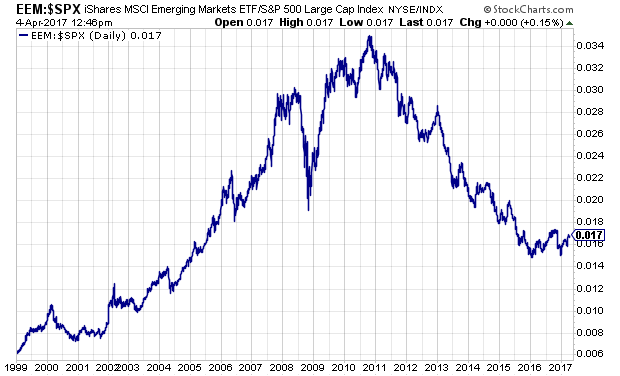
As you can see, it goes in long cycles. From 1999 to 2010, EEM beat the market regularly (except during the financial crisis).
Since 2010, the U.S. market has been the champ. The S&P 500 has doubled while EEM hasn’t gained at all.
Has the cycle turned? I can’t say for certain, but EEM has started to perk up against the overall market. If it’s a new trend, I think it could last several years.
-
Can Emerging Markets Keep Leading the Way?
Posted by Eddy Elfenbein on April 4th, 2017 at 12:39 pm -
Morning News: April 4, 2017
Posted by Eddy Elfenbein on April 4th, 2017 at 7:01 amIt’s a Big Week for One of the Most Important Debates in Markets
Uncovering the Secret History of Wall Street’s Largest Oil Trade
Within Hours, Plans for a Quiet Corner of China Send Home Prices Soaring
RBA’s Lowe Lashes Out at Australian Banks for Risky Home Lending
H-1B Visa Applications Pour In By Truckload Before Door Slams Shut
Trump Completes Repeal of Online Privacy Protections From Obama Era
Boeing Says It Signed $3 Billion Deal With Iranian Airline
Amazon Launches Amazon Cash, a Way To Shop Its Site Without a Bank Card
Tesla Passes Ford in Market Value as Investors Bet on the Future
Verizon Announces New Name Brand for AOL and Yahoo: Oath
J. Crew’s Parting With Once-Prized Top Merchant Echoes Retail’s Woes
Vale Megadeal Puts Morgan Stanley, Bradesco At The Top of Brazil M&A
Wells Fargo Whistle-Blower Wins $5.4 Million and His Job Back
Cullen Roche: What Is “Enough”?
Howard Lindzon: Elon Musk is the Mayor of Shortville…and This Shnook Caught a Snook
Be sure to follow me on Twitter.
-
Can the Worst Performing Stock in the S&P 500 Catch a Break?
Posted by Eddy Elfenbein on April 3rd, 2017 at 11:22 pm -
Trading the Automakers
Posted by Eddy Elfenbein on April 3rd, 2017 at 8:15 pm -
March ISM = 57.2
Posted by Eddy Elfenbein on April 3rd, 2017 at 11:28 amPlease forgive me, but I was very busy last week with traveling. I wasn’t able to get to the newsletter, but I promise it will return this week.
To be honest, there hasn’t been a lot of action on Wall Street lately. This morning, we learned that the ISM Manufacturing report for March came in at 57.2. That’s a decent number.
I like to track the ISM number because it tends to line up well with recessions and expansions. Recessions typically kick in when the ISM is 45 or less. Also, the ISM report comes out on the first business day of the month. For now, we’re not near a recession.
Even though the overall market has been flatlining recently, the Nasdaq Composite continues to climb higher. This is the danger in placing too much faith in an index. The rising Nasdaq really tells us more about the health of large-cap tech than the overall market.
A week ago, the S&P 500 dipped below its 50-day moving average. Crucially, it didn’t close below it. The index then briefly rallied, but the 50-DMA still lurks not far away. I’m going to keep an eye on this. Falling below support can often be a warning sign of bad things to come.
-
Morning News: April 3, 2017
Posted by Eddy Elfenbein on April 3rd, 2017 at 7:20 amJapanese Corporate Sentiment Improves on Better Profits
Foreigners Have Long Mined Indonesia, But Now There’s an Outcry
EU’s Fastest-Growing Economy Needs a Band-Aid
U.K. Manufacturing Slows as Inflationary Pressures Continue
Praet Says QE Reduction Doesn’t Signal Start of Stimulus Exit
Murthy, Infosys And Pay – It’s Markets That Make Capitalism Compassionate, Nothing Else
What the YouTube Ad Boycott Tells Us?
The Question That Continues to Loom Over Uber and Lyft – And Vex Lawyers
Self-Driving Cars Raise Questions About Who Carries Insurance
Dyson Is the Apple of Appliances (and Just as Secretive)
It’s Not Their Pop Idol, But a Bot. Fans Cheer Anyway.
Burberry Licenses Beauty Business to Coty In New Drive to Expand
Josh Brown: Would A Value Investor Buy Trump’s Presidency Here?
Jeff Miller: What Can We Learn From The Trump-Xi Meeting?
Be sure to follow me on Twitter.
-
Morning News: March 31, 2017
Posted by Eddy Elfenbein on March 31st, 2017 at 6:54 amDraghi Dials Down ECB Stimulus as QE’s Far Future Debated
U.S. Economic Growth Revised Higher, Boosted By Consumer Spending
The FCC Wants To Block Dozens of Companies From Providing Low-Cost Internet
AT&T Is Building a New Cell Network That’ll Give Cops and Firefighters Priority In a Crisis
Apple, Wal-Mart Stick With Climate Pledges Despite Trump’s Pivot
McDonald’s to Start Using Fresh Beef in `Watershed Moment’
Huawei’s Sales Jump But Profits Go Nowhere
Amazon Is Worth More Than Berkshire Hathaway – What That Means For You
Amazon’s Household Goods Unit May Have Been a Casualty of Prime’s Success
Qatar and Etihad Airways Are Loaning Free Laptops and Tablets to Some U.S.-Bound Passengers
Elon Musk’s Real Moonshot: Five Things We Learned This Week
Westinghouse Bankruptcy Shakes The Nuclear World
Airlines Make More Money Selling Miles Than Seats
Jeff Carter: Are Strategic Investors’ Interests Aligned With Entrepreneur Interests?
Roger Nusbaum: Hindsight Bias Catches Up With Even The Best Of Us
Be sure to follow me on Twitter.
-
Morning News: March 30, 2017
Posted by Eddy Elfenbein on March 30th, 2017 at 7:09 amOil Stays Above $49 as U.S. Fuel Demand Blunts Crude Supply Gain
Beginning `Brexit’ and Bracing For Impact
Lloyd’s of London Chooses Brussels for Post-Brexit EU Hub
Coal Mining Jobs Trump Would Bring Back No Longer Exist
Why Buffett and BlackRock Think You Should Fire Your Fund Manager
‘Toshiba Has Become a Laughingstock’: Angry Shareholders Vent at CEO After Westinghouse Bankruptcy
ESPN Has Seen the Future of TV and They’re Not Really Into It
BofA Shakes Up Merrill Lynch Leadership Under New Chief Sieg
Toyota Recalls 2.9 Million Vehicles Globally Over Airbags
Lululemon Says Lack of Bold Colors to Blame for Poor Start to 2017
In China, `Disney’ Deals Turn Out to Be Fantasy
Ackman Is ‘Profoundly’ Sorry for $4 Billion Valeant ‘Mistake’
Jeff Miller: Headline Spin – Recession Forecasting Is Back!
Cullen Roche: Why Capitalism Can’t Fix Healthcare
Be sure to follow me on Twitter.
-
Morning News: March 29, 2017
Posted by Eddy Elfenbein on March 29th, 2017 at 6:37 amBritain Heads Into the Unknown as May Signs Brexit Letter
EU Blocks Deutsche Boerse’s $14 Billion Takeover of London Stock Exchange
India’s GST, Complicated, Yes, But An Excellent Idea All The Same
China Poised To Take Lead on Climate After Trump’s Move to Undo Policies
The House Just Voted To Wipe Away The FCC’s Landmark Internet Privacy Protections
The Great Nevada Lithium Rush to Fuel the New Economy
Westinghouse Files for Bankruptcy, in Blow to Nuclear Power
Wells Fargo Reaches $110 Million Fake Accounts Settlement
Ford’s Biggest News Is About The Michigan Data Center, Not Warmed-Over Words About Truck Jobs
Amazon’s Ambitions Unboxed: Stores for Furniture, Appliances and More
BlackRock Cuts Dozens of Jobs and Fees in Stock-Picking Unit
Didi Chuxing, China’s Ride-Hailing Giant, Holds Talks With SoftBank
Tencent of China Takes 5% Stake in Tesla
Jeff Carter: You Cannot Chase A Trade
Cullen Roche: The Biggest Myths in Investing, Part 10 – Forecasts are Useless
Be sure to follow me on Twitter.
-
Archives
- September 2026
- August 2026
- July 2026
- June 2026
- May 2026
- April 2026
- March 2026
- February 2026
- January 2026
- December 2025
- November 2025
- October 2025
- September 2025
- August 2025
- July 2025
- June 2025
- May 2025
- April 2025
- March 2025
- February 2025
- January 2025
- December 2024
- November 2024
- October 2024
- September 2024
- August 2024
- July 2024
- June 2024
- May 2024
- April 2024
- March 2024
- February 2024
- January 2024
- December 2023
- November 2023
- October 2023
- September 2023
- August 2023
- July 2023
- June 2023
- May 2023
- April 2023
- March 2023
- February 2023
- January 2023
- December 2022
- November 2022
- October 2022
- September 2022
- August 2022
- July 2022
- June 2022
- May 2022
- April 2022
- March 2022
- February 2022
- January 2022
- December 2021
- November 2021
- October 2021
- September 2021
- August 2021
- July 2021
- June 2021
- May 2021
- April 2021
- March 2021
- February 2021
- January 2021
- December 2020
- November 2020
- October 2020
- September 2020
- August 2020
- July 2020
- June 2020
- May 2020
- April 2020
- March 2020
- February 2020
- January 2020
- December 2019
- November 2019
- October 2019
- September 2019
- August 2019
- July 2019
- June 2019
- May 2019
- April 2019
- March 2019
- February 2019
- January 2019
- December 2018
- November 2018
- October 2018
- September 2018
- August 2018
- July 2018
- June 2018
- May 2018
- April 2018
- March 2018
- February 2018
- January 2018
- December 2017
- November 2017
- October 2017
- September 2017
- August 2017
- July 2017
- June 2017
- May 2017
- April 2017
- March 2017
- February 2017
- January 2017
- December 2016
- November 2016
- October 2016
- September 2016
- August 2016
- July 2016
- June 2016
- May 2016
- April 2016
- March 2016
- February 2016
- January 2016
- December 2015
- November 2015
- October 2015
- September 2015
- August 2015
- July 2015
- June 2015
- May 2015
- April 2015
- March 2015
- February 2015
- January 2015
- December 2014
- November 2014
- October 2014
- September 2014
- August 2014
- July 2014
- June 2014
- May 2014
- April 2014
- March 2014
- February 2014
- January 2014
- December 2013
- November 2013
- October 2013
- September 2013
- August 2013
- July 2013
- June 2013
- May 2013
- April 2013
- March 2013
- February 2013
- January 2013
- December 2012
- November 2012
- October 2012
- September 2012
- August 2012
- July 2012
- June 2012
- May 2012
- April 2012
- March 2012
- February 2012
- January 2012
- December 2011
- November 2011
- October 2011
- September 2011
- August 2011
- July 2011
- June 2011
- May 2011
- April 2011
- March 2011
- February 2011
- January 2011
- December 2010
- November 2010
- October 2010
- September 2010
- August 2010
- July 2010
- June 2010
- May 2010
- April 2010
- March 2010
- February 2010
- January 2010
- December 2009
- November 2009
- October 2009
- September 2009
- August 2009
- July 2009
- June 2009
- May 2009
- April 2009
- March 2009
- February 2009
- January 2009
- December 2008
- November 2008
- October 2008
- September 2008
- August 2008
- July 2008
- June 2008
- May 2008
- April 2008
- March 2008
- February 2008
- January 2008
- December 2007
- November 2007
- October 2007
- September 2007
- August 2007
- July 2007
- June 2007
- May 2007
- April 2007
- March 2007
- February 2007
- January 2007
- December 2006
- November 2006
- October 2006
- September 2006
- August 2006
- July 2006
- June 2006
- May 2006
- April 2006
- March 2006
- February 2006
- January 2006
- December 2005
- November 2005
- October 2005
- September 2005
- August 2005
- July 2005
 Eddy Elfenbein is a Washington, DC-based speaker, portfolio manager and editor of the blog Crossing Wall Street. His