-
Morning News: February 28, 2017
Posted by Eddy Elfenbein on February 28th, 2017 at 6:03 amBill Gates Says It’s Too Early For Basic Income, But Over Time ‘Countries Will Be Rich Enough’
Warren Buffett Thinks Only These Two Newspapers Are Certain to Survive
Big Business Giants From Microsoft to J.P. Morgan Are Getting Behind Ethereum
Snap IPO: Why It May Be The Next Facebook
How Walmart Is Improving Its Pharmacy Service
Fidelity Slashes Commissions in the Latest Salvo in the Fee Wars
Priceline Revenue Up 17.4% on Higher Hotel Bookings
Starbucks to Make Italian Debut With Upscale Roastery Cafe
JPMorgan Software Does in Seconds What Took Lawyers 360,000 Hours
Takata Pleads Guilty In Air Bag Scheme, Will Pay $1 Billion In Penalties
Samsung Group Dismantles Nerve Centre as Chief Faces Bribery Charge Amid Scandal
Uber Executive, Linked to an Old Harassment Claim, Resigns
Oscars Mistake Casts Unwanted Spotlight on PwC
Howard Lindzon: The Pusher of Omaha
Cullen Roche: The Biggest Myths in Investing, Part 6 – Gold is a Good Portfolio Hedge
Be sure to follow me on Twitter.
-
The Financial Crisis 10 Years On
Posted by Eddy Elfenbein on February 27th, 2017 at 1:29 pmYou can quibble with an exact starting point for the Financial Crisis, but I’d go with February 27, 2007 — ten years ago today.
The thing about the Financial Crisis is that it didn’t suddenly begin as one turned on the lights. Rather, several events came together that got worse and worse until…boom!
Stocks tumbled across the board Tuesday, after declining markets in China and Europe and a steep drop in durable goods orders triggered a massive selloff on Wall Street.
The Dow Jones industrial average (down 416.02 to 12,216.24) tumbled 416.02 points, its biggest one-day point loss since the day the stock market reopened after the Sept. 11th attacks. On that day, the Dow lost 684.81 points.
On a percentage basis, the Dow lost about 3.3 percent. The blue-chip barometer has now fallen for five sessions straight.
The broader S&P 500 (down 50.33 to 1,399.04) index fell 3.5 percent and saw its biggest one-day percentage loss in nearly four years. The S&P 500 also slumped for the previous four sessions.
The Nasdaq (down 96.66 to 2,407.86, Charts) composite tumbled about 3.9 percent and saw its biggest one-day percentage loss since Dec. 9, 2002, according to early tallies.
The Russell 2000 (down 31.03 to 792.66) small-cap index lost almost 4 percent.
Trying to limit the declines, the New York Stock Exchange said it imposed trading curbs as of 1:03 p.m. ET, around the time the Dow slipped 200 points, CNN confirmed.
Treasury bonds rallied as investors sought a safe place to park their money while the dollar fell. Oil prices inched higher and gold prices fell.
On the final day of trading in 2012, the S&P 500 was still below its close from February 26, 2007.

-
Barron’s Highlights Axalta
Posted by Eddy Elfenbein on February 27th, 2017 at 10:23 amIn this weekend’s Barron’s, David Englander highlights the smallest stock on our Buy List, Axalta Coating Systems (AXTA). He lays out the case for a 20% rally from here:
Axalta has a high-quality franchise, with No. 1 or No. 2 positions in various automotive-coating sectors. Notably, it’s the leader in refinishing, a less cyclical business than selling coatings for vehicles that are being assembled. Sales depend on collisions and miles driven, not on production rates.
Refinishing, which accounts for about 40% of revenue, is expected to grow in the next year, a beneficiary of the more than 1.2 billion vehicles on the road, globally. Axalta draws another 40% of its revenue from coatings for new vehicles.
On the basis of enterprise value to estimated Ebitda (earnings before interest, taxes, depreciation, and amortization), Axalta trades at a 10 times multiple, which looks inexpensive compared with coating peers. PPG Industries (PPG), for example, fetches 11 times.
One bull on the stock, analyst Mike Sisson at KeyBanc Capital Markets, thinks a 12 multiple is reasonable. He values Axalta shares at $35. Using the same multiple on 2018 estimates, the stock could be worth more than $38.
-
The Treasury Is Considering 50-Year Bonds
Posted by Eddy Elfenbein on February 27th, 2017 at 9:14 amTreasury Secretary Steven Mnuchin recently said that the Treasury is considering floating 50-year Treasury bonds. I think this would be a good idea.
Generally speaking, the larger your debt is, the longer you want to roll it out. Now that Uncle Sam’s debt is at $20 trillion, we should think about longer durations. Also, interest rates are still historically low. This would be a good opportunity to lock in low yields.
Having a liquid market is valuable, but the market is telling other bond issuers that it wants lots more long-term debt. The Treasury should sell more 30-year bonds, and even 50-year or 100-year bonds to meet that demand.
Ireland, Belgium and Mexico have recently sold 100-year bonds. Ford, Disney and Coca-Cola have sold 100-year bonds as well. The Canadian Pacific Corp. sold a 1,000-year bond.
And many governments, such as the U.K., have issued bonds that have no maturity date at all: Called perpetuals or consols, these bonds continue paying a coupon year-after-year until the principal is redeemed. The U.K. recently redeemed the consols that had financed its earlier wars against Napoleon and the kaiser.
Who buys these long bonds? Mostly pension funds and insurance companies that want to match the maturities of their assets and their liabilities. The U.S. government should also think about issuing more long-term bonds to match the timing of future Social Security and Medicare payments.
Kudos to Mnuchin and Trump for thinking of the taxpayer first.
From a data perspective, I’d be curious to see if there’s any significant difference in the yield of a 30-year and 50-year bond.
-
The Dow Makes It 11 in a Row
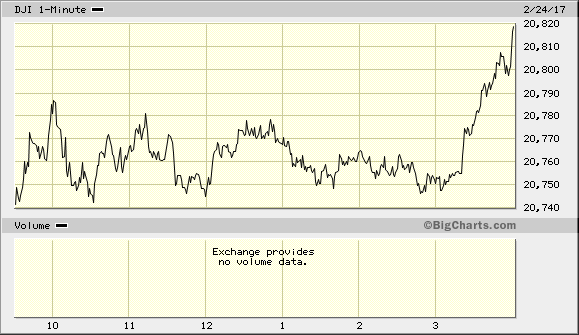
Posted by Eddy Elfenbein on February 27th, 2017 at 9:01 amLate in the day on Friday, the Dow staged a great comeback to close higher for the 11th day in a row.
-
Morning News: February 27, 2017
Posted by Eddy Elfenbein on February 27th, 2017 at 7:22 amMan Who Moved Oil With His Words Won’t Talk About It Anymore
LSE-Deutsche Boerse Deal In Danger
Fed Turns to Job Hoppers as 1950s Inflation Guide Shows Its Age
FBI Lawyer Sting Rattles Billion-Dollar Whistle-Blower Unit
To Keep U.S. Jobs, Chip Makers Share a Factory and Pin Hopes on Trump
Buffett Asks Big Money: Why Pay High Fees?
The Complete Bearish Case Against Investing in Snapchat’s Massive IPO
Minimum Wage Hikes And Online Sales Will Save Wal-Mart, But Not Neighborhood Stores
SoftBank Is Homing in on a $3 Billion Investment in WeWork
Smartvue Delivers IoT Video Services for Hewlett Packard Enterprise
Popularity of Sony’s PlayStation VR Surprises Even the Company
Amazon, Netflix Grab a Share of Oscar Glory
Takata’s Guilty Plea to Be Considered Monday by U.S. Judge
Jeff Miller: Have Stock Prices Lost Touch with Reality?
Josh Brown: Proudly Permabullish
Be sure to follow me on Twitter.
-
The Berkshire Letter
Posted by Eddy Elfenbein on February 25th, 2017 at 10:46 pmHere’s Warren Buffett’s latest letter to shareholders. Even for those of you who don’t own any shares of Berkshire Hathaway, the annual letter makes for good reading.
I though this section on share repurchases was interesting.
Share Repurchases
In the investment world, discussions about share repurchases often become heated. But I’d suggest that participants in this debate take a deep breath: Assessing the desirability of repurchases isn’t that complicated.
From the standpoint of exiting shareholders, repurchases are always a plus. Though the day-to-day impact of these purchases is usually minuscule, it’s always better for a seller to have an additional buyer in the market.
For continuing shareholders, however, repurchases only make sense if the shares are bought at a price below intrinsic value. When that rule is followed, the remaining shares experience an immediate gain in intrinsic value. Consider a simple analogy: If there are three equal partners in a business worth $3,000 and one is bought out by the partnership for $900, each of the remaining partners realizes an immediate gain of $50. If the exiting partner is paid $1,100, however, the continuing partners each suffer a loss of $50. The same math applies with corporations and their shareholders. Ergo, the question of whether a repurchase action is value-enhancing or value-destroying for continuing shareholders is entirely purchase-price dependent.
It is puzzling, therefore, that corporate repurchase announcements almost never refer to a price above which repurchases will be eschewed. That certainly wouldn’t be the case if a management was buying an outside business. There, price would always factor into a buy-or-pass decision.
When CEOs or boards are buying a small part of their own company, though, they all too often seem oblivious to price. Would they behave similarly if they were managing a private company with just a few owners and were evaluating the wisdom of buying out one of them? Of course not.
It is important to remember that there are two occasions in which repurchases should not take place, even if the company’s shares are underpriced. One is when a business both needs all its available money to protect or expand its own operations and is also uncomfortable adding further debt. Here, the internal need for funds should take priority. This exception assumes, of course, that the business has a decent future awaiting it after the needed expenditures are made.
The second exception, less common, materializes when a business acquisition (or some other investment opportunity) offers far greater value than do the undervalued shares of the potential repurchaser. Long ago, Berkshire itself often had to choose between these alternatives. At our present size, the issue is far less likely to arise.
My suggestion: Before even discussing repurchases, a CEO and his or her Board should stand, join hands and in unison declare, ‘What is smart at one price is stupid at another.’
-
Buy These Two S&P Losers?
Posted by Eddy Elfenbein on February 24th, 2017 at 9:25 am -
CWS Market Review – February 24, 2017
Posted by Eddy Elfenbein on February 24th, 2017 at 7:08 am“90% of the people in the stock market, professionals and amateurs alike,
simply haven’t done enough homework.” – William J. O’NeilYou can’t keep a good market down! The Dow has now risen for 10 days in a row, which is the longest winning streak in 30 years. Not only that, but the bull continues to be unusually calm. The S&P 500 has now gone 91 days in a row without a 1% down day.
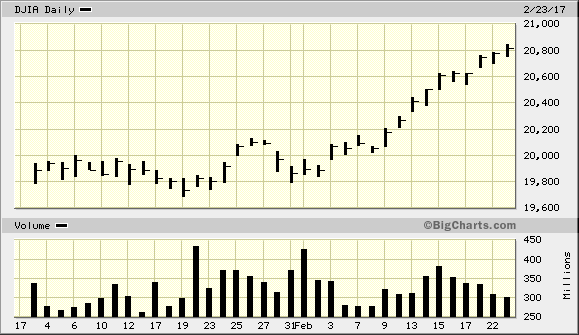
Can the market sustain this pace? The answer is no, but it’s a tough game predicting exactly when the bull needs to take a rest. Our strategy continues to be: focus on high-quality stocks, and don’t get scared out of them. I’m pleased to see that our Buy List is already up 6% for the year. Thanks to a strong earnings report, Moody’s just became our first 20% winner on the year.
In this week’s CWS Market Review, I’ll go over our recent earnings reports. We had some good ones like Moody’s, but also some disappointing ones like Hormel and Wabtec. I’ll go over them all in a just a bit. I’ll also bring you up to speed on the latest economic news. There’s a decent chance the Federal Reserve will raise rates again sometime soon. We also got dividend increases from Danaher and Cinemark. But first, let’s spend a few seconds on this week’s Fed minutes.
The Federal Reserve May Strike Soon
The Federal Reserve had a two-day meeting on January 31 and February 1. At the time, I told you not to expect them to make any moves on interest rates. I was right, and the Fed left rates unchanged.
This week, however, the Fed released the minutes from that meeting, and they indicated that some members want to see rates go up soon. This is important because higher rates can kill any rally, even one as durable as the current bull.
Like many things economic, the minutes aren’t very clearly written. All we know is that “many” members want to see rates go up “fairly soon.” How many is “many” and how soon is “fairly”? I’m afraid that’s left shrouded in the mystery that only economists can penetrate.
Those of us who live in the real world can make some reasonable guesses and assume it comes down to the Fed’s next two meetings. The central bankers get together again on March 14-15, and then again on May 2-3. The futures market now thinks there’s a 38% chance of a rate hike in March, and a 63% chance of a hike in May. That latter figure is up from 49% at the start of this month.
The Fed always says they want to be flexible and focused on the data. While the Fed raised rates in December, the latest inflation data suggests that the rise in consumer prices completely negated the rate increase. So it may be time for another. Plus, there are now clear signs that the economy is getting better. This week, we learned that existing home sales rose to a 10-year high. Also, the four-week moving average on initial jobless claims dropped to a 43-year low.
What does this mean for investors? I continue to believe that investors should be defensive over the next several weeks. I don’t expect the market to crash, but Wall Street’s calmness won’t last forever. Interestingly, the S&P 500 Tech Sector Index just snapped a 15-day winning streak. Like other record streaks, it had never happened before. Then it ended.
Now let’s look at our recent Buy List earnings reports.
Six Buy List Earnings Reports
We had two earnings reports last Friday. First up, JM Smucker (SJM) reported fiscal Q3 earnings of $2 per share. That’s down from $2.05 per share a year ago, but it matched Wall Street’s forecast on the nose. Quarterly sales fell 5%.
Smucker said they’ve been working hard to control costs, so the sales shortfall didn’t hurt the bottom line. The bad news is that Smucker lowered the high end of their full-year EPS forecast by a nickel per share. The company now sees 2017 earnings ranging between $7.60 and $7.70 per share. This is for the fiscal year that ends in April.
Here’s what’s interesting. The stock dropped at Friday’s open to about $130 per share from $138 at last Thursday’s close. SJM then rallied during the day on Friday to $136 by the closing bell. The shares then gapped up to $143 on Monday, probably due to Kraft Heinz backing out of its mega-merger deal with Unilever. That has to put Smucker in play. I’m raising my Buy Below on Smucker to $146 per share.
Also on Friday, Moody’s (MCO) said that it earned $1.23 per share for Q4. That was nine cents better than expectations. Quarterly revenues rose 8.8% to $942.1 million, which also beat expectations. The earnings, I should add, are adjusted for a big check the company had to send the Justice Department to settle its legal problems. I’m glad that’s now behind them.
For 2017, Moody’s said they expect earnings between $5 and $5.15 per share, which doesn’t include a 15-cent per share accounting benefit. Wall Street had been expecting $5.07 per share. That’s pretty good growth. For 2016, Moody’s made $4.81 per share.
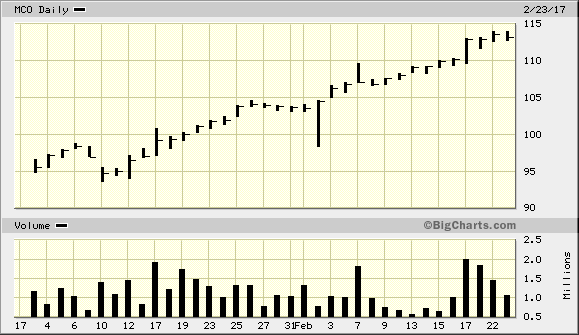
The stock is already a 20% winner for us this year. This week, I’m lifting my Buy Below on Moody’s to $119 per share.
Big Earnings Miss from Wabtec
Wabtec (WAB) gave us disappointing news on Tuesday. The rail-service company said they made 81 cents per share for Q4, which was 13 cents below estimates. This is their second soggy earnings report in a row.
Even the CEO said the earnings were “disappointing.” The problem is that the freight-rail sector continues to be soft. Also, it’s been more difficult for WAB to close the deal for Faiveley Transport than they expected. For the year, WAB earned $3.34 per share, which was below the company’s forecast of $3.45 to $3.50 per share.
Earnings, likewise, missed the mark, coming in at $3.34 per share, which was below its guidance of $3.45 to $3.50 per share. Despite the rough year in 2016, Wabtec sees things getting better this year. They expect full-year earnings to range between $3.95 and $4.15 per share.
The shares have now shed 11% since Monday’s close. I’m lowering my Buy Below on Wabtec to $84 per share.
Three More Earnings Reports on Thursday
On Thursday, we had three more earnings reports. Hormel Foods (HRL) posted fiscal Q1 earnings of 44 cents per share, which was one penny shy of estimates. The Spam stock also lowered its full-year guidance to $1.65 to $1.71 per share. That’s a decrease of three cents to both ends of the range. Hormel cited “challenging market conditions in the turkey industry.”
For Q1, Jennie-O Turkey sales rose 13%, but segment profits fell 25%. Overall sales fell 0.5% to $2.28 billion. Despite the earnings miss, this was Hormel’s 15th record quarter in a row.
“We are tempering our full-year outlook for the Jennie-O Turkey Store segment given the shortfalls in the first quarter and the expected continuation of pricing pressure due to low commodity turkey prices. Improvements in our other segments are expected to offset some of the earnings headwinds from Jennie-O Turkey Store,” Snee said.
Shares of Hormel lost 5.4% on Thursday. These results are disappointing, but I’m not too concerned about a minor drop in outlook from a company like Hormel. They’ll be fine. Hormel is a buy up to $37 per share.
Also on Thursday, Cinemark (CNK) reported Q4 earnings of 66 cents per share, which demolished Wall Street’s estimates of 44 cents per share. Quarterly revenues slipped a bit to $700.9 million.
“It was a banner year for the North American industry box office, achieving its 4th all-time high in the past 5 years,” stated Mark Zoradi, Cinemark’s Chief Executive Officer. “Cinemark’s domestic operations outperformed the North American industry box office by 100 basis points, and globally we set numerous records, including total revenues of nearly $3 billion, net income of $255 million and Adjusted EBITDA of more than $706 million. Furthermore, our ability to increase our dividend, while continuing to actively invest in growth initiatives, is indicative of the consistent strength of our balance sheet, as well as our confidence in Cinemark.”
For the year, CNK’s revenues increased 2.3% to $2.92 billion. Earnings per share came in at $2.19 compared to $1.87 for 2015. They also have ambitious plans for this future: CNK wants to open eight new theaters this year.
Cinemark also raised its quarterly dividend from 27 to 29 cents per share. The new dividend will be paid on March 20 to stockholders of record on March 8. I’m raising my Buy Below on Cinemark to $46 per share.
Our final earnings report for this season came from Continental Building Products (CBPX). The company earned 31 cents per share last quarter, which was four cents more than Wall Street had been expecting. Quarterly revenue rose 7.1% to $118.2 million, which also topped estimates.
Looking through the numbers, Continental had a solid year in 2016. Of course, what matters to us is 2017 and beyond. The company provided guidance on several performance metrics, but not on EPS. The company earned $1.08 per share last year. I think the company can earn as much as $1.35 per share this year. The stock could turn out to be one of our big winners this year.
Two Buy List Reports Next Week
Just two more Buy List earnings reports next week, but these are for companies with quarters that ended in January. After them, I promise we won’t have much in the way of earnings news for several weeks.
Ross Stores (ROST) is due to report fiscal Q4 earnings on Tuesday, February 28. This will be for the key holiday-shopping season. In November, Ross had a very good earnings report for Q3. However, they offered somewhat tepid guidance for Q4. I know Ross likes to set expectations low. That always makes the earnings “beats” look that much more impressive.
For Q4, Ross sees comparable-store sales growth of just 1% to 2%, and earnings per share ranging between 72 and 75 cents per share. Since Ross has already made $2.06 per share for the first three quarters, that works out to full-year earnings of $2.78 to $2.81 per share. That would be an increase of 11% to 12% over last year’s profit of $2.51 per share.
Also on Tuesday, HEICO (HEI) is due to report. The company had a great year in 2016, and it was our top-performing stock. For 2017, HEICO sees net sales growth of 5% to 7% and net income growth of 7% to 10%. That works out to an EPS range of $2.45 to $2.52. Wall Street expects quarterly earnings of 54 cents per share.
Before I go, I wanted to mention that Danaher (DHR) raised its quarterly dividend from 12.5 cents to 14 cents per share. The new dividend is payable on April 28 to holders of record on March 31. DHR is a buy up to $87 per share.
That’s all for now. Next week will be a busy one for economic reports. The durable-goods report comes out on Monday. On Tuesday, the government will revise its report on Q4 GDP. Then on Wednesday, we’ll get reports on consumer income and spending, plus the ISM Index. Be sure to keep checking the blog for daily updates. I’ll have more market analysis for you in the next issue of CWS Market Review!
– Eddy
-
Morning News: February 24, 2017
Posted by Eddy Elfenbein on February 24th, 2017 at 6:58 amOil Prices Fall as U.S. Crude Inventories Rise Further
China Overtakes U.S., France as Germany’s Biggest Trading Partner
China Says No Intention Of Using Currency Devaluation To Its Advantage
RBS Cuts CEO’s Potential Share Award 40% After Ninth Annual Loss
Mnuchin Tells Carney to Expect America-First Push on Regulation
Jury Rejects U.S. Seizure of Luxury Cars From Exporters
Fewer Niceties, Similar Price: Airlines Turn to ‘Basic Economy’ Fares
HPE’s Whitman Struggles in Shift to Smaller Size, Cloud Pressure
Is Snapchat’s IPO the Good Kind of Crazy?
Google Self-Driving Car Unit Accuses Uber of Using Stolen Technology
Mercedes-Benz Mulls North American Potential For Pick-Up Trucks
Here’s Where Travis Kalanick Really Went Wrong With Uber’s Harassment Claims
Roger Nusbaum: Don’t Make The Same Mistake As Norway
Jeff Miller: Stock Exchange: How To Play Sector Rotation
Be sure to follow me on Twitter.
-
Archives
- July 2026
- June 2026
- May 2026
- April 2026
- March 2026
- February 2026
- January 2026
- December 2025
- November 2025
- October 2025
- September 2025
- August 2025
- July 2025
- June 2025
- May 2025
- April 2025
- March 2025
- February 2025
- January 2025
- December 2024
- November 2024
- October 2024
- September 2024
- August 2024
- July 2024
- June 2024
- May 2024
- April 2024
- March 2024
- February 2024
- January 2024
- December 2023
- November 2023
- October 2023
- September 2023
- August 2023
- July 2023
- June 2023
- May 2023
- April 2023
- March 2023
- February 2023
- January 2023
- December 2022
- November 2022
- October 2022
- September 2022
- August 2022
- July 2022
- June 2022
- May 2022
- April 2022
- March 2022
- February 2022
- January 2022
- December 2021
- November 2021
- October 2021
- September 2021
- August 2021
- July 2021
- June 2021
- May 2021
- April 2021
- March 2021
- February 2021
- January 2021
- December 2020
- November 2020
- October 2020
- September 2020
- August 2020
- July 2020
- June 2020
- May 2020
- April 2020
- March 2020
- February 2020
- January 2020
- December 2019
- November 2019
- October 2019
- September 2019
- August 2019
- July 2019
- June 2019
- May 2019
- April 2019
- March 2019
- February 2019
- January 2019
- December 2018
- November 2018
- October 2018
- September 2018
- August 2018
- July 2018
- June 2018
- May 2018
- April 2018
- March 2018
- February 2018
- January 2018
- December 2017
- November 2017
- October 2017
- September 2017
- August 2017
- July 2017
- June 2017
- May 2017
- April 2017
- March 2017
- February 2017
- January 2017
- December 2016
- November 2016
- October 2016
- September 2016
- August 2016
- July 2016
- June 2016
- May 2016
- April 2016
- March 2016
- February 2016
- January 2016
- December 2015
- November 2015
- October 2015
- September 2015
- August 2015
- July 2015
- June 2015
- May 2015
- April 2015
- March 2015
- February 2015
- January 2015
- December 2014
- November 2014
- October 2014
- September 2014
- August 2014
- July 2014
- June 2014
- May 2014
- April 2014
- March 2014
- February 2014
- January 2014
- December 2013
- November 2013
- October 2013
- September 2013
- August 2013
- July 2013
- June 2013
- May 2013
- April 2013
- March 2013
- February 2013
- January 2013
- December 2012
- November 2012
- October 2012
- September 2012
- August 2012
- July 2012
- June 2012
- May 2012
- April 2012
- March 2012
- February 2012
- January 2012
- December 2011
- November 2011
- October 2011
- September 2011
- August 2011
- July 2011
- June 2011
- May 2011
- April 2011
- March 2011
- February 2011
- January 2011
- December 2010
- November 2010
- October 2010
- September 2010
- August 2010
- July 2010
- June 2010
- May 2010
- April 2010
- March 2010
- February 2010
- January 2010
- December 2009
- November 2009
- October 2009
- September 2009
- August 2009
- July 2009
- June 2009
- May 2009
- April 2009
- March 2009
- February 2009
- January 2009
- December 2008
- November 2008
- October 2008
- September 2008
- August 2008
- July 2008
- June 2008
- May 2008
- April 2008
- March 2008
- February 2008
- January 2008
- December 2007
- November 2007
- October 2007
- September 2007
- August 2007
- July 2007
- June 2007
- May 2007
- April 2007
- March 2007
- February 2007
- January 2007
- December 2006
- November 2006
- October 2006
- September 2006
- August 2006
- July 2006
- June 2006
- May 2006
- April 2006
- March 2006
- February 2006
- January 2006
- December 2005
- November 2005
- October 2005
- September 2005
- August 2005
- July 2005
 Eddy Elfenbein is a Washington, DC-based speaker, portfolio manager and editor of the blog Crossing Wall Street. His