I was curious to see what effect movements in the U.S. dollar have on different stock sectors. I took ten years of data. I then isolated all the days when the U.S. Dollar Index rose and saw how the 10 different stock sectors did relative to the S&P 500. I then did the same for when the Dollar Index fell.
Not surprisingly, the dollar has its greatest impact on the Energy and Materials sectors. When the dollar falls, those sectors outperform the rest of the market. When the dollar rises, Staples and Healthcare do the best against the market.
Interestingly, the impact of the dollar isn’t that strong on the other sectors. I was particularly surprised to see such a small effect on tech stocks.
(I apologize if my methodology is confusing. Just understand that the higher or lower number reflects how each sector performs when the dollar is weak or strong.)
| Sector |
Weak $ |
Strong $ |
| Energy |
777.2% |
-91.4% |
| Material |
591.8% |
-87.5% |
| Industrials |
57.2% |
-34.4% |
| Financials |
14.0% |
-49.6% |
| Tech |
-9.4% |
43.3% |
| Utilities |
-27.7% |
36.9% |
| Discretion |
-34.0% |
94.5% |
| Telecom |
-55.1% |
92.0% |
| Staples |
-58.6% |
219.9% |
| Health Care |
-61.8% |
223.4% |
The Dow is going for its ninth-straight daily gain. This would be the index’s longest winning streak since early 1987.

Ryan Detrick points out that the S&P 500 has now gone 50 straight days without closing up or down by more than 1%. Over the same 50 days one year ago, it happened 29 times!
We haven’t had a 1% decline for the S&P 500 for 90 straight days. That’s the longest streak since 2006, and we’re close to making it the longest streak since 1995.
The S&P 500 Tech Sector has risen for the last 14 days in a row. Yesterday, the index closed at 886.09. The all-time high from March 27, 2000 was 987.07.
The S&P 500 Financials Index had its highest close on February 20, 2007 (10 years and two days ago) at 505.55. Yesterday, it closed at 407.65.
Good news from Danaher (DHR). The company raised its quarterly dividend from 12.5 cents to 14 cents per share. The new dividend is payable on April 28 to holders of record on March 31.
German Optimism Up in Positive Sign for Europe’s Economy
Mexico and Canada Say Nafta Should Be Re-Negotiated Trilaterally
The Fallout From “A Day Without Immigrants”
Hedge Funds Can’t Sue Over Investments in Fannie and Freddie
Trump’s Threatened Tariffs Could Cloud Walmart’s Future
Airbus Profit Hit By Chart on A400M Program
UPS Has a New Trick to Make Drone Deliveries a Reality
Popeyes’s Eye-Popping Deal
The Big Reason Why Home Depot’s Sales Continue to Build
Macy’s 4Q Sales Sharply Dropped
Uber CEO Apologizes for Company Culture After Harassment Claims
Wells Fargo Has Fired and Cut Bonuses for 4 Executives Over Its Sales Scandal
Switzerland’s ABB Uncovers $100 Million Korean Fraud as Suspect Vanishes
Roger Nusbaum: A Litte Bumpier, But Higher!
Jeff Carter: A Critical Point of Differentiation in Framing
Be sure to follow me on Twitter.
It’s interesting how bearish predictions are so easily forgotten.
This is from the New York Times on October 31.
Assume, for a moment, that Donald J. Trump wins the presidency.
Some readers of this column will shudder at the thought and might even stop reading now. Others in the business world will beam, like Peter Thiel, the Silicon Valley entrepreneur.
But what exactly happens the day after? To markets? To the economy?
The conventional wisdom is that, right off the bat, the stock market would fall precipitously. Simon Johnson, the Massachusetts Institute of Technology economist, posited that Mr. Trump’s presidency would “likely cause the stock market to crash and plunge the world into recession.”
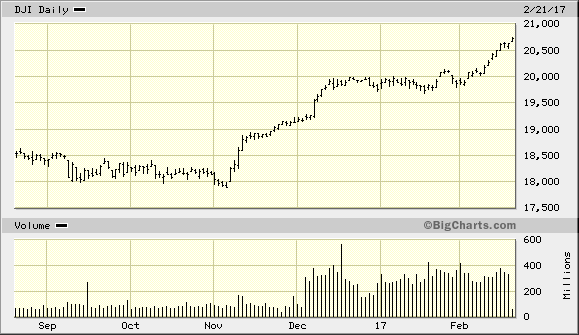
The Dow is up more than 2,500 points since then.
It’s a tough morning for our Buy List. Shares of Wabtec (WAB) have been down as much as 7.8%.
The S&P 500 is up to a new all-time high. The index is currently over 2,361.
The U.S. consumer appears to be doing well as reflected by some recent earnings reports. Home Depot (HD), for example, just reported blow-out earnings. HD said it’s going to buy back $15 billion worth of stock, plus they’re hiking their dividend by 29%. Also, Walmart (WMT) reported its best comp store sales increase in four years. Both stocks are in the Dow.
Interestingly, since its 1981 IPO, shares of HD are up 6,000-fold. Not bad.
I’d probably take the earnings reports from Home Depot, Walmart and Amazon over any government report on U.S. consumer spending.
Bad earnings report this morning from Wabtec (WAB). The company made 81 cents per share which was 13 cents below estimates.
The maker of parts for locomotives, subways and buses posted revenue of $760 million in the period, which also fell short of Street forecasts. Five analysts surveyed by Zacks expected $795.4 million.
For the year, the company reported profit of $304.9 million, or $3.34 per share. Revenue was reported as $2.93 billion.
Wabtec expects full-year earnings in the range of $3.95 to $4.15 per share.
Oil Rises Towards Top of Recent Trading Range as OPEC Cuts Output
Saudi Arabia Breaks Records on Oil Exports and Output for Year
Chinese Minister Appeals to Washington to Avoid ‘Trade War’
Euro-Area Economic Recovery Broadens as France Outpaces Germany
Bill Gates Warns Of Epidemic That Will Kill Over 30 Million People
Snap Finds Its IPO Is a Tough Sell in London
WhatsApp’s New Feature Continues Facebook’s Snapchat Mimicry
Reliance Jio To Offer Bargain Rates, Crosses 100 Million Customers
Toshiba Seeks $8.8 Billion for Chip Unit Stake as Banks Fret Over Risks
Burger King and Tim Hortons Owner Nears Deal to Buy Popeyes
Anglo Shelves Asset Sales After Profit Doubles on Cost Cuts
Wanda’s Dick Clark Deal Shaky, But Not Yet Dead
HSBC Boosts CEO Gulliver’s Pay as Bank’s Bonus Pool Drops 12%
Josh Brown: What If Brokerages Graded Their Customers’ Trading?
Howard Lindzon: The Cashtag Awards (Live in NYC March 30th) – From Stocktwits
Be sure to follow me on Twitter.
Gold Isn’t Behaving in Practice The Way It Should in Theory
Global Arms Sales Hit Highest Level Since End of Cold War
Greeks Turn To The Black Market As Another Bailout Showdown Looms
Saudi Arabia Breaks Records on Oil Exports and Output for Year
RBS Shares Are Popping Thanks To A New Plan To Clear Up A Major EU Headache
Trump Administration Considers Changing the Way It Calculates Trade Deficits
Fed’s Mester Says She’s ‘Comfortable’ With Rates Moving Higher
Kraft Heinz Needs to Plug the Leaks
Why Boeing Should Not Increase Dreamliner Production
Amazon Shrugs Off Brexit With Plans To Hire 5,000 More Staff In The UK
Snap Bets on Hardward as Facebook Threat Looms
With New Invention, Virtual Reality’s Potential for Magic Gets Real
Jeff Miller: Will Trump Policies Extend the Business Cycle?
Cullen Roche: The Biggest Myths in Investing, Part 5 – Bonds Lose Value if Rates Rise
Jeff Carter: Including Diversity in Entrepreneurship
Be sure to follow me on Twitter.
We had two earnings reports on Friday. JM Smucker (SJM) reported fiscal Q3 earnings of $2 per share. That’s down from $2.05 per share a year ago but it matched Wall Street’s forecast. Quarterly sales fell 5%.
“Accelerating the realization of synergies and a concentrated effort to reduce costs across the Company support our ability to deliver bottom-line growth, despite the top-line softness in our business and across the industry,” said Mark Smucker, Chief Executive Officer. “We are also aggressively pursuing a variety of growth opportunities. During the quarter, we launched our Nature’s Recipe® premium pet food brand into grocery and mass merchandise outlets. In addition, we announced plans to build a new manufacturing facility to support growth for our Smucker’s® Uncrustables® frozen sandwiches. Behind these and other initiatives, we remain confident in achieving our long-term growth objectives and continuously enhancing shareholder value.”
The bad news is that Smucker lowered the high-end of their full-year EPS forecast by a nickel per share. The company now sees 2017 earnings ranging between $7.60 to $7.70 per share.
Shares of SJM dropped sharply at the open, but made for a lot of lost ground during the day. By the closing bell, the stock lost 1.37%.
Also on Friday, Moody’s (MCO) said that it earned $1.23 per share for Q4. That was nine cents better than expectations. Quarterly revenues rose 8.8% to $942.1 million, which also beat expectations.
For 2017, Moody’s said they expect earnings between $5 and $5.15 per share, which doesn’t include a 15-cent per share accounting benefit. Wall Street had been expecting $5.07 per share. For 2016, Moody’s made $4.81 per share.
Shares of MCO gained 2.4% on Friday.
-
 Eddy Elfenbein is a Washington, DC-based speaker, portfolio manager and editor of the blog Crossing Wall Street. His Buy List has beaten the S&P 500 over the last 20 years. (more)
-
Archives