-
Morning News: November 10, 2016
Posted by Eddy Elfenbein on November 10th, 2016 at 6:32 amWall Street Rebounds After Donald Trump’s Victory
Markets Rise as Investors Buy Into Trump
Theresa May Promises ‘Golden Era’ in UK-Chinese Relations
Oil Output Surge Piles Pressure on OPEC as IEA Warns on Price
Egypt Issues $4 Billion Private Bond Placement, Mulls Eurobond Delay
For Mexico, a Long List of Dangers Accompany Trump’s Presidency
Trump Promised to Repeal Obamacare. Now What?
Trump Expected to Seek Deep Cuts in Business Regulations
Why Chinese Car Sales Are Surging Faster Than Expected
Siemens Plans to Spin Off Health Unit as CEO Sharpens Focus
Why Starbucks’ Christmas Cups Are Special This Year
Yahoo Knew About the Breach in 2014
Jeff Miller: Post Election: Pause, Reflect, and Act Carefully
Howard Lindzon: The University of Donald Trump … How to Survive
Be sure to follow me on Twitter.
-
Morning News: November 9, 2016
Posted by Eddy Elfenbein on November 9th, 2016 at 7:03 amRepublican Donald Trump Is Elected President Of United States And Global Markets Plunge
Trump’s Victory Shakes Europe’s Geopolitical Order
What Trump’s Win Means for the Fed
News Media Yet Again Misreads America’s Complex Pulse
Why India Pulled Big Bank Bills From Circulation
China Oct Factory Prices Rise More Than Forecast, Consumer Prices Also Pick Up
Big Oil Looks Past Profit Crunch as Cash Flow Shows Recovery
Alphabet Pushes Out Leaders of Drone-Delivery Project
Carlsberg Upgrades Full Year Outlook Despite Sales Dip
Dish Network Profit Jumps; Subscriber Loss Smaller Than Expected
Warner Bros., Quietly Thriving, Recasts Its Own Story
Samsung Runs Newspaper Ads on Note 7 Fires: ‘We Are Truly Sorry’
Cullen Roche: What Does President Trump Mean for the Economy & Market?
Be sure to follow me on Twitter.
-
Morning News: November 8, 2016
Posted by Eddy Elfenbein on November 8th, 2016 at 6:23 amSafeguarding As The ‘Fear Index’ Surges
Hillary Clinton and Donald Trump Keep Asia Markets Guessing
Mexico is Feeling Jitters Over the Prospect of a Trump Victory
An Idea to Revolutionize Europe’s Debt Could Be Coming of Age
Voters Take Note: China’s Trade Surplus With U.S. Is Shrinking
Iran to Sign $6 Billion Gas-Field Deal With Total, CNPC
Dubai, Hyperloop One to Study Potential for Abu Dhabi Line
Toyota Raises Operating Profit Forecast, Says Cost Cuts To Curb Yen Impact
US Senate Panel Urges FTC to Launch Antitrust Probe of Mylan
CBS Taps Moelis, Goldman to Advise on Possible Viacom Merger
Priceline Shares Hit All-Time High After Profit and Revenue Beat Estimates
TV Networks Face a Skeptical Public on Election Night
Josh Brown: How to Become a “2%” Investor
Jeff Carter: The Oligopoly and Crony Employeeism
Be sure to follow me on Twitter.
-
Updates on Today’s Market
Posted by Eddy Elfenbein on November 7th, 2016 at 10:40 pmI wanted to add a few comments on today’s market activity. The S&P 500 had its best day since March 1. The stock market had fallen nine days in a row, but those declines were quite modest. Today’s big gain won back more than 70% of what had been lost in nine days.
Gold had its worst day in a few weeks, and the Dow retook 18,000. The Dow also crossed back above its 50-day moving average.
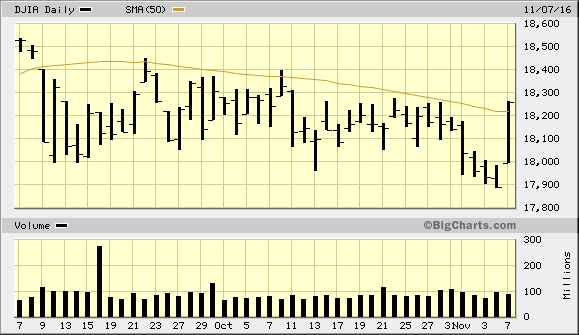
Today was the best pre-election day for the market in 84 years. All 20 Buy List stocks closed higher. We had especially big gains from Biogen (BIIB) and Cognizant Technology (CTSH), the latter due to its impressive earnings report, and the former due to a positive drug study.
A few weeks ago, shares of CTSH fell sharply after the company said it may have been involved in some illegal activities. Until now, we haven’t had any more news. Now we have some details from Reuters:
IT services provider Cognizant Technology Solutions Corp said on Monday some senior managers may have participated in or failed to take action to prevent making about $5 million in “potentially improper payments” primarily related to real estate and procurement in India.
Cognizant, whose shares were up 4 percent at $54.18 in early trading, said the material weakness existed as of Dec. 31, 2015, and continues to exist in subsequent interim periods.
The company also said its ongoing internal investigation had identified a material weakness in its internal control over financial reporting.
If the payments are limited to $5 million, this would probably be well below investors’ worst case, Cowen and Co analysts said in a research note.
Cognizant said in September it was conducting an internal investigation into possible violations of U.S. anti-corrupt practices laws related to payments in India.
The company also said that the people possibly involved with the payments are no longer with the company or in a senior management position.
The company said in September that President Gordon Coburn had resigned, giving no reason for his departure, and that he would be replaced by Rajeev Mehta, the head of IT services.
Cognizant said in a regulatory filing on Monday that it had not maintained an “effective tone at the top”.
“We will continue the investigation until we are confident that we have tracked it all down,” Chief Financial Officer Karen McLoughlin said on a conference call, adding that it was “early days” in the investigation.
I think this is very good news. It shows that CTSH is on top of it, and it doesn’t appear to be a very large deal in financial terms. Bear in mind that CTSH plunged more than 13% when the news first came out on September 30.
-
The Power of One Stock
Posted by Eddy Elfenbein on November 7th, 2016 at 2:11 pmHere’s a good lesson on what one stock can do to your portfolio.
In 1939, IBM was taken out of the Dow Jones Industrial Average. It was put back 40 years later, in 1979. Over those four decades, IBM was an outstanding stock. It gained over 220 fold!
So what if IBM had stayed in the Dow? Bryan Taylor at Global Financial Data ran the numbers. First we assume that IBM replaced AT&T. Technically, two stocks left in 1939 (IBM and Nash Motors) and two came in (AT&T and United Aircraft).
The DJIA stood at 151.1 on March 14, 1939 and 841.98 on June 29, 1979. Since the DJIA is price weighted, you can remove the impact of AT&T on the DJIA by subtracting out the price of AT&T allowing for the splits, and replacing this amount with the value of IBM stock, allowing for the splits in IBM. If you do this, you would find that the DJIA would have been at 23,582 in June 1979, not 841.98. In other words, IBM would have added 22,740 points to the DJIA had it never been removed.
(Update: Now that I’ve looked this over, I’m not sure the math is correct. I think IBM’s price needs to be adjusted for the Dow’s divisor. I’m not positive, but it’s a strong suspicion. Still, the larger point stands that one huge long-term winner can do wonders for a portfolio.)
(Update to the previous update: Dividend Investor passes along two articles (here and here) which suggest I’m correct.)
-
WSJ: “Why the Math Behind Passive Investing May Be Wrong”
Posted by Eddy Elfenbein on November 7th, 2016 at 12:19 pmWesley R. Gray has an interesting piece at today’s WSJ: “Why the Math Behind Passive Investing May Be Wrong.” It’s zeroes in on the research of William Sharpe who was an early advocate of passive investing. Here’s a sample:
A recent essay by Druce Vertes at the CFA Institute, and more formal research by NYU Professor Lasse Pedersen, suggests that Mr. Sharpe’s conclusions might be incorrect. Dr. Pedersen offers a very powerful critique in a new white paper entitled, “Sharpening the Arithmetic of Active Management.” Dr. Pedersen argues Mr. Sharpe’s arithmetic relies on the faulty assumptions that the market never changes and passive investors never need to trade.
Objectively, these assumptions are false: The market is not static, as new firms are created through IPOs, new shares are issued or repurchased, and indexes are reconstituted all the time. Additionally, passive investors must sometimes rebalance their portfolios, for instance to raise cash or reinvest dividends. In short, passive managers must, and do, trade with active investors.
As evidence for the need of passive investors to trade, Dr. Pedersen cites the case of a theoretical passive investor in 1927, who never trades. After 10 years, this investor owns only 60% of the market. And this ongoing market turnover is persistent: The average turnover for all equities from 1926 through 2015 was a whopping 7.6% per year. Last year, the Vanguard 500 Index Fund reported turnover of 10%. Clearly, the assumption that passive investors never need to buy and sell is false. And this mechanical need to trade opens passive investors up to exploitation by active investors.
-
Cognizant Earns 86 Cents per Share
Posted by Eddy Elfenbein on November 7th, 2016 at 7:10 amThis morning, Cognizant Technology Solutions (CTSH) reported third-quarter earnings of 86 cents per share. That was two cents better than estimates. They earned 76 cents per share in last year’s Q3. Cognizant’s quarterly revenue climbed 8.4% to $3.45 billion. Operating margin was 19.3%.
“We see ongoing client demand for our services across industries and geographies,” said Francisco D’Souza, Chief Executive Officer. “As the physical and digital worlds converge, we have made it easier for clients to work with us by aligning our organizational structure and capabilities around the broader focus of assisting clients drive digital transformations. Our new President, Raj Mehta, who has been a key member of our senior leadership team for two decades, and the broader team of executives are leading our strategic initiatives. They have a proven track record of innovation, execution and an unwavering focus on client service and satisfaction.”
For Q4, Cognizant sees revenues between $3.45 billion and $3.51 billion, and EPS between 85 and 88 cents per share. That works out to full-year revenue of $13.47 billion to $13.53 billion, and 2016 EPS between $3.38 and $3.41.
“Third quarter revenue was within, and non-GAAP EPS was slightly above, our guided range, indicating that we continue to execute well on our stated strategy,” said Karen McLoughlin, Chief Financial Officer. “Our solid performance was also reflected in another strong quarter of cash flow generation as cash and investments, net of debt increased by $390 million.”
-
Q3 2016 Earnings Calendar
Posted by Eddy Elfenbein on November 7th, 2016 at 7:03 amSixteen of our 20 Buy List stocks have been reporting Q3 earnings over these past few weeks. Here’s a list of reporting dates, Wall Street’s consensus estimates and actual reported results:
 Eddy Elfenbein is a Washington, DC-based speaker, portfolio manager and editor of the blog Crossing Wall Street. His