-
Morning News: August 12, 2016
Posted by Eddy Elfenbein on August 12th, 2016 at 7:05 amStocks Hit New Highs, and That Could Be Just the Start
IMF Deal Boosts Egypt, Saudi Falls Despite Reform News
German Economy Grows Faster Than Expected; Italy Disappoints
Economic Doldrums? China Blames it on the Rain
EU Opens Antitrust Probe on Dow Chemical, DuPont Merger
Envisioning Bitcoin’s Technology at the Heart of Global Finance
Will Jet.com Be Enough to Move the Needle for Wal-Mart Stores Inc?
Hewlett Packard Enterprise Just Spent Millions on This Supercomputer Maker
Toshiba Reports Its First Profit in 6 Quarters
Macy’s, Kohl’s and Nordstrom’s 2Q 2016 Earnings Reports Deliver Some Positive Surprises
Electronic Marlboro Sucks Japanese Smokers Away From Japan Tobacco
Arianna Huffington to Leave the Huffington Post
Driven to Suicide by an ‘Inhuman and Unnatural’ Pressure to Sell
Josh Brown: Reaction: Jesse Livermore – Boy Plunger
Roger Nusbaum: This Is The New Normal
Be sure to follow me on Twitter.
-
Morning News: August 11, 2016
Posted by Eddy Elfenbein on August 11th, 2016 at 7:12 amMore Old Than Young: A Population Plague Spreads Around the Globe
IMF, Egypt Agree on $12 Billion Loan to Fix Ailing Economy
Australia Risks Chinese Anger Over Power Grid Sale
U.S. Budget Deficit Little Changed in July
The Bond Bubble Is About to Burst
Why the Big Three Airlines Are So Much the Same
Alphabet Unit Google’s VC Chief Bill Maris to Exit
Alibaba Results Boosted by More Users, Mobile Growth
Yelp Rises After Earnings Beat Estimates, Analysts Back Stock
Shake Shack’s Stock Gets Whacked As Investors React To Disappointing Sales
Ralph Lauren Is Losing the Battle for America’s Preppies
Valeant Under Criminal Investigation
Howard Lindzon: The NASDAQ Made America Great Again…
Josh Brown: Volatility Drives Us Mad and Steals Our Future
Be sure to follow me on Twitter.
-
Oil and Stocks Part Ways
Posted by Eddy Elfenbein on August 10th, 2016 at 11:30 amOne of the interesting developments this summer is that the previous relationship between oil and stocks seems to have broken down. For several months, the two asset classes were like waltzing partners. Wherever oil went, stocks weren’t far behind. Or maybe it was the other way around.
Either way, the relationship appeared solid. Even when both markets turned in early February, they turned together.
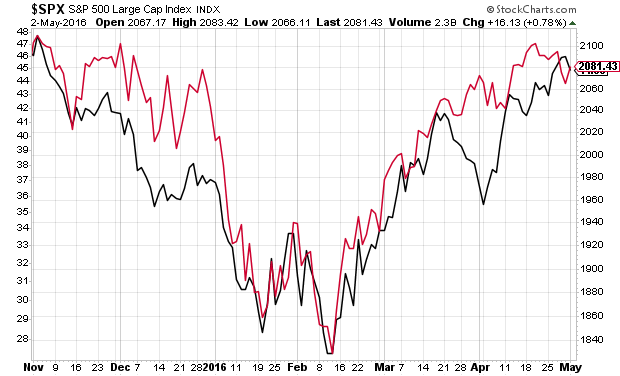
Lately, however, the two seem to have parted ways. It’s hard to place an exact starting point when this happened. I think something clearly broke down at the beginning of May. But by July, oil and stocks were no longer speaking.
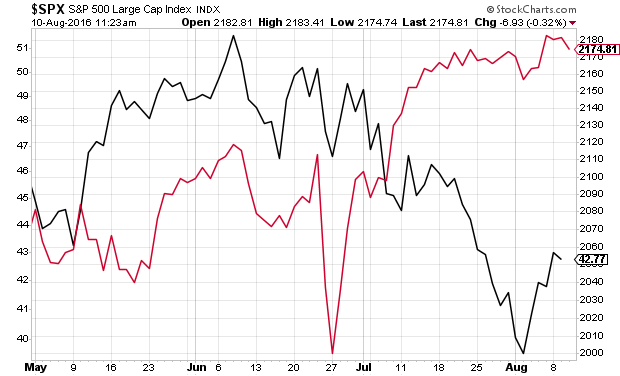
According to the WSJ, the correlation fell to 0.77 although I’m not sure what time frame their figure indicates.
What does this all mean? That’s hard to say exactly. I think we’ve moved into an era where low oil prices are good — that is, until they’re not. There’s probably a point at which low oil is a net negative for the U.S. economy. I suspect that’s below $40 per barrel but that’s just a guess.
OPEC has noticed the lower price for oil and they’re going to hold a less-formal meeting next month. I strongly doubt they’ll come to any agreement on holding back production. The Iranians are recently off sanctions and they’re going to gun supply until they get back to pre-sanctions levels. The Saudis also don’t seem interested in cutting back production. My guess is that we’re going to see more downward pressure on oil this year.
-
Morning News: August 10, 2016
Posted by Eddy Elfenbein on August 10th, 2016 at 7:17 amJapan’s Plunging Jobless Rate Is All About Aging, Not Abenomics
BOE Finds Its Brexit Warnings Coming True in Company Plans
Why Did Productivity Fall? Look To The Price of Oil and Gas
America’s Worst Borrowers Are Grabbing Credit Cards Like It’s 2006
U.S. Judge Dismisses Challenge to Seattle’s Uber, Lyft Union Law
Jefferies, Free of the Restraints of Bigger Banks Is Emboldened
Apple Said to Plan First Pro Laptop Overhaul in Years
Why Coach Is Disappearing From Some Department Stores
Yelp Raises Revenue Projection as It Swings to Quarterly Profit
Disney Bets on Streaming, Joining With Major League Baseball
Walmart, In Acquiring Jet.com, Gets More Than An Early Leg Up On Amazon
‘Self-Driving’ in Spotlight Again as China Sees First Tesla Autopilot Crash
PG&E Guilty of Safety Violations Stemming From Fatal Blast
Howard Lindzon: Big Stock Market Crash Coming … Guaranteed
Cullen Roche: What Does it Mean to be a “Modern” Monetary System?
Be sure to follow me on Twitter.
-
Morning News: August 9, 2016
Posted by Eddy Elfenbein on August 9th, 2016 at 7:07 amChina Inflation Slows Again, Giving PBOC Room for Easing
China Warns U.K. That Relations Hang on Hinkley Point
BOE’s McCafferty Says More Easing Will Likely Be Required
Valeant Says to Reorganize; Maintains Full-Year Forecast
Why Twilio Uses Two Revenue Metrics to Report Its Financials
Randstad to Buy U.S. Jobs Site Monster for $429 Million
Alibaba Cloud Computing Arm to Help Foreign Tech Firms Enter China
Barclays Agrees to Pay $100 Million Over State Libor Probes
FTC Sues 1-800 Contacts Over Online Search Advertising
Why Mattress Firm May Give Steinhoff Sleepless Nights
SFR Shares Rally as CEO Says French Price War Easing
Uber’s Deal With Didi in China Totally Sideswiped Indian Competitor Ola
Every User of This Hacked Bitcoin Exchange Is About to Lose 36% From Their Account
Jeff Carter: How to Fix Capitalism
Be sure to follow me on Twitter.
-
P/E Ratios Are Effectively Worthless
Posted by Eddy Elfenbein on August 8th, 2016 at 7:25 pmI wanted to show you this passage from an article criticizing the Fed model as a valuation metric.
The Fed model fares poorly compared with simpler methods of judging when stocks are attractive. A study by Bank of America found that as a tool for predicting 10-year returns, P/E ratios were 10 times more accurate as an indicator of what stocks would do, while metrics like price to book value did even better. The S&P 500 trades for 20 times annual earnings, the highest P/E since 2009, and 2.9 times book, or assets minus liabilities.
In many respects, the case against the Fed model is the same as the case against any investment strategy predicated on valuation: they’re fraught with false signals. Data compiled by Bloomberg show that even the most conservative applications of price-earnings ratios as a buy or sell indicator are effectively useless for predicting how stocks will perform in the coming year.
-
How Good of a Predictor is the Yield Curve?
Posted by Eddy Elfenbein on August 8th, 2016 at 3:36 pmHow good of a predictor is the yield curve? Economists Michael Bordo and Joseph Haubrich dug through the data and found the answer. It depends.
The results are intriguing. They surveyed many distinct periods in U.S. financial and monetary history, from the era of the classical gold standard to the creation of the Fed to the breakdown of the gold standard, its resurrection on the international level under Bretton Woods, and its eventual collapse in 1971.
They found that the utility of the yield curve had a great deal to do with the monetary regimes of the day. In particular, they found that the yield curve worked better as a predictive tool when the monetary system was out of kilter and inflation a problem, and worse when the monetary system was predictable and inflation stable.
In other words, it would seem that the utility of the yield curve is inversely related to the credibility of the monetary regime. When the market thinks that inflation could spiral out of control because of the incompetence of policy makers, the yield curve works pretty well. But when inflation is kept in check, you can’t take the yield curve as seriously.
Which brings us to today. Although we still don’t know for certain what the yield curve is telling us, the possible answers come into sharper focus. If the market is sensing that the Fed doesn’t have a hold on inflation, then perhaps the yield curve is unequivocally signaling a recession. But if inflation isn’t a threat, then the yield curve could be giving us a misleading reading.
Right now, there’s almost no sign that inflation is about to spin out of control. And that, perhaps, is a sign that the crystal ball known as the yield curve is too cloudy to trust.
-
Morning News: August 8, 2016
Posted by Eddy Elfenbein on August 8th, 2016 at 7:12 amDisappointing China July Imports Suggest Cooling Domestic Demand
German Industrial Output Stronger Than Expected in June
Fed’s Powell Urges Patience on U.S. Rates, Citing Growth Risks
OPEC to Hold Talks in September as Oil Market Takes Downturn
Amazon Japan Offices Searched on Suspicion of Antitrust Law Violations
Steinhoff Buys Mattress Firm For 115% Premium As Foreign Buyers Bet Big On The U.S. Economy
Wal-Mart’s Deal for Jet.com Said to Hinge on Keeping Its Founder
Bristol-Myers Partner Ono Plunges as Drug Fails Trial
Video Software Maker Kaltura Raises $50 Million From Goldman
UK to Probe Airbus’s Use of Third-Party Agents to Sell Planes
How a Hairdresser’s Lawsuit Could Spell Trouble for Brexit
Delta Grounds Flights Worldwide Following Computer Outage
Jeff Miller: Earnings Recession Ending Next Quarter?
Howard Lindzon: NASDAQ 10,000…What Could go Right?
Be sure to follow me on Twitter.
-
Duncan Weldon Eats His Shoes
Posted by Eddy Elfenbein on August 7th, 2016 at 5:47 pm -
Q2 2016 Earnings Calendar
Posted by Eddy Elfenbein on August 5th, 2016 at 9:25 amSixteen of our 20 Buy List stocks reported Q2 earnings throughout the past month. Here’s a list of reporting dates, Wall Street’s consensus estimates and actual reported results:
 Eddy Elfenbein is a Washington, DC-based speaker, portfolio manager and editor of the blog Crossing Wall Street. His