-
The 5 Stocks Wall Street Analysts Love
Posted by Eddy Elfenbein on June 22nd, 2016 at 7:43 pm -
How dangerous is corporate America’s cash hoard?
Posted by Eddy Elfenbein on June 22nd, 2016 at 6:10 pm -
Digesting Tesla’s SolarCity Bid
Posted by Eddy Elfenbein on June 22nd, 2016 at 3:49 pm -
Buy List ETF Update
Posted by Eddy Elfenbein on June 22nd, 2016 at 9:48 amI wanted to let everyone know that we have BIG NEWS coming soon.
I’m currently in a legal “blackout” period so I’m limited in what I can say to you.
But I can say that something is definitely coming.
Stay tuned!
-
Morning News: June 22, 2016
Posted by Eddy Elfenbein on June 22nd, 2016 at 7:21 amBrexit Polls and Markets Disagree in Campaign’s Final Hours
In SolarCity Bid, Tesla’s Musk Targets Customers Wanting All
Close a Nuclear Plant, Save Money and Carbon, Improve the Grid, Says PG&E
Apple Pays Back E-Book Buyers Following Settlement
Hyperloop One Explores Building High-Speed Transport System in Moscow
FedEx Posts $70 Million Loss, Gives Cautious Outlook
Teva and Allergan Sell Generic Drugs to Impax In Latest Divestiture
Former Bangladesh Bank Chief Blames Global System for Theft
Volkswagen Leaders Struggle to Appease Shareholders at Meeting
Mitsubishi Motors Expects to Swing to $1.38 Billion Net Loss
A $541 Million Loss Haunts Deutsche Bank And Former Trader Dixon
United: Catching Up From a Long Delay
Ex-Jet QB Sanchez Among Athletes Cheated in Investment Fraud
Josh Brown: Five-Word Financial Advice For New Graduates
Be sure to follow me on Twitter.
-
Yellen Warns
Posted by Eddy Elfenbein on June 21st, 2016 at 12:50 pmStocks Fluctuate as Yellen Warns of ‘Brexit’ Consequences
Fed Chair Janet Yellen Warns That U.S. Economy Faces ‘Considerable Uncertainty’
Yellen Warns Global Turbulence Could Hit Growth
Janet Yellen Warns of Domestic, Global Risks to US Economy
Yellen Warns of ‘Considerable Uncertainty’
Yellen Warns Against Fed Reforms
Yellen Warns on Waiting Too Long to Hike
-
Janet Yellen’s Testimony
Posted by Eddy Elfenbein on June 21st, 2016 at 10:03 amHere’s what Janet Yellen will be saying to the Senate Banking Committee today:
Chairman Shelby, Ranking Member Brown, and other members of the Committee, I am pleased to present the Federal Reserve’s semiannual Monetary Policy Report to the Congress. In my remarks today, I will briefly discuss the current economic situation and outlook before turning to monetary policy.
Current Economic Situation and Outlook
Since my last appearance before this Committee in February, the economy has made further progress toward the Federal Reserve’s objective of maximum employment. And while inflation has continued to run below our 2 percent objective, the Federal Open Market Committee (FOMC) expects inflation to rise to that level over the medium term. However, the pace of improvement in the labor market appears to have slowed more recently, suggesting that our cautious approach to adjusting monetary policy remains appropriate.
In the labor market, the cumulative increase in jobs since its trough in early 2010 has now topped 14 million, while the unemployment rate has fallen more than 5 percentage points from its peak. In addition, as we detail in the Monetary Policy Report, jobless rates have declined for all major demographic groups, including for African Americans and Hispanics. Despite these declines, however, it is troubling that unemployment rates for these minority groups remain higher than for the nation overall, and that the annual income of the median African American household is still well below the median income of other U.S. households.
During the first quarter of this year, job gains averaged 200,000 per month, just a bit slower than last year’s pace. And while the unemployment rate held steady at 5 percent over this period, the labor force participation rate moved up noticeably. In April and May, however, the average pace of job gains slowed to only 80,000 per month or about 100,000 per month after adjustment for the effects of a strike. The unemployment rate fell to 4.7 percent in May, but that decline mainly occurred because fewer people reported that they were actively seeking work. A broader measure of labor market slack that includes workers marginally attached to the workforce and those working part-time who would prefer full-time work was unchanged in May and remains above its level prior to the recession. Of course, it is important not to overreact to one or two reports, and several other timely indicators of labor market conditions still look favorable. One notable development is that there are some tentative signs that wage growth may finally be picking up. That said, we will be watching the job market carefully to see whether the recent slowing in employment growth is transitory, as we believe it is.
Economic growth has been uneven over recent quarters. U.S. inflation-adjusted gross domestic product (GDP) is currently estimated to have increased at an annual rate of only 3/4 percent in the first quarter of this year. Subdued foreign growth and the appreciation of the dollar weighed on exports, while the energy sector was hard hit by the steep drop in oil prices since mid-2014; in addition, business investment outside of the energy sector was surprisingly weak. However, the available indicators point to a noticeable step-up in GDP growth in the second quarter. In particular, consumer spending has picked up smartly in recent months, supported by solid growth in real disposable income and the ongoing effects of the increases in household wealth. And housing has continued to recover gradually, aided by income gains and the very low level of mortgage rates.
The recent pickup in household spending, together with underlying conditions that are favorable for growth, lead me to be optimistic that we will see further improvements in the labor market and the economy more broadly over the next few years. Monetary policy remains accommodative; low oil prices and ongoing job gains should continue to support the growth of incomes and therefore consumer spending; fiscal policy is now a small positive for growth; and global economic growth should pick up over time, supported by accommodative monetary policies abroad. As a result, the FOMC expects that with gradual increases in the federal funds rate, economic activity will continue to expand at a moderate pace and labor market indicators will strengthen further.
Turning to inflation, overall consumer prices, as measured by the price index for personal consumption expenditures, increased just 1 percent over the 12 months ending in April, up noticeably from its pace through much of last year but still well short of the Committee’s 2 percent objective. Much of this shortfall continues to reflect earlier declines in energy prices and lower prices for imports. Core inflation, which excludes energy and food prices, has been running close to 1-1/2 percent. As the transitory influences holding down inflation fade and the labor market strengthens further, the Committee expects inflation to rise to 2 percent over the medium term. Nonetheless, in considering future policy decisions, we will continue to carefully monitor actual and expected progress toward our inflation goal.
Of course, considerable uncertainty about the economic outlook remains. The latest readings on the labor market and the weak pace of investment illustrate one downside risk–that domestic demand might falter. In addition, although I am optimistic about the longer-run prospects for the U.S. economy, we cannot rule out the possibility expressed by some prominent economists that the slow productivity growth seen in recent years will continue into the future. Vulnerabilities in the global economy also remain. Although concerns about slowing growth in China and falling commodity prices appear to have eased from earlier this year, China continues to face considerable challenges as it rebalances its economy toward domestic demand and consumption and away from export-led growth. More generally, in the current environment of sluggish growth, low inflation, and already very accommodative monetary policy in many advanced economies, investor perceptions of and appetite for risk can change abruptly. One development that could shift investor sentiment is the upcoming referendum in the United Kingdom. A U.K. vote to exit the European Union could have significant economic repercussions. For all of these reasons, the Committee is closely monitoring global economic and financial developments and their implications for domestic economic activity, labor markets, and inflation.
Monetary Policy
I will turn next to monetary policy. The FOMC seeks to promote maximum employment and price stability, as mandated by the Congress. Given the economic situation I just described, monetary policy has remained accommodative over the first half of this year to support further improvement in the labor market and a return of inflation to our 2 percent objective. Specifically, the FOMC has maintained the target range for the federal funds rate at 1/4 to 1/2 percent and has kept the Federal Reserve’s holdings of longer-term securities at an elevated level.
The Committee’s actions reflect a careful assessment of the appropriate setting for monetary policy, taking into account continuing below-target inflation and the mixed readings on the labor market and economic growth seen this year. Proceeding cautiously in raising the federal funds rate will allow us to keep the monetary support to economic growth in place while we assess whether growth is returning to a moderate pace, whether the labor market will strengthen further, and whether inflation will continue to make progress toward our 2 percent objective. Another factor that supports taking a cautious approach in raising the federal funds rate is that the federal funds rate is still near its effective lower bound. If inflation were to remain persistently low or the labor market were to weaken, the Committee would have only limited room to reduce the target range for the federal funds rate. However, if the economy were to overheat and inflation seemed likely to move significantly or persistently above 2 percent, the FOMC could readily increase the target range for the federal funds rate.
The FOMC continues to anticipate that economic conditions will improve further and that the economy will evolve in a manner that will warrant only gradual increases in the federal funds rate. In addition, the Committee expects that the federal funds rate is likely to remain, for some time, below the levels that are expected to prevail in the longer run because headwinds–which include restraint on U.S. economic activity from economic and financial developments abroad, subdued household formation, and meager productivity growth–mean that the interest rate needed to keep the economy operating near its potential is low by historical standards (This is the Wicksell natural rate stuff – Eddy). If these headwinds slowly fade over time, as the Committee expects, then gradual increases in the federal funds rate are likely to be needed. In line with that view, most FOMC participants, based on their projections prepared for the June meeting, anticipate that values for the federal funds rate of less than 1 percent at the end of this year and less than 2 percent at the end of next year will be consistent with their assessment of appropriate monetary policy.
Of course, the economic outlook is uncertain, so monetary policy is by no means on a preset course and FOMC participants’ projections for the federal funds rate are not a predetermined plan for future policy. The actual path of the federal funds rate will depend on economic and financial developments and their implications for the outlook and associated risks. Stronger growth or a more rapid increase in inflation than the Committee currently anticipates would likely make it appropriate to raise the federal funds rate more quickly. Conversely, if the economy were to disappoint, a lower path of the federal funds rate would be appropriate. We are committed to our dual objectives, and we will adjust policy as appropriate to foster financial conditions consistent with their attainment over time.
The Committee is continuing its policy of reinvesting proceeds from maturing Treasury securities and principal payments from agency debt and mortgage-backed securities. As highlighted in the statement released after the June FOMC meeting, we anticipate continuing this policy until normalization of the level of the federal funds rate is well under way. Maintaining our sizable holdings of longer-term securities should help maintain accommodative financial conditions and should reduce the risk that we might have to lower the federal funds rate to the effective lower bound in the event of a future large adverse shock.
Thank you. I would be pleased to take your questions.
-
Morning News: June 21, 2016
Posted by Eddy Elfenbein on June 21st, 2016 at 7:23 amWith Two Days To Go, Britain’s EU Referendum on a Knife-Edge
Brexit Vote in Balance in Polls as Soros Warns of Pound Plunge
German Market Sentiment Unexpectedly Rises Before U.K. Vote
The Fed Gets an Attitude Adjustment
Supreme Court Sides With R.J. Reynolds in RICO Case
SoftBank President Nikesh Arora to Step Down
Tencent Seals Deal to Buy ‘Clash of Clans’ Developer Supercell for $8.6 Billion
Boeing Signs Deal to Sell Jets to Iran’s State Airline
United Continental Targets $3.1 Billion in Revenue, Efficiency Gains
Credit Suisse Chief Contends With Rising Tensions, and a Sinking Stock
A Desperate Search for Gold After Brazil’s Worst Mining Disaster Ever
Carl Icahn Bid Pushes Shares of Federal-Mogul Up
Here Are The Tech Companies People Are Dying to Work For, According to LinkedIn
Cullen Roche: The Three Types of Financial Forecasters
Jeff Carter: Heuristics. Sometimes They Lead to Bad Decisions
Be sure to follow me on Twitter.
-
The 2/10’s Track Record
Posted by Eddy Elfenbein on June 20th, 2016 at 10:06 pmThere are lots of good metrics that tell you how well the economy did. There are very few that tell you how well the economy is doing. But there are almost none that tell you how well the economy is about to do.
One example of the last one is the spread between the 2- and 10-year Treasury yields. When the spread has turned negative, it’s been a fairly good indicator that a recession is close by.
Check out this chart showing the 2/10 spread along with the recession periods (the gray shaded areas).
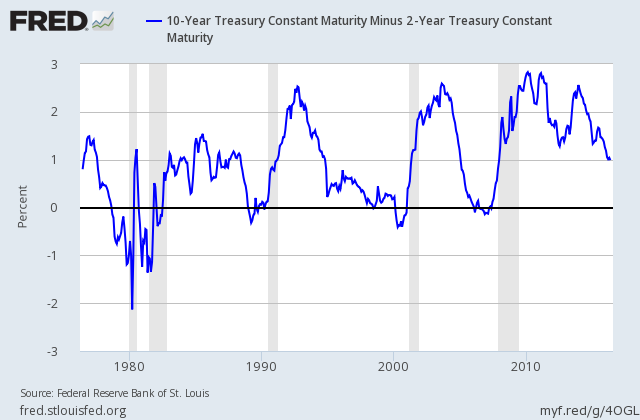
That’s not bad. Compared with the Fed or Wall Street, it’s outstanding.
I wanted to run the numbers and see how well the 2/10 spread did. Here’s the 2/10 spread versus the number of times the economy was in recession 12 months in the future.
 Eddy Elfenbein is a Washington, DC-based speaker, portfolio manager and editor of the blog Crossing Wall Street. His