-
The Market Rotates
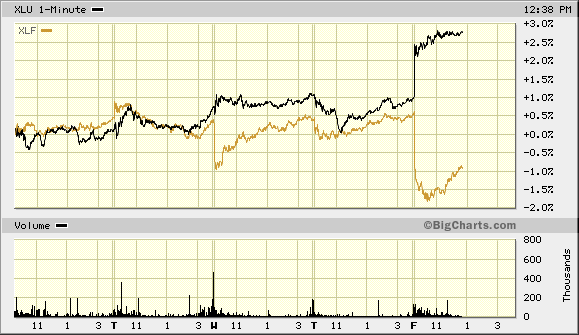
Posted by Eddy Elfenbein on June 3rd, 2016 at 12:38 pmWith today’s lousy employment report, the market suddenly realizes that the Fed probably won’t raise rates later this month, and perhaps not in July as well.
Students of “The Elfenbein Theory to Explain the Entire Stock Market” know exactly what to expect. High dividend areas like Utilities are doing well, while banks and financials are doing poorly.
Check this out:
-
May Jobs Report +38,000
Posted by Eddy Elfenbein on June 3rd, 2016 at 8:32 amThe government just released the May jobs report. The economy created only 38,000 net new jobs last month. The unemployment rate fell to 4.7%.
Revisions for March and April subtracted 59,000. Average hourly earnings rose by 0.2%.
I think this takes a June rate hike off the table.
The unemployment rate is lower now than it was in every single month from November 1973 to October 1997.
Here’s payroll employment along with the stock market.
-
CWS Market Review – June 3, 2016
Posted by Eddy Elfenbein on June 3rd, 2016 at 7:08 am“If you’ve followed my forecasts, you’ve probably lost a lot of money.”
– St. Louis Fed President James BullardYeah, thanks for that tip, James, but we’ve already shied away from following the Federal Reserve’s predictions. Still, the central bank is kinda hard to ignore. There’s another big Fed meeting in two weeks, and the top brass is hinting that they’re serious about a rate hike. I honestly don’t know what will happen, but I think raising rates now would be a big mistake.
In this week’s CWS Market Review, we’ll take a closer look at where we stand with the economy, the Fed and Wall Street. More importantly, we’ll zero in on how it impacts our portfolios.
Later on, I’ll cover the very good earnings report from HEICO. The company raised guidance for the second time this year. (I love it when our stocks do that!) HEICO is now our #1 performer this year, with a YTD gain of 22%. When you have a well-diversified portfolio, you never know who’s going to have an all-star year.
I’ll also bring you up to speed on some other Buy List stocks, plus I’ll tell you which ones look particularly cheap at the moment. But first, let’s look at what the Fed might have planned for us later this month.
The S&P 500 Rises to a Seven-Month High
Wall Street has been in a good mood lately. The Nasdaq Composite has rallied for seven straight sessions. The S&P 500 closed Thursday at 2,105.26, which is a seven-month high. The index is now just 1.2% from its all-time high close reached a little over a year ago.
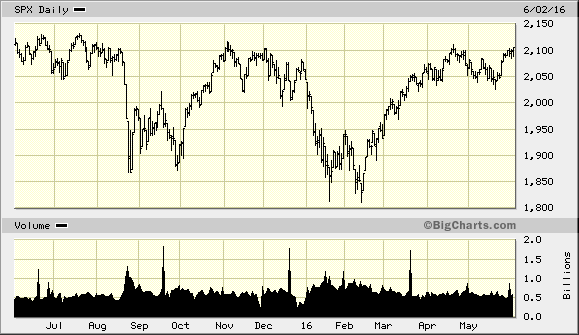
While the recent uptick is nice to see, I’m not ready to celebrate a breakout just yet. As we’ve seen, the broad market indexes have been fairly range-bound for the past 18 months. The 2,100 barrier has been tough to break. We also have a few hurdles in our way, like the upcoming Fed meeting, plus the Brexit vote in the U.K.
One factor I like about the market’s rally is that it’s been fairly broad, meaning more stocks are joining in on the fun. Charlie Bilello, one of my favorite technicians, points out that 66% of stocks on the NYSE are trading above their 200-day moving averages. That’s the most since July 2014.
We’re also seeing that different sectors like Utilities, Tech and Industrials are all near new highs. For example, Amazon.com is at a new high, and that’s getting a lot of attention (I was asked about it this week on CNBC). Yet fairly bread-and-butter stocks like Johnson & Johnson, Lowe’s and Illinois Tool Works are also at new highs (alas, CNBC did not ask me about ITW).
At the moment, Wall Street is focused on the June 14-15 Fed meeting. At this meeting, the Fed will also update its economic forecasts, and Chairwoman Yellen will host a post-meeting press conference. She and other Fed officials have signaled their willingness to raise interest rates in the coming months. This has been in contrast to what Wall Street, and I, think is needed.
For the most part, I believe the Fed has overestimated the need for higher interest rates (and Mr. Bullard apparently agrees). While there have been some improvements to the economy, there are still large areas of weakness, especially in the labor market. I could certainly understand the need for a rate increase if we saw rising consumer prices and decent wage gains. Instead, commodities like oil are rebounding after a steep fall, and wage growth has been fairly lackluster.
While I think a rate hike now would be a bad idea, I can’t say that a 0.25% increase would sink the economy. We got through the first rate hike from late last year. Second-quarter GDP will probably be a lot better than Q1. I‘ve also noticed that many heavy-industry stocks have been doing well. From our Buy List, Wabtec (WAB) and HEICO are good examples. That may suggest that the industrial sector is gaining strength. This week, we saw that the ISM Manufacturing Index for May was 51.3. That’s not great, but it does mean that the factory sector is expanding.
If I had to guess, I’d say the Fed won’t raise rates at this meeting, but I’m far from certain. Right now, the futures market thinks there’s a 20.6% the Fed will raise rates. But for the July meeting, the odds rise to 58.5%. After that, the futures market expects the Fed to sit on its hands for a few months.
The bond market is already taking notice. The yield on the one-year Treasury is up to 0.68%. Of course, that’s not very high, but it’s near the highest yield in more than seven years. Not that long ago, the one-year Treasury yield was bouncing around between 0.1% and 0.2%. Still, much of the world is talking about negative interest rates. This week, the ECB decided to keep deposit rates at -0.4%. If that’s not enough, next week, the ECB will start buying corporate bonds.
One interesting stat to watch is the spread between the two- and ten-year Treasuries. I’ve talked about the 2/10 spread before. It’s been one of the best economic indicators of the last three decades. Whenever the spread has turned negative, meaning the two-year yield has exceeded the ten-year yield, economic trouble has shortly followed.
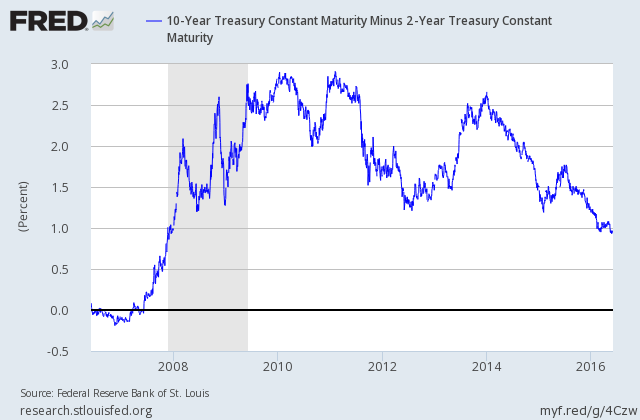
The 2/10 spread recently narrowed to less than 95 basis points. It hasn’t been that narrow since 2007. What this means is that lenders are becoming more discerning with their loans. Let me be clear: we’re still a long way from the danger zone, but within the credit markets, the tightening cycle has begun. Just this week, JPMorgan CEO Jamie Dimon said that the auto-loan business is “a little stressed.” Eventually, tighter credit spills over to less consumer spending.
If the Fed hikes, and the long end of the bond market doesn’t respond, then the spread will get narrower. But consumers aren’t so sour just yet. This week, the Federal Reserve released its Beige Book report. This is a pretty wonky report, but it often has good insight into the economy. I was surprised to see the Beige Book mention that labor markets were “tight,” which would suggest that wages are improving. The report was largely optimistic for the economy.
I’m not concerned yet about higher interest rates, but it certainly could be a problem in the near future. A few months ago, I looked at the data and found that the stock market has performed much better when the difference between the 90-day and 10-year Treasuries has been greater than 1.21%. The difference is currently 1.51%.
As investors, we’re in a good spot now, but it’s important that the Fed not cause any damage. Now let’s take a look at the excellent earnings report from HEICO.
HEICO Is a Buy up to $70 per Share
On Wednesday of last week, May 25, HEICO (HEI) reported fiscal Q2 earnings of 57 cents per share. This was another good quarter for the aircraft-parts supplier. Not enough analysts follow HEICO for us to claim that there’s truly a “consensus” on Wall Street, but I had been expecting earnings of 55 cents per share. HEICO had earned 49 cents per share in last year’s Q2. Quarterly sales rose 20% to $350.6 million.
Laurans A. Mendelson, HEICO’s Chairman and CEO, commented on the Company’s second-quarter results, stating, “We are very pleased to report record quarterly results in consolidated net sales and net income driven by record net sales at both operating segments and record operating income at the Electronic Technologies Group. Our outstanding performance reflects profitable contributions to earnings from the fiscal 2015 and 2016 acquisitions, strong quarterly organic growth within the Electronic Technologies Group and continued increased demand within our Flight Support Group’s aftermarket replacement-parts and specialty-products lines.
The good news is that HEICO also raised its guidance for this year:
Based on our current economic visibility, we are increasing our estimated consolidated fiscal 2016 year-over-year growth in net sales to 15% – 17% and net income to 12% – 14%, up from prior growth estimates in net sales of 14% – 16% and growth in net income of 10% – 13%. Additionally, we anticipate our consolidated full-year operating margin to approximate 18.5% – 19.0%, depreciation and amortization expenses to approximate $62 million, capital expenditures to approximate $32 million and cash flow from operations to approximate $220 million.
This is the second time HEICO has increased its guidance this year. Unfortunately, HEICO only provides guidance for net income and not earnings-per-share. The company earned $1.97 per share last time, so we can infer a full-year EPS between $2.25 and $2.30 (assuming a stable number of shares). That’s seems very doable. HEICO has already earned $1.03 per share for the first half of this year.
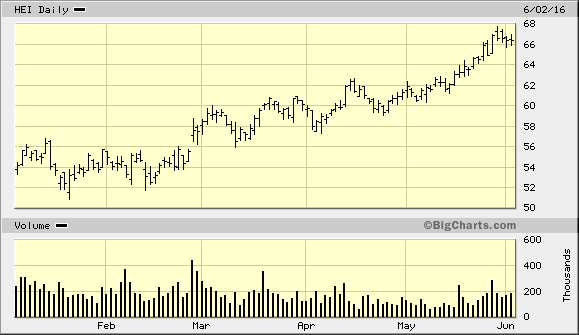
The shares reacted very well to the earnings report. At one point, HEI broke $67 per share. I had been holding off on adjusting our Buy Below price, but this earnings report shows us that the company is doing very well. This week, I’m raising my Buy Below on HEICO to $70 per share.
Buy List Updates
A few of our lagging Buy List stocks have started to perk up. High-quality stocks may disappoint you for a few months, but they tend to bounce back. Stocks like Wells Fargo (WFC) and Biogen have recently broken out to fresh four-month highs.
Remember back in March when Oppenheimer downgraded Fiserv (FISV)? The firm also pulled its $100 price target. Fortunately, we ignored it. Fiserv had another great earnings report in April, and the shares hit yet another new high this week of $106.65. Fiserv remains a solid stock.
Shares of Alliance Data Systems (ADS) are finally showing signs of life. I won’t mince words—ADS has been a big disappointment for us this year. In January, the stock plunged 19% in one day. But lately, ADS has rallied, and it just touched a four-month high. The stock is now up more than 27% from its February low. This is exactly why we focus on the long term.
Three weeks ago, I said that Biogen (BIIB) hasn’t done well for us this year, “but I think it’s ready for a turn.” It’s still early, but it looks like I was right. The biotech stock recently breached $291 per share, and it’s at its highest point since the start of the year. Keep watching this one.
Look for another dividend increase from CR Bard (BCR). The company usually announces the new dividend in early June. My guess is they’ll raise the quarterly payout from 24 to 27 cents per share. Bard has increased its dividend every year since 1972.
Express Scripts (ESRX) is another disappointing stock that’s starting to come back. Shares of ESRX are now at their highest level since January. The company has had a lot of drama this year, which has weighed down the stock, but let’s not forget how profitable they are. I’m expecting another good earnings report in July.
Shares of Ford Motor (F) dropped this week after a disappointing sales report for May. Ford’s truck business is still doing well, but their car business didn’t live up to expectations. I still like Ford a lot here. Look for another good earnings report in late July. The dividend currently yields 4.5%.
There are a few Buy List stocks that look especially good right now. I mentioned Biogen before, but I think this one has room to run. I also like Bed Bath & Beyond (BBBY). I realize it’s a frustrating stock to own but the price is very low. Earnings are due out on June 22.
That’s all for now. I’m writing this to you early Friday, and the May jobs report comes out later this morning. Wall Street expects a gain of 160,000 jobs, but this number may be distorted by the Verizon strike. Still, the key figure to watch will be wage growth. On Tuesday, we’ll get the productivity report, and on Friday, the government reports on the budget. Be sure to keep checking the blog for daily updates. I’ll have more market analysis for you in the next issue of CWS Market Review!
– Eddy
-
Morning News: June 3, 2016
Posted by Eddy Elfenbein on June 3rd, 2016 at 7:03 amSaudi Oil Chief Khalid al-Falih Tells OPEC Changes Are Coming
Osborne Enlists JPMorgan’s Dimon for Help as Brexit Gains Ground
Former Morgan Stanley Deal Makers Reunite on Exchange Merger
U.S. Subpoenas Huawei Over Its Dealings in Iran and North Korea
Employers in U.S. Moderating the Pace of Hiring
Treasuries Hold Three-Day Advance Before U.S. Payrolls Data
Lesson One at Trump University: The Hard Sell
Gannett Is Leaning Toward Dropping Bid to Acquire Tribune
Samsung Pay Enters Europe Via Spain
Wal-Mart to Test Grocery Delivery With Uber and Lyft
Wal-Mart Says It Is 6-9 Months From Using Drones to Check Warehouse Inventory
Amid SEC Probe, Jack Ma Says Hard For U.S. to Understand Alibaba
Cullen Roche: What is the Worst Case Scenario for Bonds?
Josh Brown: What You Need to Know About the “Earnings Recession”
Be sure to follow me on Twitter.
-
Morning News: June 2, 2016
Posted by Eddy Elfenbein on June 2nd, 2016 at 7:06 amInvestors Cautious Ahead of ECB and OPEC Meetings
Greece Running Out of Time for Quick ECB Waiver Reinstatement
U.S. Consumer Spending Increase Strongest in Over Six Years
Payday Borrowing’s Debt Spiral to Be Curtailed
Johnson & Johnson Treats Itself to $3.3B Deal for Vogue International
EU Cautions Governments Against Banning Uber, Airbnb
Uber Raises $3.5 Billion From Saudi Sovereign Wealth Fund, Keeps $62.5 Billion Valuation
Qatar Airways Takes Battle To Delta With Daily Flights To Atlanta From Today
This Year’s NBA Finals Pit Nike Against Under Armour
Lululemon’s Billionaire Founder Slams Company, Saying It Has ‘Lost Its Way’
Instagram Adds Business Profiles in Advertising Growth Push
Temasek, GIC Buy $1 Billion in Alibaba Stock in SoftBank Sale
Going Broke Slowly: A Guide to Sprint’s $33 Billion Debt Dilemma
Jeff Carter: Does a Rate Rise Hurt Startup Financing?
Cullen Roche: Is There a Bubble in Low-Volatility Funds?
Be sure to follow me on Twitter.
-
Hey Elizabeth, How Much Does Forbes Say You’re Worth?
Posted by Eddy Elfenbein on June 1st, 2016 at 10:53 am
From Forbes:
Last year, Elizabeth Holmes topped the FORBES list of America’s Richest Self-Made Women with a net worth of $4.5 billion. Today, FORBES is lowering our estimate of her net worth to nothing. Theranos had no comment.
-
The Tech Rollercoaster
Posted by Eddy Elfenbein on June 1st, 2016 at 8:28 am -
Morning News: June 1, 2016
Posted by Eddy Elfenbein on June 1st, 2016 at 7:12 amAbe to Delay Putting Japan’s Sales Tax Increase Into Effect
OECD Blasts Governments for Slipping Into ‘Low-Growth Trap’
Ahead of Meeting, OPEC Seems Close to Riding Out Price Slump
What the Sharp Consumer Spending Revival Means for the Economy
Consumer Confidence Misses Estimates
U.S. Court Rules $24.9 Billion Dell Buyout Underpriced By 22%
Tesla Rival Faraday Wants to Build Electric Cars in Vallejo
Amazon CEO Jeff Bezos: We Should Settle Mars ‘Because It’s Cool’
Japan’s SoftBank Plans to Sell $7.9 Billion in Alibaba Stock to Cut Debt
Ahold Earnings Benefit From Increased Sales and Cost-Savings
Russian Manufacturing Edges Toward Growth as Economy Stabilizes
Musk Says It’s ‘Obvious’ Model 3 Owners to Pay for Superchargers
Barclays Director Accused of Trading Tips for New Bathroom
Josh Brown: Banks Should Get Down on Their Knees and Pray for Regulation
Roger Nusbaum: Summertime & The Trading Is Not So Easy
Be sure to follow me on Twitter.
-
Talking Amazon
Posted by Eddy Elfenbein on May 31st, 2016 at 3:25 pm -
The Tech Rollercoaster
Posted by Eddy Elfenbein on May 31st, 2016 at 10:01 amHere’s a strange chart.
The Tech Sector ETF (XLK) lagged the S&P 500 nearly every day last month. Then suddenly, it beat the market most days this month. It’s hard to show just how unusual this kind of behavior is.

-
Archives
- September 2026
- August 2026
- July 2026
- June 2026
- May 2026
- April 2026
- March 2026
- February 2026
- January 2026
- December 2025
- November 2025
- October 2025
- September 2025
- August 2025
- July 2025
- June 2025
- May 2025
- April 2025
- March 2025
- February 2025
- January 2025
- December 2024
- November 2024
- October 2024
- September 2024
- August 2024
- July 2024
- June 2024
- May 2024
- April 2024
- March 2024
- February 2024
- January 2024
- December 2023
- November 2023
- October 2023
- September 2023
- August 2023
- July 2023
- June 2023
- May 2023
- April 2023
- March 2023
- February 2023
- January 2023
- December 2022
- November 2022
- October 2022
- September 2022
- August 2022
- July 2022
- June 2022
- May 2022
- April 2022
- March 2022
- February 2022
- January 2022
- December 2021
- November 2021
- October 2021
- September 2021
- August 2021
- July 2021
- June 2021
- May 2021
- April 2021
- March 2021
- February 2021
- January 2021
- December 2020
- November 2020
- October 2020
- September 2020
- August 2020
- July 2020
- June 2020
- May 2020
- April 2020
- March 2020
- February 2020
- January 2020
- December 2019
- November 2019
- October 2019
- September 2019
- August 2019
- July 2019
- June 2019
- May 2019
- April 2019
- March 2019
- February 2019
- January 2019
- December 2018
- November 2018
- October 2018
- September 2018
- August 2018
- July 2018
- June 2018
- May 2018
- April 2018
- March 2018
- February 2018
- January 2018
- December 2017
- November 2017
- October 2017
- September 2017
- August 2017
- July 2017
- June 2017
- May 2017
- April 2017
- March 2017
- February 2017
- January 2017
- December 2016
- November 2016
- October 2016
- September 2016
- August 2016
- July 2016
- June 2016
- May 2016
- April 2016
- March 2016
- February 2016
- January 2016
- December 2015
- November 2015
- October 2015
- September 2015
- August 2015
- July 2015
- June 2015
- May 2015
- April 2015
- March 2015
- February 2015
- January 2015
- December 2014
- November 2014
- October 2014
- September 2014
- August 2014
- July 2014
- June 2014
- May 2014
- April 2014
- March 2014
- February 2014
- January 2014
- December 2013
- November 2013
- October 2013
- September 2013
- August 2013
- July 2013
- June 2013
- May 2013
- April 2013
- March 2013
- February 2013
- January 2013
- December 2012
- November 2012
- October 2012
- September 2012
- August 2012
- July 2012
- June 2012
- May 2012
- April 2012
- March 2012
- February 2012
- January 2012
- December 2011
- November 2011
- October 2011
- September 2011
- August 2011
- July 2011
- June 2011
- May 2011
- April 2011
- March 2011
- February 2011
- January 2011
- December 2010
- November 2010
- October 2010
- September 2010
- August 2010
- July 2010
- June 2010
- May 2010
- April 2010
- March 2010
- February 2010
- January 2010
- December 2009
- November 2009
- October 2009
- September 2009
- August 2009
- July 2009
- June 2009
- May 2009
- April 2009
- March 2009
- February 2009
- January 2009
- December 2008
- November 2008
- October 2008
- September 2008
- August 2008
- July 2008
- June 2008
- May 2008
- April 2008
- March 2008
- February 2008
- January 2008
- December 2007
- November 2007
- October 2007
- September 2007
- August 2007
- July 2007
- June 2007
- May 2007
- April 2007
- March 2007
- February 2007
- January 2007
- December 2006
- November 2006
- October 2006
- September 2006
- August 2006
- July 2006
- June 2006
- May 2006
- April 2006
- March 2006
- February 2006
- January 2006
- December 2005
- November 2005
- October 2005
- September 2005
- August 2005
- July 2005
 Eddy Elfenbein is a Washington, DC-based speaker, portfolio manager and editor of the blog Crossing Wall Street. His