-
The Market Yawns After Doha
Posted by Eddy Elfenbein on April 18th, 2016 at 9:53 amIn the trading pits, oil is down sharply this morning after this weekend’s non-OPEC OPEC meeting.
There’s been a lot of talk about implementing a production freeze, but ultimately, no one could agree on one. The Saudis wanted Iran to go along but the Iranians just got off sanctions so they want to pump at full speed. So for now, there’s no production freeze and world oil should keep on flowing.
Right now, West Texas Crude is going for about $40 per barrel, but it was even lower earlier today.
The market seems to be indifferent. The S&P 500 is currently down about 0.17%. Even most energy stocks don’t seem to care.
-
Morning News: April 18, 2016
Posted by Eddy Elfenbein on April 18th, 2016 at 7:11 amGreece’s Latest Bailout Negotiations: Kicking The Can Again
China’s Home-Price Gains Spread as Easing Measures Spur Demand
Rousseff Hangs by a Thread After Losing Impeachment Vote
Oil Prices Drop After Doha Talks Fail to Bring Production Freeze
Gold Boosted by Dollar and Equities After Oil Freeze Fails
Insurers May Leave Obamacare Markets, But Don’t Expect A Mass Exodus
Verily, Truth Telling From China: Donald Trump Is Irrational On Trade
Spain’s CaixaBank Expects To Close Deal For Banco BPI
Verizon Tops Pack of Suitors Chasing Yahoo
The Error In Robert Samuelson’s Tax Proposal
Morgan Stanley Profit Beats Estimates on Stock, Bond Trading
Media Websites Battle Faltering Ad Revenue and Traffic
New McDonald’s Location Will Feature All-You-Can-Eat Fries/a>
Jeff Carter: An Exchange Goes Public
Jeff Miller: Time to Sell the News?
Be sure to follow me on Twitter.
-
Industrial Production Fell 0.6% Last Month
Posted by Eddy Elfenbein on April 15th, 2016 at 10:03 amFrom CNBC:
Industrial output decreased 0.6 percent last month after a downwardly revised 0.6 percent drop in February, the Federal Reserve said on Friday. Industrial production has declined in six of the last seven months.
Economists polled by Reuters had forecast industrial production slipping 0.1 percent last month after a previously reported 0.5 percent drop in February.
Industrial production peaked in November 2014. The March report was 3.1% below the peak.
-
60 Straight Quarters of Sales Growth
Posted by Eddy Elfenbein on April 15th, 2016 at 9:58 amMarketWatch has an interesting article where it lists 12 companies that have grown their sales every quarter for the last 15 years. But what truly caught my eye was that five of the 12 stocks are on our Buy List.
Here are the twelve, with our Buy List stocks in bold.
Amazon.com (AMZN)
C.R. Bard (BCR)
Biogen Inc. (BIIB)
Cognizant Technology Solutions (CTSH)
Dollar General (DG)
DaVita HealthCare Partners (DVA)
Equinix Inc. (EQIX)
O’Reilly Automotive (ORLY)
Ross Stores (ROST)
Stericycle (SRCL)
Tractor Supply (TSCO)
UnitedHealth Group (UNH) -
CWS Market Review – April 15, 2016
Posted by Eddy Elfenbein on April 15th, 2016 at 7:08 am“Doubt is not a pleasant condition, but certainty is absurd.” – Voltaire
Earnings season has begun, and so far, the market seems quite pleased. On Thursday, the S&P 500 closed at its highest point this year. What a turnaround for stocks. The index is up nearly 14% from its February low, and it’s now less than 2.5% from a new all-time high.

On Thursday, Wells Fargo (WFC) was our first Buy List stock to report earnings for this season. The big bank beat Wall Street’s consensus by two cents per share. Wells is continuing to churn out a steady profit despite a tough environment for banks. I’ll have more details in a bit.
Several of our Buy List stocks have been quietly rallying lately ahead of their earnings reports. Stocks like AFLAC (AFL), Stryker (SYK) and CR Bard (BCR) just hit fresh 52-week highs. Other stocks like HEICO (HEI) aren’t far from new highs. The earnings parade is about to get much busier. Next week, we have five Buy List earnings reports including Microsoft (MSFT) and Biogen (BIIB). I’ll preview them later on.
But first, I want to focus on some recent economic news. I realize this sounds like a parody of an economist, but the numbers have been mixed. Some good and some bad. Let’s take a look.
Retail Sales Unexpectedly Tank
Since the Financial Crisis, there’s been a small industry of folks predicting the imminent return of inflation. So far, all those predictions have gone bust. Personally, I try to avoid the macro-forecasting game and instead focus on the numbers.
That’s why I was concerned about the consumer inflation reports for January and February. The headline numbers were quite tame, but the “core” number, which excludes food and energy, started to concern me.
In January, seasonally-adjusted core inflation rose by 0.293% (that’s monthly, not annualized). That may not sound like a lot, and quite frankly, it’s not, but it was the highest in more than nine years. Then in February, the core rate came in at 0.283%, which was the fourth highest in the past nine years.
On Wall Street, two data points count as a trend. Personally, I like to see a little more data, which is why I chose M. Voltaire for today’s epigraph. On Thursday, the government reported that the core inflation rate for March was a tame 0.069%. So there’s no apparent trend. At least not yet.
I wouldn’t mind seeing a bit of inflation. They key part here is “a bit.” It would give the Federal Reserve some more latitude with interest rates. Inflation expectations are very low. As it stands right now, there’s a good chance that the Fed won’t touch interest rates until after the election. I still believe investors are overpaying for risk-averse assets while they’re ignoring assets that are slightly more risky but have much more potential.
Of course, an improving economy needs more shoppers, and that means more people with jobs. The jobs reports have gradually improved, but the best news this week was that the initial jobless report fell to 253,000. That’s the lowest in more than 42 years. Obviously, the country has a lot more people than it did back then. Initial jobless claims have now been below 300,000 for 58 consecutive weeks.
These good numbers are probably due to seasonal factors as much as the jobs market. While the labor picture has improved, there are still many Americans out of work or not even looking for work. There have been some signs of improvement here. The labor-force participation rate finally ticked higher, and wage growth is slowly picking up after a long stretch of flatlining.
I had expected that this would cause more folks to head out shopping. That wasn’t the case. Maybe it was March Madness, but too many people sat at home last month instead of buying things at the mall. On Wednesday, the Commerce Department reported that retail sales fell 0.3% last month. Wall Street had been expecting an increase of 0.1%.
The Atlanta Fed has a cool new estimate of future GDP. They dump tons of numbers into a blender, hit puree, and somehow get an estimate for GDP growth. Right now, they say Q1 real GDP rose by just 0.3%. I had thought their estimate was too pessimistic, but this week’s retail sales report tells me they may be right. We’ll get the first estimates of Q1 GDP on April 28.
Heading into this earnings season, analysts had pared back their estimates by the most since the financial crisis. At the start of the year, Wall Street had been expecting flat earnings for Q1. Now expectations are down 10%. The Wall Street Journal noted that a near-record number of companies in the S&P 500 issued guidance below Wall Street’s expectations. This is expected to be the first earnings season where earnings growth, excluding energy, is negative.
I’m optimistic for our stocks this earnings season because they tend to be much higher quality than the rest of the market. When investors get nervous, they seek out quality. I especially think we’ll see good results from companies like Biogen (BIIB) and Microsoft (MSFT). More on those soon, but first let’s look at this week’s earnings report from Wells Fargo.
Wells Fargo Earns 99 Cents per Share
On Thursday, Wells Fargo (WFC) reported Q1 earnings of 99 cents per share. That was two cents better than Wall Street’s expectations and one penny below my expectations.
There’s not much new to this story. Wells is doing fine, but the environment for banks is choppy. Some bank stocks started to perk up last year. But once it seemed that interest rates would stay lower for longer, the bank stocks got crushed. So far, this has been a terrible year for the big names like JPMorgan Chase, Citigroup and Bank of America.
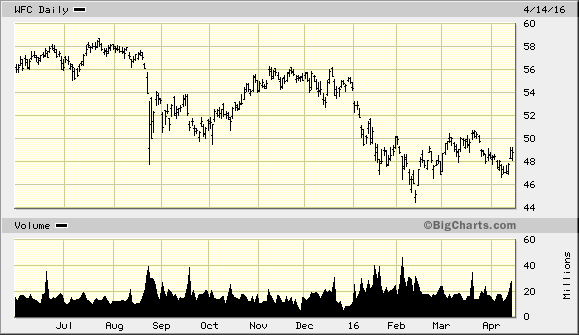
Going into earnings season, one question mark about Wells was how big was the damage from bum energy loans? The plunging price of crude has wrecked the balance sheets of tons of energy firms, and they owed money to Wells. Now we have some numbers: during Q1, Wells charged off more than $200 million in energy loans. That’s an increase of 75%. The bank also added $200 million to reserves for potential losses. This was the first time they raised reserves in seven years.
The energy loans are an issue, but it’s a small part of their overall business. Last quarter, Wells’s total loan portfolio rose by 10% to $947.26 billion, and commercial loans were up 19% thanks to GE’s commercial lending unit. The bank’s “efficiency ratio” for Q1 was 58.7%. The ratio is expense as a percent of revenues. Wells’s net interest margin is down to 2.9%. I’d like to see that improve, but it’s tough to do in a low-rate world.
Wells also got stung this week when the government rejected its living will. The government has required any of the “too big to fail” banks to explain what they would do in the case of bankruptcy. WFC wasn’t the only bank to have its plan criticized. The CEO has said they’ll work to address whatever issues the government has.
Overall, I think this was a decent quarter for Wells. They’re working their way through some rough seas. The stock is cheap here, but I don’t expect any fireworks. Investors should know that Wells is a stock for the long term. I’m keeping my Buy Below for Wells Fargo at $53 per share.
Q1 Buy List Earnings Calendar
Over the next month, 16 of our 20 Buy List stocks are due to report Q1 earnings. Here’s a handy calendar. I’ve included each stock’s name, ticker, reporting date, Wall Street’s consensus estimate and actual reported result. Please note that some of these dates and numbers are subject to change. This info is the latest I have.
Company Ticker Date Estimate Result Wells Fargo WFC 14-Apr $0.97 $0.99 Stryker SYK 20-Apr $1.20 Alliance Data ADS 21-Apr $3.84 Biogen BIIB 21-Apr $4.48 Microsoft MSFT 21-Apr $0.64 Snap-on SNA 21-Apr $2.09 Express Scripts ESRX 25-Apr $1.22 AFLAC AFL 26-Apr $1.61 CR Bard BCR 27-Apr $2.17 Ford Motor F 28-Apr $0.47 Stericycle SRCL 28-Apr $1.16 Cerner CERN 5-May $0.53 Fiserv FISV 5-May $1.02 Cognizant Tech CTSH 6-May $0.79 Signature Bank SBNY TBD $1.95 Wabtec WAB TBD $1.00 Five Earnings Reports Next Week
Let’s focus on the five Buy List earnings for next week. On Wednesday, April 20, Stryker (SYK) will report its first quarter earnings. Shares of SYK have been doing quite well lately. The stock is up more than 27% from its January low.
Stryker said to expect Q1 earnings to range between $1.17 and $1.22 per share. Like a lot of companies, Stryker has seen its earnings squeezed by the strong dollar. In January, they said that if the exchange remains constant, that will shave two to three cents per share off Q1 earnings. The dollar, however, has been weaker, which may explain some of Stryker’s rally. The stock is currently above my $105 Buy Below price. I’ll probably raise that next week, but I want to see the earnings results first.
On Thursday, April 21, four more Buy List stocks are due to report. Alliance Data Systems (ADS) is one of our new stocks this year, and it’s not been a good start. After the last earnings report, ADS got crushed for a 19.4% loss.
The reason for the steep drop was ADS’s Q1 guidance. They see earnings of $3.83 per share for Q1. Adjusted for currency, that would be $3.93 per share. Wall Street had been expecting $4.14 per share. Interestingly, ADS kept its full-year forecast unchanged at $17 per share.
Biogen (BIIB) is another new stock this year. The last earnings report was very strong. The stock soared after they beat earnings by more than 10%. The rally, however, didn’t last. Wall Street expects earnings of $4.47 per share.
Microsoft (MSFT) has been very stable recently. I’m a little surprised the stock hasn’t been able to break above $56 per share. Look for another good earnings report. Six months ago, shares of MSFT jumped 10% after its earnings report.
Snap-on (SNA) wrapped up a solid year for 2015. Wall Street sees quarterly earnings rising to $2.09, compared with $1.87 for last year’s Q1. I think the company can make $9 per share this year.
That’s all for now. Next week is a slow week for economic reports, but earnings reports will significantly heat up. On Tuesday, we’ll get reports on building permits and housing starts. The existing home-sales report is on Wednesday. Thursday is initial jobless claims. I’ll be curious to see if we can make another four-decade low. Be sure to keep checking the blog for daily updates. I’ll have more market analysis for you in the next issue of CWS Market Review!
– Eddy
Morning News: April 15, 2016
Posted by Eddy Elfenbein on April 15th, 2016 at 7:04 amChina Averts a Hard Landing With a Credit-Powered Trampoline
Obama to Back Anti-Brexit Campaign on Trip to U.K. Next Week
Obama to Help Push for Open Market for Cable Set-Top Boxes
Oil Falls Before Doha as Global Markets Brace for Weekend Risk
Sanders Can’t Clarify Wall Street Plan in Testy Clinton Debate
Microsoft Sues Justice Department to Protest Electronic Gag Order Statute
Twitter Hires China Head in Search of Growth
A Tough Year for Banking Takes Shape
Goldman’s Blankfein Said to Push Deepest Cost Cuts in Years
Yahoo’s Suitors Uncover Few Financial Details
Legal Fight Hits General Motors’ Acquisition of Cruise Automation
Valeant Calls in Investment Banks to Weigh Options
Josh Brown: Confusing Sophistication with Substance
Howard Lindzon: Amazon Web Services…to the Financial Moon
Be sure to follow me on Twitter.
Will oil crack the S&P 500?
Posted by Eddy Elfenbein on April 14th, 2016 at 6:04 pmWells Fargo Earns 99 Cents Per Share
Posted by Eddy Elfenbein on April 14th, 2016 at 12:01 pmWells Fargo (WFC) kicked off Q1 earnings season for our Buy List. The big bank earned 99 cents per share which beat estimates by two cents per share.
The San Francisco-based bank reported a profit of $5.46 billion, or 99 cents a share. That compares with $5.8 billion, or $1.04 a share, in the same period of 2015. The latest results included a tax benefit of 7 cents a share.
Analysts polled by Thomson Reuters had expected earnings of 97 cents a share.
Revenue rose 4.3% to $22.2 billion, making Wells Fargo the first big bank to report rising revenue in the first quarter. Analysts had expected $21.61 billion.
Analysts have long looked to Wells Fargo as a bellwether of the housing market, but in recent quarters they are also looking to the bank as a barometer for how falling oil prices are affecting big banks.
Low oil prices have pushed many energy firms into distress, which affects Wells Fargo more than other large banks since it is one of the most sizable lenders to the industry. Within Wells Fargo’s energy loan book, the number of loans labeled as “classified,” or in danger of defaulting, is on pace to exceed 50% this year, up from 38% in the fourth quarter.
In the first quarter, Wells Fargo charged off $204 million in energy loans, an increase of about 75% from the amount it charged off in the fourth quarter. The bank also added $200 million to funds for loans that could sour because of deterioration in its oil and gas portfolio. That marked the first time since 2009 that Wells Fargo built up reserves for loan losses reserves instead of releasing them.
Jobless Claims Fall to 42-Year Low
Posted by Eddy Elfenbein on April 14th, 2016 at 10:57 amThis week’s initial jobless claims report fell to 253,000. That’s the lowest since November 1973.
Core Inflation Cools Off
Posted by Eddy Elfenbein on April 14th, 2016 at 10:53 amThe government reported on March consumer inflation this morning. It appears that core inflation is cooling off. For March, core consumer prices rose by 0.069%. The previous two months were 0.283% and 0.293%. Those were two of the highest readings in the last ten years.
The headline CPI rose by just 0.1% which was below expectations of 0.2%.
-
Archives
- June 2026
- May 2026
- April 2026
- March 2026
- February 2026
- January 2026
- December 2025
- November 2025
- October 2025
- September 2025
- August 2025
- July 2025
- June 2025
- May 2025
- April 2025
- March 2025
- February 2025
- January 2025
- December 2024
- November 2024
- October 2024
- September 2024
- August 2024
- July 2024
- June 2024
- May 2024
- April 2024
- March 2024
- February 2024
- January 2024
- December 2023
- November 2023
- October 2023
- September 2023
- August 2023
- July 2023
- June 2023
- May 2023
- April 2023
- March 2023
- February 2023
- January 2023
- December 2022
- November 2022
- October 2022
- September 2022
- August 2022
- July 2022
- June 2022
- May 2022
- April 2022
- March 2022
- February 2022
- January 2022
- December 2021
- November 2021
- October 2021
- September 2021
- August 2021
- July 2021
- June 2021
- May 2021
- April 2021
- March 2021
- February 2021
- January 2021
- December 2020
- November 2020
- October 2020
- September 2020
- August 2020
- July 2020
- June 2020
- May 2020
- April 2020
- March 2020
- February 2020
- January 2020
- December 2019
- November 2019
- October 2019
- September 2019
- August 2019
- July 2019
- June 2019
- May 2019
- April 2019
- March 2019
- February 2019
- January 2019
- December 2018
- November 2018
- October 2018
- September 2018
- August 2018
- July 2018
- June 2018
- May 2018
- April 2018
- March 2018
- February 2018
- January 2018
- December 2017
- November 2017
- October 2017
- September 2017
- August 2017
- July 2017
- June 2017
- May 2017
- April 2017
- March 2017
- February 2017
- January 2017
- December 2016
- November 2016
- October 2016
- September 2016
- August 2016
- July 2016
- June 2016
- May 2016
- April 2016
- March 2016
- February 2016
- January 2016
- December 2015
- November 2015
- October 2015
- September 2015
- August 2015
- July 2015
- June 2015
- May 2015
- April 2015
- March 2015
- February 2015
- January 2015
- December 2014
- November 2014
- October 2014
- September 2014
- August 2014
- July 2014
- June 2014
- May 2014
- April 2014
- March 2014
- February 2014
- January 2014
- December 2013
- November 2013
- October 2013
- September 2013
- August 2013
- July 2013
- June 2013
- May 2013
- April 2013
- March 2013
- February 2013
- January 2013
- December 2012
- November 2012
- October 2012
- September 2012
- August 2012
- July 2012
- June 2012
- May 2012
- April 2012
- March 2012
- February 2012
- January 2012
- December 2011
- November 2011
- October 2011
- September 2011
- August 2011
- July 2011
- June 2011
- May 2011
- April 2011
- March 2011
- February 2011
- January 2011
- December 2010
- November 2010
- October 2010
- September 2010
- August 2010
- July 2010
- June 2010
- May 2010
- April 2010
- March 2010
- February 2010
- January 2010
- December 2009
- November 2009
- October 2009
- September 2009
- August 2009
- July 2009
- June 2009
- May 2009
- April 2009
- March 2009
- February 2009
- January 2009
- December 2008
- November 2008
- October 2008
- September 2008
- August 2008
- July 2008
- June 2008
- May 2008
- April 2008
- March 2008
- February 2008
- January 2008
- December 2007
- November 2007
- October 2007
- September 2007
- August 2007
- July 2007
- June 2007
- May 2007
- April 2007
- March 2007
- February 2007
- January 2007
- December 2006
- November 2006
- October 2006
- September 2006
- August 2006
- July 2006
- June 2006
- May 2006
- April 2006
- March 2006
- February 2006
- January 2006
- December 2005
- November 2005
- October 2005
- September 2005
- August 2005
- July 2005
 Eddy Elfenbein is a Washington, DC-based speaker, portfolio manager and editor of the blog Crossing Wall Street. His