-
Ross Just Opened 28 New Stores
Posted by Eddy Elfenbein on March 29th, 2016 at 11:07 amRoss Stores (ROST) continues to grow impressively. The discounter opened 28 new stores in February and March.
Ross Stores recently opened a total of 22 Ross Dress for Less® (“Ross”) and six dd’s DISCOUNTS® stores across 15 different states in February and March. These new locations are part of the Company’s 2016 expansion plans to add approximately 70 Ross and 20 dd’s DISCOUNTS locations throughout the year.
“These recent openings reflect our ongoing plans to continue building our presence in both existing and newer markets, including the Midwest for Ross, and expansion of dd’s DISCOUNTS,” said Jim Fassio, President and Chief Development Officer. “Ross Dress for Less remains the largest off-price apparel and home fashion chain in the U.S with 1,295 locations in 34 states, the District of Columbia and Guam. We continue to identify plenty of domestic growth opportunities ahead for both Ross and dd’s DISCOUNTS, and believe that over the long term, Ross can grow to 2,000 total locations and dd’s DISCOUNTS can become a chain of 500 stores.”
-
When the Storm Passes
Posted by Eddy Elfenbein on March 29th, 2016 at 10:43 amMost people realize it when a rainstorm starts but they generally don’t notice it when the rainstorm ends. That’s a reflection of how the mind works, and also how rainstorms work. The rain just slowly tapers off and then it’s gone.
The same can be said for market drama. Investors are well aware of it when it’s going on, but when it fades away, they don’t see that as an event. Over the last two weeks, the stock market’s volatility has dropped dramatically.
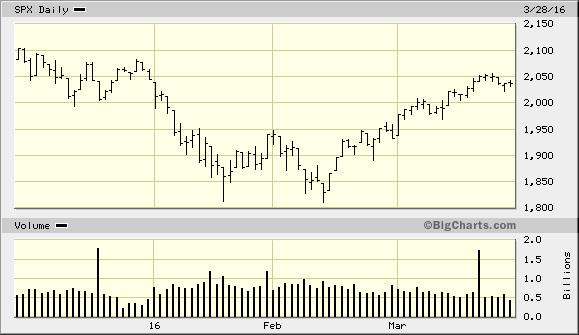
In the chart above, notice how much the spread between the daily high-low range has narrowed. Yesterday was the 10th day in a row where the S&P 500 closed up or down by less than 1%. In fact, four of the last five days, the index changed by less than 0.1%. Now compare that with the start of the year where 1% days were coming more than 50% of the time. We were on track for one of the most volatile years since the 1930s. The Volatility Index peaked over 30 last month. Recently, it dipped below 14 though it’s back over 15 now.
This is an important generality. The stock market tends to move in two gears—quick and down, and slow and up. This year we went from quick down to quick up. I suspect we’re in for several weeks of quietness.
-
Morning News: March 29, 2016
Posted by Eddy Elfenbein on March 29th, 2016 at 7:10 amNatural Gas Prices Rise With Demand Expectations
Existing Home Sales Collapsed In February – Why You Can Rest Easy
Saudi Land Purchases Fuel Debate Over US Water Rights
Consumer Spending in U.S. Rose 0.1% in February for Third Month
Yahoo Sets April 11 Deadline to Submit Preliminary Bids
As Valeant Struggles, Its Tally Sheet of Scandals Grows
Samsung Pay Launches in China and Singapore
Foxconn’s Price Tag for Sharp Likely to Fall by More Than $2 Billion
TSMC’s $3B Plant Latest Sign Of Growing China Clout In Sensitive Chip Industry
Banker Accused of $25 Million Fraud Arose From a Gilded Legacy
Cullen Roche: My “Wisdom” on Robo Advisors
Roger Nusbaum: Markets Confront Terror & Tragedy
Be sure to follow me on Twitter.
-
Barron’s on Cerner
Posted by Eddy Elfenbein on March 28th, 2016 at 9:40 amIn this weekend’s Barron’s, Vito J. Racanelli looks at Cerner (CERN) and sees a bargain.
The market’s love affair with health-care stocks has grown frosty. Since mid-July the sector is the market’s worst performer, down 13%. Shares of Cerner (ticker: CERN), a provider of health-care information technology have fallen even more, losing about a third of their value in the past 12 months to $51.46. The stock isn’t much above where it traded three years ago, and it looks invitingly cheap.
Cerner hasn’t helped its case by missing revenue expectations in the past few quarters. On Feb. 16, when reporting fourth- quarter results, it tweaked its 2016 sales projection, guiding for a range of $4.9 billion to $5.1 billion, versus a prior forecast of $5 billion. Revenue of $4.4 billion in 2015 was below an earlier projection of $4.8 billion to $5 billion.
Bookings continue to grow nicely, up 16% in the fourth quarter to $1.35 billion—but again, below the company’s earlier guidance of $1.45 billion to $1.55 billion. The drop in Cerner’s price/earnings ratio to the low 20s from an average P/E above 30 is deserved.
Nevertheless, the company’s still-robust earnings visibility, a hefty $14.2 billion backlog, and ongoing demand to reduce the country’s rampaging health-care costs suggest that Cerner could turn out to be a quiet winner for long-term-oriented investors.
-
Morning News: March 28, 2016
Posted by Eddy Elfenbein on March 28th, 2016 at 6:59 amOil Recovery Hits Saudi Devaluation Bet
Oil Enthusiasts Stay Out of Rally Led by Shrinking Bearish Bets
Red Meat, It’s What’s for Dinner Again as Beef Prices Tumble
China Bank Profits Flat-Line as Bad Debts Continue to Soar
Brazilians Scrimp and Save in Unwelcome Surprise for Investors
Israeli Court Strikes Down Natural Gas Development Deal
Japan’s NTT to Buy Dell Systems for $3.055 Billion
American Tech Giants Face Fight in Europe Over Encrypted Data
Where Tech Leads? The Battle For Yahoo’s Boardroom
Microsoft Meets With Private Equity Over Yahoo Deal
Ethereum, a Virtual Currency, Enables Transactions That Rival Bitcoin’s
Charter’s $67 Billion Cable Merger Hinges on the Cord Cutters
Popular IRS Charitable Tax Break Can Be Valuable—for Those Who Know How to Use It
Jeff Miller: Can Markets Finally Celebrate Good News?
Be sure to follow me on Twitter.
-
Q4 GDP Growth was Revised Up to 1.4%
Posted by Eddy Elfenbein on March 25th, 2016 at 9:33 amThis morning, the government revised higher its report on fourth-quarter GDP. The economy grew, in real terms, by 1.4% (annualized) during the final three months of last year.
The revision mainly reflects better consumer spending on services, signaling domestic stability in the face of overseas headwinds that stung manufacturers, energy firms and financial markets.
The balance sheets of U.S. companies weakened during the quarter. Corporate profits after tax, without inventory valuation and capital consumption adjustments, fell at an 8.1% pace last quarter from the third. That was largest quarterly decline since the first quarter of 2011. Profits fell 3.3% in third quarter from the second. On a year-over-year basis, corporate profits declined 3.6% in the fourth quarter.
Still, for all of 2015, profits were up 3.3% from 2014. The unadjusted measure of corporate profits tracks most closely with what companies report in earnings statements.
-
CWS Market Review – March 25, 2016
Posted by Eddy Elfenbein on March 25th, 2016 at 7:08 am“Fate laughs at probabilities.” – Edward Bulwer-Lytton
Wall Street is closed today for Good Friday, so this is a good opportunity to look at the recent sea change on Wall Street.
Stocks are up, volatility is down and risky assets are gaining in popularity. To sum it up, things have chilled out in a major way this month.
Consider that Thursday was the ninth day in a row in which the S&P 500 closed up or down by less than 1%. In the 48 days prior to that, it happened 27 times. That’s pretty frenetic trading. At that rate, 2016 was on pace to being one of the most volatile years since the 1930s.
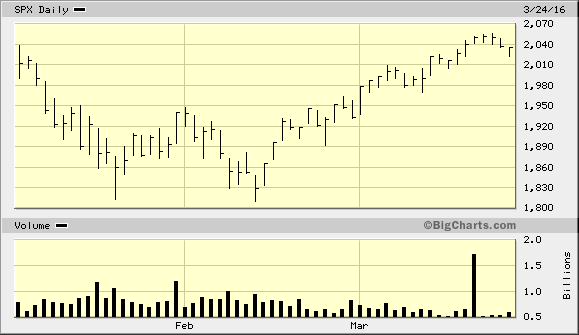
Then it all changed. In this week’s CWS Market Review, we’ll take a closer look at what happened, why it happened and what it means for us. I also want to preview the Q1 earnings season, which is quickly coming our way. I’ll also update you on several of our Buy List stocks. I particularly want to focus on the legal issues impacting Express Scripts (ESRX). But first, let’s look at the market’s impressive resiliency in the wake of terror.
Terror Fails to Scare Investors
On Tuesday, the world was shocked by the awful events in Belgium. I’ll never understand what could lead people to such senseless acts of violence.
If there’s a silver lining, at least in the world of business, it’s that the terrorist acts failed to scare investors. There was a small “flight to safety” move, but it was hardly similar to what we’ve seen following previous attacks.
I think this is notable for a few reasons. First, let’s remember that the market’s rally since the February low has been led, in large part, by riskier stocks. By that I mean “high beta” sectors. While many “low-vol” and defensive stocks have made new highs, those stocks were largely unscathed by the market’s nasty downturn during the first six weeks of this year. It’s the riskier assets that Wall Street has returned to.
To be very blunt, the events of Tuesday gave investors an understandable reason to rotate away from risk, and they didn’t take it. That’s a very encouraging sign. I’ll give you an example. Look at the recent performance of transportation stocks.
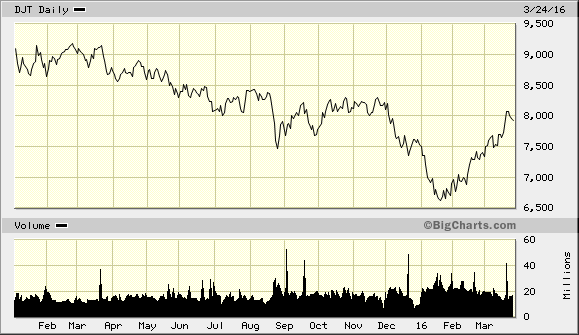
This is a group that had a horrible 2015, and it got really bad late in the year. But Transports suddenly became hot again in January. The Dow Jones Transportation Index, now in its 132nd year, has soared 20% in the last two months. FedEx (FDX), for example, recently popped on a good earnings report. On our Buy List, shares of Wabtec (WAB), a key supplier for the rail industry, have also rebounded impressively.
After the terror attacks, some airlines and travel stocks pulled back, but it was a fairly muted response. Market watchers like to keep an eye on transports for hints of the future. It’s a key cyclical sector. After all, if companies are shipping more goods, they expect consumers to buy them. It’s not surprising that the recovery in transports has come at the same time that we’ve seen improvement in consumer spending.
Another region that’s popped back has been Emerging Markets. Stock markets in countries like Brazil, Argentina and Russia were in a world of pain last year. Now they’re suddenly hot again. This is another example of investors being willing to step up the risk ladder and take on more-volatile stocks.
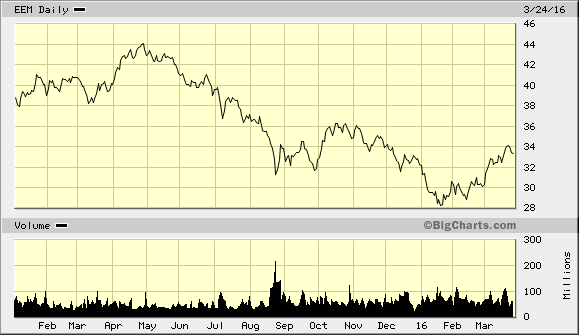
The movement in Emerging Markets is often an echo of the U.S. dollar. In short, investors want to get some extra reward for venturing into Emerging Markets. But if the dollar spurts higher, the effect is taken away, so capital flees back to America. As a result, Emerging Markets tend to move in strong waves—everybody in or everybody out. There’s not a lot of middle ground. (Of course, I’m generalizing.)
The softer dollar has helped many Emerging Markets. I was impressed to see that the Emerging Markets ETF (EEM) pulled back only a bit this week, but not as much as I expected (see above). This is another good sign that investors are committed to weathering greater volatility.
I’ve also noticed that high yield spreads have narrowed recently. This is the premium that investors demand in order to lend to lower-grade borrowers. Part of this trend is clearly the surge in energy prices, but that’s not all of it. If the economy is improving, as the data suggest, then defaults ought to decline. This means lenders will have more confidence to fund marginal borrowers. Of course, the lower borrowing costs also help the balance sheet of the borrowers, so it can become a self-reinforcing trend. While high yield spreads have narrowed dramatically, they’re still much wider than they were a year ago.
Most importantly, the Federal Reserve is still on the side of taking more risks. The recent Fed statement seems to be a signal that the Fed isn’t in a hurry to raise rates. Traders see a 10% chance of a rate hike in April and a 41% chance of a hike in June. I’d place those odds at 1% and 15%. So if you can’t get income from your bank account, it becomes necessary to own stocks, especially stocks with good earnings.
Now let’s look at the Q1 earnings season, which is less than three weeks away.
Preview of First-Quarter Earnings Season
The first quarter comes to an end next Thursday. Shortly after that, Q1 earnings season will start. On our Buy List, Bed Bath & Beyond (BBBY) still has to report Q4 earnings. That’s scheduled for April 6. After that, Wells Fargo (WFC) will lead off our earnings season with their report on April 14. Over the following four weeks, sixteen of our Buy List stocks will report earnings. I like to say that earnings time is Judgment Day for Corporate America, and Wall Street can render harsh verdicts.
For Q4, more than two-thirds of the companies in the S&P 500 beat expectations. That’s roughly in line with the long-term average. (Yes, that’s right. In Wall Streetistan, companies are expected to beat expectations.) But expectations had been slashed going into earnings.
As a result, last quarter was the fifth quarter in a row of declining earnings. Earnings for the S&P 500 fell by 13.8%. I should add that this is earnings per share, and that’s a metric that’s been greatly aided by share buybacks. Companies in the S&P 500 are on pace to buy back $165 billion worth of stock this quarter. During Q4, 25% of the stocks in the index reduced their share count by more than 4%.
It looks like Q1 could be the sixth quarter in a row for declining earnings. As of now, Wall Street expects the S&P 500 to report earnings of $26.11 for Q1 (that’s the index-adjusted figure). That’s a small increase of 1.6% over last year’s Q1. I should note that earnings estimates have been slashed the past few weeks, and we’ll probably see some more paring by the time earnings season begins. On the other hand, Wall Street will most likely top expectations by a predictably modest amount.
Another factor driving this earnings season is the horrible state of many energy companies. Earnings for the Energy sector are expected to be cut in half for Q1. Analysts also expect a 12% earnings decline for Financials. Outside that, the earnings picture shouldn’t be that bad. The Tech Sector is expected to show a 4% increase for Q1, and Consumer Discretionaries are expected to be up close to 10%.
For all of 2016, Wall Street sees earnings of $118.57 for the S&P 500. That’s almost certainly too high. The index earned about $100 last year, and I’m expecting around $110 for this year. Investors should continue to focus on solid companies with consistently growing earnings. Now let’s look at some current bargains on our Buy List.
Buy List Updates
Like the rest of the market, our Buy List has shaken off a poor start to the year, and we’re close to being in the black for 2016. Stocks like Fiserv (FISV) and Stryker (SYK) have recently made new highs, and CR Bard (BCR) came close to breaking $200 per share for the first time in six months.
Be sure to take notice of my Buy Below prices. The rule is simple: any time a stock is below its Buy Below price, I consider it a buy. It’s not a price target, since I change these prices frequently.
One Buy List stock that looks particularly attractive at the moment is Biogen (BIIB). Don’t be alarmed by the biotech’s poor start to the year. I’m looking forward to a good earnings report from Biogen on April 21.
My Buy Below for Cerner (CERN) is $58 per share. I’m going to keep it there, but the stock is an especially good buy if you can get it below $52 per share.
I also like Signature Bank (SBNY). If you can pick up SBNY below $140, then you made a good move.
Let’s look at some recent news affecting our Buy List stocks.
Oppenheimer downgraded Fiserv (FISV). That’s nothing to worry about. I’m looking forward to another good earnings report.
UBS shocked Wall Street by initiating coverage of Wells Fargo (WFC) with a Sell rating. No one ever says Sell! UBS says Wells faces several headwinds impacting all banking. I can’t disagree, but the bank has solid management and the valuation is still quite reasonable. Of all the stocks on our Buy List, Wells Fargo is one of the least to worry about.
Warren Buffett recently said that Mark Fields, Ford’s CEO, is doing an outstanding job. I agree. Here’s an interesting extended interview Henry Blodget recently did with Fields.
The war between Express Scripts (ESRX) and Anthem (ANTM) doesn’t appear to be cooling off. This week, Anthem filed a lawsuit in an attempt to recover what they claim were excess charges. Anthem is ESRX’s largest customer.
This feud has been going on for a few weeks, and you just knew somebody was going to throw down a lawsuit. I had thought Anthem’s public whining was part of the negotiating process. Unfortunately, the relationship may be in worse shape than I imagined.
Anthem has been throwing around pretty outrageous figures for damages, but that happens in most lawsuits. Tim Wentworth, the incoming CEO for Express, said he’s committed to keeping Anthem as a client. As I look at it, I think it would be too much of a hassle for Anthem to ditch Express, but I also don’t see the need for these theatrics. I still lean towards Anthem staying with Express, but it’s not unthinkable for them to part ways.
That’s all for now. The first quarter comes to an end next Thursday. On Monday, we’ll get the personal-income report for February. On Wednesday, ADO will release its private-payroll report. Friday will be a busy day for economic reports. We’ll get the latest construction-spending report and ISM report. It’s also Jobs Day. The last report should show unemployment to be at an eight-year low. Be sure to keep checking the blog for daily updates. I’ll have more market analysis for you in the next issue of CWS Market Review!
– Eddy
P.S. Good news! We’re moving ahead with our plans for an ETF based on our Buy List. But we need to gauge the level of interest. Please take a moment to fill out this brief survey. Thank you!
-
Morning News: March 25, 2016
Posted by Eddy Elfenbein on March 25th, 2016 at 7:00 amHow $40 Oil Is Driving Social Change in Saudi Arabia
U.S. Oil Explorers Return to Parking Rigs as Supplies Build
Plan to Rescue Puerto Rico Advances, Led by House Republicans
Wait Times Are Down, But IRS Still Faces Serious Challenges
On Business Issues, Republicans Might Want a Justice Garland
Durable Goods Orders Dropped 2.8% in February
Cage-Free Eggs May Be Golden Goose for Retail Profits
Wall Street Got Bullish on Power Deals After Pepco Approval
Judge Gives Volkswagen One More Month to Fix its Cheating Diesel Engines
Starboard Value Seeks to Oust Yahoo’s Board
TiVo Surges on Report Company Is in Sale Talks With Rovi
In Shift to Streaming, Music Business Has Lost Billions
Playboy is Looking to Sell Itself for $500 Million
Howard Lindzon: A Real Catalyst For Real Estate
Be sure to follow me on Twitter.
-
ETF Survey: Let Me Hear From You!
Posted by Eddy Elfenbein on March 24th, 2016 at 5:20 pmA few months ago, I ran an informal survey looking at the potential interest in an exchanged traded fund (ETF) based on our Crossing Wall Street Buy List. The response was overwhelming, and greatly exceeded our expectations.
I’m happy to say that we’re working to make a Buy List ETF a reality. This will be great tool for investors. After we launch, you’ll be able to easily buy the entire Buy List in one tradeable security in a highly tax-efficient structure. But I’m absolutely determined to keep our fees low. I refuse to budge on this point.
Now we run up against simple economics. In order to keep our costs low, the ETF must be a respectable size. That’s why I want to reach out to you again and gauge your interest. This is very important so I welcome your responses.
Please fill out our brief survey.
Thank you for your feedback!
-
Morning News: March 24, 2016
Posted by Eddy Elfenbein on March 24th, 2016 at 7:06 amThe World’s Best Performing Market Is Still in Serious Trouble
Pound’s $16 Billion of Option Trades Envisage Drop to 1980s Lows
Pentagon Opens Investigation Into Space Launch Contracts
Crude Oil Poised for First Weekly Decline Since Mid-February
F.B.I. Clash With Apple Loosed a Torrent of Possible Ways to Hack an iPhone
Mega Utility Deal Between Exelon and Pepco Gets Toughest Approval Yet
Starboard Will Seek to Replace Yahoo’s Entire Board, WSJ Says
KKR, Chinese Sovereign Fund Said to Study Yum! China Investment
Virgin America’s Biggest Shareholders Appear To Want To Cash Out, But Who Would Buy Them Out?
Zoomlion Shares Tumble After Sweetening Terex Offer
Opposition Rises Over Chinese Bid For Syngenta
Energy Transfer Paints Grim Picture of Williams Deal
Goldfarb Exits as Sequoia’s Valeant Debacle Caps 45-Year Career
Cullen Roche: The Investor Podcast – Macro Thoughts
Jeff Miller: How to Create a Perfect “Forecast”
Be sure to follow me on Twitter.
-
Archives
- June 2026
- May 2026
- April 2026
- March 2026
- February 2026
- January 2026
- December 2025
- November 2025
- October 2025
- September 2025
- August 2025
- July 2025
- June 2025
- May 2025
- April 2025
- March 2025
- February 2025
- January 2025
- December 2024
- November 2024
- October 2024
- September 2024
- August 2024
- July 2024
- June 2024
- May 2024
- April 2024
- March 2024
- February 2024
- January 2024
- December 2023
- November 2023
- October 2023
- September 2023
- August 2023
- July 2023
- June 2023
- May 2023
- April 2023
- March 2023
- February 2023
- January 2023
- December 2022
- November 2022
- October 2022
- September 2022
- August 2022
- July 2022
- June 2022
- May 2022
- April 2022
- March 2022
- February 2022
- January 2022
- December 2021
- November 2021
- October 2021
- September 2021
- August 2021
- July 2021
- June 2021
- May 2021
- April 2021
- March 2021
- February 2021
- January 2021
- December 2020
- November 2020
- October 2020
- September 2020
- August 2020
- July 2020
- June 2020
- May 2020
- April 2020
- March 2020
- February 2020
- January 2020
- December 2019
- November 2019
- October 2019
- September 2019
- August 2019
- July 2019
- June 2019
- May 2019
- April 2019
- March 2019
- February 2019
- January 2019
- December 2018
- November 2018
- October 2018
- September 2018
- August 2018
- July 2018
- June 2018
- May 2018
- April 2018
- March 2018
- February 2018
- January 2018
- December 2017
- November 2017
- October 2017
- September 2017
- August 2017
- July 2017
- June 2017
- May 2017
- April 2017
- March 2017
- February 2017
- January 2017
- December 2016
- November 2016
- October 2016
- September 2016
- August 2016
- July 2016
- June 2016
- May 2016
- April 2016
- March 2016
- February 2016
- January 2016
- December 2015
- November 2015
- October 2015
- September 2015
- August 2015
- July 2015
- June 2015
- May 2015
- April 2015
- March 2015
- February 2015
- January 2015
- December 2014
- November 2014
- October 2014
- September 2014
- August 2014
- July 2014
- June 2014
- May 2014
- April 2014
- March 2014
- February 2014
- January 2014
- December 2013
- November 2013
- October 2013
- September 2013
- August 2013
- July 2013
- June 2013
- May 2013
- April 2013
- March 2013
- February 2013
- January 2013
- December 2012
- November 2012
- October 2012
- September 2012
- August 2012
- July 2012
- June 2012
- May 2012
- April 2012
- March 2012
- February 2012
- January 2012
- December 2011
- November 2011
- October 2011
- September 2011
- August 2011
- July 2011
- June 2011
- May 2011
- April 2011
- March 2011
- February 2011
- January 2011
- December 2010
- November 2010
- October 2010
- September 2010
- August 2010
- July 2010
- June 2010
- May 2010
- April 2010
- March 2010
- February 2010
- January 2010
- December 2009
- November 2009
- October 2009
- September 2009
- August 2009
- July 2009
- June 2009
- May 2009
- April 2009
- March 2009
- February 2009
- January 2009
- December 2008
- November 2008
- October 2008
- September 2008
- August 2008
- July 2008
- June 2008
- May 2008
- April 2008
- March 2008
- February 2008
- January 2008
- December 2007
- November 2007
- October 2007
- September 2007
- August 2007
- July 2007
- June 2007
- May 2007
- April 2007
- March 2007
- February 2007
- January 2007
- December 2006
- November 2006
- October 2006
- September 2006
- August 2006
- July 2006
- June 2006
- May 2006
- April 2006
- March 2006
- February 2006
- January 2006
- December 2005
- November 2005
- October 2005
- September 2005
- August 2005
- July 2005
 Eddy Elfenbein is a Washington, DC-based speaker, portfolio manager and editor of the blog Crossing Wall Street. His