-
Best Blogs of 2016
Posted by Eddy Elfenbein on March 7th, 2016 at 10:15 amThank you to The College Investor which has named us one of the 20 Best Investing Blogs of 2016!
-
Seven Years Ago
Posted by Eddy Elfenbein on March 7th, 2016 at 9:12 amThis time of year has been fairly popular for major stock market turns. In 2000, the Nasdaq reached its nosebleed peak on March 10. Sixteen years later, we’re still below that level.
On March 11, 2003, the S&P 500 reached its closing low ahead of an impressive rally sparked by the opening of the Iraq War.
But the most impressive turn came seven years ago when the market reached one of the best buying opportunities in market history.
On Friday, March 6, 2009, the S&P 500 reached an intra-day low of 666.79. Like last Friday, that was also Jobs Day. That morning, the government reported that the economy had lost an astounding 651,000 jobs in February. The number for January was revised to a loss of 655,000, and December to minus 681,000. The unemployment rate rose to 8.1%, which was a 25-year high. So you can see why everyone was so bummed out.
That morning, The Wall Street Journal ran a piece from Michael Bostin, “Obama’s Radicalism is Killing the Dow.”
That day I posted a chart showing that the Dow, adjusted for inflation, was where it was 43 years before.
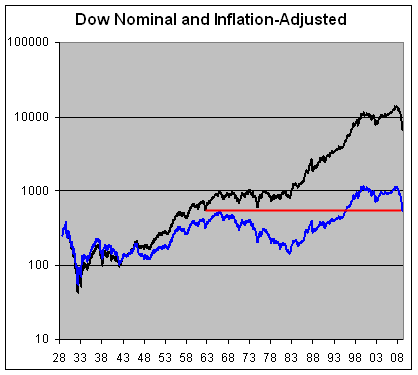
Then on Monday March 9, 2009, the S&P 500 reached its low close of 676.53, although it never dipped below the intra-day close from the previous Friday. The market hadn’t been this low in over 12 years.
To give you an idea of how nervous people were, the Volatility Index was near 50, and the TED Spread was over 1%. Yet this was a great time to buy. Or rather, I should say “because of this,” it was a great time to buy.
On Thursday, March 12, 2009, Bernie Madoff pled guilty to charges around his Ponzi scheme. In Forbes, Nouriel Roubini said the S&P 500 “could fall to 600.”
This was also the time when comedian Jon Stewart was criticizing CNBC and Jim Cramer. Stewart first mocked CNBC on March 5. That led to some public back-and-forth between him and Cramer. On the evening of March 12, Cramer came on The Daily Show for their famous matchup.
From its closing low on March 9, 2009, the S&P 500 would triple by November 6, 2014.
-
1,999.99
Posted by Eddy Elfenbein on March 7th, 2016 at 8:51 amOn Friday, the S&P 500 closed at 1,999.99. If you’re really serious, Howard Silverblatt, the top numbers guy at S&P 500, says the close was specifically 1,999.98722585876.
Every 0.01 in the index is worth about $88 million. For some context, the companies in the index earn that, on average, roughly every 40 minutes.
Are “.99” closes common? Apparently they are. I looked at the past 1,000 daily closes for the S&P 500 and the #1 decimal (only going out two places) was .99 with 21 closes. Second place went to .89 with 17 closes.
Here’s all the data:
Decimal Count 0.99 21 0.89 19 0.15 17 0.20 17 0.03 15 0.50 15 0.78 15 0.33 14 0.57 14 0.85 14 0.18 13 0.29 13 0.48 13 0.51 13 0.53 13 0.69 13 0.77 13 0.05 12 0.28 12 0.32 12 0.36 12 0.37 12 0.63 12 0.82 12 0.94 12 0.96 12 0.04 11 0.11 11 0.13 11 0.16 11 0.26 11 0.34 11 0.42 11 0.44 11 0.58 11 0.61 11 0.66 11 0.83 11 0.84 11 0.08 10 0.10 10 0.17 10 0.24 10 0.40 10 0.49 10 0.56 10 0.59 10 0.62 10 0.68 10 0.81 10 0.92 10 0.98 10 0.02 9 0.07 9 0.12 9 0.19 9 0.31 9 0.39 9 0.43 9 0.45 9 0.52 9 0.67 9 0.75 9 0.76 9 0.86 9 0.93 9 0.97 9 0.09 8 0.14 8 0.25 8 0.46 8 0.54 8 0.60 8 0.65 8 0.74 8 0.80 8 0.90 8 0.91 8 0.95 8 0.21 7 0.22 7 0.23 7 0.35 7 0.38 7 0.41 7 0.47 7 0.55 7 0.71 7 0.72 7 0.73 7 0.79 7 0.87 7 0.88 7 0.00 6 0.06 6 0.64 6 0.70 6 0.01 5 0.30 5 0.27 4 A few years ago, I looked at Benford’s Law and the Dow Jones.
Morning News: March 7, 2016
Posted by Eddy Elfenbein on March 7th, 2016 at 7:07 amJapan Central Bank to Cut Next Fiscal Year’s Growth, Price Estimates
German Factory Orders Drop as Global Slowdown Weighs on
World’s Food-Import Bill Just Shrank $9 Billion to Five-Year Low
Europe’s Antitrust Enforcer on Google, Apple and the Year Ahead
U.S. Government Preparing to Crack Down on Chinese Tech Firm
What the Average American’s Social Security Retirement Check Would Look Like if Cuts Are Made
BASF Is Weighing a Counterbid for Dupont
Wells Fargo Said to Seek Dealmaking Chief to Succeed Laughlin
EDF Finance Chief Quits Amid Split Over U.K. Reactor Project
Tech Companies, New and Old, Clamor to Entice Cloud Computing Experts
Wall Street Vets Battle BP in Fallout Over Canada Refinery
Cullen Roche: Three Things I Think I Think – Weekend Edition
Jeff Miller: What Does the Election Mean for Financial Markets?
Be sure to follow me on Twitter.
February NFP: +242,000
Posted by Eddy Elfenbein on March 4th, 2016 at 8:34 amThe February jobs report is out. The U.S. economy created 242,000 net new jobs last month. Plus, another 30,000 were added due to revisions. The private sector added 230,000 jobs in February.
The unemployment rate is 4.9%. Interestingly, average hourly earnings fell by 0.1%.
CWS Market Review – March 4, 2016
Posted by Eddy Elfenbein on March 4th, 2016 at 7:08 am“It is not the crook in modern business that we fear, but the
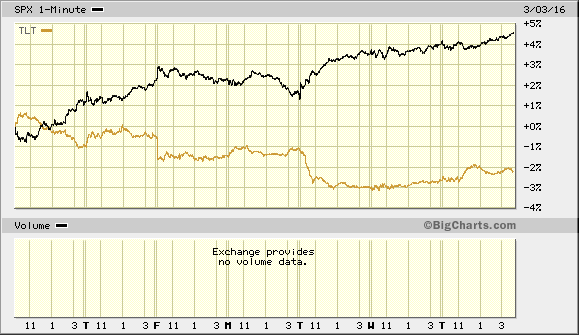
honest man who doesn’t know what he is doing.” – Owen D. YoungOver the last few months, there’s been a global rush to safety that’s dominated world markets. Stocks have dropped, bonds have risen and volatility has increased. But over the last three weeks, that trend has started to unwind, and that trend is increasing every day.
Now stocks are rallying while bonds are retreating, and for the first time this year, the Volatility Index closed below 17. Suddenly, risky assets are popular again. Since February 11, the S&P 500 has gained 9% and our Buy List is up 10.2%. Check out how the stock market has performed (black line) compared with the Long Bond ETF (gold line).
In this week’s CWS Market Review, I’ll tell you what it all means. Plus, I’ll talk about the strong earnings report from Ross Stores. They had a very good holiday quarter. The deep-discounter also gave us a nice 15% dividend increase. (I love dividend hikes!) I’ll also bring you up to speed on some of our other Buy List stocks. But first, let’s look at the market’s newly-found appetite for risk.
Investors Rediscover Risk
The year 2016 got off to a no-good, horrible, very bad start for investors. What happened is that we saw a global flight from any and every asset that smacked of risk. Investors left stocks, particularly risky sectors like High Beta, and sought safety in areas like treasury bonds and dividend stocks.
The dynamic was simple. The risker it was, the worse it did. The safer it was, the better it did. Junk bonds and emerging markets tanked, but gold, the safest investment of all, did the best. The yellow metal shone for the first time in several years.
This mini-panic was fueled by concerns of a slowdown in the U.S. economy. This was compounded by fears of a currency war in Asia and Europe. In China, the economy is weak (we have to guess since no one trusts the government’s numbers), and the authorities are trying to weaken the yuan. Except they don’t want anyone to notice. I’m not trying to sound facetious. I really don’t think the suits in the PBOC understand that their actions reverberate, very quickly, all around the world.
In Europe, Mario Draghi is trying his best to get the Eurozone back on its feet. But in the Old World, bond yields have plunged to absurd levels. In Germany, a two-year bond will fetch you -0.6%. That’s 145 basis points less than a two-year U.S. Treasury bond.
In the U.S., the Federal Reserve has said it expects the U.S. economy will improve, and it’s standing by, ready to raise interest rates. The only problem has been that the economy wasn’t cooperating. Futures traders didn’t buy the Fed’s interest rate plans at all. The market expected the Fed to largely stand apart for the next year, and possibly longer.
But since February 11, the whole game has changed. Stocks are popular and bonds are not. In particular, High-Beta stocks are doing well. Junk bonds and emerging markets are up. So many beaten-down names from last year are recovering the strongest. On our Buy List, stocks like Ford Motor (F) and Bed, Bath & Beyond (BBBY) are up more than 20% over the last few weeks.
More Encouraging News for the Economy
As I mentioned in last week’s issue, the economic data have improved. The economy still needs a lot of work, but the arrows are pointing in the right direction. Just this week, we learned that the ISM Manufacturing Index improved to 49.5. That’s not great, but it’s the best number since September. Jobless claims have now been under 300,000 for 52-straight weeks. We also got good reports on construction spending, and the car sales report was quite good. (I’ll have more on Ford Motor later on.)
I’m particularly pleased to see that inflation expectations have picked up a tad. I don’t want to see a lot of inflation, but it’s very important that we steer clear of deflation. I like to look at the difference between the five-year Treasury and the five-year inflation-protected Treasury. That tells us what the market is expecting for inflation over the next five years. Recently, it dipped below 1% for the first time since 2009. But now, it’s now ticked up to 1.34%. I want it to go higher.
Tied to that is that crude oil has rallied well since February 11. It’s still dancing step-for-step right along side the stock market. As technician Charlie Bilello points out, oil has traded below its 200-day moving average for 400 straight days. That’s by far the longest run on record. But it’s important to note that the increase in prices may not be felt across the board. For example, natural gas prices just hit a 17-year low.
You can be sure this news is getting attention at the Federal Reserve, which meets again on March 15-16. Don’t expect a rate increase. But the market thinks there’s roughly a 50-50 chance the Fed could hike rates again by its September meeting. Just a few weeks ago, that was seen as a distant possibility. The Fed will also update its projections for the coming year. I think we’ll see the central bankers reel back their aggressive plans for interest rates.
On Thursday, the S&P 500 rallied as high as 1,993.69. That’s the highest in two months. Here’s an interesting fact I learned from Ryan Detrick: Every up day since February has closed near the high. That tells me that the bulls have found some courage. Earlier I mentioned that the Volatility Index closed below 17 for the first time this year. On February 11, it peaked at over 30. Measuring over the past three weeks, this has been one of the steepest declines in expected volatility on record.
While the market’s behavior has been quite good since February 11, I’m still not convinced that we’re out of the woods. As always, we need to play it safe. Investors should continue to buy and hold quality names. As we’ve seen, you never know when the market will suddenly turn in your favor.
Right now on our Buy List, I particularly like Microsoft (MSFT). The last few earnings reports have been quite good. At its current price, MSFT yields 2.75%. I also like Wells Fargo (WFC). The stock hasn’t performed well this year, but Wells is a very well-run outfit. WFC is currently yielding just over 3%. That’s not bad. Now let’s look at the latest earnings report from Ross Stores.
Ross Stores Beats Earnings and Raises Dividend
On Tuesday, Ross Stores (ROST) reported fiscal Q4 earnings of 66 cents per share. Let’s take a step back and see this earnings report in context. In August, when Ross released its second-quarter report, they also gave us guidance for Q3 and Q4. I remembering thinking it was odd that they would give guidance for two quarters out. But more pressingly, I was struck by how pessimistic the guidance was.
Ross said they expected Q3 earnings to range between 48 and 50 cents per share, and for Q4, they expected 60 to 63 cents per share. That was well below what Wall Street (and I) had been expecting. Of course, we know that Ross has a habit of low-balling Wall Street, and then “surprising” us with better-than-expected results. It’s a game they know well.
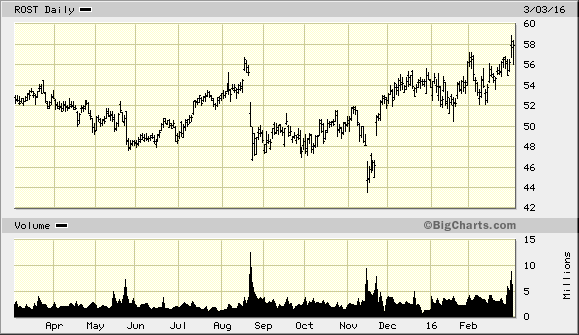
At the time, CEO Barbara Rentler said, “While we hope to do better, we are maintaining a cautious outlook for the second half, when we face more challenging sales and earnings comparisons. In addition, the macro-economic and retail landscapes remain uncertain.” The next day, shares of Ross plunged nearly 10%.
As it turned out, Ross was indeed being cautious. Very cautious. For Q3, the company earned 53 cents per share, and on Tuesday, we learned that they made 66 cents per share for Q4. I was particularly impressed with the details in the Q4 report. Previously, Ross said they expected same-store sales to grow between 0% and 1%. Instead, it was 4%. Overall sales rose by 7.2%, which also beat expectations.
For the whole year, Ross earned $2.51 per share. Net sales rose 8%, and same-store sales rose 4%. But the best news is that Ross raised its quarterly dividend by 15% to 13.5 cents per share. The previous dividend was 11.75 cents per share (it had been 23.5 cents prior to the 2-for-1 stock split).
Once again, Ross is offering conservative guidance. For Q1, they see earnings ranging between 69 and 72 cents per share. Wall Street had been expecting 76 cents per share. For the current fiscal year, Ross sees earnings between $2.59 and $2.71 per share. That’s below Wall Street’s consensus of $2.75 per share. For the quarter and full year, Ross expects same-store sales growth of 1% to 2%. I think we can expect some upside “surprises” this year.
This week, I’m lifting my Buy Below price on Ross Stores to $60 per share.
Buy List Updates
In last week’s CWS Market Review, I told you about the strong earnings report from HEICO Corp. (HEI). The company earned 49 cents per share for fiscal Q4, which was a 20% increase over the year before. All around, it was a solid report. HEICO also raised its full-year guidance. This week, I’m lifting my Buy Below on HEICO to $61 per share. These quiet stocks are fun to watch.
With the strong retail results from Ross Stores, you may have also noticed the rebound in shares of Bed Bath & Beyond (BBBY). On Thursday, the home-furnishings store broke $50 per share for the first time this year. The stock is up over 22% from its February low. BBBY will report earnings again on April 6. Bed Bath remains a good buy up to $53 per share.
Investor’s Business Daily recently featured Fiserv (FISV): “If you’ve withdrawn money from an automated teller or transferred a balance from one account to another, there’s a good chance it went smoothly in part because of Fiserv.” This is been such a solid company for so long, it’s easy to forget how special they are. You can see the whole article here.
Shares of Ford Motor (F) got a big boost this week after the automaker reported very good sales for February. Sales rose 20% from a year ago. Wall Street had been expecting a 12.6% increase. SUV sales were particularly strong. The stock is up more than 21% in the last three weeks. For now, I’m going to hold off raising the Buy Below. Ford Motor remains a solid buy up to $13 per share.
That’s all for now. The February jobs report is due to come out later today. In my mind, what’s more important than the net number of jobs created is an increase in hourly average earnings. I hope this trend continues. Next week will be a fairly quiet week for economic news. Wholesale inventories are reported on Wednesday. The latest Treasury Budget report comes out on Thursday. Be sure to keep checking the blog for daily updates. I’ll have more market analysis for you in the next issue of CWS Market Review!
– Eddy
Morning News: March 4, 2016
Posted by Eddy Elfenbein on March 4th, 2016 at 7:03 amBOJ Governor Kuroda: Not Considering Cutting Rates Further for Now
Brazil’s Economy Shrinks by Most in 25 Years
Iran Invites Boeing for Talks, a Stride Toward Business Ties With the U.S.
RBC Targets Market Share Gains in U.S. Investment Banking
Facebook to Pay Millions of Pounds More in U.K. Tax
Hacked! Business Bank Accounts Vulnerable to Cybercriminals
Snapchat Raises $175 Million From Fidelity at Flat Valuation
Adidas to Open 3,000 Stores in China by 2020
In the Bag: Samsonite Confirms Deal to Buy Tumi
Aurora Flight Sciences Wins $89 Million Contract for X-Plane
Why Barnes & Noble Isn’t Going Away Yet
Apple Is Rolling Up Supporters in Privacy Fight Against F.B.I.
The Mystery Madoff Victims Who Left $2.5 Billion on the Table
Josh Brown: On the Reaction to “Abundance”
Be sure to follow me on Twitter.
Morning News: March 3, 2016
Posted by Eddy Elfenbein on March 3rd, 2016 at 7:12 amJapan Feb Services PMI Falls to Seven-Month Low, New Business Slows
Trudeau’s Message to World: Let Government Spending Do the Work
U.S. Economy Expands With Wide Range of Wage Growth, Fed Says
Investors Are Flipping Houses Again
Cisco Buying Israel’s Leaba Semiconductor for $380 Million
Goldman Sachs Invests in Africa’s ‘First Unicorn’
This Is How Target Is Solving Its Out-of-Stock Problems
Adidas’s Fourth-Quarter Loss Narrows
LinkedIn CEO’s Equity Package to Be Distributed to Other Employees
The Shipping Industry Isn’t Doing as Well as It Looks From Space
Alaska’s Biotech Sugar Daddy Is Showering Money on Startups
Whistleblower Award for NYSE Fine Goes to HFT Critic
Energy Pioneer McClendon Dies in Oklahoma Car Crash a Day After Indictment
Cullen Roche: Scarcity Vs. Abundance
Roger Nusbaum: Hindsight Bias & Incorrect Expectations
Be sure to follow me on Twitter.
Warren Buffett: Economists Don’t Make Money Buying And Selling Stocks
Posted by Eddy Elfenbein on March 2nd, 2016 at 11:05 pmIBD on Fiserv
Posted by Eddy Elfenbein on March 2nd, 2016 at 5:39 pmInvestors Business Daily looks at Fiserv (FISV):
Financial Industry Still Craves Tech, Which Is Good For Fiserv
As banks farm out more tech services and try to keep up with customers managing more of their money via their phones, Fiserv (FISV), a company that provides back-end technology to the finance industry, seems to be expanding at a solid, measured pace.
Companies spilling over with triple-digit growth every quarter are drawing more adventurous investors, which is why many on Wall Street seem to like Fiserv’s steadiness. The company routinely generates single-digit sales gains and low-double-digit earnings growth, aided by share buybacks.
Following the Fed’s rate hike last year and forecasts for fatter industry tech budgets, more of the same could be in store despite worries over a downturn and consolidation, the company and analysts say. That’s due primarily to a steady income base.
“When you have 85% of revenue recurring, it gives them a very good visibility into their numbers,” helping enable more accurate guidance and minimizing surprises when earnings season rolls around, Monness Crespi Hardt analyst Alexander Veytsman told Investor’s Business Daily.
“They do increase pricing, but given the longevity of those contracts and given the fact that these clients have been with them for a number of years, I would say they’re growing it slowly and steadily,” Veytsman said.
The nature of the company’s contracts with clients helps Fiserv maintain its firm footing. Many deals are longer-term and retention is high, Morningstar notes in its research on the company. In addition, it’s costly and potentially hugely disruptive for financial companies to switch from one core-processing service to another, helping Fiserv keep customers in the fold.
And even amid Wall Street’s hand-wringing over a possible recession, Chief Executive Jeffrey Yabuki told IBD that he sees the trends in tech spending among Fiserv’s own clients continuing.
“Most of our revenue is based on non-discretionary, mission-critical technologies under longer term contracts and is not subject to dramatic fluctuation,” he said via email. “We are seeing stable and growing demand for newer technologies that enhance experiences in the increasingly digital world.”
13,000 Clients
Brookfield, Wis.-based Fiserv serves 13,000 banks, credit unions, retailers and other clients around the world. If you’ve withdrawn money from an automated teller or transferred a balance from one account to another, there’s a good chance it went smoothly in part because of Fiserv.
Created in 1984 through a merger, Fiserv handles everything from transaction processing to data analysis to person-to-person payment systems. With this year’s technology spending seen growing 4%-5% among banks and credit-union customers — Fiserv’s bread and butter — the company is set to follow, Argus Research says.
“We believe that Fiserv remains well positioned to benefit from technology infrastructure spending among its primary customers (banks and credit unions), many of whom are working to improve processing efficiency for online bill payment and debit card transactions,” Argus analyst Stephen Biggar said in a research note last month.
“This should help revenue to keep rising at a modest mid-single-digit pace,” Biggar said, adding that Argus sees 5.5% in sales growth this year.
Shares are up 25% over the past 12 months. The company has a Composite Rating of 93 out of a best-possible 99, boosted most recently by its strong fourth-quarter results that were marked by better-than-expected operating margins.
The company also has tried to stay relevant through acquisitions. In 2011, Fiserv snapped up mobile banking company M-Com and digital payments outfit CashEdge, which gave it Popmoney, a bank-based person-to-person payments system for participating institutions that has helped drive sales growth. The company in 2013 announced that it acquired Open Solutions, giving it real-time account-processing technology.
“You don’t need a new product every day,” Biggar said, “but you need something fairly significant every 2-3 years that would have its own sort of life cycle.”
Last month, Fiserv said the United Nations Federal Credit Union for U.N. employees, among the largest in the U.S. by assets, will begin using Fiserv’s core account-processing technology. Analysts say the Federal Reserve’s rate hike in December could help strengthen banks’ finances, potentially freeing up cash for their technology budgets.
“We view the Fed rate increase for the first time in a decade as good news for banks and a way to help fund needed increases in IT spend, as institutions look for ways to keep up with the broad changes across the technology landscape,” CEO Yabuki said on the company’s fourth-quarter earnings call last month.
Outsourcing Limits?
Some concern persists that Fiserv could make less money if consolidation continues within the banking industry, either due to tightening regulations or an event like the 2008 financial crisis. Mergers and acquisitions could reduce client count and give those bigger, combined companies more muscle in negotiating cheaper contract prices with companies like Fiserv.
However, the reduction in clients hasn’t materialized, Veytsman said, and the prospect of more banks bringing tech operations in-house seems unlikely. Fiserv counts Wells Fargo (WFC) among its big clients, potentially signaling a stronger shift to outsourcing among larger banks.
Monness Crespi’s Veytsman said consolidation could actually accelerate the trend of tech outsourcing.
“When they consolidate they also look to see what’s happening with the bottom line and what they’re doing around the costs,” he said. “And if someone was not considering using Fiserv as a client, maybe together, they will.”
Yabuki sees consolidation continuing, but stressed that the number of accounts and transactions has kept rising for the company.
Foreign exchange amid a stronger dollar could also hurt the company, although its international exposure is limited, Veytsman said. Jack Henry & Associates and FIS are among the company’s primary competitors. Concern also lingers about Fiserv’s debt, although Yabuki cites the company’s $1-billion-plus free cash flow last year.
Still, both Biggar and Veytsman say the company’s acquisitions have been relatively focused and restrained.
And one might be forgiven for wondering whether a person-to-person service like Popmoney can compete with PayPal’s (PYPL) Venmo, or payment-tech offerings from Facebook (FB), Alphabet (GOOGL) and, potentially, Apple (AAPL).
However, Yabuki said P2P was in the early innings. And Veytsman said Popmoney is intended more as a side dish in its offerings to midcap banks than a main course.
“It’s very hard to challenge PayPal,” he said.
-
Archives
- June 2026
- May 2026
- April 2026
- March 2026
- February 2026
- January 2026
- December 2025
- November 2025
- October 2025
- September 2025
- August 2025
- July 2025
- June 2025
- May 2025
- April 2025
- March 2025
- February 2025
- January 2025
- December 2024
- November 2024
- October 2024
- September 2024
- August 2024
- July 2024
- June 2024
- May 2024
- April 2024
- March 2024
- February 2024
- January 2024
- December 2023
- November 2023
- October 2023
- September 2023
- August 2023
- July 2023
- June 2023
- May 2023
- April 2023
- March 2023
- February 2023
- January 2023
- December 2022
- November 2022
- October 2022
- September 2022
- August 2022
- July 2022
- June 2022
- May 2022
- April 2022
- March 2022
- February 2022
- January 2022
- December 2021
- November 2021
- October 2021
- September 2021
- August 2021
- July 2021
- June 2021
- May 2021
- April 2021
- March 2021
- February 2021
- January 2021
- December 2020
- November 2020
- October 2020
- September 2020
- August 2020
- July 2020
- June 2020
- May 2020
- April 2020
- March 2020
- February 2020
- January 2020
- December 2019
- November 2019
- October 2019
- September 2019
- August 2019
- July 2019
- June 2019
- May 2019
- April 2019
- March 2019
- February 2019
- January 2019
- December 2018
- November 2018
- October 2018
- September 2018
- August 2018
- July 2018
- June 2018
- May 2018
- April 2018
- March 2018
- February 2018
- January 2018
- December 2017
- November 2017
- October 2017
- September 2017
- August 2017
- July 2017
- June 2017
- May 2017
- April 2017
- March 2017
- February 2017
- January 2017
- December 2016
- November 2016
- October 2016
- September 2016
- August 2016
- July 2016
- June 2016
- May 2016
- April 2016
- March 2016
- February 2016
- January 2016
- December 2015
- November 2015
- October 2015
- September 2015
- August 2015
- July 2015
- June 2015
- May 2015
- April 2015
- March 2015
- February 2015
- January 2015
- December 2014
- November 2014
- October 2014
- September 2014
- August 2014
- July 2014
- June 2014
- May 2014
- April 2014
- March 2014
- February 2014
- January 2014
- December 2013
- November 2013
- October 2013
- September 2013
- August 2013
- July 2013
- June 2013
- May 2013
- April 2013
- March 2013
- February 2013
- January 2013
- December 2012
- November 2012
- October 2012
- September 2012
- August 2012
- July 2012
- June 2012
- May 2012
- April 2012
- March 2012
- February 2012
- January 2012
- December 2011
- November 2011
- October 2011
- September 2011
- August 2011
- July 2011
- June 2011
- May 2011
- April 2011
- March 2011
- February 2011
- January 2011
- December 2010
- November 2010
- October 2010
- September 2010
- August 2010
- July 2010
- June 2010
- May 2010
- April 2010
- March 2010
- February 2010
- January 2010
- December 2009
- November 2009
- October 2009
- September 2009
- August 2009
- July 2009
- June 2009
- May 2009
- April 2009
- March 2009
- February 2009
- January 2009
- December 2008
- November 2008
- October 2008
- September 2008
- August 2008
- July 2008
- June 2008
- May 2008
- April 2008
- March 2008
- February 2008
- January 2008
- December 2007
- November 2007
- October 2007
- September 2007
- August 2007
- July 2007
- June 2007
- May 2007
- April 2007
- March 2007
- February 2007
- January 2007
- December 2006
- November 2006
- October 2006
- September 2006
- August 2006
- July 2006
- June 2006
- May 2006
- April 2006
- March 2006
- February 2006
- January 2006
- December 2005
- November 2005
- October 2005
- September 2005
- August 2005
- July 2005
 Eddy Elfenbein is a Washington, DC-based speaker, portfolio manager and editor of the blog Crossing Wall Street. His