-
The Top Market Trends of the Day
Posted by Eddy Elfenbein on March 23rd, 2016 at 4:06 pmHere’s my appearance yesterday on Bloomberg:
-
Morning News: March 23, 2016
Posted by Eddy Elfenbein on March 23rd, 2016 at 7:01 amGermany’s Bonds Fall as Nation Auctions 30-Year Securities
Puerto Rico Gets Mixed Reception at U.S. Supreme Court
After Taking a Shower, Shower Your Lawn?
Helicopter Money Takes Flight as Latest Drastic Monetary Idea
The Unsettling Acquisitiveness of Anbang, a Chinese Insurer, in the U.S.
Time To Buy Airlines Despite The Brussels Terror Attacks
Nike Profit Jumps 20% Even As Currency Headwinds Persist
Sell Herbalife Before It Ends Up Like Valeant
Coke Tweaks Its Business Model Again
Apple Policy on Bugs May Explain Why Hackers Would Help F.B.I.
Google’s Cloud Business Nabs Home Depot as Client
Convoy Sees Itself as the Uber of Local Trucking
Credit Suisse, the Jailed Banker and an Oligarch’s Missing Money
Jeff Carter: Trading Virtual Reality
Josh Brown: The Market’s Response to Crisis
Be sure to follow me on Twitter.
-
Morning News: March 22, 2016
Posted by Eddy Elfenbein on March 22nd, 2016 at 7:02 amGerman Business Confidence Rebounds on Resilient Domestic
RBS Pays $1.7 Billion to Scrap U.K. Treasury’s Dividend Rights
The Great Commodity Rebound – Central Bank Cherry On Top
OPEC Official Says Some Members May Not Attend Doha Freeze Meeting
New York Fed Had `Major Lapse’ in Robbery, Bangladesh Says
Euro-Area Deflation Risks Persist Even as Markit Sees Growth
IHS Becomes Latest Company to Give Up U.S. Citizenship for Lower Taxes
Anthem Sues Express Scripts On Drug Pricing
Amazon Begins Reselling Comcast Services on its New Site, the Amazon Cable Store
Petrobras Surprises Analysts with Record Loss as Oil Rout Bites
Deutsche Bank CFO Says Banks Have Had Tough Start To Year
Fed Approves Goldman Acquisition of GE Capital’s U.S. Online Deposits
The German Chain That’s Beating Wal-Mart at Its Own Game
Cullen Roche: Understanding Flow of Funds Accounting
Roger Nusbaum: It’s An Easy Planet
Be sure to follow me on Twitter.
-
Five Straight Up Weeks
Posted by Eddy Elfenbein on March 21st, 2016 at 10:08 amThe S&P 500 closed out its fifth-straight winning week. It’s quite early but we’re already in the black for #6.
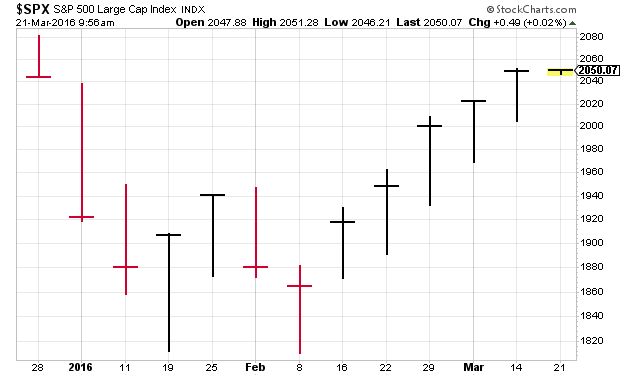
This is an unusually broad rally for the market. Within the S&P 500, 470 stocks are above their 50-DMA. The data exists on that since 2002 and it’s nearly a record. A total of 455 stocks in the index are above their 20-DMA.
Volatility has also chilled out. The VIX is back below 15. It was over 30 a little more than one month ago. The S%P 500 hasn’t had a 1% daily move for five straight days. Ryan Detrick notes that that is the longest such streak this year. We had 1% moves in 26 of the first 50 days this year.
-
Morning News: March 21, 2016
Posted by Eddy Elfenbein on March 21st, 2016 at 7:13 amToday’s Brexit FUD: CBI Says Economy Would Take £100 Billion Hit
Shanghai Composite Rallies Above 3,000 as Margin Debt Curbs Ease
Growth-Focused China Signals It Hasn’t Forgotten Leverage
Brazilians Brace for More Drama at Top Court, Congress
Crude Oil: Putin’s Star Rises As Politics Rule For The Next Month
As Coal’s Future Grows Murkier, Banks Pull Financing
Wall Street’s Pile of Unwanted Treasuries Exposes Market Cracks
Fed’s Lacker Says He is Confident Inflation Will Return to 2%
IHS and Markit to Merge, Creating Data Heavyweight
Marriott (MAR) Revises Terms of Starwood Hotels (HOT) Merger to $79.53/Share
ASX CEO Elmer Funke Kupper Quits as Tabcorp Is Investigated
Sherwin-Williams to Acquire Valspar in $9.3 Billion Paint Deal
Hollywood Divided Over Movie Streaming Service
Josh Brown: America’s Fifth Largest Brokerage Goes Fiduciary
Jeff Miller: Weighing the Week Ahead: What’s Up With Housing?
Be sure to follow me on Twitter.
-
CWS Market Review – March 18, 2016
Posted by Eddy Elfenbein on March 18th, 2016 at 7:08 am“A bull market is like sex. It feels best just before it ends.” – Barton Biggs
The Federal Reserve met this week, and finally, after months of exploring several other options, decided to agree with reality. The Fed no longer believes it will need to raise interest rates a few more times this year.
Wall Street responded, “Gee, you think so, Captain Obvious?” (I’m paraphrasing.) The stock market jumped to its highest level all year. The S&P 500 is now down a wee 0.16% for 2016, but remember how lousily the year started? This was one of the worst starts to a year in Wall Street history. By February 11, the S&P 500 was more than 11% in the hole. Five weeks later, we can see this has been a hugely impressive turnaround, and a few of our stocks, like Fiserv and Stryker, broke out to new highs this week.
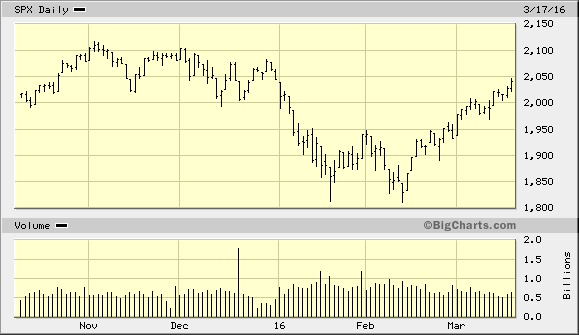
I’ll break down what this week’s Fed decision means for us (spoiler alert: it’s quite good). We also got some surprising news on the inflation front. Core prices, which exclude food and energy, are rising at their fastest pace in years. I’ll tell you what it all means. But first, let’s take a closer look at what Janet and her friends at the FOMC were up to this week.
Wall Street Loves the Fed’s Softer Tone
The Federal Reserve had another policy meeting this week, and as expected, the central bank held off on raising interest rates. Frankly, that wasn’t much of a surprise.
But what was a surprise was the Fed’s new “dovish” outlook. Until now, the Fed projected that it would need to raise interest rates four times this year. Even as trouble spread in Europe and Asia, the central bank stuck to its guns. The Federal Reserve is the only major central bank in the world whose last move was a rate hike. Everybody else is cutting. Poor Mario Draghi at the ECB has slashed below 0% and he doesn’t seem to have plans to stop.
But Wall Street never went along with the Fed’s view. At the start of the year, traders expected a few more hikes, though not much. During the first part of the year (January 1 to February 11), the economic outlook badly deteriorated. Not only was oil moving in lockstep with the market, but so were the expectations for the Fed. As stocks sunk lower, the odds for more rate hikes became ever smaller.
At the time, we heard loud calls that the Fed had screwed up by raising interest rates in December. The Fed, we were told, had to placate the market gods by taking back the rate increase. Some people started to jabber that Janet would have to follow Mario into negative-rate land. Chairwoman Yellen was even asked this at last month’s Congressional testimony.
You could really see the sea change by looking at the bond market. At the start of the year, the two-year Treasury (which is often a good proxy for Fed policy) was yielding 1.02%. By February 11, it was down to 0.64%. In the futures pits, the odds for a June rate hike fell to 2%. Futures traders didn’t think there would be any rate hikes this year, or next. It was as if interest rates had become a thing of the past. You may recall that a lot of bank stocks got squeezed.
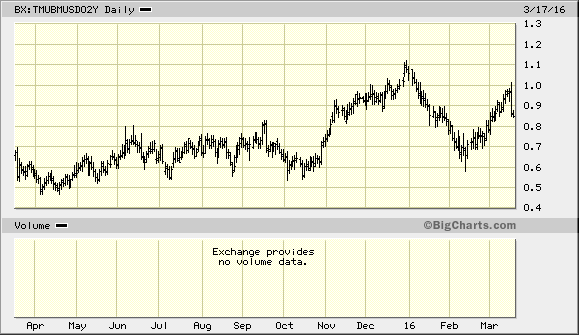
Then a funny thing happened. People suddenly realized that the economy isn’t that bad. Also, why would anyone want to get 0.64% for a two-year note if you could get three or four times that much from stock dividends? Or in the case of a Buy List stock like Microsoft, they could get four or five times that—not to mention that MSFT is a growing company.
“A Slightly More Accommodative Path”
In the last few issues of CWS Market Review, I’ve highlighted the better economic numbers. I’ve been careful to say that the economy still has a lot of room for improvement, but it’s far from dire. Wall Street finally got the message. On February 11, the S&P 500 retested the “Tchaikovsky Low” and broke it, and the bulls have been top dog ever since. On January 20, only 9% of the stocks in the S&P 500 were above their 50-day moving average. Now 90% are.
Which brings us to this week’s Fed news. At her press conference, Chairwoman Yellen said, “What you see here is a virtually unchanged path of economic projections and a slightly more accommodative path.” In other words, rates will be lower for longer.
Yellen gave two reasons for the policy shift. She noted that while the U.S. is getting back to normal, the rest of the world is still mired in slow growth. It’s especially hard for the Fed to raise rates when so many other central banks are cutting. The other reason is that the market has already done much of the Fed’s work for them. By that, I mean that lending standards have tightened.
So what we’re seeing is a twofold move. First, the Fed is abandoning its strongly hawkish cash for rate hikes, while Wall Street has abandoned its very strongly dovish outlook for a moderately dovish outlook. The two-year yield, in fact, is now back up to 0.87%, and traders think there’s a 40% chance of a June hike. What a difference one month makes!
Why does this matter for stock investors? It all comes down to math. If investors can get stiffer competition from fixed income relative to stocks, stocks will go down to compensate. Capital always goes to wherever it’s treated best.
Let me explain why the Fed’s move this week is very good for us. In addition to the policy statement, the Fed also updated its economic projections. In December, the FOMC expected that they would be raising rates four times in 2016, and another four times in 2017. The median projection thought rates would be around 2.5% by the end of 2017.
This week’s projections are far more realistic. A majority of members think rates will be under 2% by the end of next year. Given the Fed’s outlook for inflation, which hasn’t changed, that would mean that the Fed thinks real rates will still be negative 21 months from now. That’s amazing, and it’s a very strong signal for investors that stocks are still your best bet. Equities love easy money.
The Fed sent us a strong signal to stick with stocks, and the economy is still on the rise. Now let’s look at a surprising trend: the quiet emergence of inflation.
Is Inflation Coming Back?
On Wednesday morning, a few hours before the Fed’s announcement, the government released the latest CPI report. For February, consumer prices fell by 0.2%, but much of that was due to lower energy prices.
In this case, it’s important for us to look at the “core rate,” which excludes volatile food and energy prices. We’re not ignoring these costs—obviously, they are an important part of a household’s budget. But food and energy prices can be subject to transient factors like a supply disruption. What we want to know is, what’s the broader trend of consumer prices?
For February, core prices rose by 0.3%. This is the second month in a row in which core prices have run hot. Here’s some context: of the last 117 months, February had the fourth-highest core inflation, while January had the highest. Together, core inflation has annualized about 3.5% this year.
To be sure, that’s hardly a lot of inflation. People who remember the 1970s surely know what I mean. But it could be evidence that the economy has turned a corner. Companies now finally have some latitude to raise prices, but they’ll have to raise wages as well. When there are millions of Americans out of work, it’s easier to keep a lid on wage hikes. Now that the labor market is getting tighter, employers have to be more accommodating. This also may suggest that the lower labor-force-participation rate could be the new normal.The stock market has an odd relationship with inflation. Historically, inflation has been bad for stocks. In fact, the only thing that’s been worse for stocks is deflation. What the market likes best is low and steady inflation. I’ve run the numbers, and inflation is pretty benign for stocks as long as it’s below 5%. We’re still well within that boundary.
Oil prices are also rising again. Let me rephrase that—oil is exploding higher. In the last 24 trading days, crude oil is up an amazing 53%. Personally, I’d welcome a modest amount of inflation. The key is that it steers us away from potential deflation. Once people know that prices are falling, they’ll hold off buying, and that causes prices to fall further.
Inflation also tends to benefit price-conscious businesses. That’s part of the reason why Walmart (WMT) became so dominant during the 1970s. Shoppers knew they could find bargains while prices seemed to rising everywhere.
I don’t want to sound the inflation alarm bells just yet, but it’s something we have to keep an eye on. Not only can inflation change the outlook for stocks, but it can alter the outlook for different kinds of stocks.
Buy List Updates
This is an unusual time for our Buy List because we’re in the lag period between earnings reports. Bed Bath & Beyond (BBBY) reports on April 6. Then after that, the Q1 Earnings Season will kick off with Wells Fargo (WFC) reporting on April 14.
Speaking of Wells, I think we can expect another dividend increase from the big bank next month. Wells currently pays out 37.5 cents per share for its quarterly dividend. They can easily bump that up to 40 cents per share. If I’m right, that means WFC currently yields more than 3.2%. Wells Fargo is a buy up to $52 per share.
I also wanted to highlight the big bounce in shares of Wabtec (WAB). The stock plunged from over $100 last year to as low as $60 a few weeks ago. Last month, the company issued fairly good guidance for this year. Since then, it’s been on an upward swing. Since February 9, WAB has gained 30%. Quality stocks go down, but value eventually shines through.
That’s all for now. Next week is the final full week of the first quarter. On Monday, we’ll get the report on existing-home sales followed by the new-home sales report on Wednesday. The durable-goods report is on Thursday. On Friday, we’ll get the second revision to Q4 GDP. The initial report showed growth of 0.7% which was later revised to 1%. Be sure to keep checking the blog for daily updates. I’ll have more market analysis for you in the next issue of CWS Market Review!
– Eddy
-
Morning News: March 18, 2016
Posted by Eddy Elfenbein on March 18th, 2016 at 7:04 amEurozone Core Inflation Revised Up, Helping Euro to Climb
Turns Out a ‘Lie’ Lurked Beneath the Bookends of the BRICS
Attackers Fire Rockets at Gas Facility in Algerian Sahara
Mozambique’s Bondholders Eyeing Gas Riches Back Exchange Offer
Dow’s Freakish Bounce Makes Investors Whole, Can’t Erase Doubts
GAO Investigator Says Federal Reserve Review May Involve Other Regulators
As U.S. Ports Go, So Goes the U.S. Economy
Baidu to Test Autonomous Cars in the U.S.
TransCanada Locks in Growth With $10.2 Billion Pipeline Deal
SEC Says Amazon Should Allow Shareholder Vote on Gender Pay
Adobe Beats Estimates as Demand Surges for Cloud Services
Tencent’s Earnings Show the Strength of the Chinese Consumer
JPMorgan increases Stock Buyback Program by Up to $1.88 Billion
Roger Nusbaum: Your Strategy Will Sometimes Lag and That’s OK
Jeff Miller: A Bear Market Rally?
Be sure to follow me on Twitter.
-
Morning News: March 17, 2016
Posted by Eddy Elfenbein on March 17th, 2016 at 7:05 amAbe Coalition Ally Says Premier Shouldn’t Back Down on Tax Rise
Billionaire Li Ka-shing Says China Property Prices `Reasonable’
Swiss Central Bank Holds Negative Rates Steady
Norway’s Central Bank Cuts Key Rate, as Expected; Sees Further Cut
Dollar Swoons as Fed Scales Down Rate Hike Forecasts
The Other March Madness: What the IRS Thinks of Your Bracket
Oil Investors See $7.4 Billion Vanish as Dividends Are Targeted
How GE Exorcised the Ghost of Jack Welch to Become a 124-Year-Old Startup
Lufthansa Shares Fall After Airline Warns of Slower Earnings Growth
Investors Shrug as China’s State Press Slams Alibaba for Fraud
Tencent’s Profit Misses Estimates as Video Content Costs Climb
GlaxoSmithKline CEO Andrew Witty to Retire in March 2017
Toshiba Gets $5.9 Billion Deal to Sell Medical Unit to Canon
Do You Hate Tying Laces? Nike Has A Solution For You!
Coal’s ‘Last Man Standing’ Dragged to the Brink of Bankruptcy
Be sure to follow me on Twitter.
-
The Fed’s Policy Statement
Posted by Eddy Elfenbein on March 16th, 2016 at 2:00 pmThe Federal Reserve has left interest rates unchanged. Here’s the policy statement:
Information received since the Federal Open Market Committee met in January suggests that economic activity has been expanding at a moderate pace despite the global economic and financial developments of recent months. Household spending has been increasing at a moderate rate, and the housing sector has improved further; however, business fixed investment and net exports have been soft. A range of recent indicators, including strong job gains, points to additional strengthening of the labor market. Inflation picked up in recent months; however, it continued to run below the Committee’s 2 percent longer-run objective, partly reflecting declines in energy prices and in prices of non-energy imports. Market-based measures of inflation compensation remain low; survey-based measures of longer-term inflation expectations are little changed, on balance, in recent months.
Consistent with its statutory mandate, the Committee seeks to foster maximum employment and price stability. The Committee currently expects that, with gradual adjustments in the stance of monetary policy, economic activity will expand at a moderate pace and labor market indicators will continue to strengthen. However, global economic and financial developments continue to pose risks. Inflation is expected to remain low in the near term, in part because of earlier declines in energy prices, but to rise to 2 percent over the medium term as the transitory effects of declines in energy and import prices dissipate and the labor market strengthens further. The Committee continues to monitor inflation developments closely.
Against this backdrop, the Committee decided to maintain the target range for the federal funds rate at 1/4 to 1/2 percent. The stance of monetary policy remains accommodative, thereby supporting further improvement in labor market conditions and a return to 2 percent inflation.
In determining the timing and size of future adjustments to the target range for the federal funds rate, the Committee will assess realized and expected economic conditions relative to its objectives of maximum employment and 2 percent inflation. This assessment will take into account a wide range of information, including measures of labor market conditions, indicators of inflation pressures and inflation expectations, and readings on financial and international developments. In light of the current shortfall of inflation from 2 percent, the Committee will carefully monitor actual and expected progress toward its inflation goal. The Committee expects that economic conditions will evolve in a manner that will warrant only gradual increases in the federal funds rate; the federal funds rate is likely to remain, for some time, below levels that are expected to prevail in the longer run. However, the actual path of the federal funds rate will depend on the economic outlook as informed by incoming data.
The Committee is maintaining its existing policy of reinvesting principal payments from its holdings of agency debt and agency mortgage-backed securities in agency mortgage-backed securities and of rolling over maturing Treasury securities at auction, and it anticipates doing so until normalization of the level of the federal funds rate is well under way. This policy, by keeping the Committee’s holdings of longer-term securities at sizable levels, should help maintain accommodative financial conditions.
Voting for the FOMC monetary policy action were: Janet L. Yellen, Chair; William C. Dudley, Vice Chairman; Lael Brainard; James Bullard; Stanley Fischer; Loretta J. Mester; Jerome H. Powell; Eric Rosengren; and Daniel K. Tarullo. Voting against the action was Esther L. George, who preferred at this meeting to raise the target range for the federal funds rate to 1/2 to 3/4 percent.
Here are the updated projections.
-
The Fed Has Been Cutting Real Rates
Posted by Eddy Elfenbein on March 16th, 2016 at 11:06 amThat’s a provocative title, but I’ll stand by it. If we look at the real Fed funds rate — the overnight rate adjusted for core inflation — then the Federal Reserve has been slightly lowering interest rates not increasing them.
The Fed’s one modest hike has been completely swallowed up by the recent rise in core inflation.
-
Archives
- August 2026
- July 2026
- June 2026
- May 2026
- April 2026
- March 2026
- February 2026
- January 2026
- December 2025
- November 2025
- October 2025
- September 2025
- August 2025
- July 2025
- June 2025
- May 2025
- April 2025
- March 2025
- February 2025
- January 2025
- December 2024
- November 2024
- October 2024
- September 2024
- August 2024
- July 2024
- June 2024
- May 2024
- April 2024
- March 2024
- February 2024
- January 2024
- December 2023
- November 2023
- October 2023
- September 2023
- August 2023
- July 2023
- June 2023
- May 2023
- April 2023
- March 2023
- February 2023
- January 2023
- December 2022
- November 2022
- October 2022
- September 2022
- August 2022
- July 2022
- June 2022
- May 2022
- April 2022
- March 2022
- February 2022
- January 2022
- December 2021
- November 2021
- October 2021
- September 2021
- August 2021
- July 2021
- June 2021
- May 2021
- April 2021
- March 2021
- February 2021
- January 2021
- December 2020
- November 2020
- October 2020
- September 2020
- August 2020
- July 2020
- June 2020
- May 2020
- April 2020
- March 2020
- February 2020
- January 2020
- December 2019
- November 2019
- October 2019
- September 2019
- August 2019
- July 2019
- June 2019
- May 2019
- April 2019
- March 2019
- February 2019
- January 2019
- December 2018
- November 2018
- October 2018
- September 2018
- August 2018
- July 2018
- June 2018
- May 2018
- April 2018
- March 2018
- February 2018
- January 2018
- December 2017
- November 2017
- October 2017
- September 2017
- August 2017
- July 2017
- June 2017
- May 2017
- April 2017
- March 2017
- February 2017
- January 2017
- December 2016
- November 2016
- October 2016
- September 2016
- August 2016
- July 2016
- June 2016
- May 2016
- April 2016
- March 2016
- February 2016
- January 2016
- December 2015
- November 2015
- October 2015
- September 2015
- August 2015
- July 2015
- June 2015
- May 2015
- April 2015
- March 2015
- February 2015
- January 2015
- December 2014
- November 2014
- October 2014
- September 2014
- August 2014
- July 2014
- June 2014
- May 2014
- April 2014
- March 2014
- February 2014
- January 2014
- December 2013
- November 2013
- October 2013
- September 2013
- August 2013
- July 2013
- June 2013
- May 2013
- April 2013
- March 2013
- February 2013
- January 2013
- December 2012
- November 2012
- October 2012
- September 2012
- August 2012
- July 2012
- June 2012
- May 2012
- April 2012
- March 2012
- February 2012
- January 2012
- December 2011
- November 2011
- October 2011
- September 2011
- August 2011
- July 2011
- June 2011
- May 2011
- April 2011
- March 2011
- February 2011
- January 2011
- December 2010
- November 2010
- October 2010
- September 2010
- August 2010
- July 2010
- June 2010
- May 2010
- April 2010
- March 2010
- February 2010
- January 2010
- December 2009
- November 2009
- October 2009
- September 2009
- August 2009
- July 2009
- June 2009
- May 2009
- April 2009
- March 2009
- February 2009
- January 2009
- December 2008
- November 2008
- October 2008
- September 2008
- August 2008
- July 2008
- June 2008
- May 2008
- April 2008
- March 2008
- February 2008
- January 2008
- December 2007
- November 2007
- October 2007
- September 2007
- August 2007
- July 2007
- June 2007
- May 2007
- April 2007
- March 2007
- February 2007
- January 2007
- December 2006
- November 2006
- October 2006
- September 2006
- August 2006
- July 2006
- June 2006
- May 2006
- April 2006
- March 2006
- February 2006
- January 2006
- December 2005
- November 2005
- October 2005
- September 2005
- August 2005
- July 2005
 Eddy Elfenbein is a Washington, DC-based speaker, portfolio manager and editor of the blog Crossing Wall Street. His