-
Morning News: January 18, 2016
Posted by Eddy Elfenbein on January 18th, 2016 at 7:00 amOil Slides to Lowest Since 2003 After Iran Sanctions Lifted
Equities Slump Worsens in Asia
China’s Securities Czar Casts Wide Blame for Market Turmoil
China to Start Implementing RRR for Offshore Banks’ Domestic Deposits
Biggest Banks Rue Millions Lost on Trader Who Failed Before
European Antitrust Chief Takes Swipe at Privacy Issue
A World Divided: Elites Descend on Swiss Alps Amid Rising Inequality
Soon You Can Hail an Uber Airbus Helicopter at Sundance
Renault Faces Criticism Over Disclosure of Emissions Raids
Airing Of Bad Blood In Bitcoin Pushes Currency Down 15%
Qualcomm Seeks Joint-Venture Shortcut to Server Sales in China
Daimler Trucks to Return to Iran With Production, Sales Accords
Disruption by Netflix Irks TV Foes
Howard Lindzon: The WTF and LOL Economy…The World’s First Digital Recession
Jeff Miller: Can Earnings Season Provide a Floor For Stocks?
Be sure to follow me on Twitter.
-
Inflation Is Your Friend
Posted by Eddy Elfenbein on January 17th, 2016 at 6:33 pm -
The S&P 500 Drops Below 1,880
Posted by Eddy Elfenbein on January 15th, 2016 at 11:47 amThe market is moving too quickly today to provide any meaningful updates, but the S&P 500 has fallen as low as 1,872.78 this morning. The Dow has lost as many as 430 points.
Here’s a minute-by-minute look at the S&P 500 for this year:
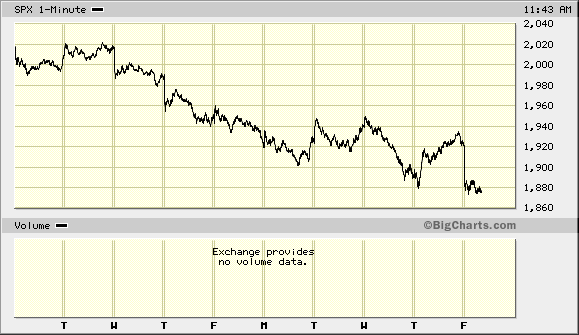
At one point, the VIX was higher than a barrel of oil. Many big banks are getting hit hard today. As usual, high beta stocks are taking the heat. The High Beta ETF (SPHB) reached another new low.
At one point I counted 99 stocks in the S&P 500 that were at new 52-week lows today. None was at a new high.
All the cyclical sectors — energy, materials and industrials — are down, and many are at multi-year lows.
-
Wells Fargo Earns $1.03 per Share
Posted by Eddy Elfenbein on January 15th, 2016 at 8:43 amFrom the WSJ:
Wells Fargo & Co. said its fourth-quarter profit was flat compared with the year-ago period, as the nation’s fourth-largest bank by assets continued to wrestle with a slump in oil prices.
The San Francisco-based bank reported a profit of $5.71 billion, or $1.03 a share. That compares with $5.71 billion, or $1.02 a share, in the same period of 2014. Analysts polled by Thomson Reuters had expected earnings of $1.02 a share.
Revenue rose to $21.6 billion from $21.4 billion. Analysts had expected $21.8 billion.
(…)
Wells Fargo’s mortgage business, the largest in the United States by volume, earned $1.66 billion in fees in the fourth quarter, up 10% from the $1.52 billion it earned in same period a year ago. The bank extended $47 billion in home loans between the end of September and the end of December, compared with $44 billion in the fourth quarter of 2014 and $55 billion in the third quarter of 2015.
Costs decreased 2% to $12.4 billion from $12.65 billion. Expenses as a share of revenue in the fourth quarter was 57.4%, within the 55%-59% range that Wells Fargo targets for its so-called “efficiency ratio.”
Loan growth remained a bright spot for Wells Fargo. Total loans at the end of the fourth quarter were $916.56 billion, a 6% increase from $862.55 billion in the same period a year ago. Commercial and industrial loans, which make up one of the largest parts of the bank’s total portfolio, were $299.89 billion, up 10% from $271.8 billion in the fourth quarter of 2014.
Despite the loan growth, Wells Fargo reported that the profitability of its lending activities continued to be challenged. Its net interest margin, a measure of how profitably it can lend out its customers’ deposits, fell to 2.92% from 2.96% at the end of September and 3.04% in the fourth quarter a year ago.
-
CWS Market Review – January 15, 2016
Posted by Eddy Elfenbein on January 15th, 2016 at 7:08 am“Planet Earth is blue and there’s nothing I can do….”
This is easily the worst start to a year in stock market history, and on Thursday, it somehow managed to get even worse. The S&P 500 broke below 1,880 before a dramatic reversal pushed the index to 1,921.84 by the closing bell.
Unfortunately, we’re still in the midst of the storm. The good news, however, is that we’re still in the midst of the storm—meaning the mass selling has led to a lot of good values out there (Biogen at $280!). I’ll give you some examples later on.
In this week’s CWS Market Review, I’ll go into more detail on Wall Street’s latest bout of the willies. Investors need to understand that there’s been a giant divide between “high beta” and “low vol” stocks. I’ll explain what it all means.
I’ll also cover some good news from our Buy List. Ford Motor (F) just announced a special 25-cent dividend. Cognizant’s (CTSH) stock popped this week after the company reiterated its earnings forecast. Also, Stryker (SYK) raised its full-year earnings forecast for the third time. But first, let’s look at the growing divide on Wall Street.
The High Beta Bear
There’s a reason I avoid making short-term forecasts: I never could have anticipated such a poor start to 2016. In last week’s CWS Market Review, I explained how nervousness stemming from China’s money problems had spooked investors. I noted that despite China’s size, it truly doesn’t have a major impact on our economy.
That didn’t stop the bears. They took full advantage of the scary headlines to cause a mad rush for the exits. Since December 29, the S&P 500 is down 7.5%. Traditionally, a market “correction” is defined as being a drop of 10%. Measuring the S&P 500’s May high, the correction line is at 1,921.25. We dipped below that in August and we did it again this week. Interestingly, Thursday’s close was just barely above the 10% correction line. (There’s always somebody playing these relationships.)
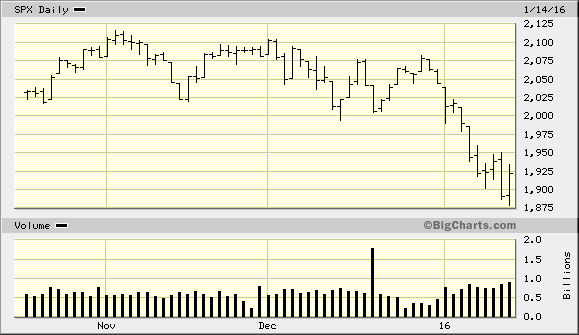
But what’s interesting about the current market is how divided it is. Energy and Materials stocks are still doing very poorly. The average stock in the S&P 500 is 24% below its 52-week high. That’s bad, but for the energy sector, the same number is 56%.
The Energy ETF (XLE) is nearly half of what it was 18 months ago, and it’s no surprise why. It’s not that oil has plunged; it’s that it can’t seem to stop plunging. This week, West Texas Intermediate fell below $30 per barrel for the first time in 12 years. In the last 15 months, oil is down 70%. Crude finally closed higher on Thursday, which snapped an eight-day losing streak. So much of the world economy is based on oil revenues of X. We now know that in reality, those revenues will be 0.3X. Let’s just say that the realization won’t be smooth.
This impacts the equity markets in several ways. I like to watch small-cap indexes because they tend to be skewed towards domestic manufacturers. Wow, these little guys have been taking a beating. Since the Russell 2000 peaked on June 22, it’s lost 22%. That’s double the loss of the S&P 500.
We can drill down another level by looking at the huge and growing divide between high beta and low vol stocks. But first, a small digression.
(Enter Professor Elfenbein.)
A beta measures a stock’s risk relative to the entire market. So if a stock has a beta of 1.2, it will rally 1.2% for every 1% the market rallies. Conversely, it will fall 1.2% for every 1% the market falls.
The theory is that high beta stocks are riskier and will outperform the market. In a sense, an investor needs to “buy” better returns by shouldering more risk. It’s a beautiful theory, and it won the Nobel Prize.
But there’s a small problem—it doesn’t work. There’s no correlation between a stock’s beta and its return. Actually, that’s not quite right. There is a correlation, and it’s negative. Over the long haul, stocks with low betas, so-called low vol stocks, have done the best.
That’s why I like to watch the relationship between the S&P 500 High Beta ETF (SPHB) and the S&P 500 Low Vol ETF (SPLV). The divergence lately has been astounding. The high-beta names have been getting clobbered, while the low-vol stocks haven’t been hit that hard. In the chart below, notice how dramatically the black line (SPHB) has fallen in the last few weeks. SPHB is currently 29% below its 52-week high, while the low vol is only 6% off its high.
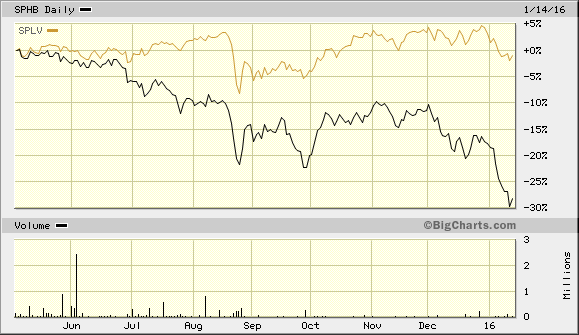
Even stalwart names like Apple (AAPL) and Walmart (WMT) are down more than 25%. But some consumer stocks like Coke (KO), McDonald’s (MCD) and Kellogg (K) are still less than 5% off their high. Just looking at the overall market doesn’t tell us the whole story.
We can see this effect on our Buy List as stocks like Hormel Foods (HRL) have largely sidestepped the bear. But even conservative industrials like Wabtec (WAB) have been taken down. It’s really about where you stand in the economy and how exposed you are to plunging commodity prices.
Here’s my view: I don’t think this divergence can last, and I expect to see high beta areas like biotech regain some love. On our Buy List, I particularly like Biogen (BIIB), Ford (F) and Snap-on (SNA). I know Ford has been a painful ride, but all value stocks start out as unloved losers. Speaking of Ford, let’s look at this week’s news from the automaker, and a few other of our Buy List stocks.
Buy List Updates
Thanks to the market’s recent headache, many of our Buy Below prices are out of date. But with earnings season so close, I want to hold off on adjusting our prices until I have a chance to see how well our companies did last quarter. I think it’s very likely that many of the beaten-down names will bounce back quickly.
On Tuesday, Ford Motor (F) announced that it’s paying out a special 25-cent dividend to shareholders. This is in addition to the company’s regular 15-cent quarterly dividend. This means that going by Thursday’s closing price, Ford yields nearly 7% for the coming 12 months. That’s a very nice deal. The special dividend will be paid on March 1 to shareholders of record on January 29.
More than a few Wall Streeters dismissed the special dividend. They think it’s an admission from Ford that the auto cycle is about to turn lower. The belief is that Ford opted to pay out a special dividend in lieu of raising its current dividend, as GM recently did. Call me a doubter on that one. Ford easily could have bypassed a dividend altogether.
Wall Street was also unnerved by Ford’s guidance for 2016. Personally, I don’t think the guidance was so bad. Ford said they expect 2016’s profits to be equal to or better than 2015’s. For 2015, they see pre-tax profits coming in in the upper half of their range of $10 billion to $11 billion.
“As we close out 2015, we are benefiting from six consecutive years of consistently strong results, and our performance is allowing us to reward our shareholders,” said Mark Fields, Ford president and CEO. “This pattern of strong returns gives us a great platform to build on as we enter the year with a focus on strengthening our core business and engaging aggressively in emerging opportunities through Ford Smart Mobility.”
I understand the apprehension, but Ford has done a commendable job. The company is also much healthier in fiscal terms. In fact, they could initiate a big share buyback if they wanted to. I still think the long game is on Ford’s side. Look for a good earnings report on January 28.
Cognizant Technology Solutions (CTSH) is our top-performing stock this year! But don’t get too excited. CTSH is sitting on a measly 0.31% YTD gain, and it’s our only Buy List stock in the black, which shows you how unpleasant the past two weeks have been.
But Cognizant had very good news this week. The company reported that it hasn’t been materially affected by the horrible flooding in Chennai, India. The best news is that Cognizant reports that all of its employees are safe.
Cognizant also stuck by its 2015 full-year earnings forecast for earnings of at least $3.03 per share. It also reiterated its guidance for revenue of at least $12.41 billion. The stock jumped more than 6% on Tuesday, and it pushed even higher on Thursday. The shares broke above $60 for the first time this year. The company usually reports Q4 earnings during the first week of February. I expect more good news.
I wanted to follow up on Bed Bath & Beyond (BBBY). Last week, we learned that the home-furnishings company earned $1.09 per share last quarter. That was basically what we expected. The stock, however, continues to sink lower. On Thursday, in fact, BBBY dipped below $44 per share.
Let’s take a step back and remember that BBBY expects earnings of $4.91 to $5.05 per share for this year (ending in February). It’s early, but I think they should be able to earn $5 per share next year. One of the best valuation metrics is Enterprise Value/EBITDA. (I did a post on the subject). For BBBY, the ratio is down to 4.89, which is very inexpensive. Don’t give up on BBBY.
We also had good news from Stryker (SYK). After the closing bell on Tuesday, the company narrowed its full-year range for 2015. The previous range was $5.07 to $5.12 per share. Now it’s $5.09 to $5.12 per share. By my count (and I could be missing one or two), this is the third time Stryker has revised its full-year guidance.
In January, the initial guidance was $4.90 to $5.10 per share. Then in April it went to $4.95 to $5.10 per share. In July, Stryker brought it up to between $5.06 and $5.12 per share. In October, they raised the low end by one penny per share, and now in January, they’ve raised it by another two pennies. Stryker’s earnings will be out on January 26.
The bad news for our Buy List came from Express Scripts (ESRX), or more specifically, it came from Anthem (ANTM). This week, Anthem threatened to ditch Express Scripts unless it can pass along major cost savings. Anthem’s CEO used the figure of $3 billion. C’mon! This is absurd, and everyone knows it.
I think Anthem is simply using this as a negotiating tactic. But it was enough to rattle investors. Shares of ESRX fell nearly 7% on Wednesday. Ironically, Anthem is making a big fuss over this because they want to do a deal with Express. One analyst estimates that Anthem accounts for 14% of Express’s $100 billion annual revenue. This Anthem news shouldn’t be a major concern for us, but I hope it gets resolved soon.
We have one Buy List earnings report coming next week. Signature Bank (SBNY) is due to report on Wednesday, January 20. Wall Street expects $1.93 per share. Guess what? They’ll beat that. SBNY is particularly attractive below $140 per share.
That’s all for now. The stock market will be closed on Monday in honor of Dr. Martin Luther King’s birthday. Get ready for more earnings reports next week. On Wednesday, we’ll also get the CPI report. We already know commodity prices have been falling, but I’ll be curious to see if there’s been any sizable increase in the “core” inflation, which excludes food and energy. I doubt it, but an increase could lead the Fed to be more aggressive this year. Be sure to keep checking the blog for daily updates. I’ll have more market analysis for you in the next issue of CWS Market Review!
– Eddy
-
Morning News: January 15, 2016
Posted by Eddy Elfenbein on January 15th, 2016 at 7:03 amEmerging Markets Drop as China Enters Bear Market, Ruble Slides
How Sustainable Is The Nikkei Rebound? Japan ETFs in Focus
Oil Falls Back Below $30 With Brent Discount Biggest Since 2010
The Biggest Foreign Shale Driller in the US Just Took a $7 Billion Hit
China’s Haier Nears Deal to Buy GE Appliance Business
Amazon Expands Logistics Reach With Move Into Ocean Shipping
Foursquare CEO Crowley Steps Down as App Seeks to Boost Growth
Xiaomi Faces Challenging Year Ahead As Growth Slows
As The PC Industry Plummets, Intel Manages To Beat Estimates In Fourth Quarter Earnings
Southern Comfort to Be Sold by Brown-Forman to Sazerac
Goldman Says It Will Pay $5.1 Billion in U.S. Mortgage Probe
Apple May Be on Hook for $8 Billion in Taxes After Europe Probe
Checking In at a Hotel? Hackers May Be, Too
Jeff Carter: Has The Bubble Popped?
Roger Nusbaum: The Most Useless Barron’s Quote Ever
Be sure to follow me on Twitter.
-
Blogger Appears on Television
Posted by Eddy Elfenbein on January 14th, 2016 at 3:52 pm -
Morning News: January 14, 2016
Posted by Eddy Elfenbein on January 14th, 2016 at 7:09 amGerman Economy Defied 2015 Global Slowdown as Growth Accelerated
A Towering Chinese Debt Mountain Looms Behind Market Gyrations
Lawyer for Iran’s Central Bank Faces Skepticism at Supreme Court
Fed’s Beige Book Finds Modest Growth in Most Districts
Solar and Wind Just Did the Unthinkable
G.E. Is Moving Headquarters to Boston and Itself Into the Digital Era
Why Apple Should Buy Time Warner
Luxury Home Market Seen Threatened by Transparency in NYC, Miami
GoPro To Cut 7% Of Workforce After Poor Holiday Sales
VW’s Chief Meets Head of E.P.A. to Discuss Pollution Problem
Al Jazeera America to Shut Down By April
JPMorgan Quarterly Profit Rises 10%
Chipotle ‘Confident’ It Can Stop Outbreaks, Shares Rise
Joashua Brown: Are Commodities a Necessary Portfolio Component?
Jeff Miller: Finding the Real Expert
Be sure to follow me on Twitter.
-
Express Scripts on Anthem Threat
Posted by Eddy Elfenbein on January 13th, 2016 at 11:45 amShares of Express Scripts (ESRX) are down today after Anthem (ANTM) threatened to ditch Express unless they can pass along savings of $3 billion a year.
Taking a contract dispute between the two companies public, Anthem Chief Executive Officer Joseph Swedish said Tuesday that Express Scripts should be passing along more of the savings it negotiates from drugmakers. If it doesn’t, the health insurer may look for another pharmacy partner. Express Scripts disputed Swedish’s description of the terms between the two companies, and the $3 billion figure.
“We are entitled to improved pharmaceutical pricing that equates to an annual value capture of more than $3 billion,” Swedish told investors Tuesday at the J.P. Morgan Health Care Conference. “To be clear, this is the amount by which we would be overpaying for pharmaceuticals on an annual basis.” Much of those savings would be passed on to clients, he said.
Anthem and Express Scripts have an unusual arrangement that stems from Anthem’s sale of its pharmacy-benefits business to Express Scripts in 2009. The insurer is entitled to periodic reviews of how much it pays for drugs, a process the companies last went through in 2012. They haven’t yet reached a deal on the most recent talks.
Express has countered:
“Express Scripts has consistently acted in good faith and is in full compliance with the terms of its agreement,” said Brian Henry, a spokesman for the company. “While the contract calls for good faith negotiations regarding a pricing review, it does not mandate specific price adjustments. Furthermore, Anthem is not entitled to $3 billion.”
My take: The $3 billion number is nuts. It’s a negotiating tactic. They’ll reach a deal because they need to reach a deal. Ironically, if ANTM wasn’t interested, they wouldn’t be so vocal right now.
-
JM Keynes: Currency Trader
Posted by Eddy Elfenbein on January 13th, 2016 at 8:40 amFrom Neil Irwin at the NYT:
But winning big in currencies is harder than it looks — even if you happen to be one of history’s greatest economic thinkers.
That’s the conclusion two scholars reached after scouring the records of John Maynard Keynes, the British economist who, when he wasn’t advancing economic thought in the 1920s and 1930s, spent a great deal of time investing in stocks and currencies. At the peak in 1936, Keynes had more than 250,000 pounds invested, the equivalent of $23 million today.
But even while writing a treatise that would be one of the foundational texts of 20th-century economics (“The General Theory of Employment, Interest and Money,” published in 1936) and hobnobbing at the highest levels of global finance, his returns were pretty, well, mediocre. He had an average annual return of 8.9 percent from 1920 to 1927, and a mere 2.5 percent from 1932 to 1939, according to research by Olivier Accominotti of the London School of Economics and David Chambers of the Cambridge Judge Business School newly published in The Journal of Economic History.
(…)
Keynes bet that the United States dollar would appreciate — just before Franklin Delano Roosevelt abandoned the gold standard in 1933, a move that caused the dollar to lose value. Keynes did correctly predict that France and the Netherlands would eventually abandon the gold standard in the 1930s, leading to declines in the franc and guilder. But he was early, and so incurred years of losses on the trade before his economic foresight paid off.
“In many cases he called currencies right in terms of direction,” Mr. Chambers said. “But his great frustration was how to time a trading position. That was the thing he found most difficult.”
This is a good point about investing: even if you’re right on the big picture, you still need to get the timing right. In The Big Short, the guys were right but they had to wait and wait and suffer big losses until they hit their payday.
From the final day of trading in 1986 until April 12, 1988, the Dow gained 11.3%. True, it wasn’t in a straight line.
-
Archives
- June 2026
- May 2026
- April 2026
- March 2026
- February 2026
- January 2026
- December 2025
- November 2025
- October 2025
- September 2025
- August 2025
- July 2025
- June 2025
- May 2025
- April 2025
- March 2025
- February 2025
- January 2025
- December 2024
- November 2024
- October 2024
- September 2024
- August 2024
- July 2024
- June 2024
- May 2024
- April 2024
- March 2024
- February 2024
- January 2024
- December 2023
- November 2023
- October 2023
- September 2023
- August 2023
- July 2023
- June 2023
- May 2023
- April 2023
- March 2023
- February 2023
- January 2023
- December 2022
- November 2022
- October 2022
- September 2022
- August 2022
- July 2022
- June 2022
- May 2022
- April 2022
- March 2022
- February 2022
- January 2022
- December 2021
- November 2021
- October 2021
- September 2021
- August 2021
- July 2021
- June 2021
- May 2021
- April 2021
- March 2021
- February 2021
- January 2021
- December 2020
- November 2020
- October 2020
- September 2020
- August 2020
- July 2020
- June 2020
- May 2020
- April 2020
- March 2020
- February 2020
- January 2020
- December 2019
- November 2019
- October 2019
- September 2019
- August 2019
- July 2019
- June 2019
- May 2019
- April 2019
- March 2019
- February 2019
- January 2019
- December 2018
- November 2018
- October 2018
- September 2018
- August 2018
- July 2018
- June 2018
- May 2018
- April 2018
- March 2018
- February 2018
- January 2018
- December 2017
- November 2017
- October 2017
- September 2017
- August 2017
- July 2017
- June 2017
- May 2017
- April 2017
- March 2017
- February 2017
- January 2017
- December 2016
- November 2016
- October 2016
- September 2016
- August 2016
- July 2016
- June 2016
- May 2016
- April 2016
- March 2016
- February 2016
- January 2016
- December 2015
- November 2015
- October 2015
- September 2015
- August 2015
- July 2015
- June 2015
- May 2015
- April 2015
- March 2015
- February 2015
- January 2015
- December 2014
- November 2014
- October 2014
- September 2014
- August 2014
- July 2014
- June 2014
- May 2014
- April 2014
- March 2014
- February 2014
- January 2014
- December 2013
- November 2013
- October 2013
- September 2013
- August 2013
- July 2013
- June 2013
- May 2013
- April 2013
- March 2013
- February 2013
- January 2013
- December 2012
- November 2012
- October 2012
- September 2012
- August 2012
- July 2012
- June 2012
- May 2012
- April 2012
- March 2012
- February 2012
- January 2012
- December 2011
- November 2011
- October 2011
- September 2011
- August 2011
- July 2011
- June 2011
- May 2011
- April 2011
- March 2011
- February 2011
- January 2011
- December 2010
- November 2010
- October 2010
- September 2010
- August 2010
- July 2010
- June 2010
- May 2010
- April 2010
- March 2010
- February 2010
- January 2010
- December 2009
- November 2009
- October 2009
- September 2009
- August 2009
- July 2009
- June 2009
- May 2009
- April 2009
- March 2009
- February 2009
- January 2009
- December 2008
- November 2008
- October 2008
- September 2008
- August 2008
- July 2008
- June 2008
- May 2008
- April 2008
- March 2008
- February 2008
- January 2008
- December 2007
- November 2007
- October 2007
- September 2007
- August 2007
- July 2007
- June 2007
- May 2007
- April 2007
- March 2007
- February 2007
- January 2007
- December 2006
- November 2006
- October 2006
- September 2006
- August 2006
- July 2006
- June 2006
- May 2006
- April 2006
- March 2006
- February 2006
- January 2006
- December 2005
- November 2005
- October 2005
- September 2005
- August 2005
- July 2005
 Eddy Elfenbein is a Washington, DC-based speaker, portfolio manager and editor of the blog Crossing Wall Street. His