-
Morning News: December 18, 2015
Posted by Eddy Elfenbein on December 18th, 2015 at 7:02 amJapan Earmarks Billions to Help Prod Its Companies
Ukraine Defaults on $3 Billion Bond to Russia
Nigerian Farmers Cleared to Sue Shell in Dutch Court
I.M.F. Chief Faces Trial in Case Dating to Time as French Finance Minister
Hedge-Fund Casualties Jump to 257 in Third Quarter Amid Rout
Glaxo to Pay Bristol-Myers Up to $1.46 Billion for HIV Drugs
China’s Qihoo 360 Strikes New Buyout Deal
Apple to Launch Apple Pay in China, Take on Alibaba, Tencent
Zurich Buys Wells Fargo Crop Insurer for Up to $1.05 Billion
Dell’s Cybersecurity Unit SecureWorks Files to Go Public
P&G’s Gillette Sues Dollar Shave Club
LifeLock to Pay $113 Million to Settle FTC Charges
Drug C.E.O. Martin Shkreli Arrested on Fraud Charges
Cullen Roche: Yellen Fears the Boom, Part Deux
Be sure to follow me on Twitter.
-
Morning News: December 17, 2015
Posted by Eddy Elfenbein on December 17th, 2015 at 7:05 amIndia Stocks Rise Most in Month as Fed Rate Increase Eases Worry
Day 1 After Fed Liftoff Shows Move Catapults Money Market Rates
Congressional Leaders Agree to Lift 40-Year Ban on Oil Exports
How Democrats and Republicans Differ on Social Security
General Mills Profit Rises, Helped by Cost Cuts
Rite Aid Revenue, Same-Store Sales Rise
AstraZeneca Buys Most of Acerta for $4 Billion to Add Cancer Drug
Oracle Shift to Cloud Products Hasn’t Yet Spurred Growth
Valeant Makes Distribution Deal With Walgreens
Air France-KLM and BA Biggest Winners as EU Fines Thrown Out
The $500 Million Battle Over Disney’s Princesses
Shkreli, CEO Reviled for Drug Price Gouging, Arrested on Securities Fraud Charges
Finma Bans Six Former UBS Employees Over FX Rigging
Cullen Roche: Rate Hikes and Roulette Wheels
Jeff Carter: You Are In It For The Equity (And To Build Value)
Be sure to follow me on Twitter.
-
Oil and Stocks Part Ways
Posted by Eddy Elfenbein on December 16th, 2015 at 10:46 pmSince late-October, stocks and oil have been somewhat correlated. But today, on the day of the Fed meeting, there was a big divergence. Stocks did well while oil did not.
Here’s the chart:
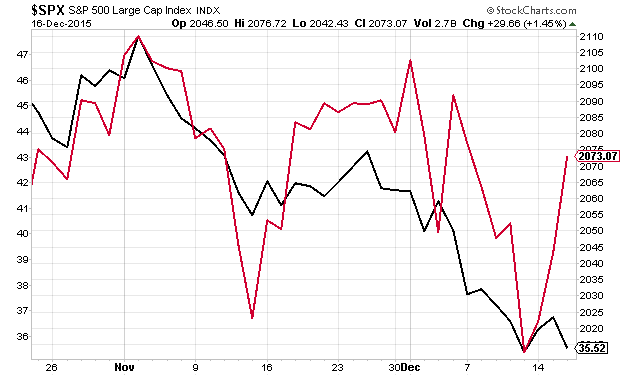
What does it mean? That’s hard to say. Odd relationships can last for a few weeks before breaking up. I suspect that as oil starts to fall, it’s good for stocks. But if it falls too far too fast, then maybe it can harm the economy.
-
Yellen on Natural Rates
Posted by Eddy Elfenbein on December 16th, 2015 at 5:33 pmThis is from Janet Yellen’s press conference:
This expectation is consistent with the view that the neutral nominal federal funds rate–defined as the value of the federal funds rate that would be neither expansionary nor contractionary if the economy were operating near potential–is currently low by historical standards and is likely to rise only gradually over time. One indication that the neutral funds rate is unusually low is that U.S. economic growth has been only moderate in recent years despite the very low level of the federal funds rate and the Federal Reserve’s very large holdings of longerterm securities. Had the neutral rate been running closer to its longer-run level, these policy actions would have been expected to foster a much more rapid economic expansion.
The marked decline in the neutral federal funds rate may be partially attributable to a range of persistent economic headwinds that have weighed on aggregate demand. Following the financial crisis, these headwinds included tighter underwriting standards and limited access to credit for some borrowers, deleveraging by many households to reduce debt burdens, contractionary fiscal policy, weak growth abroad coupled with a significant appreciation of the dollar, slower productivity and labor force growth, and elevated uncertainty about the economic outlook. Although the restraint imposed by many of these factors has declined noticeably over the past few years, some of these effects have remained significant. As these effects abate, the neutral federal funds rate should gradually move higher over time.
This view is implicitly reflected in participants’ projections of appropriate monetary policy. The median projection for the federal funds rate rises gradually to nearly 1-1/2 percent in late 2016 and 2-1/2 percent in late 2017. As the factors restraining economic growth continue to fade over time, the median rate rises to 3-1/4 percent by the end of 2018, close to its longer-run normal level. Compared with the projections made in September, a number of participants lowered somewhat their paths for the federal funds rate, although changes to the median path are fairly minor.
I think this is very important and I’ll try to explain why. Prior to the recession, it was assumed that the natural rate was about 2% in real terms, meaning after inflation.
That means that the Fed’s job is pretty simple: bring the Fed funds rate below 2% to get the economy going, and then bring it above 2% when the economy is running hot. As such, the trend of real Fed funds should oscillate between about 0% on the low end and 4% or so on the high end. Check out this chart:
After the recession hit, all that went out the window. The Fed believes that the natural rate tanked and probably went negative. I think that’s right.
Now the “sine wave” of real rates may fluctuate between, say, -2% and +2%. According to today’s blue dots, the Fed expects the real Fed funds rate (the blue line in the chart above) to be -0.9% at the end of this year. It will rise to -0.2% at the end of 2016, and to +0.5% by the end of 2017. The Fed believes the long-rate rate is 1.4% which we can assume is the Fed’s guess for the natural rate. I think that’s too high.
To me, what the new numbers are isn’t exactly important. It’s that we live in a new economic world. The old rules no longer apply.
-
Oracle Earns 63 Cents per Share
Posted by Eddy Elfenbein on December 16th, 2015 at 4:40 pmOracle (ORCL) just reported fiscal Q2 earnings of 63 cents per share, three cents more than Wall Street’s consensus. Revenue fell 6% to $9.0 billion, but adjusted for currency, revenue was flat.
“We’re very pleased with our non-GAAP EPS of $0.63, beating the mid-point of guidance by 4 cents despite a stronger than expected currency headwind,” said Oracle CEO, Safra Catz. “We grew our SaaS and PaaS revenue 38% in constant dollars this past quarter, and we expect that revenue growth rate to accelerate to nearly 50% in Q3 and close to 60% in Q4. This rapid increase in our cloud revenue will help drive our SaaS and PaaS cloud gross margins from 43% in Q2 to approaching 60% in Q4 and drive significant EPS growth in Q4.”
“It was a very strong growth quarter for our cloud business, with SaaS and PaaS bookings up 75% in constant currency and billings up 68% in U.S. dollars,” said Oracle CEO, Mark Hurd. “We did 100 Fusion HCM deals and over 300 Fusion ERP deals in the quarter. We now have more than 1,500 ERP customers in the cloud — that’s at least ten times more ERP customers than Workday.”
“We are still on-target to sell and book more than $1.5 billion of new SaaS and PaaS business this fiscal year,” said Oracle Executive Chairman and CTO Larry Ellison. “That is considerably more SaaS and PaaS new business than any other cloud services provider including salesforce.com.”
The shares are up 2.2% in after-hours.
Update: Oracle is now down in the after-hours market. On the conference call, the company gave fiscal Q3 guidance of 63 to 66 cents per share. For Q4, they gave guidance of 83 to 86 cents per share.
-
The Bond Market’s Reaction
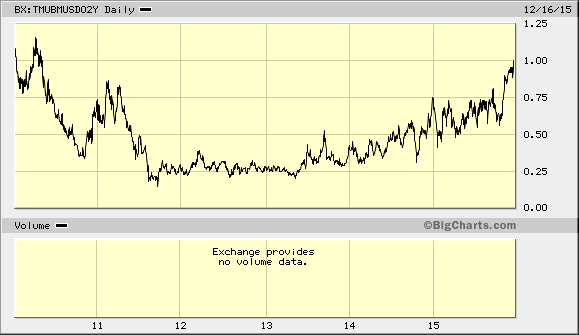
Posted by Eddy Elfenbein on December 16th, 2015 at 3:12 pmSo far, the market’s reaction is pretty muted. The two-year yield looks to close above 1% for the first time in several years.
-
The Fed’s Projections
Posted by Eddy Elfenbein on December 16th, 2015 at 2:22 pmHere are the Fed’s projections. This is often referred to as the “blue dots.” Personally, I think the Fed is way off here. They see rates rising much faster than I think is needed. The FOMC members currently project four rate hikes next year, and another four in 2017. I think we’ll see one, or maybe two, next year.
-
The Fed Raises Rates
Posted by Eddy Elfenbein on December 16th, 2015 at 2:00 pmThe Federal Reserve has raised interest rates by 0.25%. The vote was unanimous. Here’s the complete statement:
Information received since the Federal Open Market Committee met in October suggests that economic activity has been expanding at a moderate pace. Household spending and business fixed investment have been increasing at solid rates in recent months, and the housing sector has improved further; however, net exports have been soft. A range of recent labor market indicators, including ongoing job gains and declining unemployment, shows further improvement and confirms that underutilization of labor resources has diminished appreciably since early this year. Inflation has continued to run below the Committee’s 2 percent longer-run objective, partly reflecting declines in energy prices and in prices of non-energy imports. Market-based measures of inflation compensation remain low; some survey-based measures of longer-term inflation expectations have edged down.
Consistent with its statutory mandate, the Committee seeks to foster maximum employment and price stability. The Committee currently expects that, with gradual adjustments in the stance of monetary policy, economic activity will continue to expand at a moderate pace and labor market indicators will continue to strengthen. Overall, taking into account domestic and international developments, the Committee sees the risks to the outlook for both economic activity and the labor market as balanced. Inflation is expected to rise to 2 percent over the medium term as the transitory effects of declines in energy and import prices dissipate and the labor market strengthens further. The Committee continues to monitor inflation developments closely.
The Committee judges that there has been considerable improvement in labor market conditions this year, and it is reasonably confident that inflation will rise, over the medium term, to its 2 percent objective. Given the economic outlook, and recognizing the time it takes for policy actions to affect future economic outcomes, the Committee decided to raise the target range for the federal funds rate to 1/4 to 1/2 percent. The stance of monetary policy remains accommodative after this increase, thereby supporting further improvement in labor market conditions and a return to 2 percent inflation.
In determining the timing and size of future adjustments to the target range for the federal funds rate, the Committee will assess realized and expected economic conditions relative to its objectives of maximum employment and 2 percent inflation. This assessment will take into account a wide range of information, including measures of labor market conditions, indicators of inflation pressures and inflation expectations, and readings on financial and international developments. In light of the current shortfall of inflation from 2 percent, the Committee will carefully monitor actual and expected progress toward its inflation goal. The Committee expects that economic conditions will evolve in a manner that will warrant only gradual increases in the federal funds rate; the federal funds rate is likely to remain, for some time, below levels that are expected to prevail in the longer run. However, the actual path of the federal funds rate will depend on the economic outlook as informed by incoming data.
The Committee is maintaining its existing policy of reinvesting principal payments from its holdings of agency debt and agency mortgage-backed securities in agency mortgage-backed securities and of rolling over maturing Treasury securities at auction, and it anticipates doing so until normalization of the level of the federal funds rate is well under way. This policy, by keeping the Committee’s holdings of longer-term securities at sizable levels, should help maintain accommodative financial conditions.
Voting for the FOMC monetary policy action were: Janet L. Yellen, Chair; William C. Dudley, Vice Chairman; Lael Brainard; Charles L. Evans; Stanley Fischer; Jeffrey M. Lacker; Dennis P. Lockhart; Jerome H. Powell; Daniel K. Tarullo; and John C. Williams.
-
Brief Updates
Posted by Eddy Elfenbein on December 16th, 2015 at 1:17 pmThe financial world is on pins and needles. Here are a few items I wanted to pass along.
Jefferies initiated coverage on Hormel Foods (HRL) with a Buy rating. Of course, this comes after the Spam people rallied 50% this year. The stock is close to breaking $80 per share.
Express Scripts (ESRX) said that they’ll announce their guidance for next year on Tuesday, December 22.
Oracle’s (ORCL) earnings report will be our final Buy List earnings report for this calendar year.
The futures market odds for the November 2016 meeting are exactly 50-50 of rates being 0.75% or less, or 1% or more.
-
Fed Day Is Here
Posted by Eddy Elfenbein on December 16th, 2015 at 12:03 pmToday is the day. After nearly 10 years, the Federal Reserve is set to raise interest rates later today (here’s my post on the last rate hike). The announcement will come at 2 pm. Wall Street and the Fed have almost continuously overestimated the need for interest rates to rise. But this time, it’s real. According to the futures market, however, there’s still some room for doubt.
I’ll put it as easily as I can. The Fed said it won’t raise rates until X happens. X happened. So that’s why I expect rates to go up.
Here’s the effective Fed funds rates for the last seven years. It’s averaged 0.128%. That means you’ve made less than 1% combined.
Bear in mind that rates aren’t going up much. Interest rates will still be below the rate of inflation. In fact, they’ll be below inflation for quite some time. Perhaps two more years.
The government reported today that industrial production fell 0.6% last month. I think it’s accurate to say that the manufacturing sector has been in a mini-recession for the last several months.
By the way, it’s one of the biggest myths you hear that “America doesn’t make anything anymore.” That’s flatly untrue. In reality, America is a manufacturing powerhouse. The difference is that fewer people do it.
Yesterday, the stock market finally delivered back-to-back gains. This is our first two-day winning streak since the beginning of November. That’s one of the longest such cold streaks in history.
Also, after today’s closing bell, Oracle will report earnings.
-
Archives
- June 2026
- May 2026
- April 2026
- March 2026
- February 2026
- January 2026
- December 2025
- November 2025
- October 2025
- September 2025
- August 2025
- July 2025
- June 2025
- May 2025
- April 2025
- March 2025
- February 2025
- January 2025
- December 2024
- November 2024
- October 2024
- September 2024
- August 2024
- July 2024
- June 2024
- May 2024
- April 2024
- March 2024
- February 2024
- January 2024
- December 2023
- November 2023
- October 2023
- September 2023
- August 2023
- July 2023
- June 2023
- May 2023
- April 2023
- March 2023
- February 2023
- January 2023
- December 2022
- November 2022
- October 2022
- September 2022
- August 2022
- July 2022
- June 2022
- May 2022
- April 2022
- March 2022
- February 2022
- January 2022
- December 2021
- November 2021
- October 2021
- September 2021
- August 2021
- July 2021
- June 2021
- May 2021
- April 2021
- March 2021
- February 2021
- January 2021
- December 2020
- November 2020
- October 2020
- September 2020
- August 2020
- July 2020
- June 2020
- May 2020
- April 2020
- March 2020
- February 2020
- January 2020
- December 2019
- November 2019
- October 2019
- September 2019
- August 2019
- July 2019
- June 2019
- May 2019
- April 2019
- March 2019
- February 2019
- January 2019
- December 2018
- November 2018
- October 2018
- September 2018
- August 2018
- July 2018
- June 2018
- May 2018
- April 2018
- March 2018
- February 2018
- January 2018
- December 2017
- November 2017
- October 2017
- September 2017
- August 2017
- July 2017
- June 2017
- May 2017
- April 2017
- March 2017
- February 2017
- January 2017
- December 2016
- November 2016
- October 2016
- September 2016
- August 2016
- July 2016
- June 2016
- May 2016
- April 2016
- March 2016
- February 2016
- January 2016
- December 2015
- November 2015
- October 2015
- September 2015
- August 2015
- July 2015
- June 2015
- May 2015
- April 2015
- March 2015
- February 2015
- January 2015
- December 2014
- November 2014
- October 2014
- September 2014
- August 2014
- July 2014
- June 2014
- May 2014
- April 2014
- March 2014
- February 2014
- January 2014
- December 2013
- November 2013
- October 2013
- September 2013
- August 2013
- July 2013
- June 2013
- May 2013
- April 2013
- March 2013
- February 2013
- January 2013
- December 2012
- November 2012
- October 2012
- September 2012
- August 2012
- July 2012
- June 2012
- May 2012
- April 2012
- March 2012
- February 2012
- January 2012
- December 2011
- November 2011
- October 2011
- September 2011
- August 2011
- July 2011
- June 2011
- May 2011
- April 2011
- March 2011
- February 2011
- January 2011
- December 2010
- November 2010
- October 2010
- September 2010
- August 2010
- July 2010
- June 2010
- May 2010
- April 2010
- March 2010
- February 2010
- January 2010
- December 2009
- November 2009
- October 2009
- September 2009
- August 2009
- July 2009
- June 2009
- May 2009
- April 2009
- March 2009
- February 2009
- January 2009
- December 2008
- November 2008
- October 2008
- September 2008
- August 2008
- July 2008
- June 2008
- May 2008
- April 2008
- March 2008
- February 2008
- January 2008
- December 2007
- November 2007
- October 2007
- September 2007
- August 2007
- July 2007
- June 2007
- May 2007
- April 2007
- March 2007
- February 2007
- January 2007
- December 2006
- November 2006
- October 2006
- September 2006
- August 2006
- July 2006
- June 2006
- May 2006
- April 2006
- March 2006
- February 2006
- January 2006
- December 2005
- November 2005
- October 2005
- September 2005
- August 2005
- July 2005
 Eddy Elfenbein is a Washington, DC-based speaker, portfolio manager and editor of the blog Crossing Wall Street. His