-
The S&P 500 and Its Earnings
Posted by Eddy Elfenbein on December 30th, 2015 at 9:38 amHere’s the S&P 500 along with its earnings. The index is in black and it follows the left scale. The earnings are in yellow and follow the right scale.
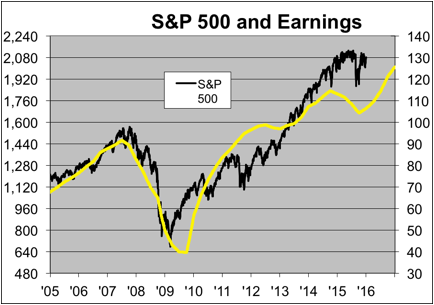
The two lines are scaled at a ratio of 16 to 1. That means whenever the lines cross, the market’s P/E Ratio is exactly 16.
As you can see, earnings have ticked down for the last four quarters but are expected to rise again for Q4. The forward part of the earnings line is Wall Street’s estimate.
-
Morning News: December 30, 2015
Posted by Eddy Elfenbein on December 30th, 2015 at 7:02 amGlobal Growth Will Be Disappointing in 2016: IMF’s Lagarde
A Chinese Company in India, Stumbling Over A Culture
Puerto Rico Debt Crisis Closes In on Jan. 1 Deadline
Consumer Confidence in U.S. Increases More Than Projected
For the Wealthiest, a Private Tax System That Saves Them Billions
Oil Prices Become a Problem for U.S. Steelmakers
A Former ‘Pharma Bro’ Company Files For Bankruptcy
FedEx Cites ‘Unprecedented’ E-Commerce Surge in Christmas Delays
China Telecom Chairman Resigns Amid Corruption Probe
Chicago Subway System Now Has Full 4G Wireless Coverage
Icahn Has High Bid for Pep Boys as Bridgestone Backs Away
Elon Musk `Stepping on Toes’ in Space Race, Russia Official Says
Cullen Roche: The Best Econ and Finance Research of 2015
Jeff Carter: Never Pay For An Introduction
Be sure to follow me on Twitter.
-
The 2/10 Spread Drops Below 120
Posted by Eddy Elfenbein on December 29th, 2015 at 2:27 pmI’ve probably become a bore on this point, but I like to keep a close eye on the spread between the 2- and 10-year Treasury bond yields. This indicator has a pretty good track record over the last few decades. When it goes negative, bad times are not long off.
We’re still a long way from going negative, but the spread dropped below 120 basis points yesterday. That’s among the narrowest spreads in eight years.
The spread briefly hit 119 in February of this next year before bouncing up to 177 by summer.
-
Should Cognizant Buy Perot Systems?
Posted by Eddy Elfenbein on December 29th, 2015 at 2:17 pmOne analyst thinks so. Here’s the story: Dell bought Perot Systems from Ross Perot for $4 billion. Now Dell is buying EMC so they want to free up some cash by selling off Perot.
David Koning at Robert W. Baird think Cognizant would be an ideal buyer:
Koning estimates Perot revenue at $3.1 billion annually, which is roughly 22.5% of Cognizant’s annual revenue. He estimates Perot’s EBITDA — earnings before interest, taxes, depreciation and amortization — at about $470 million, or roughly 15% of Cognizant’s EBITDA. He expects the combination would create about $50 million worth “of synergies.” Cognizant’s $3 billion of net cash in the bank could swing to $2 billion in debt, depending on how Cognizant financed the acquisition, he says.
Bottom line? Maybe 20 to 25 cents per share of improvement to Cognizant’s annual earnings, Koning says. “Investors sometimes don’t like the strategic fit but end up giving credit for accretion,” he wrote.
Interesting, but I’m not sure if this would be a good idea long-term. Sometimes I wonder if sitting on too much cash is a good thing. I’m reminded of what Peter Lynch called the “Bladder Theory of Corporate Finance.”
-
Lost in a Gloom of Uninspired Research
Posted by Eddy Elfenbein on December 29th, 2015 at 11:07 amThis time of year is popular for market watchers to make forecasts for the coming year. I try to avoid that game. I like to say that my year-end forecast for the Dow is December 31. Of course, I have the Buy List, but I’m referring to analysts who confidently say that the Dow or the S&P 500 will close next year at some precise level. The most I’ll say is that the math favors or doesn’t favor something. That’s quite a bit different from forecasting the precise close 12 months hence.
Bad news sells, and making dire forecasts is especially popular. In finance, there’s no shortage of people predicting doom and gloom. The problem is that whatever bad news comes along, they claim they were vindicated while conveniently overlooking the other bad stuff they predicted.
I remember one guru who claimed he predicted the financial crisis. To be fair, he did predict a financial collapse, but he predicted the meltdown of civil society. He said chaos would overtake the earth and people would have to turn to drinking rainwater to survive. I don’t recall that happening but those other forecasts get pushed down the memory.
I recently saw the movie, The Big Short. It’s OK, but not outstanding. I give the moviemakers credit for trying to explain some of the complex finance. As such, the movie is unconventional at times. The film centers on Dr. Michael Burry, an eccentric doctor-turned-hedge fund manager who correctly predicted the housing bubble.
The problem is that lots and lots of other people also predicted the housing bubble. Neil Irwin of the New York Times shows that the Google searches for housing bubble peaked in August 2005, two years before the crisis began. Even if you get the phenomenon right, there’s still the issue of timing.
What Dr. Burry got right was the systemic collapse. Burry recently had a rather gloomy outlook for the U.S. I have to say that I don’t find his views very persuasive. That’s the issue I want to get at. Burry is obviously intelligent, but intelligence isn’t the top trait an investor needs to have. I would rank patience and discipline above brains.
But there’s a certain kind of intelligence that can actively hinder investing performance. When you overanalyze too many variables, it often leads to a certain kind of highly intelligent person down the road forecasting disaster. As Wordsworth put it, “lost in a gloom of uninspired research.”
This leads me to one of the most complex and difficult to understand observations about people, and by extension, markets. This complex idea is that people generally find a way to muddle through, especially at the micro level.
Sounds earth-shattering, I know, but lots of smart people don’t get it. The famous guru will identify some terrible event, but they project its impact well out in the future. Instead, people will work around it.
For example, when a snowstorm hits a city, folks in the neighborhood are largely able to get by. They eventually dig themselves out. People look in on their elderly neighbors. Sure, It may not be pleasant, but within time, things slowly return to normal. But the city business or transit system will be complete chaos. That’s the thing. Big breakdowns usually happen at the higher orders (think Katrina). Large systems can freeze up, but people usually don’t.
Dr. Burry was able to see the threats to the system. His eccentric personality probably aided him in connecting all the dots. It’s usually the outsider with marginal views who’s right when all the experts are wrong. But that’s also why the same person will likely be dead wrong with their next 20 predictions. Making forecasts isn’t a skill like shooting free throws where you simply listen to people with better track records.
The Big Short notes that $5 trillion was destroyed by the financial crisis. That’s true, but at Gary Alexander points out, $30 trillion has been created since then. People muddled through.
-
Morning News: December 29, 2015
Posted by Eddy Elfenbein on December 29th, 2015 at 7:06 amPutin’s Bailout Bank Needs a Rescue; It’s an $18 Billion Whopper
Crude Prices Rise on U.S. Export Prospects
Oil-Producing States Battered as Tax-Gushing Wells Are Shut Down
Saudis Plan Unprecedented Subsidy Cuts to Counter Oil Plunge
Marc Faber Takes on Janet Yellen
4 Tactical/Momentum ETFs: A Disappointing 1-Year Anniversary
Icahn Sweetens His Bid for Pep Boys to More Than $1 Billion
Whole Foods to Pay $500,000 for Overcharging NYC Customers
Deutsche Bank to Raise Up to $4 Billion From Huaxia Sale
U.S. Trade Body Declines Nvidia’s Review Petition Against Samsung
Start-Up With Bitcoin in Its DNA Stumbles on Fund-Raising Trail
Universities Race to Nurture Start-Up Founders of the Future
Adidas Not Facing Shareholder Pressure to Sell Reebok
Roger Nusbaum: Santa Claus Checks In
Joshua Brown: The Riskalyze Report: A Year-End Rotation
Be sure to follow me on Twitter.
-
Once Again…
Posted by Eddy Elfenbein on December 28th, 2015 at 3:14 pmHere’s the 2016 Crossing Wall Street Buy List. The list goes live at the opening bell next Monday.
AFLAC (AFL)
Alliance Data Systems (ADS)
Bed Bath & Beyond (BBBY)
Biogen (BIIB)
Cerner (CERN)
Cognizant Technology Solutions (CTSH)
CR Bard (BCR)
Express Scripts (ESRX)
Fiserv (FISV)
Ford (F)
HEICO (HEI)
Hormel Foods (HRL)
Microsoft (MSFT)
Ross Stores (ROST)
Signature Bank (SBNY)
Snap-on (SNA)
Stericycle (SRCL)
Stryker (SYK)
Wabtec (WAB)
Wells Fargo (WFC)
-
Overpaying for Low Probability
Posted by Eddy Elfenbein on December 28th, 2015 at 9:40 amIn Big Short, people betting on low probability events are geniuses. In reality, people do this all the time, generally overpaying.
— Eric Falkenstein (@egfalken) December 27, 2015
I posted this tweet from Eric Falkenstein because it’s one of the fundamental truths about investing. Markets are generally not very good judges of low-probability events.
One of the best examples of this comes from horse racing. Historically, the worst bet to make is to bet on the long shot. Why is that the case? I think it’s because a certain amount of people want to bet on the long shot precisely because it is the long shot.
Think of the guy who says, “Dude, that horse is 70-to-1! I’m betting $10 on it. How crazy would it be if he won?”
Not to get overly philosophical, but the price impacts the price. I’m sure you’ve heard stories of an art gallery owner who can’t move a painting. Then he triples the price and it sells the next day.
In stocks, this effect often happens with companies that are supposed to be the “next Apple” or “next Google.” Sure, it might work out, but the odds are against it. Some people just want to own for the big payoff, and that itself makes it overpriced.
I suspect that the historic outperformance of value stocks isn’t due to something within value stocks but rather it’s due to the underperformance of richly-valued growth stocks.
-
Morning News: December 28, 2015
Posted by Eddy Elfenbein on December 28th, 2015 at 7:13 amJapan Firms Cold on Abe’s Calls For Wage Hikes in 2016
Japan November Industrial Production Falls 1%
India Offers Atypical Video Challenges
Ruble Drops to 2015 Low on Year-End Budget Flows as Oil Tumbles
Prospects For The Oil Market – What Is Market Structure Telling Us As We Head Into 2016?
Shale’s Running Out of Survival Tricks as OPEC Ramps Up Pressure
Yellen Price-Quirk Focus Shows Confidence in Inflation Comeback
Are Democrats Crippling Obamacare?
Which Puerto Rico Bond Defaults Next? 42% Yields Provide a Clue
F.A.A. Drone Laws Start to Clash With Stricter Local Rules
Colorado Banking Case Tests Federal Drug Rules
China Telecom Falls After Chairman Becomes Target of Probe
Volkswagen’s Audi Tempers Spending Plans for 2016
Cullen Roche: The Importance of First Principle Thinking
Jeff Miller: 2015 in Review: Hi-Yo, Silver!
Be sure to follow me on Twitter.
-
Merry Everything
Posted by Eddy Elfenbein on December 25th, 2015 at 8:49 am
I want to take this opportunity to wish everyone a Merry Christmas and a happy, healthy and profitable new year.
This has been a great year for Crossing Wall Street. Our Buy List is up again this year, and it looks like we’ll beat the market. Traffic to the blog continues to be strong, and the newsletter, CWS Market Review, has a record number of subscribers.
I want to thank Marcia Hippen for editing my posts and repairing my numerous typos. I also want to acknowledge some of my fellow financial bloggers Barry Ritholtz, Josh Brown, Morgan Housel, Howard Lindzon, Tadas Viskanta and many, many others for their continued support.
I’d also like to thank the people who follow and interact with me each day on Twitter. In particular, I want to call out George Acs, Zachary Shrier and Joseph Weisenthal. I now have over 22,000 Twitter followers.
Most of all, I want to thank all of my readers for your continued support.
Let’s hope 2016 brings us more success!
-
Archives
- July 2026
- June 2026
- May 2026
- April 2026
- March 2026
- February 2026
- January 2026
- December 2025
- November 2025
- October 2025
- September 2025
- August 2025
- July 2025
- June 2025
- May 2025
- April 2025
- March 2025
- February 2025
- January 2025
- December 2024
- November 2024
- October 2024
- September 2024
- August 2024
- July 2024
- June 2024
- May 2024
- April 2024
- March 2024
- February 2024
- January 2024
- December 2023
- November 2023
- October 2023
- September 2023
- August 2023
- July 2023
- June 2023
- May 2023
- April 2023
- March 2023
- February 2023
- January 2023
- December 2022
- November 2022
- October 2022
- September 2022
- August 2022
- July 2022
- June 2022
- May 2022
- April 2022
- March 2022
- February 2022
- January 2022
- December 2021
- November 2021
- October 2021
- September 2021
- August 2021
- July 2021
- June 2021
- May 2021
- April 2021
- March 2021
- February 2021
- January 2021
- December 2020
- November 2020
- October 2020
- September 2020
- August 2020
- July 2020
- June 2020
- May 2020
- April 2020
- March 2020
- February 2020
- January 2020
- December 2019
- November 2019
- October 2019
- September 2019
- August 2019
- July 2019
- June 2019
- May 2019
- April 2019
- March 2019
- February 2019
- January 2019
- December 2018
- November 2018
- October 2018
- September 2018
- August 2018
- July 2018
- June 2018
- May 2018
- April 2018
- March 2018
- February 2018
- January 2018
- December 2017
- November 2017
- October 2017
- September 2017
- August 2017
- July 2017
- June 2017
- May 2017
- April 2017
- March 2017
- February 2017
- January 2017
- December 2016
- November 2016
- October 2016
- September 2016
- August 2016
- July 2016
- June 2016
- May 2016
- April 2016
- March 2016
- February 2016
- January 2016
- December 2015
- November 2015
- October 2015
- September 2015
- August 2015
- July 2015
- June 2015
- May 2015
- April 2015
- March 2015
- February 2015
- January 2015
- December 2014
- November 2014
- October 2014
- September 2014
- August 2014
- July 2014
- June 2014
- May 2014
- April 2014
- March 2014
- February 2014
- January 2014
- December 2013
- November 2013
- October 2013
- September 2013
- August 2013
- July 2013
- June 2013
- May 2013
- April 2013
- March 2013
- February 2013
- January 2013
- December 2012
- November 2012
- October 2012
- September 2012
- August 2012
- July 2012
- June 2012
- May 2012
- April 2012
- March 2012
- February 2012
- January 2012
- December 2011
- November 2011
- October 2011
- September 2011
- August 2011
- July 2011
- June 2011
- May 2011
- April 2011
- March 2011
- February 2011
- January 2011
- December 2010
- November 2010
- October 2010
- September 2010
- August 2010
- July 2010
- June 2010
- May 2010
- April 2010
- March 2010
- February 2010
- January 2010
- December 2009
- November 2009
- October 2009
- September 2009
- August 2009
- July 2009
- June 2009
- May 2009
- April 2009
- March 2009
- February 2009
- January 2009
- December 2008
- November 2008
- October 2008
- September 2008
- August 2008
- July 2008
- June 2008
- May 2008
- April 2008
- March 2008
- February 2008
- January 2008
- December 2007
- November 2007
- October 2007
- September 2007
- August 2007
- July 2007
- June 2007
- May 2007
- April 2007
- March 2007
- February 2007
- January 2007
- December 2006
- November 2006
- October 2006
- September 2006
- August 2006
- July 2006
- June 2006
- May 2006
- April 2006
- March 2006
- February 2006
- January 2006
- December 2005
- November 2005
- October 2005
- September 2005
- August 2005
- July 2005
 Eddy Elfenbein is a Washington, DC-based speaker, portfolio manager and editor of the blog Crossing Wall Street. His