-
The Dollar’s Impact on Your Investments
Posted by Eddy Elfenbein on October 21st, 2015 at 1:55 pmSimon Constable has an article at U.S. News & World Report on the dollar’s impact on the stock market.
The greenback is looking strong, but there’s no reason to believe that it can’t get even stronger. If it does, then it will have an impact on your investments. Here’s why it matters and some key things you need to know.
“It’s the kind of thing that Americans don’t think about much unless they travel overseas,” says Eddy Elfenbein, a Washington, D.C.-based private investor and author of the influential Crossing Wall Street blog. But when the dollar is strong, it does change the way various types of investments perform. “It’s like putting a magnet near a compass,” he says.
Read the whole thing.
-
Morning News: October 21, 2015
Posted by Eddy Elfenbein on October 21st, 2015 at 7:09 amSaudis Risk Draining Financial Assets in 5 Years, IMF Says
Japan’s Export Growth Slows as China Stumbles
Netherlands and Luxembourg Ordered to Recover Taxes From Starbucks and Fiat
Demand for Rental Apartments Boosts U.S. Housing Starts
Credit Suisse to Launch $6.3 Billion Capital Increase
Fiat Chrysler Shares Ease After Ferrari IPO Priced
Michael Dell Dishes on Meg Whitman, the PC Biz and on EMC
Lam to Buy KLA-Tencor in $10.6 Billion Chip Machinery Deal
Chipotle Profit Misses, as Sales Growth Slows
Uber CEO Says Public Offering `Years Away’ as Company Matures
Intel to Convert Processor Chip Factory in China to Make Memory Chips
Consumer Reports Stops Recommending the Tesla
The 401(k) Crisis Is Getting Worse
Cullen Roche: Creating Demand Out Of Thin Air
Jeff Carter: The Reason The Fed Needs to Move Interest Rates Higher Now
Be sure to follow me on Twitter.
-
Signature Bank Beats Earnings
Posted by Eddy Elfenbein on October 20th, 2015 at 11:36 amThis morning, Signature Bank (SBNY) reported Q3 earnings of $1.88 per share which was six cents better than estimates.
Signature Bank (Nasdaq: SBNY), a New York-based full-service commercial bank, today announced results for its third quarter ended September 30, 2015. Net income for the 2015 third quarter reached a record $96.2 million, or $1.88 diluted earnings per share, versus $76.8 million, or $1.52 diluted earnings per share, for the 2014 third quarter. The record net income for the 2015 third quarter, versus the comparable quarter last year, is primarily due to an increase in net interest income, fueled by record deposit growth and record loan growth. These factors were partially offset by an increase in non-interest expenses.
Net interest income for the 2015 third quarter reached $250.0 million, up $44.7 million, or 21.8 percent, when compared with the 2014 third quarter. This increase is primarily due to growth in average interest-earning assets. Total assets reached $31.92 billion at September 30, 2015, an increase of $5.97 billion, or 23.0 percent, from $25.95 billion at September 30, 2014. Average assets for the 2015 third quarter reached $31.19 billion, an increase of $5.82 billion, or 22.9 percent, compared with the 2014 third quarter.
Deposits for the 2015 third quarter rose a record $2.16 billion, or 8.8 percent, to $26.61 billion at September 30, 2015. When compared with deposits at September 30, 2014, overall deposit growth for the last twelve months was 24.8 percent, or $5.29 billion. Excluding short-term escrow and brokered deposits of $4.40 billion at the end of the 2015 third quarter and $3.40 billion at the end of the 2015 second quarter, core deposits increased $1.15 billion for the quarter. Average deposits for the 2015 third quarter reached $26.10 billion, an increase of $1.54 billion, or 6.3 percent.
The shares have been as high as $146.39 today. From the July 21 high to the September 2 low, SBNY had fallen from $155.84 to $126.49.
-
Morning News: October 20, 2015
Posted by Eddy Elfenbein on October 20th, 2015 at 7:08 amEurozone Banks Take Advantage of QE, Lend on Easier Terms, ECB Survey Finds
Here’s Why Japanese Investors Have Gone Ga-ga Over That Leveraged ETF
The Man Accused of Spoofing Some of the World’s Biggest Futures Exchanges
Hedge Funds are Bringing Back Everyone’s Least Favorite Toxic Investment
Drug Makers Sidestep Barriers on Pricing
Anheuser-Busch InBev Aims Its Tax-Trimming Skills at SABMiller
With United Airlines’ Chief in the Hospital, General Counsel Will Fill In
Yum Brands Plans to Separate China Business
Apple CEO Defends Encryption, Opposes Government Back Door
United Tech Profit Falls on Currency Swings; Plans $12 Billion Share Buyback
BNY Mellon Profit Down 23% on Year-Ago Gains, Cuts Expenses
Citigroup Accused of Improperly Avoiding $800 Million in New York State Taxes
How Emojis Find Their Way to Phones
Joshua Brown: The Ballad of the Breakaway Broker
Be sure to follow me on Twitter.
-
Ford’s Move to Aluminum is Paying Off
Posted by Eddy Elfenbein on October 19th, 2015 at 1:44 pmFord Motor (F) took a big gamble in changing their F-150 pick-up bodies to aluminum. After some initial mis-steps, the strategy seems to be paying off.
It’s not like the old F-Series was broken. In 2014, U.S. drivers bought one every 42 seconds or so. A full-frontal switch to aluminum was a massive gamble, and an expensive one. Ford essentially rebuilt two of its biggest factories to crank out the new trucks, shuttering them for 13 weeks at the opportunity cost of all the F-150s it could have made in that time—more than 90,000 vehicles in all.
The change, however, is palpable. At Ford, they call it “the 50-foot test”—you can tell in 50 feet of driving the difference all that aluminum makes. Specifically, the 2015 trucks are about 700 pounds lighter, which makes them far more peppy and eager. Even with the smallest of the four engines Ford offers, the F-150 will go from a dead stop to 60 miles per hour faster than the Ford Fusion, its little cousin. “Just 10 years ago, that would have been complete science fiction,” Levine said.
Cruising in a pickup is a bit like crawling in a Lamborghini; it’s possible, but not natural. That’s not the case with Ford’s new moneymaker. A long haul on an interstate isn’t a low-gear grind.
Then there’s the heavy lifting. Every version of Ford’s pickup will tow a few hundred pounds more than previous iterations, with a max load of 12,200 pounds. Smaller, faster, and stronger, it’s like a linebacker, a mountain of muscle that can run the 40 in less than 5 seconds.A lot of truck fans don’t really care about those things. They buy a pickup because it feels like riding around in your living room, with bigger windows and more places to put a drink. Ford didn’t mess with that experience.
The F-Series still has a center console capable of holding a bag of groceries, and its cabin is layered with enough trays and bins to store a family’s worth of iPhones and beef jerky. Meanwhile, Ford’s engineers lowered the window frames by two inches to provide even more visibility. It’s one of the most thoughtful touches, in addition to a snug, hand-size space at the bottom of the steering wheel that presents a perfect handle on long, straight roads. The one place Ford left some steel is in the wall behind the engine, sealing a cabin as quiet as a church.
Earnings are due out a week from tomorrow, and I’m expecting good results. Ford made 24 cents per share for last year’s Q3. The consensus for this year is 47 cents per share.
-
Three Booming Sectors.
Posted by Eddy Elfenbein on October 19th, 2015 at 11:08 amIt’s still early in Q3 earnings season but 71% of the reports so far have beaten expectations. Some industries are doing quite well. Alex Rosenberg of CNBC notes that we’re seeing 50% earnings growth in automobiles, airlines and construction materials.
“Those are the sectors not tied to commodities, and they also benefit from low rates. That’s the sweet spot right now,” commented Eddy Elfenbein, editor of the “Crossing Wall Street” blog.
And perhaps in the spirit of finding a phoenix amid the ashes, Elfenbein says that the fact that these companies are making it happen is actually good news.
“All in all, this bodes well for the economy, since these are the early cyclicals,” Elfenbein told CNBC in an email, adding: “Yes, six years after the recession ended, the early cyclicals are moving.”
The hope, of course, is that strength in these consumer-reliant sectors points to positive news ahead for the economy and stocks alike, as the “cycle” blooms.
-
Morning News: October 19, 2015
Posted by Eddy Elfenbein on October 19th, 2015 at 7:07 amIran Urges OPEC to Cut Oil Output to Raise Prices to $70-$80
How Not to Fix Fannie and Freddie
Quite A Roller-Coaster Ride For China’s Youku Tudou And VCs With Latest Alibaba Bid
Providers of Fixed-Income ETFs Aim To Make Them Easier to Use
Morgan Stanley Misses Estimates on Drop in Bond Trading Revenue
Valeant Results Boosted By Recent Buys
Microsemi Offers $2.4 Billion for PMC-Sierra to Top Skyworks
The Great Ball of China Money Rolls into Bonds
Zephyrs Of Hope Within The Zafgen Storm
Netflix Faces Challengers In Its Push to Expand Globally
Halliburton Profit Beats As Costs Fall
Cullen Roche: When Venture Capitalists are Heroes and Bankers are Zeroes
Jeff Miller: Can Strong Housing Data Give An “All Clear” Signal For The U.S. Economy?
Be sure to follow me on Twitter.
-
Greeting from San Diego!
Posted by Eddy Elfenbein on October 19th, 2015 at 2:02 amI’m currently in San Diego for Stocktoberfest 2015. This is the annual gathering thrown by Howard Lindzon, the guiding force behind StockTwits. Howard is a force of nature and he’s been a big supporter of mine for years.
The weather alone is enough to get me here but I’m looking forward to connecting with other members of the finance part of Social Media. On Monday, I’ll be hosting a panel of technical analysts. This should be good. If I have time, I’ll try to give you updates.
-
S&P 500 Closes at Two-Month High
Posted by Eddy Elfenbein on October 16th, 2015 at 5:22 pmThe S&P 500 rallied again today. That makes 11 up days in the last 14 sessions.
The S&P 500 closed today at 2,033.11 which means we’ve nearly erased everything we lost in the two-day plunge back in August.
As a reminder, the index closed at 2,035.73 on Thursday, August 20. It then lost 3.19% on Friday, August 21 and another 3.94% on Monday, August 24. So we’re now just 0.13% below from the start of that two-day plunge. (The index had dropped for three days in a row going into the big two-day drop.)
-
CWS Market Review – October 16, 2015
Posted by Eddy Elfenbein on October 16th, 2015 at 7:08 am“I hate weekends because there is no stock market.” – Rene Rivkin
Last week, I sounded the “All Clear” signal, and the market has responded. On Thursday, the S&P 500 closed at its highest level in eight weeks. The index has now risen for 10 of the last 13 days. Ever since Carl Icahn warned investors of danger ahead, the stock market has jumped 7.5%. I hope we get more warnings soon.
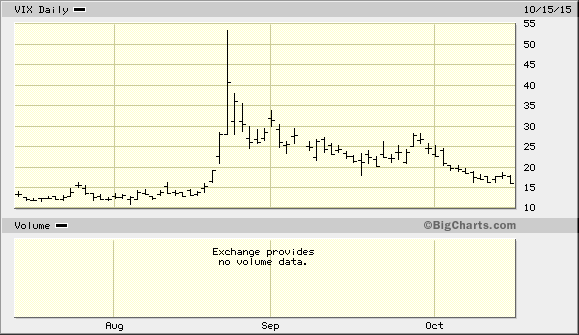
A few weeks ago, I was interviewed on Bloomberg TV, and I said that the VIX was too high given the market’s volatility. This was one of those times where I was hardly revealing some hidden fact—the math just didn’t add up. Since then, the VIX has crashed (see below). At one point, it fell for 10 straight days, and on Thursday, the VIX closed at its lowest level in nearly two months. Stocks are up, and expected volatility is down.
Fortunately, we can now focus on something important: earnings. Since our Buy List is focused on high-quality stocks, I look forward to earnings season. That’s when we can prove our mettle. In fact, we’ve already had our first earnings beat with Wells Fargo (WFC). But I need to warn investors: this is going to be a tough earnings season for companies that don’t please the expectations gods of Wall Street. We’ve already seen Walmart (WMT) get cut down for a 10% loss while Netflix (NFLX) lost more than 8%. There will be more.
Next week is going to be crucial for us. Seven of our Buy List stocks are due to report, including five on Thursday. In this issue, I’ll preview what’s in store. Before I get to that, though, I want to discuss the latest economic news. It now looks as if Wall Street doesn’t expect the Federal Reserve to do anything with interest rates for a few more months. As it turns out, all the warnings from the Fed this summer may have been for naught. Of course, this isn’t the first time the Fed has changed its plans.
No Rate Hike This Year Is Good for Stocks
On Wednesday evening, the Wall Street Journal posted an article by Jon Hilsenrath and Anna Louie Sussman titled “Fed Doubts Grow on 2015 Rate Hike.” Investors have learned to take notice when Hilsenrath writes because it’s widely assumed that he’s Janet Yellen’s main conduit to the investing community.
The article said that the odds of a rate hike coming from the Fed this year are falling fast. As you may recall, the central bank did everything it could this summer to prepare investors for a rate hike. Several times it hinted that an increase was coming soon.
The problem is the Fed expected the economy to accelerate in the back half of 2015, and that hasn’t happened. This week’s retail sales report wasn’t that good. The ISM report was weak, and the September jobs report was a bust.
This week, we got another inflation report and once again, consumer prices fell. In fact, the rate of deflation increased last month. That means that by doing nothing, the Fed has actually raised real interest rates. Some of this is the result of plunging commodity prices, but not all. The “core rate” of inflation is subdued as well.
A rate hike in 2015 is most likely off the table. The Fed has another meeting scheduled in two weeks. After that, there’s only one more meeting left for this year, which is on December 15-16. The futures market thinks there’s a 30% chance that rates will go up in December. It’s not until March that the futures market expects a rate hike, and that’s still only at 54%.
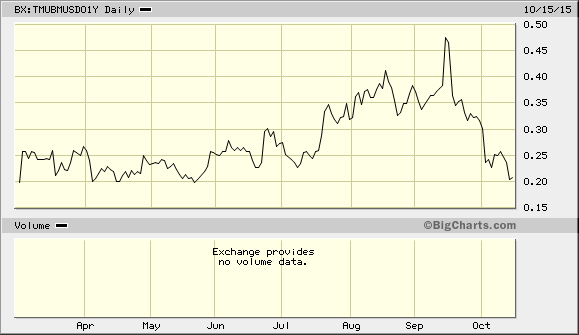
At the time, the Fed’s decision to forego a rate hike in September was controversial. Now it appears to be a no-brainer. In just a few weeks, the bond market has dramatically reversed course. On Wednesday, the 10-year Treasury closed at its lowest yield since April. One month ago, the one-year Treasury got to 0.47%. Now it’s back down to 0.22%.
What does this mean for us as investors? It all comes down to simple competition. The bond market is the stock market’s main rival. When the 10-year Treasury is yielding a measly 2% like it is now, that’s not much competition for stocks going at 14 or 15 times earnings. The S&P 500 will probably see its earnings fall around 5% this earnings season. Even with that decrease, stocks are still a bargain compared with the bond market.
Right now, 10-year TIPs (inflation-protected bonds) are going for 0.54%. My research has shown that TIPs historically aren’t a threat to stocks until they yield 2.43%. We’re still a long way from there.
There’s a concept in economics called the “non-accelerating inflation rate of unemployment” or NAIRU. Don’t let the name scare you; it’s actually pretty simple. NAIRU says that once the economy drops below X% unemployment, inflation will start heating up. So…what’s X? As turns out, no one knows. Economists had assumed X to be around 5.5%. We’re now down to 5.1%, and there’s still no inflation in sight.
Now folks are beginning to wonder if X is a lot lower than we’d thought. Maybe 4.5% or even lower. Why the change? That’s hard to say. Maybe demographics. Maybe technology. Or maybe the structure of the economy has changed in some way we don’t quite understand. As investors we don’t need to worry about why. The good news is that there’s no worry that inflation is going to strike us soon.
The chain of causality goes like this. Inflation leads to higher interest rates. Higher interest rates are tougher competition against stocks. That tougher competition leads to lower stock prices. Without that first step, I’m not so worried about the last step. Now let’s take a look at our first earnings report for this earnings season.
Wells Fargo Beat by a Penny per Share
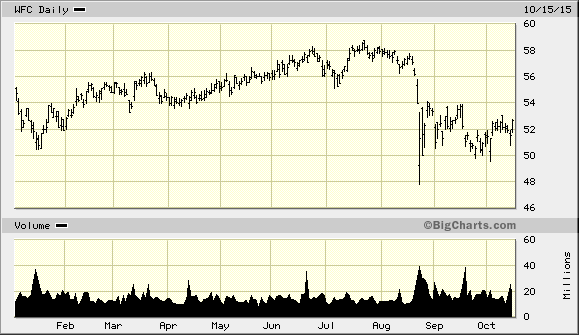
On Wednesday, Wells Fargo (WFC) became our first stock to report results. Wells reported Q3 earnings of $1.05 per share, which beat Wall Street’s estimate by one penny per share. Overall, Wells had a decent quarter, but there are a few weak spots. Looking past that, Wells continues to be, in my opinion, the best-run large bank in America.
For Q3, the bank’s revenue rose to $21.88 billion, which beat estimates by $120 million. Total loans were up 7.7% while commercial and industrial loans were up 15%. That’s the good news. The downside is that Wells’s net interest margin came in a tad below 3%, which isn’t where I’d like it Of course, that’s the problem of living in a low-interest-rate world.
The bank has also been squeezed by dud loans to the energy sector. There’s been a lot of careless jabber on Wall Street about how large banks are much more vulnerable to bad energy loans than people realize. Truthfully, it’s an issue, but it’s hardly an earnings killer. Energy loans make up about 2% of Wells’s overall portfolio.
Wells conceded that the delinquency risk is higher than they initially estimated. Last quarter, the bank set aside $703 million for bad loans. That’s nearly double the number from a year ago, but the slowly-improving economy is helping consumers. Profits in community banking rose 6.5% to $3.69 billion, and profits in their brokerage unit were up 10% to $550 million.
Banks have what’s called an “efficiency ratio” which is expenses as a share of revenue. For Wells, their ratio last quarter was 56.7%. That’s within the bank’s target range.
The mortgage business has been a drag on Wells. Profits in that division fell by 2.7%, but I think we’ll see improvement from here. Earlier this week, Wells said it bought a big chunk of assets from General Electric (GE). GE’s strategy is to ditch its financial businesses.
Wells started off the year quite well for us, but it’s been lagging the market for the past two months. It’s been especially bad since the market turned towards Cyclicals about two weeks ago. This isn’t as much of a problem for Wells as it has been for the entire financial sector. This report tells me that Wells is doing just fine. Wells Fargo remains a strong buy up to $56 per share.
Seven Buy List Earnings Reports Next Week
Next week is going to be a busy one for us. Seven of our Buy List stocks are due to report, including five on Thursday. You can see a complete calendar of our earnings reports here. Let me preview what’s in store for next week.
On Tuesday, Signature Bank (SBNY) will report Q3 earnings. I said that Wells is the best-run big bank in America. Well, Signature is the best-run smaller bank. If they keep growing at this rate, soon they won’t be so small. Signature has now delivered 23-straight record quarters. They’ll almost certainly make that 24 next week. The consensus on Wall Street is for earnings of $1.82 per share.
One item that concerns me is that Signature has made many medallion loans for cab drivers, but Uber has hurt that business. Like Wells and energy, it’s an issue, but not a back-breaker.
On Wednesday, eBay (EBAY) is due to report its earnings. This will be the first earnings report for eBay without PayPal (PYPL). Wall Street expects 40 cents per share. Frankly, I’ve grown a bit frustrated with the online auction house. Amazon is squeezing them and the strong dollar has also taken its toll. ChannelAdvisor recently reported some poor metrics for eBay’s core business. I’m not ready to toss in the towel just yet on eBay, but I want hard evidence that business is getting better.
Thursday is the big day for us. Snap-on (SNA) and Wabtec (WAB) are due to report before the opening bell, while CR Bard (BCR), Microsoft (MSFT) and Stryker (SYK) will report after the closing bell.
Snap-on (SNA) has been one of our surprise winners this year. Through Thursday, the shares are up 17.4% YTD. The consensus on Wall Street is for Q3 earnings of $1.94 per share, which is probably a few cents too low. I also expect a nice dividend increase from Snap-on sometime next month. The stock is particularly attractive if you see it below $160 per share.
This summer, Wabtec (WAB) said that it’s targeting full-year earnings of $4.10 per share. That seems very doable. The company has already made $2.03 per share for the first half of the year.
Three months ago, CR Bard (BCR) not only beat earnings but raised its full-year guidance as well. For Q3, Bard expects earnings to range between $2.21 and $2.25 per share. For the full year, Bard is looking for earnings of $9.00 to $9.05 per share. I think they can beat both numbers. This is a solid stock.
Three weeks ago, I highlighted Microsoft (MSFT) as being an especially good buy below $44 per share. The bargain didn’t last long; shares of MSFT perked up and are now above $47 per share. I particularly liked the company’s 16% dividend increase from a few weeks ago. I have to say that I’m a bit cautious on this earnings report. While Microsoft has been struggling with its phones, the company has been doing well in other areas. Xbox, for example, is strong. The consensus for this earnings report is for 58 cents per share.
Stryker (SYK) has said it expects Q3 earnings to come in between $1.20 and $1.25 per share. It also raised its full-year guidance to a range of $5.06 to $5.12 per share. A lot of healthcare stocks have gotten beaten up lately, and Stryker suffered some as well. Between August 19 and September 28, Stryker dropped 11.6%. I think a lot of this was sector-focused, and the stock has started to recover. Look for another good earnings report from Stryker.
That’s all for now. Next week will be dominated by earnings. The big day for us will be Thursday, when five of our Buy List stocks are due to report. There’s not much in the way of econ reports next week, but I’ll want to see if the initial jobless claims can make a fresh four-decade low on Thursday. Existing homes will also come out on Thursday. Be sure to keep checking the blog for daily updates. I’ll have more market analysis for you in the next issue of CWS Market Review!
– Eddy
-
Archives
- June 2026
- May 2026
- April 2026
- March 2026
- February 2026
- January 2026
- December 2025
- November 2025
- October 2025
- September 2025
- August 2025
- July 2025
- June 2025
- May 2025
- April 2025
- March 2025
- February 2025
- January 2025
- December 2024
- November 2024
- October 2024
- September 2024
- August 2024
- July 2024
- June 2024
- May 2024
- April 2024
- March 2024
- February 2024
- January 2024
- December 2023
- November 2023
- October 2023
- September 2023
- August 2023
- July 2023
- June 2023
- May 2023
- April 2023
- March 2023
- February 2023
- January 2023
- December 2022
- November 2022
- October 2022
- September 2022
- August 2022
- July 2022
- June 2022
- May 2022
- April 2022
- March 2022
- February 2022
- January 2022
- December 2021
- November 2021
- October 2021
- September 2021
- August 2021
- July 2021
- June 2021
- May 2021
- April 2021
- March 2021
- February 2021
- January 2021
- December 2020
- November 2020
- October 2020
- September 2020
- August 2020
- July 2020
- June 2020
- May 2020
- April 2020
- March 2020
- February 2020
- January 2020
- December 2019
- November 2019
- October 2019
- September 2019
- August 2019
- July 2019
- June 2019
- May 2019
- April 2019
- March 2019
- February 2019
- January 2019
- December 2018
- November 2018
- October 2018
- September 2018
- August 2018
- July 2018
- June 2018
- May 2018
- April 2018
- March 2018
- February 2018
- January 2018
- December 2017
- November 2017
- October 2017
- September 2017
- August 2017
- July 2017
- June 2017
- May 2017
- April 2017
- March 2017
- February 2017
- January 2017
- December 2016
- November 2016
- October 2016
- September 2016
- August 2016
- July 2016
- June 2016
- May 2016
- April 2016
- March 2016
- February 2016
- January 2016
- December 2015
- November 2015
- October 2015
- September 2015
- August 2015
- July 2015
- June 2015
- May 2015
- April 2015
- March 2015
- February 2015
- January 2015
- December 2014
- November 2014
- October 2014
- September 2014
- August 2014
- July 2014
- June 2014
- May 2014
- April 2014
- March 2014
- February 2014
- January 2014
- December 2013
- November 2013
- October 2013
- September 2013
- August 2013
- July 2013
- June 2013
- May 2013
- April 2013
- March 2013
- February 2013
- January 2013
- December 2012
- November 2012
- October 2012
- September 2012
- August 2012
- July 2012
- June 2012
- May 2012
- April 2012
- March 2012
- February 2012
- January 2012
- December 2011
- November 2011
- October 2011
- September 2011
- August 2011
- July 2011
- June 2011
- May 2011
- April 2011
- March 2011
- February 2011
- January 2011
- December 2010
- November 2010
- October 2010
- September 2010
- August 2010
- July 2010
- June 2010
- May 2010
- April 2010
- March 2010
- February 2010
- January 2010
- December 2009
- November 2009
- October 2009
- September 2009
- August 2009
- July 2009
- June 2009
- May 2009
- April 2009
- March 2009
- February 2009
- January 2009
- December 2008
- November 2008
- October 2008
- September 2008
- August 2008
- July 2008
- June 2008
- May 2008
- April 2008
- March 2008
- February 2008
- January 2008
- December 2007
- November 2007
- October 2007
- September 2007
- August 2007
- July 2007
- June 2007
- May 2007
- April 2007
- March 2007
- February 2007
- January 2007
- December 2006
- November 2006
- October 2006
- September 2006
- August 2006
- July 2006
- June 2006
- May 2006
- April 2006
- March 2006
- February 2006
- January 2006
- December 2005
- November 2005
- October 2005
- September 2005
- August 2005
- July 2005
 Eddy Elfenbein is a Washington, DC-based speaker, portfolio manager and editor of the blog Crossing Wall Street. His