-
AFLAC Beats and Raises Dividend
Posted by Eddy Elfenbein on October 27th, 2015 at 6:29 pmAFLAC (AFL) is our fourth stock to report Q3 earnings today. For Q3, the duck stock earned $1.56 per share in operating earnings. Remember that for insurance companies, it’s better to look at operating earnings rather than net earnings. Currency exchange continues to be an issue for AFLAC. The weak yen knocked off 13 cents per share.
Quarterly revenue dropped 12.1% to $5 billion. Compared with last year’s Q3, operating earnings fell from $685 million to $672 million. But thanks to share buybacks, operating earnings per share rose by 3.3%. Ignoring the yen, operating earnings per share increased by 11.9%. During Q3, the average exchange rate for the yen was down 14.9% from last year.
For the first nine months of the year, operating earnings came to $4.60 per share, but AFLAC lost 40 cents due to the yen. Excluding that, operating earnings were up 2.9%.
So far this year, AFLAC has repurchased 17.4 million shares for $1.1 billion. They still have 52.1 million shares left under the current plan.
The board approved raising the quarterly dividend from 39 to 41 cents per share. That comes to $1.64 per share for the year, or 2.6% based on today’s closing price.
Now for guidance. AFLAC said that if the yen stays between 120 and 125 on the dollar, then they expect operating earnings to range between $1.36 and $1.56 per share. That translates to a full-year range of $5.96 to $6.16 per share.
-
Fiserv and Express Scripts Beat and Raised
Posted by Eddy Elfenbein on October 27th, 2015 at 4:14 pmFiserv (FISV) just reported third-quarter earnings of $1.03 per share. That beat estimates by six cents per share. That’s up from 86 cents per share in last year’s third quarter.
“Strong performance in the quarter was highlighted by revenue growth acceleration and a 20 percent increase in adjusted EPS,” said Jeffery Yabuki, President and Chief Executive Officer of Fiserv. “Our focus on delivering innovative, high-value client services should drive differentiated client experiences and continued growth.”
For the first nine months of the year, Fiserv has made $2.86 per share. That’s up from $2.48 per share last year.
The company has also raised its full-year guidance. The old range was $3.73 to $3.83 per share. The new range is $3.84 to $3.87 per share. Fiserv earned $3.37 per share last year. The new range implies Q4 earnings of 98 cents to $1.01 per share.
Express Scripts (ESRX) reported third-quarter earnings of $1.45 per share, which was one penny better than estimates. They also narrowed their full-range. Previously, it was $5.46 to $5.54 per share. Now it’s $5.51 to $5.55 per share. Last year, they made $4.88 per share.
“With the rising cost of prescription drugs, we are continuing our mission to make medicine more affordable and accessible for clients and patients,” said George Paz, Chairman and CEO. “Our innovative solutions, focused scale, specialized care and unmatched leadership manages cost more favorably for payers while improving health outcomes of our patients. Effective pharmacy benefit management has never been more critical to ensuring a cost-effective healthcare system in our country, and Express Scripts uniquely delivers.”
“We are confident in the upper range of our expected retention rate, a reflection of the trust clients have in Express Scripts,” said Tim Wentworth, President. “Our core capabilities are differentiated and are in greater demand in the marketplace. Accredo, our specialty pharmacy, is one of our leading differentiators providing the best, most convenient care for patients with complex diseases. Our pharma services organization continues to provide differentiated value to manufacturers who want to bring innovative drugs to market in the safest way possible. It is clear that our unique collection of cost-saving solutions and our business model of client alignment position us well for continued growth.”
Since ESRX has already earned $3.97 per share for the first three quarters of this year (up from $3.50 per share last year), the new guidance implies Q4 earnings of $1.54 to $1.58 per share.
-
WSJ: Greek Orthodox priest boasts of ability to ‘crash’ stocks
Posted by Eddy Elfenbein on October 27th, 2015 at 12:38 pmWell, this is…different.
There are thousands of hedge funds in the world, but only one is run by a traveling priest who boasts of his ability to “crash” stocks in between baptisms, funerals and Sunday sermons in this bucolic New Hampshire town.
“My whole life I always knew things before they happened. I guess it’s just a gift from God,” said Mr. Lemelson, 39 years old.
So far he is hardly the second coming of George Soros. His fledgling Amvona Fund LP is a blip in a $3 trillion universe where anyone can call themselves a hedge-fund manager, most anyone can market themselves as one and it is possible to operate with almost no official scrutiny.
This man of the cloth has earned enough—millions of dollars in the past few years for the firm’s general partnership, according to audited investor documents—to live a distinct double life.
Late last month, he donned his clerical collar to offer opening prayers and a personal blessing at a town-hall meeting here for Donald Trump, the Republican presidential candidate who has made raising taxes on hedge-fund managers a campaign centerpiece.
-
Ford Motor Misses by Two Cents
Posted by Eddy Elfenbein on October 27th, 2015 at 11:09 amToday is another big day for Buy List earnings reports. Four of our stocks are due to report. Three come after the close, but Ford Motor (F) reported this morning.
It was a decent quarter for Ford. They doubled profits compared with one year ago. However, they missed estimates by two pennies per share.
While net income more than doubled to $1.9 billion from $835 million a year earlier, earnings of 45 cents a share, excluding some items, were below the 47-cent average of 18 analyst estimates. The miss sent Ford shares down 4 percent to $15.05 at 10:47 a.m. New York time after dropping as much as 5.6 percent, the most in two months.
“It looks like the classic story of someone missing EPS consensus and the market punishing them unfairly,” said David Whiston, an analyst at Morningstar Inc. in Chicago, who rates Ford equivalent of a buy. “They still had a really excellent quarter. The longer-term story at Ford is still very solid and very bright.”
Truck sales continue to do well for Ford.
The F-Series had its best third quarter in nine years, with an 8 percent increase to U.S. sales of 207,271. The trucks, which are the top-selling vehicle line in America, account for 90 percent of Ford’s global automotive profit, according to Morgan Stanley.
“As we look at 2016, we expect a strong year with the momentum we’ve built in 2015, and particularly in the second half of 2015,” Fields told analysts on a conference call today.
The cause for the earnings miss was entirely due to taxes, not business.
The earnings per share miss “is entirely due to a tax rate difference,” Chief Financial Officer Bob Shanks said. “We came right on in terms of operating results, but we had a 33 percent tax rate. The analysts on average had a 32 percent tax rate.”
The average tax rate jumped from 21 percent a year earlier when it was reduced by several special items. Ford had forecast a 34 percent rate, he said.
“Expectations were high and I think they delivered,” Whiston said. “The margins in North America were outstanding. It was an all-time record.”
Drilling down into the numbers, Ford’s business looks good.
The company maintained its full-year forecast for pretax profits of as much as $9.5 billion and said North American profit margin for the year would be 9.5 percent, at the top of its projected 8.5 percent to 9.5 percent range. In the third quarter, it was 11.3 percent, up from 7.1 percent a year earlier, Ford said.
“It’s an outstanding quarter,” Shanks told reporters at the company’s headquarters. “We’re on a really, really strong track towards the breakthrough year that we’ve described throughout this year.”
Shares of Ford are down about 3% to 4% this morning, but remember, that’s after gaining 20% in the previous month.
-
Morning News: October 27, 2015
Posted by Eddy Elfenbein on October 27th, 2015 at 7:06 amChina September Industry Core Earnings Fall, Third-Quarter Unemployment Stable
U.K. Economy Expands Less Than Forecast as Production Cools
The Fed Strives for a Clear Signal on Interest Rates
Alibaba Announces September Quarter Revenue of 22.2 Billion Yuan
Ford 3Q Profits Short of Analysts’ Estimates
Duke Energy to Buy Piedmont Natural Gas for $4.9 Billion
This Is The Drone Company Walmart Is Hoping To Use For Deliveries
U.S. New-Home Sales Tumble in September
DuPont Interim CEO Vows to Tackle Costs After Drop in Profit
REI is Paying its Employees to Take Black Friday Off
BP Profit Beats Estimates as CEO Plans Deeper Cost Cuts
JPMorgan Challenges Apple Pay With Mobile App Offering Discounts
ABN Amro Proceeds With IPO to Pay Back Dutch State Bailout
Roger Nusbaum: Make That Four Weeks of Gains
Howard Lindzon: Stocktoberfest – My Top 10 Takeaways
Be sure to follow me on Twitter.
-
Morning News: October 26, 2015
Posted by Eddy Elfenbein on October 26th, 2015 at 7:10 amGerman Business Confidence Deteriorates Less Than Expected
BOJ Faces Key Test to Rosy Forecast, Leaning Toward Standing Pat
Yellen, Consensus-Builder, Needs to Send Strong Signal at Fed Meet
House Set to Vote on Reopening of Embattled Ex-Im Bank
Gold Trades Near 2-Week Low as Rates Weighed Before Fed Meeting
Treasuries Epicenter Tilts Toward Chicago With High-Speed Firms
Philips Deal to Sell Lighting Unit to Chinese Group Hits U.S. Regulatory Snag
Duke Energy to Buy Piedmont Natural Gas For $4.9 BIllion
General Motors and U.A.W. Reach Tentative Contract Accord
Maersk Will Cut Up to 12% of Oil Jobs After Prices Slump
Valeant Board Forms Committee to Look Into Philidor Ties
Securitas to Buy Diebold’s North American e-Security Business
Google Turning Its Lucrative Web Search Over to AI Machines
Joshua Brown: Why We Lead With Planning
Jeff Miller: Will the Fed Put the Brakes on The Breakout?
Be sure to follow me on Twitter.
-
Microsoft +11%
Posted by Eddy Elfenbein on October 23rd, 2015 at 10:32 amThanks to its strong earnings report, shares of Microsoft (MSFT) are currently up 11% this morning. It’s like an old fashioned techmania as Alphabet (GOOGL) and Amazon (AMZN) are up strongly as well. The Nasdaq Composite is over 5,000.
The weak spots are CR Bard (BCR) and Stryker (SYK) which are lower despite beating earnings. BCR is off by 4.4% and SYK is down by 3.2%.
The S&P 500 has been as high as 2,077.79 this morning, and it’s taken out its 200-day moving average.
Two things to pass along. Here’s a good article on Signature Bank (SBNY). Also, here’s Jim Cramer speaking with Nick Pinchuk, the CEO of Snap-on (SNA).
-
CWS Market Review – October 23, 2015
Posted by Eddy Elfenbein on October 23rd, 2015 at 7:08 am“Investing without research is like playing stud poker and never looking at the cards.” – Peter Lynch
We’re in the thick of earnings season, and so far, it’s been very good for our Buy List. Last week, Wells Fargo (WFC) started us off with a solid earnings beat. This week, we got strong results from several more Buy List favorites including Microsoft (MSFT), Stryker (SYK), CR Bard (BCR) and eBay (EBAY). You can check out the complete calendar of our earnings reports.
In Thursday’s trading, shares of eBay shot up nearly 14%. Not a bad gain for one day! In Thursday’s after-hours trading, Microsoft was up more than 7.7%. If that holds up into Friday, the software giant won’t merely be at a 52-week high; it will be at a 15-year high. Can you believe that less than two months ago, MSFT was below $40 per share? We really need to thank those panicky day traders.
In this week’s CWS Market Review, I’ll run through our latest earnings reports. We’re not done yet. There are seven more reports coming our way this week. I’ll preview them for you in just a bit. Plus, I have some new Buy Below prices for you. But first, let’s look at the market’s recent upswing.
The S&P 500 Nears Its 200-DMA
Earlier this month, I sounded our “All Clear” signal—that’s when the VIX closed below 20. Since then, the stock market has climbed steadily higher, while the VIX has fallen even lower. The market has massively chilled out. On Thursday, the VIX closed at 14.45. In other words, it’s been cut in half in less than one month.
On August 24, I sent you a special newsletter urging you not to get swept up in the fear hitting Wall Street. I wrote, “Don’t panic. Don’t sell. Take a step back and don’t get caught up in this mess. The volatility will pass.” It certainly has. The market’s up more than 8% since then.
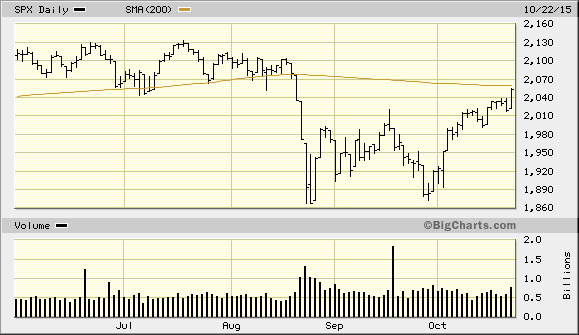
On Thursday, the S&P 500 closed at 2052.51, which is a two-month high. The stock market has now made back everything it lost in the two-day plunge from August 21 to August 24. Wall Street got a nice boost this week when Mario Draghi signaled that the ECB could take on another big stimulus package. Interest rates there are already negative, and that’s part of the reason why the dollar’s been so strong.
I’m also happy to see that the S&P 500 is nearing its 200-day moving average (the gold line in the chart above) which is an important sentiment indicator. The 200-DMA is currently at 2,060.04, so there’s a very good chance we’ll top it soon. You may recall that until this summer, the S&P 500 had stayed above its 200-DMA nearly every day for 30 straight months.
Right now, Wall Street is focused on earnings. Some stocks, like Amazon (AMZN) and Alphabet (GOOGL), have surged on strong numbers. So far this earnings season, 74% of companies have topped their earnings expectations, while 44% have beaten their sales expectations. Of course, earnings expectations had been pared back as earnings season approached. At the current rate, the S&P 500 is tracking an earnings decline of 6.7%, but earnings growth should tick positive for Q4.
Now let’s look at our earnings results, starting with one of my favorite banks.
Signature Bank Is a Buy up to $150 per Share
On Tuesday, Signature Bank (SBNY) reported Q3 earnings of $1.88 per share which was six cents better than estimates. That’s a big increase from the $1.52 per share Signature made in last year’s Q3. In the last year, total deposits are up 25%. Signature has now delivered 24 record quarters in a row! Not many banks can say that.
“Once again, Signature Bank delivered another quarter of record-setting performance as exemplified by both record deposit and loan growth as well as record earnings. The Bank’s disciplined approach to client-centric banking allows us to continue to flourish while meeting the rigors of the unprecedented current regulatory environment,” said Joseph J. DePaolo, President and Chief Executive Officer.
Signature prefers to stay out of the spotlight. I like that. For Q3, their net interest margin was 3.22%. That’s very good. Their efficiency ratio is 33.4%, which is amazingly good.
The shares ran to $155 by July before dropping to $127 last month. In September, I dropped my Buy Below price by $17 to $139 per share. It took a little patience, but SBNY is rallying again. This week, I’m raising my Buy Below on Signature Bank to $150 per share. I’ll keep my summary brief: this is a great bank.
eBay Soars 14% on Earnings Beat and Higher Guidance
eBay (EBAY) stunned Wall Street (and me) by reporting very good Q3 results. This was the first earnings report without PayPal, and it was feared that their results would be lackluster. Expectations were for 40 cents per share. Instead, eBay reported earnings of 43 cents per share.
Last quarter, the online auction house added two million active users to reach a total of 159 million. These numbers shouldn’t mask the fact that eBay’s business is under a lot of pressure from many different directions. Quarterly revenues were down 2%, and profits were off by 25%. People were expecting worse.
The good news is that eBay raised its full-year forecast to a range of $1.80 to $1.82 per share from the previous range of $1.72 to $1.77 per share. The stock rocketed higher on Thursday by $3.37 per share, or 13.9%, to close at $27.58.
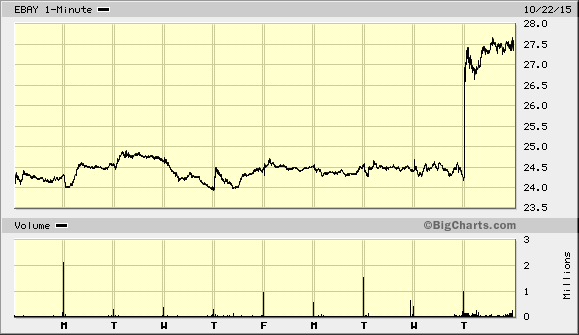
As pleased as I am with this latest surge, I’ve been disappointed with eBay’s performance. I have to admit that it may not make it onto next year’s Buy List. I’m keeping our Buy Below on eBay at $28 per share.
Five Buy List Earnings Reports on Thursday
Thursday was the big day for us. We had five Buy List earnings reports. Before the bell, Snap-on (SNA) reported Q3 earnings of $1.98 per share which was four cents better than estimates. Sales rose 1.9% to $821.5 million.
“We believe our third-quarter results continue to confirm Snap-on’s capabilities in serving serious professionals performing critical tasks in workplaces of consequence around the world,” said Nick Pinchuk, Snap-on chairman and chief executive officer. “These results, which include 7.3% organic sales growth and a 12.5% increase in diluted earnings per share, demonstrate continued progress along our defined runways for coherent growth while overcoming headwinds in certain end markets and geographies. The 130-basis-point improvement in operating margin before financial services also reflects contributions from our Snap-on Value Creation Processes, which drive ongoing improvements in safety, quality, customer connection, innovation and rapid continuous improvement.”
This was a solid quarter for Snap-on. The shares rose 2.5% on Thursday to $164.11. Snap-on remains a buy up to $169 per share.
Also that morning, we got our first earnings dud which was from Wabtec (WAB). The company reported Q3 earnings of $1.02 per share which was two cents below estimates. To be fair, the company got dinged by five cents due to currency and by another two cents due to acquisition costs. Revenue rose 1.5% to $809.5 million which missed estimates of $846.35 million.
For the full-year, Wabtec sees earnings of $4.10 per share (which implies Q4 earnings of $1.05 per share). That’s slightly below consensus of $4.13 per share. Wabtec also sees full-year revenue growth of 9%, which comes to $3.32 billion. That was below consensus of $3.37 billion.
WAB got slammed hard at Thursday’s open. At one point, the stock was off by 10%. I don’t believe the results were that bad. Fortunately, the shares recovered a little lost ground, and by the end of the end day, WAB closed at $83.74 for a loss of 5.4%. This week, I’m lowering my Buy Below on Wabtec to $90 per share.
After the closing bell, Microsoft (MSFT) reported fiscal Q1 earnings of 67 cents per share. That beat Wall Street’s estimates of 59 cents per share. The story here is that Microsoft is having success with its cloud business. Satya Nadella, the CEO, said that MSFT’s cloud business is on track to pull in $8.2 billion this year.
Microsoft is the midst of an impressive corporate turnaround. They’ve had to let a lot of people go, and there are probably more layoffs to come. The company also re-organized itself into three operating divisions in an effort to emphasize its mobile and cloud businesses. That was a smart move.
Microsoft didn’t give EPS guidance for the December quarter, but the company said revenues should range between $24.8 billion and $25.4 billion. I estimate that should work out to about 75 cents per share. Last month, I told you that MSFT looked especially good when it was below $44 per share. Now it looks to open today over $51 per share. Remember that they boosted their dividend by 16% last month. I’m raising my Buy Below on Microsoft to $53 per share.
CR Bard (BCR) reported Q3 earnings of $2.28 per share. That was five cents better than Wall Street’s estimate. That was also more than the range Bard had given us of $2.21 to $2.25 per share.
There’s really not much to say about Bard. They just make money. This medical-devices company is as good as they get. The company has increased its dividend every year since 1972. For Q4, Bard expects earnings between $2.38 and $2.42 per share. That means full-year earnings between $9.03 and $9.07 per share. I currently rate CR Bard a buy up to $204 per share.
Lastly, Stryker (SYK) reported Q3 earnings of $1.25 per share which was two cents better than estimates. They also raised the low-end of their full-year guidance by one penny per share. They now see 2015 earnings coming in between $5.07 and $5.12 per share. In January, Stryker’s initial guidance was $4.90 to $5.10 per share. I said they should have no problem topping $5 per share this year. I think it’s possible they could do a major deal soon. Stryker is a buy up to $101 per share.
Seven Buy List Earnings Reports Next Week
Next week is going to be another busy week for earnings. On Tuesday, four Buy List stocks are due to report: AFLAC (AFL), Express Scripts (ESRX), Fiserv (FISV) and Ford Motor (F). I’m particularly curious to hear what Ford has to say. I feel like I’ve been a lonely voice saying that Ford is doing well. Only lately have the shares started to reflect that. Wall Street expects Ford to report earnings of 47 cents per share which is nearly double last year’s third quarter. I’ll probably raise our Buy Below next week, but I want to see the results first.
In July, AFLAC told us to expect Q3 earnings between $1.40 and $1.53 per share. That sounds about right. Business is going well. The problem is that the strong dollar pinches their profits. I’ll be curious to hear if AFLAC offers any guidance for 2016.
Then on Wednesday, PayPal (PYPL) will release its first earnings report as an independent company. Wall Street expects earnings of 29 cents per share. I expect an earnings beat here.
Ball Corp. (BLL) is due to report on Thursday, October 29. Ball is an impressive company, but I haven’t liked their recent earnings reports. I want to see clear signs of improvement here. I’d also like to hear an update on their merger with Rexam. The consensus is for earnings of 95 cents per share.
Moog (MOG-A) hasn’t officially said when they’ll report but I suspect it will be on Friday, October 30. That’s usually about when the numbers come out. Moog has had a terrible year this year. They lowered their full-year guidance three times. But recently, the company gave an upbeat forecast for next year.
That’s all for now. More earnings to come next week. The Federal Reserve meets again on October 28. Don’t expect a rate increase. On Tuesday, the Census Bureau reports on durable-goods orders for September. The big econ report will come on Thursday when the government releases its first estimate for Q3 GDP growth. We had a good number for Q2 (3.9%), but it’s been hard for the economy to string together more than two good quarters in a row. Be sure to keep checking the blog for daily updates. I’ll have more market analysis for you in the next issue of CWS Market Review!
– Eddy
-
Morning News: October 23, 2015
Posted by Eddy Elfenbein on October 23rd, 2015 at 7:05 amGlobal Stocks Hit Tow-Month High on Dovish Draghi Message
Weak Japan Inflation, Output Data to Cast Cloud Over BOJ Meeting
Oil Heads for Second Weekly Drop as Stockpiles Exacerbate Glut
Are We Tight Yet? The Fed’s Problem in Finding the Neutral Rate
Senate Panel Is Chilly to Puerto Rico’s Pleas and Obama’s Aid Plan
The IRS Freezes Most Retirement Plan Contribution Limits
Existing U.S. Home Sales Rise to Second-Highest Since 2007
Amazon Sales Top Estimates on Prime Day Event, Cloud-Computing
Australia Flags Concerns on $35 Billion Halliburton Bid for Baker Hughes
American Airlines Profit Jumps, Beats Expectations
Ericsson Q3 Operating Profit Lags Forecasts at $604 Million as China Sales Slow
Skechers’ Shares Plunge on Disappointing Sales
SAC Capital’s Steinberg Gets Insider-Trading Charges Dropped
Jeff Carter: Have Faith in Markets
Roger Nusbaum: Yieldco or Yieldno?
Be sure to follow me on Twitter.
-
Earnings from Snap-on and Wabtec
Posted by Eddy Elfenbein on October 22nd, 2015 at 12:01 pmThe S&P 500 is up to a new two-month high today. The index has now recouped everything it lost from the August 21 to 24 plunge. This morning, we’ve been as high as 2,046.42.
Thanks to its surprising earnings report, eBay (EBAY) is having a very good day. The shares are currently up close to 13%.
We have five earnings reports today, and two of them were this morning. Snap-on (SNA) reported Q3 earnings of $1.98 per share which was four cents better than estimates.
“We believe our third quarter results continue to confirm Snap-on’s capabilities in serving serious professionals performing critical tasks in workplaces of consequence around the world,” said Nick Pinchuk, Snap-on chairman and chief executive officer. “These results, which include 7.3% organic sales growth and a 12.5% increase in diluted earnings per share, demonstrate continued progress along our defined runways for coherent growth while overcoming headwinds in certain end markets and geographies. The 130 basis point improvement in operating margin before financial services also reflects contributions from our Snap-on Value Creation Processes, which drive ongoing improvements in safety, quality, customer connection, innovation and rapid continuous improvement.
This was a solid quarter. The stock is currently up 2.5% today.
Our big loser today is Wabtec (WAB). The company reported Q3 earnings of $1.02 per share. Wall Street had been looking for $1.04 per share. Revenues rose 1.5% to $809.5 million, which missed estimates of $846.35 million.
For the full-year, Wabtec sees earnings of $4.10 per share (which implies Q4 earnings of $1.05 per share). That’s below the consensus of $4.13 per share. Wabtec also sees full-year revenue growth of 9% which comes to $3.32 billion. That’s below the consensus of $3.37 billion.
The stock gapped downward sharply at the open. At one point, WAB was down 10% on the day. It’s coming back some and is currently down 4%.
-
Archives
- September 2026
- August 2026
- July 2026
- June 2026
- May 2026
- April 2026
- March 2026
- February 2026
- January 2026
- December 2025
- November 2025
- October 2025
- September 2025
- August 2025
- July 2025
- June 2025
- May 2025
- April 2025
- March 2025
- February 2025
- January 2025
- December 2024
- November 2024
- October 2024
- September 2024
- August 2024
- July 2024
- June 2024
- May 2024
- April 2024
- March 2024
- February 2024
- January 2024
- December 2023
- November 2023
- October 2023
- September 2023
- August 2023
- July 2023
- June 2023
- May 2023
- April 2023
- March 2023
- February 2023
- January 2023
- December 2022
- November 2022
- October 2022
- September 2022
- August 2022
- July 2022
- June 2022
- May 2022
- April 2022
- March 2022
- February 2022
- January 2022
- December 2021
- November 2021
- October 2021
- September 2021
- August 2021
- July 2021
- June 2021
- May 2021
- April 2021
- March 2021
- February 2021
- January 2021
- December 2020
- November 2020
- October 2020
- September 2020
- August 2020
- July 2020
- June 2020
- May 2020
- April 2020
- March 2020
- February 2020
- January 2020
- December 2019
- November 2019
- October 2019
- September 2019
- August 2019
- July 2019
- June 2019
- May 2019
- April 2019
- March 2019
- February 2019
- January 2019
- December 2018
- November 2018
- October 2018
- September 2018
- August 2018
- July 2018
- June 2018
- May 2018
- April 2018
- March 2018
- February 2018
- January 2018
- December 2017
- November 2017
- October 2017
- September 2017
- August 2017
- July 2017
- June 2017
- May 2017
- April 2017
- March 2017
- February 2017
- January 2017
- December 2016
- November 2016
- October 2016
- September 2016
- August 2016
- July 2016
- June 2016
- May 2016
- April 2016
- March 2016
- February 2016
- January 2016
- December 2015
- November 2015
- October 2015
- September 2015
- August 2015
- July 2015
- June 2015
- May 2015
- April 2015
- March 2015
- February 2015
- January 2015
- December 2014
- November 2014
- October 2014
- September 2014
- August 2014
- July 2014
- June 2014
- May 2014
- April 2014
- March 2014
- February 2014
- January 2014
- December 2013
- November 2013
- October 2013
- September 2013
- August 2013
- July 2013
- June 2013
- May 2013
- April 2013
- March 2013
- February 2013
- January 2013
- December 2012
- November 2012
- October 2012
- September 2012
- August 2012
- July 2012
- June 2012
- May 2012
- April 2012
- March 2012
- February 2012
- January 2012
- December 2011
- November 2011
- October 2011
- September 2011
- August 2011
- July 2011
- June 2011
- May 2011
- April 2011
- March 2011
- February 2011
- January 2011
- December 2010
- November 2010
- October 2010
- September 2010
- August 2010
- July 2010
- June 2010
- May 2010
- April 2010
- March 2010
- February 2010
- January 2010
- December 2009
- November 2009
- October 2009
- September 2009
- August 2009
- July 2009
- June 2009
- May 2009
- April 2009
- March 2009
- February 2009
- January 2009
- December 2008
- November 2008
- October 2008
- September 2008
- August 2008
- July 2008
- June 2008
- May 2008
- April 2008
- March 2008
- February 2008
- January 2008
- December 2007
- November 2007
- October 2007
- September 2007
- August 2007
- July 2007
- June 2007
- May 2007
- April 2007
- March 2007
- February 2007
- January 2007
- December 2006
- November 2006
- October 2006
- September 2006
- August 2006
- July 2006
- June 2006
- May 2006
- April 2006
- March 2006
- February 2006
- January 2006
- December 2005
- November 2005
- October 2005
- September 2005
- August 2005
- July 2005
 Eddy Elfenbein is a Washington, DC-based speaker, portfolio manager and editor of the blog Crossing Wall Street. His