-
Wells Fargo Beats by a Penny
Posted by Eddy Elfenbein on October 14th, 2015 at 10:23 amEarnings season is underway for our Buy List. This morning, our first Buy List earnings report came out. For Q3, Wells Fargo (WFC) earned $1.05 per share which topped Wall Street’s estimate by one penny per share. The bank’s revenue rose to $21.88 billion which beat estimates by $120 million.
Wells Fargo’s loan activity picked up during the quarter. Total loans at the end of the quarter were $903.23 billion, a 7.7% increase from $838.88 billion in the same period a year ago. Commercial and industrial loans, which make up one of the largest parts of the bank’s total portfolio, were $292.23 billion, up 15% from $254.2 billion in the same period last year.
That’s pretty good. The downside is that Wells’s net interest margin came in a tad below 3% which isn’t where I’d like it. The bank has also been squeezed by dud loans to the energy sector. There’s been a lot of careless jabber on Wall Street that large banks are much more vulnerable to bad energy loans than people realize. Truthfully, it’s an issue, but it’s not an earnings killer. Last quarter, Wells didn’t release a dime in loan loss reserves.
Loans to energy companies comprised about 2% of Wells Fargo’s overall portfolio, but the bank said after its second-quarter earnings report that there was a risk of delinquency on $508 million in those balances, or around four times its estimate for the first quarter.
In the third quarter, Wells Fargo set aside $703 million to cover loans that could potentially turn bad in the future. That compares with $368 million in the third quarter of 2014 and $300 million in the second quarter. The bank lost $703 million to loan defaults, or 0.31% of its overall portfolio, compared with a 0.32% charge-off rate in the third quarter a year ago.
More importantly, Wells is profiting from the slowly-recovering consumer.
Overall profits at Wells Fargo’s community banking division, which includes its consumer operations, were $3.69 billion, a 6.5% increase from the $3.46 billion it earned in the third quarter of 2014. Wells Fargo’s wholesale banking division recorded profits of $1.77 billion, down 8.1% from the $1.93 billion it reported in the same quarter last year. The bank’s wealth, brokerage and retirement unit posted profits of $606 million, a 10% increase from the $550 million it earned in the third quarter of 2014.
Costs increased 1.2% to $12.4 billion. Expenses as a share of revenue was 56.7%, within the range of 55% to 59% that Wells Fargo targets for its so-called “efficiency ratio.”
Wells Fargo’s mortgage business, the largest in the U.S. by volume, earned $1.59 billion in fees in the quarter, down 2.7% from the $1.63 billion it earned in same period a year ago. The bank extended $55 billion in home loans between the end of June and the end of September, compared with $48 billion in the third quarter of 2014 and $62 billion in the second quarter of this year.
A large piece of Wells Fargo’s growth strategy this year has involved acquiring assets and businesses that General Electric Co.’s finance arm was shedding as part of the manufacturer’s retreat from banking. Within the past two weeks the bank announced it was acquiring the conglomerate’s railcar leasing and commercial lending and leasing businesses, and earlier this year it purchased $9 billion of GE’s property loans.
Wells started off the year quite well for us, but it’s been lagging the market for the past two months. It’s been especially bad since the market turned towards cyclicals about two weeks ago. This isn’t so much a problem for Wells as it has been for the entire financial sector. The shares are down about 1% this morning, but it’s not something to worry about.
-
Morning News: October 14, 2015
Posted by Eddy Elfenbein on October 14th, 2015 at 7:09 amU.K. Unemployment Unexpectedly Drops to Least Since 2008
China Third-Quarter Growth Seen Dipping to 6.8%, Weakest Since 2009
Brazil’s Next Big Crisis Is Scaring Bankers and Wiping Out Jobs
Cyberspace Becomes Second Front in Russia’s Clash With NATO
Gold Hits 3-Month High on Talk of Delay in Fed Rate Hike
A 2nd Fed Governor Opposes Raising Rates This Year, Breaking With Yellen
Mounting Full-Time Employment Shows Less Slack for Yellen’s Fed
Why Angus Deaton Deserved the Economics Nobel Prize
Wells Fargo to Buy $32 Billion GE Assets, Add 3,000 Workers
Mega Beer Deal Offers Molson Coors a Bigger Swig of U.S. Market
Twitter to Cut Up to 8% of Workforce
Intel Q3: Cloud, Memory Chips Shine, Enterprise Weakens
BofA Posts Quarterly Profit as Expenses Fall
Joshua Brown: Why the Stock Market Has to Go Down
Howard Lindzon: Stocktoberfest 2015- Robinhood, Stocktwits and SparkFin
Be sure to follow me on Twitter.
-
Big Move for Wells Fargo
Posted by Eddy Elfenbein on October 13th, 2015 at 2:20 pmJust ahead of their Q3 earnings report, Wells Fargo (WFC) announced they’re buying $32 billion in assets from General Electric (GE). Wells will take on 3,000 GE employees.
The sale includes commercial-distribution and vendor-finance units, and a portion of the corporate-finance business, from GE Capital, San Francisco-based Wells Fargo said Tuesday in a statement that didn’t include additional terms. The transaction is expected to be completed in the first quarter of 2016 and would allow the finance unit to return about $4.2 billion of capital to its parent, GE said in a separate statement.
Wells Fargo has been one of the biggest buyers of GE assets. In September, the lender agreed to purchase the bulk of a railcar- and locomotive-leasing unit from the company, and earlier this year, Wells Fargo said it would acquire GE real estate assets.
“This acquisition is an outstanding opportunity for Wells Fargo to deepen relationships and strengthen our presence in key commercial lending markets,” Tim Sloan, head of the wholesale banking division, said in the statement.
-
Morning News: October 13, 2015
Posted by Eddy Elfenbein on October 13th, 2015 at 7:09 amGlobal Stocks Lower as China Concerns Deepen
Pound Falls to Five-Month Low as Inflation Rate Turns Negative
Switzerland Said to Impose 5% Leverage Ratio on Big Banks
Oil Surplus to Persist in 2016 as IEA Sees Demand Growth Slowing
Fed’s Brainard Urges Patience in Raising Rates Amid Global Risk
AB InBev, SABMiller Brew Up $100 Billion Deal
Dell to Buy EMC in Biggest Tech Takeover, a Year in the Making
Etihad Airways Signs $700 Million Deal With IBM
Barclays Set to Name Jes Staley As Chief Executive
Investors Joining Messaging Startup Symphony, to Tune of $100 Million
Orlen Buys Oil and Gas Assets in Canada, Poland for $392 Million
Eli Lilly Abandons Heart Disease Drug in Final Stage of Trials
Shell Is Reeling After Pulling Out of the Arctic
Cullen Roche: Game Theory Thinking – Mets/Dodgers Edition
Roger Nusbaum: The Zinc Rally?
Be sure to follow me on Twitter.
-
Dell to Buy EMC for $67 Billion
Posted by Eddy Elfenbein on October 12th, 2015 at 10:55 amThis morning we got the news that Dell is going to buy EMC (EMC) for $67 billion. This is the largest tech deal ever.
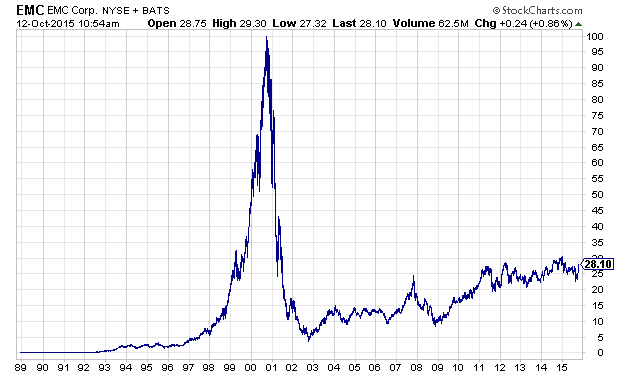
For those of you who remember the 1990s, you certainly remember these two stocks. EMC was the #1 performing stock on the 1990s. The shares gained 80,575% in that decade.
Not only was EMC the top performer of the decade, but that’s the best return of any stock in any decade in NYSE history. Shares of EMC gained, on average, 1% every 5.43 calendar days for 10 straight years.
In seven years, EMC split 2-for-1 an amazing five times. EMC went public on April 4, 1986 at $16.50 per share. Adjusted for splits, that comes to 23 cents per share. Today, it’s around $28 per share. Of course, the stock fell from $104.94 in 2000 down to $3.67 in 2002.
EMC has one of the more interesting long-term charts you’ll see:
-
Morning News: October 12, 2015
Posted by Eddy Elfenbein on October 12th, 2015 at 6:52 amRussia’s Gazprom Resumes Gas Supplies to Ukraine
Bankers Grapple With How to Help Emerging Markets
Bernanke: Fed Critics Were ‘Mistaken’
Oil Takes a Third Swing at Holding $50 as OPEC Sees Recovery
Energy Storage Needs to Think Bigger Than Batteries to Beat Fossil Fuels
Ford to Focus $1.8 Billion on China Smart Cars
Ferrari to Be Valued at Up to $9.82 Billion in IPO
Glencore Starts Process to Sell Some Assets in Chile and Australia
‘Stars Aligned’ For AB InBev’s Megabrew Merger Plan
PC Shipments Continue to Slump
Dell to Buy EMC for $65 Billion, a Record Takeover in Technology
What Scandal? Fantasy Sports Sites Just Had Their Biggest Weekend Ever
He’s a Banker, Crocodile Farmer and Wanted in the United States
Joshua Brown: and now, a brief rant about historic valuation
Jeff Miller: Earnings Recession Coming? Does It Matter?
Be sure to follow me on Twitter.
-
Reader’s Poll: Let Me Hear from You
Posted by Eddy Elfenbein on October 9th, 2015 at 10:49 pmI’ve been talking with an ETF firm about launching a tradeable version of our Buy List. This would be the entire Buy List packed into one stock that could be bought and sold just like any other stock.
Naturally, we’re curious about the level of interest in such a product. That’s why I’m turning to you. Don’t worry, I’m not asking for any type of commitment. Nor should you feel any pressure in voting “yes.” I’m trying to gauge an accurate assessment of potential demand.
Would you be interested in investing in a tradeable Crossing Wall Street ETF?
If so, how much would you consider investing?
Thanks for your help!
-
CWS Market Review – October 9, 2015
Posted by Eddy Elfenbein on October 9th, 2015 at 7:08 am“Become more humble as the market goes your way.” – Bernard Baruch
Ladies and gentlemen, our “All Clear” signal has officially been triggered!
On Monday, the VIX closed below 20. That’s been my boundary marker to consider the market’s recent unpleasantness to be behind us. That ended a run of 30 consecutive days in which the VIX closed above 20. It was longest such streak in more than three years.
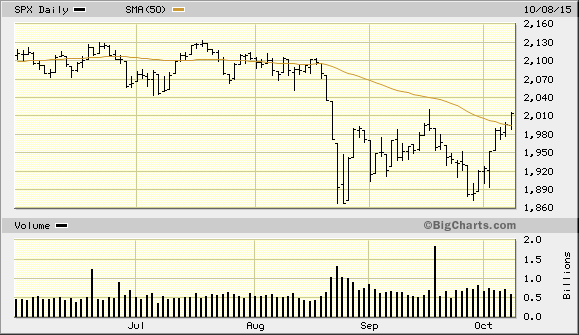
Fortunately, the stock market has been behaving much better recently. The S&P 500 has rallied seven times in the past eight sessions. On Thursday, the index not only broke above 2,000 for the first time in seven weeks but it also closed above its 50-day moving average, which is a key technical indicator.
But here’s a fact investors need to understand: the market’s recent uptick is quite different from what we’ve seen before. Lately, it’s been the cyclical stocks that have grabbed Wall Street’s attention. In this week’s CWS Market Review, we’ll take a closer look at what’s made traders so happy this week. I’ll also preview our first Buy List earnings report for the Q3 earnings season. Later on, I’ll bring you up to speed on our Buy List stocks. But first, let’s look at last week’s poor jobs report and how it vindicates Janet Yellen and the Federal Reserve.
Yes, the Fed Got It Right
Last Friday, the Labor Department released the September jobs report, and it wasn’t a good one. The U.S. economy created only 142,000 net new jobs last month which was well below expectations.
For some context, the economy had been churning out an average of 200,000 jobs per month for the last few years. Not only was the September report bad but the government also lowered the numbers for July and August by 59,000.
What’s more is that more folks are simply opting out of the jobs market entirely. Last month, the labor-force participation rate dropped down to 62.4% which is a 38-year low. Some of the decline, but not all, is due to demographic factors like retiring Baby Boomers.
They key takeaway from this report is that it vindicates the Federal Reserve’s decision last month to hold off on raising interest rates. Honestly, it seems like a no-brainer. How can you argue that the economy’s overheating when job growth is so slow and there’s no inflation in sight? In fact, the dominant global-economy story this year is massive commodity deflation. The Fed’s had rates at 0% for seven straight years, so what’s a few months more?
Now we have some more details on the Fed’s mindset. On Thursday, the Fed released the minutes from its September meeting, and it showed that members were concerned that the economy wasn’t strong enough for a rate hike. Broadly speaking, the Fed is still optimistic about the economy. I think they’re probably right. I don’t see a recession looming for us. Rather, the economy will likely experience more growth, but at a subdued pace.
Getting a rate increase is tricky. What’s interesting is that in 2010-11, several countries like Sweden, Norway, Australia and Israel went ahead with premature rate hikes, and then they quickly backed off when the damage became apparent. What makes the story more interesting is that at the time, Stanley Fischer was head of the Bank of Israel. Now he’s the number 2 at the Fed. We also know from history that raising rates before the economy is ready can lead to trouble. In 1937, the Fed made a similar mistake when it incorrectly thought the Great Depression was behind it. Short version: it wasn’t.
For much of this summer, the Fed sent signals to investors to expect higher rates soon. I talked a lot about that in previous issues. Now we know that “soon” isn’t quite as soon as we thought. For its part, the market is quite pleased that 0% rates will be around for a bit longer. The futures market doesn’t see a rate hike coming until March, and a second hike may come next September. Just look at the bond market: three weeks ago, the six-month Treasury was yielding 0.27%. Today that’s down to 0.07%.
The Market’s Shift Towards Cyclicals
The stock market is also happy about lower rates. (Perhaps Carl Icahn’s warning from last week was a signal to buy.) The key fact about the market’s recovery is that it’s been led by cyclical stocks. By Cyclicals, I mean businesses that are heavily tied to the business cycle. This would include areas like steel, cars and railroads.
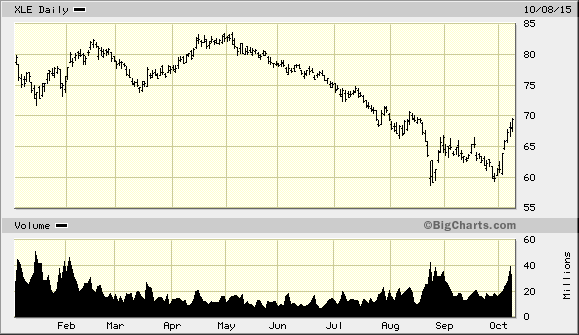
The three key cyclical sectors I like to watch are the Industrials (XLI), the Materials (XLB) and Energy (XLE). In the last eight days, the S&P 500 has gained 6.997%, but over that same time, XLI is up 9%, XLB is up 13% and XLE is up more than 15% (see below). Of course, these were the sectors hit the hardest over the past few months, so what we’re seeing is a cyclical rebound. Once a cyclical trend gets established, it tends to run on for a long time. Of course, that’s why they’re called cyclicals. The difficulty is spotting the turning points, and we may have just seen one.
One cyclical stock on our Buy List is Wabtec (WAB). In fact, I would say Wabtec is a classic cyclical. The company makes locomotives, brakes and other parts for the freight and passenger-rail industries. The shares are up 8.5% over the last eight days.
Another cyclical on our Buy List is Ford Motor (F). If you recall, the company recently announced its best September in 11 years. The shares have risen eight days in a row for a total gain of 14.2%. The stock closed Thursday one penny below $15 per share. The automaker hasn’t closed above $15 since July. I think we’ll see another solid earnings report from Ford later this month.
Another helpful sign for Cyclicals is that some commodity prices have found their feet. Oil, for example, broke $50 per barrel for the first time since July. Only a few weeks ago, oil was less than $38 per barrel. The recent rise probably reflects the actions of the Russian military in Syria. While Syria isn’t a big deal in the global oil market, it’s located in a very important neighborhood.
Mirroring the leadership in Cyclicals has been a somewhat tame performance from defensive sectors like Consumer Staples and Utilities. The Healthcare sector continues to be hurt by crumbling biotech shares. The biotech bubble has been bursting, and it’s not over.
I often say that true stock bubbles are quite rare. The problem is that market gurus love to proclaim bubbles. In reality, they don’t come along that often, and they’re usually focused in a sector.
Four years ago, right about this time, the Biotech ETF (IBB) was going for less than $88 per share. By this summer, it skyrocketed to $400 per share. Since then, it’s slowly deflated, and then Hillary’s Clinton’s tweet knocked the entire sector for a loop. Late last month, IBB dropped to $285 per share. It’s recovered a bit since then, but my advice is to stay away. This sector hasn’t hit bottom just yet.
When I say that we’ve hit our “All Clear” signal, I don’t mean to say that investors should expect a robust rally. Rather, I mean that we can expect reduced daily volatility. I doubt we’ll see as many 2% moves for the rest of the year or the hyperactive intra-day swings that characterized the past six weeks.
The midpoint of the S&P 500’s high close (2,130.82 on May 20) and low close (1,867.61 on August 25) comes to 1,999.215, and we just passed it. In other words, we’ve made back half of what we lost. It took a few weeks, but we’ve shaken off the late-summer story. Now we can focus on Q3 earnings season.
Wells Fargo Earnings Preview
Wells Fargo (WFC) is scheduled to report Q3 earnings before the market opens next Wednesday, October 14. This will be an interesting report for the big bank because the last report was decent but nothing great. Don’t be fooled—the bank is still very strong. The problem for Wells has been a weak mortgage market, and there’s not much they can do until that sector improves. For Q2, Wells’s mortgage-banking revenue fell by 1%. The bank’s net interest margin, which is a key metric for banks, has fallen below 3%. With ultra-low rates, that’s put the squeeze on all of their costs.
The stock got dinged up pretty hard in the August swoon. At one point, Wells dropped below $48 per share. The shares are still pretty cheap. Let’s look at some numbers. The bank should earn about $4.50 per share next year, give or take. If it can trade at 14 times that, which is hardly excessive, that translates to a price of $63 per share. Going by Thursday’s close, Wells would have to rally 20% to get there.
Wells has been one of the strongest large banks in the country. They’re also one of the few banks whose dividend is higher now than it was at the onset of the financial crisis. The dividend now yields 2.85%. That certainly beats 0% in short-term Treasuries. The consensus on Wall Street is for Wells to report Q3 earnings of $1.04 per share. That matches my numbers. By the way, if you want to know more about Wells Fargo, Jim Cramer recently had a good interview with John Stumpf, Wells’s CEO.
Buy List Updates
Express Scripts (ESRX) said this week that it will cover two new cholesterol-lowering drugs, Praluent from Regeneron and Sanofi, and Repatha from Amgen. Both drugs were approved this summer, and both run about $14,000 per year.
Express Scripts said that next year, it will spend $750 million on these drugs. That’s probably too low, and a lot of folks on Wall Street said Express’s math doesn’t add up. They’re obviously getting a big discount. This week’s announcement will give a lift to ESRX’s business next year. I still think the shares are going for a good value at the current price. I like this stock. Look for another good earnings report later this month.
Shares of eBay (EBAY) got knocked for a 6% loss on Thursday. But the catalyst for the loss didn’t involve eBay. Instead, it was the news that Amazon (AMZN) is going to take on Etsy (ETSY). I think it’s interesting that eBay lost more than Etsy did on the news. Etsy is a site that lets artisans sell their wares over the Internet. Amazon may not make a lot of money, or probably lost more last quarter, but they’re the undisputed giant in online retail.
That’s all for now. Early earnings reports will start to flow in next week. It won’t take long before we get an idea of how well Corporate America did during Q3. There will also be some important economic reports. On Wednesday, the Census Bureau will report on retail sales for September. The CPI report comes on Thursday. This will be an interesting CPI report because the last one showed the lowest inflation all year. It was actually deflation. You can be sure bond traders will be eyeing next week’s CPI report closely. Be sure to keep checking the blog for daily updates. I’ll have more market analysis for you in the next issue of CWS Market Review!
– Eddy
-
Morning News: October 9, 2015
Posted by Eddy Elfenbein on October 9th, 2015 at 6:28 amChina ‘Golden Week’ Retail Sales Growth Slows to 11% Year-On-Year
Spanish Bonds Beating German Peers Signals Wagers on Stimulus
U.S. Chases Swiss Bank Secrets to Singapore and Israel
Treasuries Erase Losses After Fed Minutes Highlight Global Risks
Alcoa’s News Isn’t All Bad for China
Products With Plastic Microbeads To Be Banned Under New California Law
Lyft Offers Car Rental, Fuel Perks to Keep Drivers Happy
AppDirect Lands $110 Million at More Than $1 Billion Valuation
Gap Reports Downbeat Profit Guidance, Drop in September Sales
Suncor Criticizes Canadian Oil Sands’ Move to Adopt Poison Pill
Six Credit Suisse Financial Advisers Leave Ahead of Overhaul
Twitter, Inc. Exec Drops Hints About the Future of Its 140-Character Limit
Regulators Investigating 2nd VW Computer Program on Emissions
Jeff Carter: Hillary and the HFT Tax
Howard Lindzon: Ticketfly Acquired By Pandora – My Investment Story
Be sure to follow me on Twitter.
-
Amazon Lauches Etsy Competitor
Posted by Eddy Elfenbein on October 8th, 2015 at 11:23 amThe stock market is lower this morning, but not by much. I think there’s an expectation that we’re soon going to attack 2,000 on the S&P 500.
This morning’s jobless claims report was a good one. Jobless claims fell to 263,000 which is the lowest in nearly two months. It’s also pretty close to a 42-year low.
At 2 pm, the Fed will release the minutes from their last meeting. This is the meeting where they held off on a rate increase. That seems to have been the right move. Wall Street will look at the minutes closely for signs of what the central bank is thinking.
Shares of eBay (EBAY) are down 7% this morning. The story here isn’t so much about eBay but about Etsy (ETSY). Amazon (AMZN) has launched a site that will compete with Etsy and may probably finish off the company.
-
Archives
- September 2026
- August 2026
- July 2026
- June 2026
- May 2026
- April 2026
- March 2026
- February 2026
- January 2026
- December 2025
- November 2025
- October 2025
- September 2025
- August 2025
- July 2025
- June 2025
- May 2025
- April 2025
- March 2025
- February 2025
- January 2025
- December 2024
- November 2024
- October 2024
- September 2024
- August 2024
- July 2024
- June 2024
- May 2024
- April 2024
- March 2024
- February 2024
- January 2024
- December 2023
- November 2023
- October 2023
- September 2023
- August 2023
- July 2023
- June 2023
- May 2023
- April 2023
- March 2023
- February 2023
- January 2023
- December 2022
- November 2022
- October 2022
- September 2022
- August 2022
- July 2022
- June 2022
- May 2022
- April 2022
- March 2022
- February 2022
- January 2022
- December 2021
- November 2021
- October 2021
- September 2021
- August 2021
- July 2021
- June 2021
- May 2021
- April 2021
- March 2021
- February 2021
- January 2021
- December 2020
- November 2020
- October 2020
- September 2020
- August 2020
- July 2020
- June 2020
- May 2020
- April 2020
- March 2020
- February 2020
- January 2020
- December 2019
- November 2019
- October 2019
- September 2019
- August 2019
- July 2019
- June 2019
- May 2019
- April 2019
- March 2019
- February 2019
- January 2019
- December 2018
- November 2018
- October 2018
- September 2018
- August 2018
- July 2018
- June 2018
- May 2018
- April 2018
- March 2018
- February 2018
- January 2018
- December 2017
- November 2017
- October 2017
- September 2017
- August 2017
- July 2017
- June 2017
- May 2017
- April 2017
- March 2017
- February 2017
- January 2017
- December 2016
- November 2016
- October 2016
- September 2016
- August 2016
- July 2016
- June 2016
- May 2016
- April 2016
- March 2016
- February 2016
- January 2016
- December 2015
- November 2015
- October 2015
- September 2015
- August 2015
- July 2015
- June 2015
- May 2015
- April 2015
- March 2015
- February 2015
- January 2015
- December 2014
- November 2014
- October 2014
- September 2014
- August 2014
- July 2014
- June 2014
- May 2014
- April 2014
- March 2014
- February 2014
- January 2014
- December 2013
- November 2013
- October 2013
- September 2013
- August 2013
- July 2013
- June 2013
- May 2013
- April 2013
- March 2013
- February 2013
- January 2013
- December 2012
- November 2012
- October 2012
- September 2012
- August 2012
- July 2012
- June 2012
- May 2012
- April 2012
- March 2012
- February 2012
- January 2012
- December 2011
- November 2011
- October 2011
- September 2011
- August 2011
- July 2011
- June 2011
- May 2011
- April 2011
- March 2011
- February 2011
- January 2011
- December 2010
- November 2010
- October 2010
- September 2010
- August 2010
- July 2010
- June 2010
- May 2010
- April 2010
- March 2010
- February 2010
- January 2010
- December 2009
- November 2009
- October 2009
- September 2009
- August 2009
- July 2009
- June 2009
- May 2009
- April 2009
- March 2009
- February 2009
- January 2009
- December 2008
- November 2008
- October 2008
- September 2008
- August 2008
- July 2008
- June 2008
- May 2008
- April 2008
- March 2008
- February 2008
- January 2008
- December 2007
- November 2007
- October 2007
- September 2007
- August 2007
- July 2007
- June 2007
- May 2007
- April 2007
- March 2007
- February 2007
- January 2007
- December 2006
- November 2006
- October 2006
- September 2006
- August 2006
- July 2006
- June 2006
- May 2006
- April 2006
- March 2006
- February 2006
- January 2006
- December 2005
- November 2005
- October 2005
- September 2005
- August 2005
- July 2005
 Eddy Elfenbein is a Washington, DC-based speaker, portfolio manager and editor of the blog Crossing Wall Street. His