-
August was Good for Ford
Posted by Eddy Elfenbein on September 1st, 2015 at 2:59 pmFord‘s (F) sales in the U.S. rose 5.4% last month. The stock is down today but not as much as everything else.
Ford said its sales were driven by demand for new cars, sport-utility vehicles and trucks. Ford SUV sales were the strongest in 12 years in August, while the F-series truck brand logged its best sales month of the year with a 4.7% increase. In all, Ford sold 234,237 vehicles in August, well above the 225,834 that automotive information website Edmunds.com had forecast.
-
Bad Markets Cause Volatility, Not Vice Versa
Posted by Eddy Elfenbein on September 1st, 2015 at 12:22 pmToday, I wanted to talk about the stock market’s volatility which has received a lot of attention recently. Many investors misunderstand the character of volatility. The key fact to understand is that volatility is not a factor separate and apart from the market’s recent direction. Markets do not go down due to volatility. Rather, bad markets are the primary cause of volatility.
As I’ve explained before, movements in the stock market are generally not symmetrical. Bull markets tend to be long and slow while bear markets are short and quick. Even in secular bear markets, most of the pain is confined within a short period of time.
The single-best days of the market almost always come after the single-worst days. These spikes aren’t really bullish moves so much as they’re counter rallies in rough markets. In fact, when the market is at a new high, the daily movements are far more subdued than they are normally.
You’ll often see the VIX quoted which is the Volatility Index. For newer investors, let me explain what the VIX is. In the formula to calculate options prices, one of the variables is volatility. As a result, we can take the current options price and work backward to find the implied price of volatility. And just like everything else, volatility can be bought and sold.
Warning: Math Ahead
The VIX shows the one-month standard deviation for the S&P 500, but the number is annualized (don’t ask me why). To get that number to a monthly figure, just divide the VIX by 3.464. That’s the square root of 12. Fans of math will remember that the standard deviation rises by N^0.5.
The VIX closed yesterday at 28.43. That means traders see the S&P 500’s one standard deviation over the next month as being 8.2%.
For some context, the stock market has historically gained about 1/30 of 1% each trading day. The daily standard deviation is about 1%. That means that about 97% of each daily move is, on average, complete noise.
After one month, assuming 21 trading days, the market averages a gain of 0.7% with a plus/minus of about 5.5%. After a year, the market averages 8.4% with a standard deviation of 16%. Even after four years, the market’s average gain and standard deviation are equal at about 33%. In other words, it’s perfectly reasonable for the stock market to be in the red even after four years.
Of course, these numbers are merely explanatory. The market doesn’t move according to the bell curve, which furthers my point about volatility.
I took the last 25 years’ worth of data on the S&P 500 and VIX. I then compared the VIX to the S&P 500’s position versus its 52-week high. The relationship is very strong. The further below the 52-week high, the higher the VIX.
Here’s what my chart below means. When the market is at its 52-week high, the average VIX is 15.16. When it’s 0% to 1% below its 52-week high, the VIX averages 14.92. The bigger the fall, the higher the VIX.
From 52-Week High Count Average VIX Zero 657 15.16 0 1 1192 14.92 1 2 923 16.02 2 3 661 17.12 3 4 507 18.35 4 5 385 18.97 5 7 464 20.56 7 10 331 24.24 10 15 414 26.48 15 20 346 25.67 20 25 258 27.42 25 30 110 32.85 30 40 120 39.30 Over 40 99 50.55 I would guess that the relationship is even stronger if you use a time period shorter than 52 weeks. I wouldn’t be surprised if three months is more accurate, or even one month.
Think of it this way (in VERY rough terms): the VIX should be around 14 to 15 in placid times. It will increase by 1 point for every 1% the S&P 500 is below its 52-week high.
ISM Drops to 51.1
Posted by Eddy Elfenbein on September 1st, 2015 at 10:14 amThe ISM Manufacturing Index for July dropped to 51.1. That’s the lowest number since May 2013. But manufacturing is still expanding.
Oil’s Three-Day Bounce
Posted by Eddy Elfenbein on September 1st, 2015 at 8:47 amThe price of oil has bounced back dramatically over the past three days. If you look carefully at this chart, you might be able to make it out:
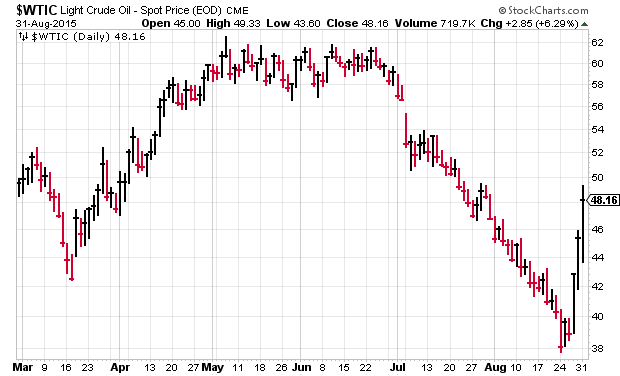
As I’ve said, the late summer storm isn’t quite over. The futures are looking lower this morning. Stock markets in Europe were hit hard overnight.
Morning News: September 1, 2015
Posted by Eddy Elfenbein on September 1st, 2015 at 7:07 amChina Data Pulls Down Regional Stocks
IMF’s Lagarde Sees Weaker-Than-Expected Global Economic Growth
German Unemployment Drops as Economy Eases Euro-Area Burden
Eurozone Jobless Rate Falls to Its Lowest Since Early 2012
Russia’s Fist Just Clenched Around the Internet a Little Tighter
World’s Top Oil Trader Vitol Sees Price Stuck at $40-$60 to 2016
Don’t Ditch Emerging Markets Just Because They’re Down
Valean Picks Up AstraZeneca Psoriasis Drug After Amgen Exit
Gold Prices Higher as Possible Fed Rate Rise Seen Later
Calpers, Calstrs Want Bank of America to Separate Roles of Chairman, CEO
Brazil’s Economic Crisis Is Destroying the World’s Busiest Helicopter Market
The Bustle in the Frozen Food Aisle
European Firms Team Up to Target Google in Civil Lawsuits
Roger Nusbaum: A White Knuckle Ride To A Small Gain
What Startup CEOs Can Learn From a No-No
Be sure to follow me on Twitter.
There Are No Hacks in the Market
Posted by Eddy Elfenbein on August 31st, 2015 at 1:32 pmWhen I was in college, my friends often came up with crazy “can’t miss” business ideas. One week, they were going to sell imported leather goods. Another week, they were going to scalp concert tickets. They always knew somebody who knew somebody who probably knew somebody else.
It didn’t take long for me to realize that these business ideas rarely involved much work on their part. Instead, they were transactions that exploited some apparently unfilled gap in the market. Not surprisingly, these business ideas never worked out. The lesson is that there’s no way to hack the economy.
I thought of that as I read Josh Brown’s recent post “Computers are the New Dumb Money.” This past week was an unhappy one for computerized trading. Josh relayed the story of hearing a quant saying he “could write a program that crushes the market in my sleep.” Yeah, sure. A $20 trillion market can be so easily hacked.
To be sure, there are patterns that emerge which can be exploited for some time. Then it stops and the computers are never told when. As Josh said, “The problem with computers is that they can’t be programmed with humility.”
This is also why I tell investors to steer clear of stock screeners or any over-systemized investing approach. They may work, and they’ll keep on working—until they don’t. It’s a very reassuring thought that very few hedge funds have beaten Smuckers (SJM), the jelly people.

I take back what I said before; there really are ways to hack the economy. For example, hard work. A college student can wake up early on a Saturday and mow someone’s lawn. They can do a good job and get referrals. Pretty soon, the student can make some decent spending money.
In the stock market, there are hacks as well. For example, value investing. Time after time, academic studies have shown that it works, and in markets all around the world. For all the evidence, you’d think more people would pay attention. Instead, they’re buying BABA for a quick buck. It’s about to pop. I heard it from someone who heard it from someone….
Stocks Yielding 3% in the S&P 500
Posted by Eddy Elfenbein on August 31st, 2015 at 10:38 amI count 112 stocks in the S&P 500 that are currently yielding more than 3%. Not all are utility stocks. Some of the 3%-ers include:
Johnson & Johnson (JNJ)
Walmart (WMT)
Coke (KO)
Procter & Gamble (PG)
Cisco (CSCO)
Merck (MRK)
General Mills (GIS)
Emerson Electric (EMR)
Sysco (SYY)
Waste Management (WM)
Kohl’s (KSS)
Ford (F)
Pepsi (PEP)
McDonald’s (MCD)WSJ on Signature Bank
Posted by Eddy Elfenbein on August 31st, 2015 at 9:23 amSometimes I feel like we’re the only ones who know about Signature Bank (SBNY). For the bank, they probably don’t care about the attention. The bank gets a nice little write-up in today’s WSJ.
Signature Bank is a throwback to a simpler time in banking, a low-profile firm with a plain-vanilla business model focused on lending and deposits.
Then again, it is also one of the country’s quirkiest and fastest-growing banks, with an unusual collection of high-profile fans.
Among the bank’s admirers are former Congressman Barney Frank, who recently joined its board, and hip-hop producer Irv “Gotti” Lorenzo, who calls himself a Signature customer for life after the bank stood by him when he was facing money-laundering charges.
The New York bank, with its headquarters on Fifth Avenue in Manhattan, maintains only a handful of branches, most in the upper floors of office towers. By lending primarily to private businesses and affluent individuals in the New York metropolitan area, Signature has grown in its nearly 15 years of operation to about $30 billion in assets, making it now one of the 50-biggest banks in the U.S.
Investors, too, have discovered Signature: Its shares have increased more than 345% over the past decade, crushing the more-than-25% decline in the KBW bank index over the same period.
Fueled by 23 consecutive quarters of earnings growth, the bank has seen its asset growth outperform all other banks with more than $20 billion in assets as of the end of July, many of which have significantly more complicated structures and balance sheets.
“Banking in and of itself is a fairly simple business: You take deposits and make loans,” said Christopher McGratty, an analyst at Keefe, Bruyette & Woods. “These guys do that exceptionally well.”
Read the whole thing.
Morning News: August 31, 2015
Posted by Eddy Elfenbein on August 31st, 2015 at 7:07 amJapan Factory Output Turns Down in July as China Demand Slumps
Macau Economy Slumps 26.4% as Anti-Graft Crackdown Deters Gamblers
Challenged on Left and Right, the Fed Faces a Decision on Rates
30-Minute VIX Frenzy Exposes Obsession With Volatility Hedging
Oil Falls Back Below $49 as Glut, China Concerns Weigh
When the Wells Run Dry: California Neighbors Cope in Drought
Would FCA’s Sergio Marchionne Really Try to Force GM Into A Merger?
Eni Open to Selling Stake in Supergiant Egypt Gas Find
BNY Mellon Races to Fix Pricing Glitches Before Markets Open Monday
The Carlyle Group Announces Agreement to Acquire Blyth Inc. for $98 Million
Toshiba Delays Annual Results Again as More Accounting Errors Found
Joshua Brown: Digesting a Week of Wonder
Jeff Miller: Weighing the Week Ahead: What Are The Lessons From the Market Turmoil?
Be sure to follow me on Twitter.
The S&P 500 Gained 0.91% Last Week
Posted by Eddy Elfenbein on August 30th, 2015 at 9:23 pmI just have to point out that in all the recent drama, the S&P 500 gained 0.91% last week. If you hadn’t followed last week’s market and only looked at Friday’s closing numbers, you probably would have thought it was a dull week for trading.
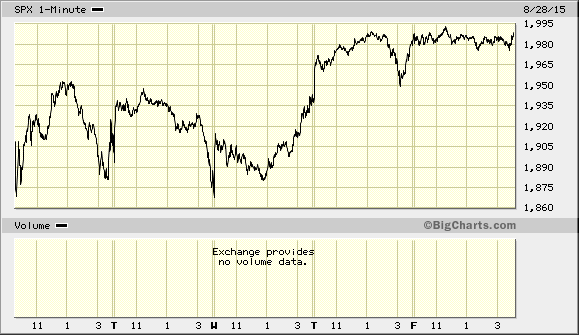
The futures market for the S&P 500 is currently down about 1.1% so we can expect a lower open. Beware. There will be more volatility next week.
Today, Jon Hilsenrath reported in the WSJ that the Fed is still ready to raise rates later this year. That shouldn’t be much of a surprise. They’ve been sending strong signals lately. A minor, albeit unpleasant, stock market decline won’t change their minds.
During the Federal Reserve Bank of Kansas City’s annual economic symposium here, many policy makers signaled that stock-market volatility and China’s woes haven’t seriously dented their view that the U.S. job market is improving, and that domestic economic output is expanding at a steady, modest pace.
Inflation might remain low for longer thanks to falling oil prices and a strong dollar. Officials will continue to keep a close watch on markets and China. But they hope U.S. consumer-price inflation will start inching toward their 2% annual target as the economy’s untapped capacity gets used up, leaving them in position to start raising rates after several months of forewarning.
“There is good reason to believe that inflation will move higher as the forces holding inflation down—oil prices and import prices, particularly—dissipate further,” said Fed Vice Chairman Stanley Fischer in comments delivered to the conference, which ended Saturday.
Finally, today is Warren Buffett’s 85th birthday. We wish him a happy birthday. Here he is in 1962:
-
Archives
- July 2026
- June 2026
- May 2026
- April 2026
- March 2026
- February 2026
- January 2026
- December 2025
- November 2025
- October 2025
- September 2025
- August 2025
- July 2025
- June 2025
- May 2025
- April 2025
- March 2025
- February 2025
- January 2025
- December 2024
- November 2024
- October 2024
- September 2024
- August 2024
- July 2024
- June 2024
- May 2024
- April 2024
- March 2024
- February 2024
- January 2024
- December 2023
- November 2023
- October 2023
- September 2023
- August 2023
- July 2023
- June 2023
- May 2023
- April 2023
- March 2023
- February 2023
- January 2023
- December 2022
- November 2022
- October 2022
- September 2022
- August 2022
- July 2022
- June 2022
- May 2022
- April 2022
- March 2022
- February 2022
- January 2022
- December 2021
- November 2021
- October 2021
- September 2021
- August 2021
- July 2021
- June 2021
- May 2021
- April 2021
- March 2021
- February 2021
- January 2021
- December 2020
- November 2020
- October 2020
- September 2020
- August 2020
- July 2020
- June 2020
- May 2020
- April 2020
- March 2020
- February 2020
- January 2020
- December 2019
- November 2019
- October 2019
- September 2019
- August 2019
- July 2019
- June 2019
- May 2019
- April 2019
- March 2019
- February 2019
- January 2019
- December 2018
- November 2018
- October 2018
- September 2018
- August 2018
- July 2018
- June 2018
- May 2018
- April 2018
- March 2018
- February 2018
- January 2018
- December 2017
- November 2017
- October 2017
- September 2017
- August 2017
- July 2017
- June 2017
- May 2017
- April 2017
- March 2017
- February 2017
- January 2017
- December 2016
- November 2016
- October 2016
- September 2016
- August 2016
- July 2016
- June 2016
- May 2016
- April 2016
- March 2016
- February 2016
- January 2016
- December 2015
- November 2015
- October 2015
- September 2015
- August 2015
- July 2015
- June 2015
- May 2015
- April 2015
- March 2015
- February 2015
- January 2015
- December 2014
- November 2014
- October 2014
- September 2014
- August 2014
- July 2014
- June 2014
- May 2014
- April 2014
- March 2014
- February 2014
- January 2014
- December 2013
- November 2013
- October 2013
- September 2013
- August 2013
- July 2013
- June 2013
- May 2013
- April 2013
- March 2013
- February 2013
- January 2013
- December 2012
- November 2012
- October 2012
- September 2012
- August 2012
- July 2012
- June 2012
- May 2012
- April 2012
- March 2012
- February 2012
- January 2012
- December 2011
- November 2011
- October 2011
- September 2011
- August 2011
- July 2011
- June 2011
- May 2011
- April 2011
- March 2011
- February 2011
- January 2011
- December 2010
- November 2010
- October 2010
- September 2010
- August 2010
- July 2010
- June 2010
- May 2010
- April 2010
- March 2010
- February 2010
- January 2010
- December 2009
- November 2009
- October 2009
- September 2009
- August 2009
- July 2009
- June 2009
- May 2009
- April 2009
- March 2009
- February 2009
- January 2009
- December 2008
- November 2008
- October 2008
- September 2008
- August 2008
- July 2008
- June 2008
- May 2008
- April 2008
- March 2008
- February 2008
- January 2008
- December 2007
- November 2007
- October 2007
- September 2007
- August 2007
- July 2007
- June 2007
- May 2007
- April 2007
- March 2007
- February 2007
- January 2007
- December 2006
- November 2006
- October 2006
- September 2006
- August 2006
- July 2006
- June 2006
- May 2006
- April 2006
- March 2006
- February 2006
- January 2006
- December 2005
- November 2005
- October 2005
- September 2005
- August 2005
- July 2005
 Eddy Elfenbein is a Washington, DC-based speaker, portfolio manager and editor of the blog Crossing Wall Street. His