-
Morning News: July 10, 2015
Posted by Eddy Elfenbein on July 10th, 2015 at 7:03 amFrance Hails Greek Aid Proposals as Germany Reserves Judgment
Greek Parliament to Back Plan, Says Party Leader
China’s Stock-Market Woes Trace Roots to Earlier Stimulus
Ignore the ‘Faint Whiff of Panic;’ Global Growth Is Accelerating
Water, Water Everywhere? Caribbean Adds to Global Drought
Oil Pares Gain as IEA Sees Lower Price While Iran Talks Drag On
Big Oil Wins Again: Why BP Isn’t Sweating Its “Historic” Gulf Spill Settlement
eBay’s Enterprise Unit Takes a Hit Amid Sale Talks
Reinventing Google for a Mobile World
Splunk Just Spent Millions To Buy a Hot Security Startup
China Fears Propel Apple Shares Toward Five-Day Losing Streak
Facebook Said to Seek Music Video Licensing Deals
Takata Says No to Fund for Victims of Defective Airbag
Jeff Miller: Evaluating the Risk From the Chinese Stock Bubble
Be sure to follow me on Twitter.
-
Energy Resumes Downtrend
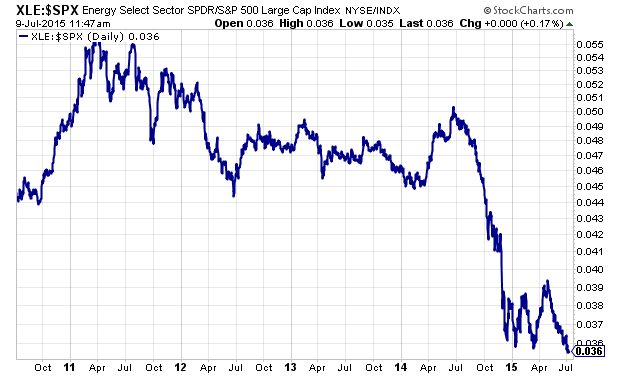
Posted by Eddy Elfenbein on July 9th, 2015 at 11:48 amEnergy stocks badly lagged the market during the second half of last year. That seemed to have ended this year, but it didn’t last. Energy stocks have again started to lag the market.
Check out this chart of the relative strength of the Energy Sector ETF (XLE):
-
Morning News: July 9, 2015
Posted by Eddy Elfenbein on July 9th, 2015 at 7:15 amEU’s Tusk Latest to Urge Some Greek Debt Help
Proof That Merkel Is Europe’s Economic Bully
Deal or No Deal, Greece Faces a Difficult Aftermath
Irrational Exuberance Triggers Chaos as China Watchdog Sidelined
Trans-Pacific Partnership’s Potential Impact Weighed in Asia and U.S.
Oil Rout Seen Ending as Demand Trumps China’s Market Crash
The Stock Market Bell Rings, Computers Fail, Wall Street Cringes
IBM Announces Computer Chips More Powerful Than Any In Existence
PepsiCo Profit, Revenue Beat Estimates as Higher Pricing Pays Off
Walgreens Beats Earnings Estimates and Appoints Pessina CEO
Albertsons Grocery Chain Makes Plans For Initial Public Offering
Alfa Oil Dream Falters as $1.7 Billion Pacific Bid Withdrawn
With Options Dwindling, BP Seized a Chance to Settle Oil Spill Case
Howard Lindzon: The China Panic
Roger Nusbaum: The Futility of Retirement Calculators
Be sure to follow me on Twitter.
-
No Reason to Panic
Posted by Eddy Elfenbein on July 8th, 2015 at 2:57 pmThe NYSE has said that they want to open at 3:10 pm. We’re about there.
The key for investors is that there’s no reason to panic. This only impacts trading on the NYSE. When you place a buy order, it automatically goes to the lowest price it can find. The computers have lots of exchanges to choose from. The closure of the NYSE has little to no impact on today’s market.
-
Stock Returns and Inflation Expectations
Posted by Eddy Elfenbein on July 8th, 2015 at 2:35 pmI wanted to see how well the stock market has performed at different points of the 10-year breakeven inflation rate. I took the Wilshire 5000 Total Return index and saw how it performed against the 10-year breakeven.
The results are interesting.
Since 2003, the Wilshire 5000 has gained 14.54% when the 10-year breakeven is 2.36% or less.
When it’s 2.37% or more, the Wilshire has an annualized loss of 0.21%.
Since 2003, the 10-year breakeven inflation rate has been 2.36% or less about two-thirds of the time. It’s currently at 1.87%. It’s been below 2.36% continuously since April 30, 2013.
-
NYSE Halts All Trading
Posted by Eddy Elfenbein on July 8th, 2015 at 11:50 amThe New York Stock Exchange has halted all trading. I don’t know the details but it appears to be a technical issue. Trading stopped at 11:32 am.
Update: Trading is still closed on the NYSE. Remember that NYSE-listed securities still trade on other exchanges. The NYSE said it is an internal issue, not an outside cyber attack.
-
Morning News: July 8, 2015
Posted by Eddy Elfenbein on July 8th, 2015 at 7:11 amGreece Faces Euro Exit Unless Demands Accepted by Sunday
Tsipras Pleads For Fair Deal For Greece in EU Parliament
China Stocks Plunge as State Support Fails to Revive Confidence
Market’s Dive Could Delay Economic Reforms in China
OECD Indicators Point to Growth Slowdown in Major Economies
Nissan Says Takata Air Bag Inflator Caused Fire in Japan Crash
Major Job Cuts Expected at Microsoft
Why Amazon Should Fear Alibaba
Didi Kuaidi Raises $2 Billion in Fresh Funding
Disney Wins City Tax Deal in Exchange for $1 Billion Park Pledge
Hostess CEO Says No Plan For Twinkie IPO
Barclays’s McFarlane Ousts CEO, Criticizes Cumbersome Bank
Corzine, Other Ex-MF Global Officials Settle Suit for $64.5 Million
Cullen Roche: Never Invest in Something You Cannot Understand
Credit Writedowns: More on Greek Tax Anticipation Note IOUs
Be sure to follow me on Twitter.
-
Below 2,050
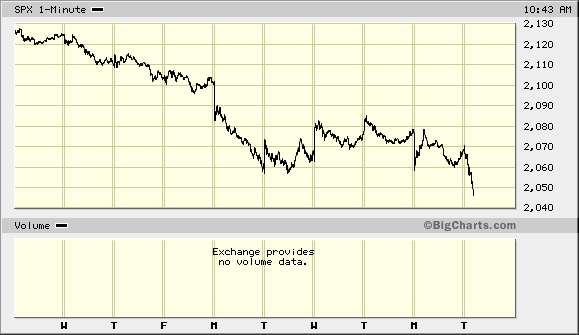
Posted by Eddy Elfenbein on July 7th, 2015 at 10:47 amFor the first time since April 1, the S&P 500 is below 2,050.
The index has also given up its 200-day moving average.
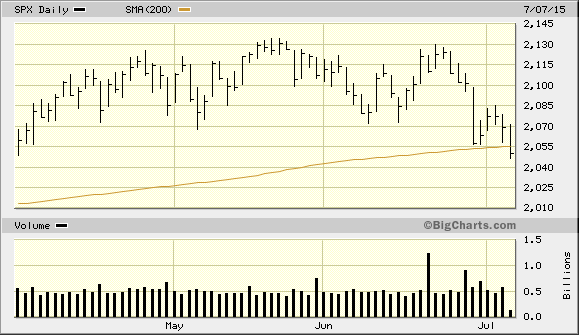
The S&P 500 has had a pretty good run of staying above its 200-DMA. There was a brief stretch of six days last October when the index drifted below its 200-DMA (thanks to Ebola). Before that, the last time the S&P 500 closed below its 200-DMA was November 16, 2012.
-
How to Game the Market
Posted by Eddy Elfenbein on July 7th, 2015 at 8:30 amFrom Bloomberg:
It’s an easy way to game the stock market, and getting easier by the day.
With some deft maneuvers, hedge funds and Wall Street trading desks are reaping hundreds of millions at the expense of index mutual funds, the investments of choice for a growing number of ordinary Americans.
The tactic, in some ways, resembles illegal front-running – – but in this case, it’s perfectly fine. The traders are simply buying stocks before they’re added to the indexes that, by definition, index funds must track.
As the popularity of index investing soars to new heights, the emergence of index front-running is raising fundamental questions about so-called passive investment strategies, as well as how indexes are compiled and the role the funds themselves play in elevating costs. By one estimate, it gouges owners of funds tracking the Standard & Poor’s 500 Index to the tune of $4.3 billion a year, a sum that can double or even triple the cost of such investments.
“Portfolio managers are aware of it, but some of them will say ‘My clients demand an index fund, and I’m going to give it to them come hell or high water,’” Michael Rawson, an analyst at Morningstar Inc., said from Chicago. “Yes, you matched the index return, but the investor is now worse off. You don’t hear about that as much.”
-
“Fixed Income is Always a Good Foundation for a Portfolio”
Posted by Eddy Elfenbein on July 7th, 2015 at 7:52 amFrom Simon Constable at the Wall Street Journal:
Given the expected rise in interest rates, does your portfolio still need a healthy allocation of bonds? Probably yes, according to the experts.
Many agree that the security and diversification bonds offer shouldn’t be spurned just because the direction of rates could be changing. But, depending on the investor, now may be a good time to adjust the size of that allocation and its contents, with regard to lengths of maturities and levels of risk.
“Fixed income is always a good foundation for a portfolio,” says Eddy Elfenbein, Washington, D.C., author of the Crossing Wall Street blog and newsletter. “Security and safety.… Each month and quarter there is a regular check from the coupons.”
Mr. Elfenbein says he generally suggests a 30% allocation in bonds once investors hit 40, and an increasing allocation as the years progress. Younger investors may want to be in stocks only, he says, because they will be able to weather more market swings.
-
Archives
- September 2026
- August 2026
- July 2026
- June 2026
- May 2026
- April 2026
- March 2026
- February 2026
- January 2026
- December 2025
- November 2025
- October 2025
- September 2025
- August 2025
- July 2025
- June 2025
- May 2025
- April 2025
- March 2025
- February 2025
- January 2025
- December 2024
- November 2024
- October 2024
- September 2024
- August 2024
- July 2024
- June 2024
- May 2024
- April 2024
- March 2024
- February 2024
- January 2024
- December 2023
- November 2023
- October 2023
- September 2023
- August 2023
- July 2023
- June 2023
- May 2023
- April 2023
- March 2023
- February 2023
- January 2023
- December 2022
- November 2022
- October 2022
- September 2022
- August 2022
- July 2022
- June 2022
- May 2022
- April 2022
- March 2022
- February 2022
- January 2022
- December 2021
- November 2021
- October 2021
- September 2021
- August 2021
- July 2021
- June 2021
- May 2021
- April 2021
- March 2021
- February 2021
- January 2021
- December 2020
- November 2020
- October 2020
- September 2020
- August 2020
- July 2020
- June 2020
- May 2020
- April 2020
- March 2020
- February 2020
- January 2020
- December 2019
- November 2019
- October 2019
- September 2019
- August 2019
- July 2019
- June 2019
- May 2019
- April 2019
- March 2019
- February 2019
- January 2019
- December 2018
- November 2018
- October 2018
- September 2018
- August 2018
- July 2018
- June 2018
- May 2018
- April 2018
- March 2018
- February 2018
- January 2018
- December 2017
- November 2017
- October 2017
- September 2017
- August 2017
- July 2017
- June 2017
- May 2017
- April 2017
- March 2017
- February 2017
- January 2017
- December 2016
- November 2016
- October 2016
- September 2016
- August 2016
- July 2016
- June 2016
- May 2016
- April 2016
- March 2016
- February 2016
- January 2016
- December 2015
- November 2015
- October 2015
- September 2015
- August 2015
- July 2015
- June 2015
- May 2015
- April 2015
- March 2015
- February 2015
- January 2015
- December 2014
- November 2014
- October 2014
- September 2014
- August 2014
- July 2014
- June 2014
- May 2014
- April 2014
- March 2014
- February 2014
- January 2014
- December 2013
- November 2013
- October 2013
- September 2013
- August 2013
- July 2013
- June 2013
- May 2013
- April 2013
- March 2013
- February 2013
- January 2013
- December 2012
- November 2012
- October 2012
- September 2012
- August 2012
- July 2012
- June 2012
- May 2012
- April 2012
- March 2012
- February 2012
- January 2012
- December 2011
- November 2011
- October 2011
- September 2011
- August 2011
- July 2011
- June 2011
- May 2011
- April 2011
- March 2011
- February 2011
- January 2011
- December 2010
- November 2010
- October 2010
- September 2010
- August 2010
- July 2010
- June 2010
- May 2010
- April 2010
- March 2010
- February 2010
- January 2010
- December 2009
- November 2009
- October 2009
- September 2009
- August 2009
- July 2009
- June 2009
- May 2009
- April 2009
- March 2009
- February 2009
- January 2009
- December 2008
- November 2008
- October 2008
- September 2008
- August 2008
- July 2008
- June 2008
- May 2008
- April 2008
- March 2008
- February 2008
- January 2008
- December 2007
- November 2007
- October 2007
- September 2007
- August 2007
- July 2007
- June 2007
- May 2007
- April 2007
- March 2007
- February 2007
- January 2007
- December 2006
- November 2006
- October 2006
- September 2006
- August 2006
- July 2006
- June 2006
- May 2006
- April 2006
- March 2006
- February 2006
- January 2006
- December 2005
- November 2005
- October 2005
- September 2005
- August 2005
- July 2005
 Eddy Elfenbein is a Washington, DC-based speaker, portfolio manager and editor of the blog Crossing Wall Street. His