-
April NFP +223,000
Posted by Eddy Elfenbein on May 8th, 2015 at 8:48 amThe Labor Department said the U.S. economy created 223,000 net new jobs last month. That was pretty close to what analysts had been expecting. The unemployment rate fell to 5.4% which is a seven-year low. The jobless rate is now lower than it was at any time between July 1974 and March 1988.
The NFP figure for March was revised lower by 39,000. That was weak to begin with and it got weaker. The number for February was revised higher by 2,000.
Average hourly earnings rose just 0.1%, and the March figured was revised down from 0.3% to 0.2%.
-
CWS Market Review – May 8, 2015
Posted by Eddy Elfenbein on May 8th, 2015 at 7:08 am“The stock market is going to fluctuate. Sometimes it will
fluc down; other times it will fluc up.” – Louis RukeyserThis week, Fed Chairwoman Janet Yellen spooked Wall Street when she said, “I would highlight that equity market valuations at this point generally are quite high.”
Uh-oh. Look, I’ve got nothing against Dr. Yellen. She’s a first-rate economist. But I’ll point out that Fed Chairs don’t exactly have a sterling record with their market calls. Remember when Alan Greenspan famously warned of the market’s “irrational exuberance” in 1996? The market doubled over the next three years. Just last summer, Yellen warned us that valuations for social media and biotech stocks were “substantially stretched.” The Nasdaq Biotech ETF (IBB) is up a cool 33% since then. I won’t even go into their dismal economic projections.
In one sense, Yellen is correct that valuations are high, if we assume that the strong dollar’s hit to earnings is going to last. But if the strong greenback’s damage is temporary, which the market’s betting on, then I don’t think we have anything to worry about.
With high valuations, the question that must always be asked is, compared to what? With bond yields so low, stocks need to be higher to compete for investors’ money. The difference now is that the bond market has recently started to turn south.
In this week’s CWS Market Review, we’ll take a closer look at the bond market’s recent grumpiness. I’ll also cover our recent Buy List earnings reports. Moog (MOG-A) pulled back on poor guidance, but both Cognizant (CTSH) and Fiserv (FISV) jumped higher on their strong earnings reports. I’ll have details in a bit. But first, let’s look at what’s got the bond market so annoyed.
Whither the Bond Market?
Suddenly, everyone’s worried about the bond market. The yield on the 10-year Treasury rose seven times in eight days. On Wednesday and Thursday, the yield got to 2.25%, which is the highest in two months.
Of course, some of this needs to be put in context. Bond yields are hardly high; they’re just higher than where they were a few weeks ago, and that was pretty darn low. The 10-year yielded 3% in early 2014, and we’re still well below that.
The 10-year yield gained 31 basis points in eight sessions. That’s enough to get people’s attention. This may sound like blasphemy, but I think some of the strength in bonds is due to a stronger economy. The evidence isn’t in just yet, but I suspect the bond market is already placing its bets.
GDP for Q1 was bad. This week’s trade data indicates that the revisions will be even worse. In fact, it’s very likely that Q1 was negative. But that data is already somewhat aged. The first quarter ended more than five weeks ago. The recent initial jobless claims have been quite strong. These are some of the lowest numbers we’ve seen in decades.
We’re also seeing that commodity prices are on the rise. Oil, in fact, has been hot. On Wednesday, West Texas Intermediate got as high as $62.58 per barrel. That’s up $20 per barrel from the March low. (Anyone else remember in February when Citigroup said oil could fall to $20 per barrel? Yeah, me neither.)
The sour mood for bonds has been mirrored in the stock market by an increase in cyclical stocks. The chart below shows how the relative strength of Tech Stocks (XLK, black line) has closely followed the path of the 10-year Treasury yield (blue line). You can see it’s a pretty close fit.
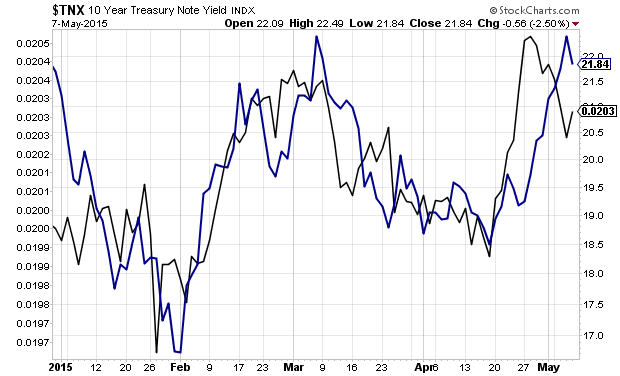
I think this suggests some hidden strengths in the economy. Or at least, that it`s stronger than people currently expect. It also means that investors are willing to leave safe havens behind and dip their toes in riskier areas of the market. It’s interesting to see that the safe and secure Utility Sector (XLU) has lagged of late.
I doubt the change in risk perception has much, if anything, to do with the Fed and the endless guessing about interest rates. The dollar’s been trending down, and gold hasn’t done much.
My advice is to ignore the bond worries. That could be an issue at some point, but we’re still a long way away. A red flag is when the 2-year yield exceeds the 10-year. The 10-year still beats the 2-year by more than 150 basis points. The smart companies are taking advantage of low yields. Just this week, Oracle (ORCL) floated $1.25 billion in 40-year bonds. Microsoft (MSFT) floated $2.25 billion of 40-year paper in February.
Investors should continue to focus on high-quality stocks like you’ll find on our Buy List. I think growth stocks will be more in favor over the next few months. Some names I especially like right now are Ford Motor (F), Ross Stores (ROST) and Wells Fargo (WFC).
Moog Beats Earnings but Lowers Guidance Again
Last Friday, Moog (MOG-A) reported fiscal-Q2 earnings of 96 cents per share. That was five cents more than estimates. Revenue came in at $637 million, which was down 2% from last year’s Q2.
Frankly, this wasn’t a good quarter. As in Q1, Moog was hurt by currency. In particular, sales dropped 15% at their Industrial Systems segment. Moog’s CEO, John Scannell, noted that the company had some unusual charges last quarter: “Excluding these charges, our underlying business performed well in the face of an adverse shift in our aircraft sales and on-going macroeconomic headwinds. As we navigate through these challenges, we continue to focus on operational improvements, strong cash flow and allocating capital to create value for our shareholders.”
In January, Moog lowered its full-year guidance from $4.25 to $3.85 per share, but that`s potentially $3.95 with share buybacks. They just lowered it again. Moog now sees full-year earnings of $3.55 per share. That includes 24 cents in special adjustments.
The market didn’t like this news at all. The shares were over $72 last week. This week, they dropped under $66. I’m not pleased with Moog’s performance this year. I’m lowering my Buy Below to $72 per share.
Cognizant Technology Solutions Earned 71 Cents per Share
On Monday, Cognizant Technology Solutions (CTSH) released a very good earnings report. The IT outsourcer earned 71 cents per share last quarter, one penny more than estimates. Their guidance had been for EPS of at least 69 cents. (CTSH is a fan of using “at least” in their forecasts.) Revenue rose 20.2% to $2.91 billion. Guidance had been for at least $2.88 billion.
For Q2, Cognizant forecasts earnings of at least 72 cents per share on revenue of at least $3.01 billion. For the whole year, they see earnings of at least $2.93 per share. That’s an increase of two cents per share from their earlier guidance. They also increased their revenue guidance from at least $12.21 billion to at least $12.24 billion.
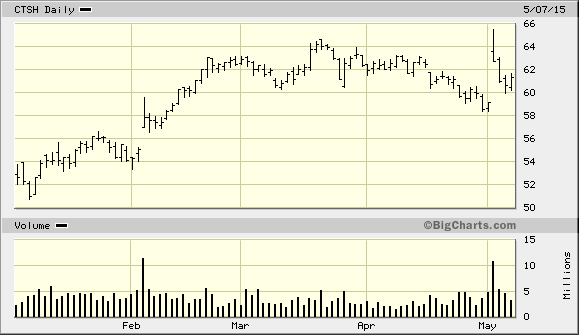
The stock reacted very well to the earnings report. Bear in mind that CTSH had been weak going into the earnings, despite a strong year overall. I think some traders were worried that CTSH was about to drop an earnings dud. They were wrong. The stock gapped as much as 11% higher on Monday and reached a new 52-week high. The stock pulled back later in the week but finished the day on Thursday at $61.31 per share. It’s our top performer this year, with a gain of 16.43%. Not bad for early May! Cognizant remains a strong buy up to $66 per share.
Fiserv: 30 Straight Years of Double-Digit Earnings Growth
After the closing bell on Tuesday, Fiserv (FISV) reported Q1 earnings of 89 cents per share. That’s a very good number. That’s a 9% increase over last year’s Q1, and it’s three cents better than expectations. Adjusted revenue grew by 4% to $1.19 billion.
“We are pleased with our strong start to the year,“ said Jeffery Yabuki, President and Chief Executive Officer of Fiserv. “Results for the quarter were consistent with our full-year expectations, highlighted by strong operating performance and excellent growth in free cash flow.”
Fiserv reiterated their revenue and earnings forecasts for this year. They expect internal revenue to grow by 5% to 6% and EPS to range between $3.73 and $3.83. Since Fiserv made $3.37 per share last year, this year’s guidance works out to an earnings-growth rate of 11% to 14%. If that’s right, this will be Fiserv’s 30th-straight year of double-digit earnings growth. That’s simply amazing.
The shares gapped up in early trading on Wednesday. At one point, FISV hit $80.79 per share, which is just shy of a new 52-week high. I like this stock a lot, but I urge investors not to chase Fiserv. Be patient and let good stocks come to you. Fiserv is an excellent buy up to $80 per share.
Buy List Notes
That’s the end of earnings season for our 16 Buy List stocks that have quarters ending in March. We have two Buy List stocks, Hormel Foods (HRL) and Ross Stores (ROST), which ended their quarters in April. Hormel will report Q2 earnings on Wednesday, May 20th, and Ross Stores follows the next day. I’ll have more details in next week’s issue.
I also wanted to comment on last Friday’s big spike in Wabtec (WAB). The shares jumped more than 6.1%. The reason for the rally was new rules out of Washington. As it turns out, Wabtec is one of only two companies that make electronically controlled pneumatic (ECP) brakes for trains. The Department of Transportation said that trains with more than 70 tank cars will have to have ECP. If not, they can’t go more than 30 mph.
The back story is that shipping oil by rail has skyrocketed in recent years. This year, it’s projected that 374 million barrels of oil will be shipped by rail. That’s up from 30 million in 2010. More shipments means more accidents, so the Feds are trying to improve safety—and that means ECP. Wabtec is a good buy up to $103 per share.
That’s all for now. Earnings season winds down next week. There will be a few key economic reports coming our way. The retail sales report is on Wednesday. Wholesale inflation follows on Thursday, and industrial production is on Friday. Industrial production has been in a troubling downward trend since November. The March report was especially poor. I’m curious to see if this continues. Be sure to keep checking the blog for daily updates. I’ll have more market analysis for you in the next issue of CWS Market Review!
– Eddy
-
Morning News: May 8, 2015
Posted by Eddy Elfenbein on May 8th, 2015 at 7:04 amIs Argentina’s Economy Pulling a Tango Turnaround?
China to Raise Wholesale Tax Rate for Cigarettes to 11%
Wal-Mart to Buy Canadian Locations From Target
Syngenta Rejects Monsanto’s $45 Billion Takeover Offer
Forget Loeb. Toyota Courts Japan’s Mom-and-Pop Investors
Yelp Up For Sale? Apple,Google Are Possible Buyers
China’s JD.com Posts 62% Rise in Quarterly Revenue
Amarin’s Vascepa Revenue Grows 42%
Bitcoin Exchange Receives First License in New York State
Profits at CBS Outperform Expectations, but N.F.L. Schedule Causes Revenue Drop
Molson Coors, U.S. Joint Venture MillerCoors Facing Stiff Challenges
Ericsson Sues Apple in Europe Over Phone Patent Royalties
How Jonathan Steinberg Made Good on a Second Chance
Joshua Brown: The Greatest Trick the Devil Ever Pulled
Howard Lindzon: Robinhood – I Love When a Plan Comes Together
Be sure to follow me on Twitter.
-
Morning News: May 7, 2015
Posted by Eddy Elfenbein on May 7th, 2015 at 7:47 amGerman Industrial Orders Up Less Than Expected in March
Brazil’s Real Buffeted By Speculation Over U.S. Rates
London Traders Brace for Marathon in Election All-Nighter
Greek Banks Face Curbs to Foreign Exchange Trading
Wary of Bond ‘Cliff,’ Fed Plans Cautious Cuts to Portfolio
FAA Says Media Can Use Drone Photos From Citizen Journalists, Not Professionals
Tesla Loss Widens as Spending Jumps
Alibaba Names New CEO as Revenue Tops Views
EDF Said to Be Ready to Buy Areva Reactor, Engineering Divisions
Company Creates Bioethics Panel on Trial Drugs
Germany’s Siemens to Cut 4,500 More Jobs as Earnings Slip
Keurig Plummets After Slow Brewer Sales Eat Into Forecast
Hedge Fund Star Dan Loeb Trashes Warren Buffett
Cullen Roche: Yes, The Fed Does Directly Influence the Broad Money Supply Through QE
Roger Nusbaum: NASCAR, Firefighting & Investing
Be sure to follow me on Twitter.
-
Are Stocks Are Overvalued?
Posted by Eddy Elfenbein on May 6th, 2015 at 7:34 pmMatt O’Brien writes at Wonkblog:
Now, stocks have cooled off since the start of the year, but not that much. So does that mean stock prices are “quite high”? Well, that depends on how you look at it. Take Robert Shiller’s cyclically-adjusted price-earnings ratio, or CAPE, which looks at the past ten years of earnings to figure out how pricey stocks are today. The idea here is that it smooths out any big ups or downs, and shows us how fairly valued—or not—stocks are. And by this measure, as you can see below, stocks really are getting expensive.
The only problem is they’ve been getting expensive for awhile low. “According to CAPE,” Crossing Wall Street’s Eddy Elfenbein told me, “stocks have been valued above average for most of the last 25 years.” Part of that is accounting standards are different than they used to be, so valuations are too—they’re higher. Another part is that interest rates having been falling the last three decades, and, all else equal, lower rates should mean higher stock valuations. And the last part is that CAPE overweights what happened before to what’s happening now. Think about it like this. Today’s 27.2 CAPE ratio is so high, in part, because earnings were so bad during the financial crisis. But it’s a little funny to say that a historically crummy economy seven years ago means stocks are overvalued now.
Another way to look at this is to just consider last year’s earnings. Now this has the opposite problem of only weighting what’s happening now. So if earnings are negligible or negative, like they were in 2008, this will say that stocks are super expensive when they’re actually super cheap. But as long as we keep that in mind, this still helps us look at stocks from a slightly different angle. And it tells us that, with a PE ratio of 19.7, the S&P 500 isn’t a bargain, but it isn’t exorbitant either. In other words, it’s a little high, but compared to the last 25 years, not crazily so. (That’d be the tech bubble). Besides, it’s a “misperception that the market falls due to valuation,” Elfenbeing says, when “more often stocks fall with lower fundamentals instead of prices soaring beyond fundamentals.”
Elfenbeing? Was he in The Hobbit?
-
Looking Ahead to Friday’s Jobs Report
Posted by Eddy Elfenbein on May 6th, 2015 at 10:02 amThe big event for the markets this week will be Friday’s jobs report for April. This will be an interesting one because the report for March was quite poor. It’s hard for me to say what will happen. The last initial claims report was very strong. This morning, the ADP report said that the economy created 169,000 new private sector jobs last month. That was below forecasts of 205,000. The consensus for Friday’s report is for 220,000 jobs.
The bond market has been drifting lower over the past three weeks. On April 17, the 10-year yielded as low as 1.845%. The yield has climbed in the last seven days in a row, and it recently broke above 2.2%. That’s still low, but it’s higher than where it was.
The price of oil has also slowly climbed higher. On March 17, West Texas Intermediate got as low as $42.41 per barrel. It’s risen almost nonstop since then. Oil closed at $60.67 yesterday and it’s up again today. That’s a jump of more than 40% in just a few weeks.
Yesterday, Fiserv (FISV) closed out earnings season for our Buy List with a three-cent earnings beat. The shares are up about 2% in early trading. Hormel (HRL) and Ross Stores (ROST) ended their quarters in April so they should report their earnings in a few weeks.
-
Morning News: May 6, 2015
Posted by Eddy Elfenbein on May 6th, 2015 at 7:09 amECB Mulls Tighter Greece Rules After 100 Days of Tspiras
Euro Zone Business Activity Starts Second Quarter on Solid Footing
EU Announces Plans to Create Digital Single Market
E.U. Commission Opens Antitrust Inquiry Into E-Commerce Sector
Never Mind Oil, Iran’s About to Shake the World Pistachio Market
Oil Extends Gain Above $62 as U.S. Crude Supply Glut Seen Easing
U.S. Trade Deficit Explodes to $51.4 Billion
Buffett and Ackman Hate U.S. Bonds and the Losses Are Piling Up
Salesforce’s Cloud Prowess and High Cost Pose Dilemma for Microsoft
Zenefits Tagged With $4.5 Billion Valuation After Just Two Years
Record SUV Sales Help BMW Beat Profit Forecasts
Imperial Tobacco Expects U.S. Deal to Complete Soon
Murdoch’s News Corp. Trails Estimates as Ad Sales Drop
Cullen Roche: Why Do We Care About High Hedge Fund Manager Incomes?
Joshua Brown: Bund Investors Lose 25 Years’ Worth of Yield in Two Weeks!
Be sure to follow me on Twitter.
-
Fiserv Earned 89 Cents per Share
Posted by Eddy Elfenbein on May 5th, 2015 at 4:20 pmAfter the closing bell, Fiserv (FISV) reported Q1 adjusted earnings of 89 cents per share. That’s a 9% increase over last year’s Q1 and it’s three cents better than expectations. Adjusted revenue grew by 4% to $1.19 billion.
“We are pleased with our strong start to the year,“ said Jeffery Yabuki, President and Chief Executive Officer of Fiserv. “Results for the quarter were consistent with our full-year expectations, highlighted by strong operating performance and excellent growth in free cash flow.”
Fiserv reiterated their revenue and earnings forecasts for this year. They expect internal revenue to grow by 5% to 6% and EPS to range between $3.73 and $3.83. Since Fiserv made $3.37 per share last year, this year’s guidance works out to an earnings growth rate of 11% to 14%. If that’s right, this will be Fiserv’s 30th-straight year of double-digit earnings growth.
The shares have largely stayed between $77 and $80 for much of the last three months, but I’m not at all worried. Fiserv is about as solid as they come.
-
Q1 Earnings Calendar
Posted by Eddy Elfenbein on May 5th, 2015 at 4:17 pmHere’s how 16 of our 20 Buy List stocks have reported Q1 earnings in the past few weeks:
 Eddy Elfenbein is a Washington, DC-based speaker, portfolio manager and editor of the blog Crossing Wall Street. His