-
6-Month/1-Year Spread Rises
Posted by Eddy Elfenbein on June 2nd, 2015 at 6:27 pmThe spread between the six-month and one-year Treasury yields recently hit 0.20% for the first time in more than five years. That’s up from four basis points in November.
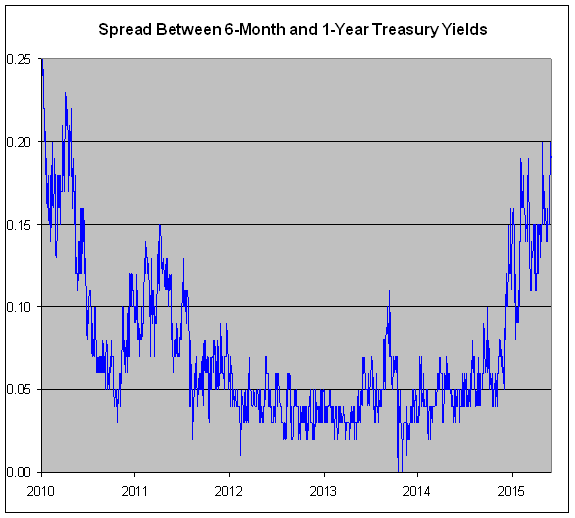
This is yet another sign that the market thinks higher rates are coming soon.
The one-year Treasury closed today at 0.26% while the six-month bill stood at 0.07%. That implies that the six-month bill will yield 0.45% six months from now.
-
Auto Sales Reach 10-Year High
Posted by Eddy Elfenbein on June 2nd, 2015 at 3:37 pmU.S. auto sales were very strong last month:
The U.S. auto industry remained on track for the best sales year in almost a decade as consumers bought cars and trucks at the fastest monthly pace since early 2006.
Sales of pickup trucks and SUVs in May again led the way, which bodes well for profit margins of the major automakers. Consumers are shying away from cars and snapping up trucks and sport utility vehicles as the national average price of gasoline, at $2.75 a gallon, is nearly a dollar less than at this time last year.
As has been the case since the 2008-2009 recession, the auto industry’s recovery continues to outpace that of the overall economy, which is on course to grow 0.8 percent in the second quarter, according to Federal Reserve forecasts.
Consumers are finding it easier to obtain auto loans – another factor in boosting sales, analysts have said. Experian reported the average length of U.S. loans for new and used vehicles in the first quarter hit record highs, and nearly 30 percent of new-vehicle loans have payback periods longer than six years.
This probably represents a rebound from the cold winter. Sales at Ford (F) dropped by 1.3% (Wall Street had been expecting a bigger drop), and the F-Series trucks fell by 10%. Demand is still high for the F-150 as Ford is ramping up production.
-
Tough Times for Dividend Stocks
Posted by Eddy Elfenbein on June 2nd, 2015 at 2:16 pmThe WSJ recently noted that high-dividend stocks have been losing out in the market recently. Utility stocks badly lagged the market in February and haven’t done much since. REIT stocks, which tend to have generous yields, have followed a similar path.
Utilities, real-estate investment trusts and master limited partnerships have been lifted since the financial crisis by a flood of money from portfolio managers and retirees starved for steady investment income amid low bond yields. Investors plowed $48.4 billion into mutual and exchange-traded funds tracking utilities and REITs from 2010 through 2014, according to Morningstar Inc.
But portfolio managers are pulling back from these shares in 2015, as the prospect of the first short-term interest-rate increase by the Federal Reserve in nine years makes high-dividend stocks less attractive. Investors reason that higher rates will boost the payout—and therefore the appeal—of more stable income-paying investments, like government and corporate debt.
Check out this chart. This shows the REIT index divided by the S&P 500 (in blue) along with the utility index divided by the S&P 500 (in black).
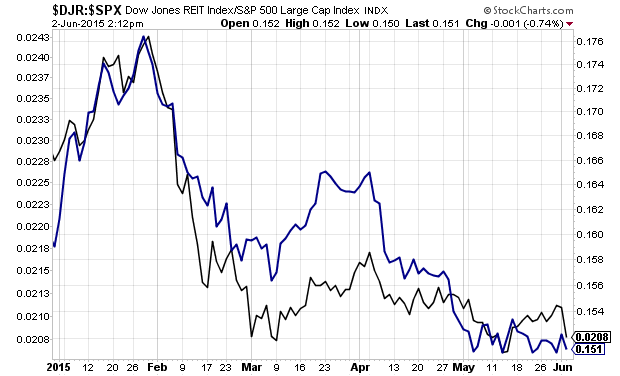
This is a good example of what I described two weeks ago in my “Elfenbein Theory” on the market. What we’re seeing is an anti-Quadrant III rotation.
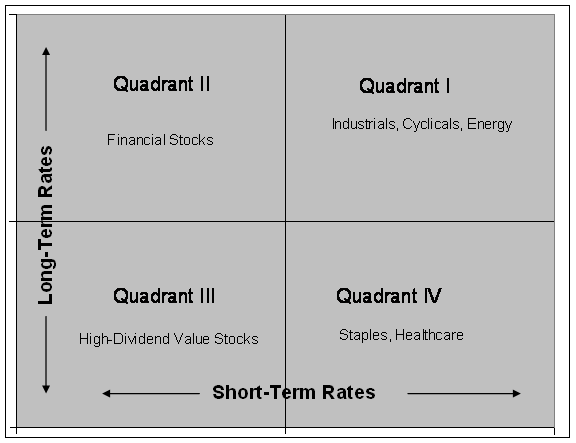
The underlying message of this rotation is that the market is preparing itself for higher interest rates.
-
Morning News: June 2, 2015
Posted by Eddy Elfenbein on June 2nd, 2015 at 7:13 amGreece Calls on Lenders to Accept ‘Realistic’ Plan Sent on Monday
Paul Krugman: That 1914 Feeling
Raghuram Rajan: We Are Under No Illusion That The Economy Is Up And Running
Justices Curb Bankruptcy Filers’ Ability to Have Second Mortgages Canceled
The Potential $1.5 Trillion Stimulus Plan Investors Are Missing
Manufacturing Growth Speeds Up for First Time in 6 Months
Seeking Rate Increases, Insurers Use Guesswork
For UAW Members, Two-Tier Wage Issue Is Personal
Mega Deals Send Merged Companies Up the Ranks of World’s Largest
Intel Agrees to Buy Altera for $16.7 Billion
Ford to Make 40,000 More Vehicles By Cutting Summer Downtime
Takata Says It Will No Longer Make Side Inflater Linked to Airbag Defect
Pinterest Just Revealed How It Is Going To Start Making Some Serious Money
Jeff Carter: All Markets Are Frothy
Roger Nusbaum: Working In Retirement Is A Hope?
Be sure to follow me on Twitter.
-
The Trendline of Real GDP
Posted by Eddy Elfenbein on June 1st, 2015 at 3:24 pmFriday’s GDP report was not a good one. The government revised its estimate of Q1 GDP growth to non-growth, down 0.7%. In the 23 quarters of expansion, this is the third time growth has been negative. They’ve all been Q1s.
This expansion has been far below average. In the last 23 quarters, the economy has averaged 2.2% annualized growth. The economy used to average 4% or 5% growth during expansions followed by -2% or 3% in sharp pullbacks during recessions. Now it’s sluggish growth all the time.
Here’s a good way of expressing just how poorly the economy has done. This is real GDP and I divided it by a trendline that grew at a constant rate of 3.28% per year.
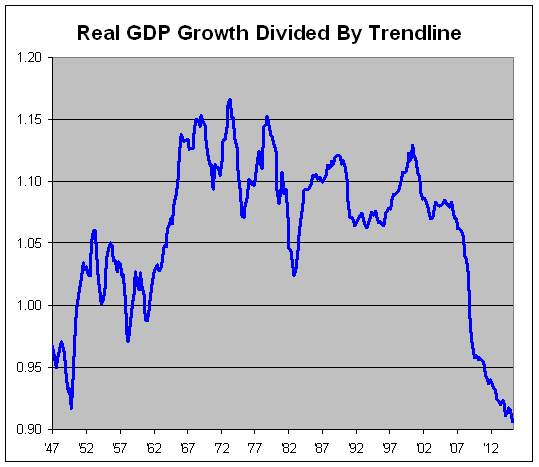
It’s been 15 years since the economy expanded faster than its long-term growth rate. To be fair, I think slower population growth also plays a role.
-
The Dividend Bull Market
Posted by Eddy Elfenbein on June 1st, 2015 at 10:54 amI get annoyed at much of the sloppy talk about the stock market incessantly being “in a bubble.” Here’s Robert Shiller making yet another noncommittal forecast. It seems sophisticated to say that stock prices are too high when in fact, true bubbles are quite rare.
Here’s another way to look at the current market. This is the S&P 500 (blue, left) along with its dividends (black right). I scaled the two lines at a ratio of 50-to-1. In other words, whenever the lines cross, the S&P 500’s dividend yield is exactly 2%.
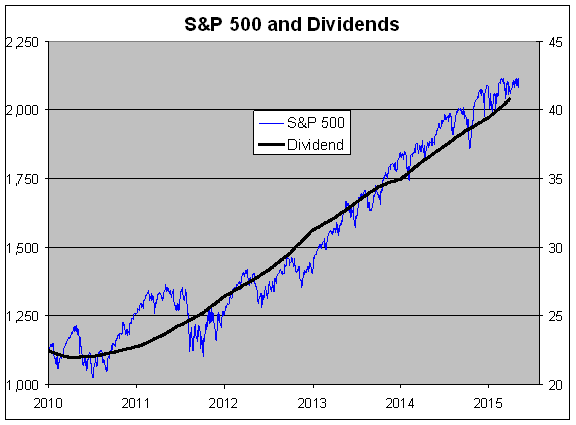
The chart shows that the market has tracked a 2% dividend yield for a few years. My point is that this has been a bull run in dividends as much as it’s been one in stock prices. That, it seems, rarely gets mentioned.
The stock line runs through May but I don’t have the Q2 data point yet for dividends. But I expect it will be a continuation of the trend.
Let me be clear on two points. I’m not saying that dividends are the only measure of valuation, nor am I saying that 2% is some platonic fair value. But dividends have the benefit of being steady and reliable. You’re never quite sure how much money a company has earned, but you do know exactly how much they’ve paid out in dividends.
If there’s any distortion, it may be to the low side since the Federal Reserve must approve capital allocation plans for major banks.
-
May ISM = 52.8
Posted by Eddy Elfenbein on June 1st, 2015 at 10:20 amThis morning, the May ISM index came in at 52.8. That’s a bit above expectations. It’s also the first monthly increase since October.
Construction spending rose 2.2% in April to hit $1 trillion. That’s the highest in six years.
The BEA also said that personal income rose 0.4% in April. Spending was flat. That means Americans are saving a little more.
-
Five Months Down…
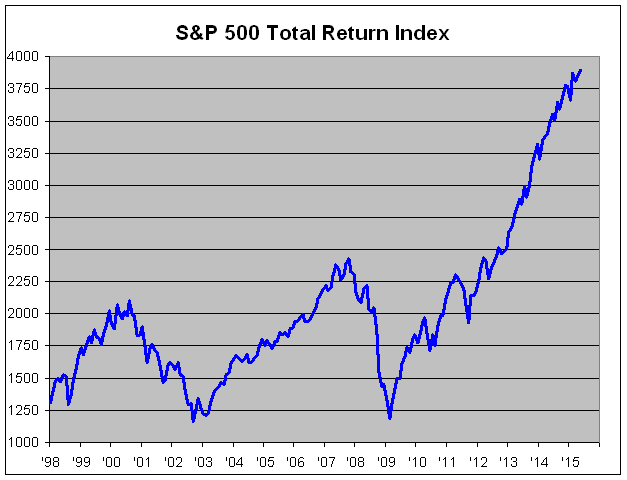
Posted by Eddy Elfenbein on June 1st, 2015 at 9:15 amFriday was the last day of trading for May. With five months down, the S&P 500 is up 2.36% on the year. With dividends, the index is up 3.23%.
Here’s a look at the S&P 500 Total Return Index going back to 1998.
-
Morning News: June 1, 2015
Posted by Eddy Elfenbein on June 1st, 2015 at 7:12 amEuropean Markets Gain as Stimulus Hopes Boost China Shares
Euro Zone Factory Growth Stumbles As Core Struggles: PMI
Sluggish Factory Growth Puts Central Bank Stimulus in Spotlight
OPEC Seen Holding Market Output to Defend Market Share
Britain to Extend Trading Plan to Reduce Its Stake in Lloyds Banking Group
Obama’s Trade Deal Faces Bipartisan Peril in the House
The Fed Whisperer, Misunderstood by Critics, Gains Sway on Board
Frugality of High Earners in U.S. Shows Long Shadow of Recession
Stealth Pays Off At Wells Fargo Investment Arm
Comcast, Time Warner Cable ‘Bottom Dwellers’ in New Consumer Reports Ratings
Macau Gambling Revenue Continues to Drop
Malaysia Airlines CEO Says Carrier ‘Technically Bankrupt’, Set to Cut Jobs, Routes
George Zimmer Starts an ‘Uber for Tailors’
Jeff Miller: Weighing the Week Ahead: Will Job Gains Signal an Economic Rebound?
Be sure to follow me on Twitter.
-
CWS Market Review – May 29, 2015
Posted by Eddy Elfenbein on May 29th, 2015 at 7:08 amFoul-cankering rust the hidden treasure frets,
But gold that’s put to use more gold begets.
– Venus and AdonisWe’re back from a nice holiday respite. I hope everyone had an enjoyable Memorial Day weekend. This has been a quiet time on Wall Street and for our Buy List. Since I sent you the last issue of CWS Market Review, our Buy List is up a whopping 0.04% while the S&P 500 has careened for a massive loss of 0.01%.
Maybe Wall Street knew I was going on vacation!
But don’t despair; there’s good news to pass along. Two of our Buy List stocks, Hormel Foods (HRL) and Ross Stores (ROST), both posted strong earnings last week. I’ll have more details in a bit. I’ll also bring you up to speed on some of the other news impacting our Buy List.
In this week’s CWS Market Review, I’ll tell you that our old friend the Strong Dollar Trade is back in town. I wrote about this a lot last year. All investors need to understand how the rising greenback impacts the stock and bond markets, and in turn, our Buy List. This is a complicated topic and I’ll break it down without using fancy econo-jargon.
Wall Street is still in a good mood. Last Thursday, the S&P 500 closed at an all-time high and one week later, we’re less than 0.5% away from record territory. Several of our Buy List stocks, like eBay (EBAY) and Snap-on (SNA), are at or near new 52-week highs. I’ve also noticed that Wall Street has mostly stopped paring back earnings estimates for Q2. That could be a good sign. Now let’s take a closer look at the return of the Strong Dollar Trade.
The Strong Dollar Trade is Back On
Late last year, I started talking a lot about the Strong Dollar Trade. This was when the U.S. dollar started soaring against other major currencies like the euro and yen. The fallout of this trade could be felt in many different arenas such as in the commodity pits as the price of oil price plunged (crude is traded in dollars) and in the stock market as energy and materials stocks floundered.
To be more precise, it wasn’t that the dollar was doing well; it was that everything else was doing worse, so the dollar, by default, looked good. In Europe, Mario Draghi finally convinced policy makers to give Quantitative Easing a shot. In Japan, after trying everything else for 25 years, the government also launched a plan to weaken the yen in hopes that it would boost the economy. In early August, one dollar would get you 102 yen. Four months later, it got you 121.
For most of this year the yen stabilized against the dollar, but recently, it’s started to fall again. In fact, the yen has lost ground against the dollar in ten of the last 11 trading sessions. The greenback just hit a 12-year high against the yen. The weak-currency tonic may be working; the Japanese stock market is in the midst of its longest rally in 27 years.
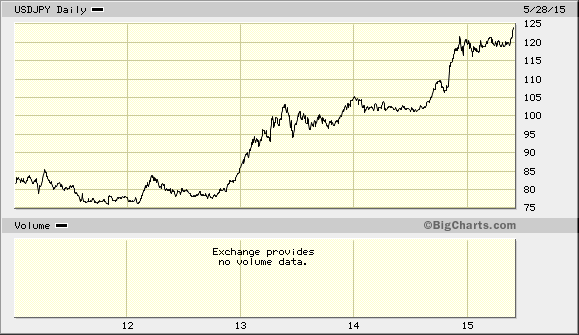
The reason why the strong dollar is back is that the market assumes that the Federal Reserve will raise interest rates at some point and those higher yields will make dollar-denominated assets more attractive. Honestly, it doesn’t look like interest rates will go up in Europe or Japan anytime soon.
The recent economic data hasn’t been great, but it’s showing that the economy is indeed moving ahead. That seems to be good enough for Janet Yellen and her friends at the Fed. Jobless claims have been below 300,000 for 12-straight weeks. Consumer confidence is up. This week we learned that pending home sales reached a nine-year high. Housing starts were up 20% in April.
The Strong Dollar Trade isn’t as pronounced as it was before. For one, the dollar hasn’t been as strong against the euro as it has been against the yen. We also see that commodities aren’t getting pounded like they did before. The price of oil is holding steady around $58 per barrel and gold is just below $1,200 per ounce. The dollar may make a run at parity with the euro, which it hasn’t seen since 2002, but it has a way to go.
I doubt we’ll see the rising dollar take a big bite out of corporate earnings like it did in the first quarter. Analysts have mostly stopped cutting back on their expectations for second-quarter earnings. The most important impact of the rising dollar will be felt in new-found respect for growth stocks. This will be seen in areas like tech. In fact, the tech sector has been outpacing the rest of the market for the last six weeks.
On our Buy List, this means that stocks like Microsoft (MSFT), Cognizant Technology (CTSH), Oracle (ORCL) and Qualcomm (QCOM) are poised to do well. As always, pay attention to my Buy Below prices. Now let’s take a closer look at two of our recent Buy List earnings reports.
Earnings from Hormel Foods and Ross Stores
We had two Buy List earnings reports last week. On Wednesday, May 20, Hormel Foods (HRL) reported fiscal Q2 earnings of 67 cents per share. That was four cents more than Wall Street had been expecting. It was also a nice increase over the 52 cents per share Hormel had made in last year’s Q2.
This was especially-welcomed news because there were concerns over the impact of the avian flu on Hormel’s business. I should say that the company has been transparent about the issue which shows you why it’s important to stick with high-quality stocks. Good companies don’t treat investors as if they’re the enemy. Quarterly revenues climbed 1.5% to $2.28 billion which was below Wall Street’s estimates of $2.39 billion.
“We achieved record second quarter earnings and sales, driving double-digit earnings growth with all five segments delivering increases,” said Jeffrey M. Ettinger, chairman of the board, president and chief executive officer.
“Although declining pork markets drove lower pricing and net sales this quarter, Refrigerated Foods increased operating profit by 52 percent with strong sales growth of foodservice and retail value-added products,” commented Ettinger. “Jennie-O Turkey Store entered the quarter with excellent momentum and drove robust sales and earnings gains, but exited the quarter with substantial supply chain challenges brought on by avian influenza. Grocery Products benefited from input cost relief and growth of our SPAM® family of products, while the export business in our International segment continued to be challenged by port issues and the strong U.S. dollar,” commented Ettinger. “Specialty Foods delivered earnings growth as the team continues to achieve synergies with the recently acquired CytoSport business.”
Hormel again acknowledged that avian flu will be an issue for them, but they’re sticking with their full-year guidance of $2.50 to $2.60 per share. That seems quite reasonable. With two quarters down, they’ve already made $1.30 per share this fiscal year.
“While we enjoyed an excellent first half, we expect Jennie-O Turkey Store to be significantly challenged going forward due to the impacts of avian influenza on our turkey supply chain,” commented Ettinger. “Refrigerated Foods and Grocery Products will continue to benefit from value-added product growth and lower pork input costs. Specialty Foods is positioned to deliver substantial earnings increases in the back half with the CytoSport business. Taking these factors into consideration, we are maintaining our 2015 non-GAAP earnings guidance at the lower end of our previously stated $2.50 to $2.60 per share range.”
The stock got a very big boost after the earnings report; HRL broke above $59 the afternoon of the earnings report. But soon after, HRL retreated back below $57. That was until this week. The stock got another boost on Wednesday when Hormel said it’s buying Applegate Farms for $775 million. Applegate is a leader in natural and organic prepared-meats. If you want 100% grass-fed beef hotdogs, then Applegate is the place to go. Hormel is wisely following eating habits as more Americans move away from those awful carbohydrates.
Hormel closed the day on Thursday at $58.20 per share. I’m keeping my Buy Below at $61. This November, I expect to see Hormel raise its dividend again. That will make 50-straight years of dividend increases. This is a good stock.
In the last issue of CWS Market Review, I told you that Ross Stores (ROST) would beat the guidance they gave—and I was right. Frankly, Ross tends to be pretty conservative with their numbers. The company projected fiscal Q1 coming in between $1.21 and $1.27 per share.
Please. I said I was expecting $1.30 and they beat that. Ross reported earnings of $1.33 per share. Quarterly sales rose 10% to $2.938 billion. Comparable store sales were up 5%. These are very good numbers.
Barbara Rentler, Chief Executive Officer, commented, “We are pleased with our better-than-expected sales and earnings in the first quarter. Our results continue to benefit from value-focused customers responding favorably to our fresh and exciting assortments of name brand bargains. Operating margin for the first quarter grew to 15.7%, up from 14.6% in the prior year, driven by a combination of higher merchandise margin, strong expense controls, and the aforementioned favorable timing of packaway-related costs.”
Ms. Rentler continued, “During the first quarter of fiscal 2015, we repurchased 1.7 million shares of common stock for an aggregate price of $176 million. As planned, we expect to buy back a total of $700 million in common stock during fiscal 2015 under the new two-year $1.4 billion authorization approved by our Board of Directors in February of this year.
The bad news is that Ross offered Q2 guidance of $1.19 to $1.24 per share with same stores sales rising by 2% to 3%. That’s pretty weak; Wall Street had been expecting $1.26 per share. But as I said, Ross tends to be conservative with their guidance.
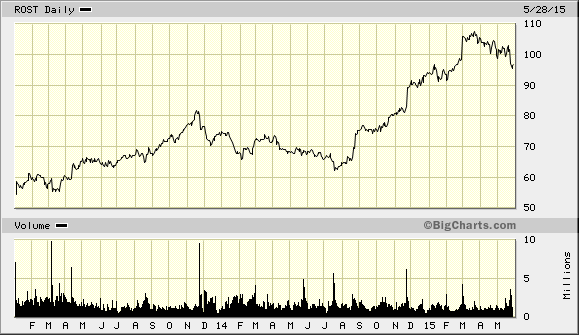
The weak outlook clearly upset traders as shares of Ross dropped more than 4.4% last Friday. I’m not worried at all and neither should you be. Two weeks ago, I told you that Ross’s full-year guidance was too low—and the company raised it. Ross now sees full-year earnings ranging between $4.72 and $4.87 per share. The old range was $4.60 to $4.80 per share.
For some context, Ross earned $4.42 per share last year. (By the way, Ross’s guidance from last May was for $4.09 to $4.21 per share which shows you how conservative they tend to be.) All the evidence tells me that Ross is executing well. Remember that ROST will split 2-for-1 next month so don’t be alarmed when you see the lower share price. Ross Stores remains a good buy up to $107 per share.
Updates on Other Buy List Stocks
In a few weeks, I expect to see CR Bard (BCR) raise its dividend again. That’s not much of a surprise since the company has increased its payout every year since 1972. Bard currently pays out 22 cents per quarter which is rather puny. For the year, that’s less than 10% of Bard’s net. Business is going well for them and they had another good earnings report last month. CR Bard is a buy up to $184 per share.
Shares of Ford Motor (F) have been weak again—the company announced a recall this week—but I encourage you not to give up on this stock. The automaker is going for less than 10 times earnings and the dividend yield is nearly 4%. Things are clearly going well for Ford. Last month, Ford raised its estimate for operating profit margin in North America. The company is standing by its forecast of a pre-tax profit of $8.5 billion to $9.5 billion for this year. Don’t let the soggy stock scare you. Ford remains a buy up to $17 per share.
Last week, Qualcomm (QCOM) said it was launching their accelerated share repurchase program. This is part of their $15 billion buyback program they announced in March. Qualcomm aims to purchase 57.7 million shares for $5 billion. The purchase is being funded by Qualcomm’s recent $10 billion bond deal. Until the offering, Qualcomm didn’t have a dime of long-term debt.
The stock hasn’t done much in the last year, and I think the activist investors are finally having an impact on Qualcomm. The company gave us a nice dividend increase and the big share buyback. Jana Partners wants them to go further and break up the company. I don’t know if that will happen, but I agree there’s a lot of untapped value here.
Qualcomm gapped up on Wednesday of this week after the news that Broadcom (BRCM) is being bought out. Qualcomm is a buy up to $72 per share.
Barron’s recently profiled Express Scripts (ESRX). Here’s a sample:
Express Scripts will benefit from a number of trends in the health-care industry. The rising demand for so-called specialty drugs, for instance, is a one-two punch for the company. First, as a pharmacy benefit manager, it uses its clout to negotiate favorable prices from drug makers for health plans — and gets a cut of those savings. But the company also operates a large mail-order and specialty drug pharmacy. So, somewhat incongruously, it also profits from growing demand for the same high-priced therapies that are playing havoc with health insurers’ medical cost trends. These two forces should combine to push shares higher.
The article noted that ESRX trades at a lower valuation than CVS (CVS). But if you tack a multiple of 17, which is quite reasonable, onto next year’s earnings estimate that gives you a share price of $102.51. That’s a 15% climb from here. This week, I’m raising my Buy Below on Express Scripts to $92 per share.
That’s all for now. With the beginning of June, we’ll get several important turn-of-the-month economic reports next week. On Monday, the ISM report for May comes out. The April ISM was unchanged from March, and the five reports prior to that all showed declines. I want to see an improvement here. Car sales come out on Tuesday. I expect more good news from Ford Motor (F). Wednesday is the Fed’s Beige Book plus the ADP jobs report. Then on Friday is the big May jobs report. The April jobs report was a nice rebound from the weak number for March. Be sure to keep checking the blog for daily updates. I’ll have more market analysis for you in the next issue of CWS Market Review!
– Eddy
-
Archives
- September 2026
- August 2026
- July 2026
- June 2026
- May 2026
- April 2026
- March 2026
- February 2026
- January 2026
- December 2025
- November 2025
- October 2025
- September 2025
- August 2025
- July 2025
- June 2025
- May 2025
- April 2025
- March 2025
- February 2025
- January 2025
- December 2024
- November 2024
- October 2024
- September 2024
- August 2024
- July 2024
- June 2024
- May 2024
- April 2024
- March 2024
- February 2024
- January 2024
- December 2023
- November 2023
- October 2023
- September 2023
- August 2023
- July 2023
- June 2023
- May 2023
- April 2023
- March 2023
- February 2023
- January 2023
- December 2022
- November 2022
- October 2022
- September 2022
- August 2022
- July 2022
- June 2022
- May 2022
- April 2022
- March 2022
- February 2022
- January 2022
- December 2021
- November 2021
- October 2021
- September 2021
- August 2021
- July 2021
- June 2021
- May 2021
- April 2021
- March 2021
- February 2021
- January 2021
- December 2020
- November 2020
- October 2020
- September 2020
- August 2020
- July 2020
- June 2020
- May 2020
- April 2020
- March 2020
- February 2020
- January 2020
- December 2019
- November 2019
- October 2019
- September 2019
- August 2019
- July 2019
- June 2019
- May 2019
- April 2019
- March 2019
- February 2019
- January 2019
- December 2018
- November 2018
- October 2018
- September 2018
- August 2018
- July 2018
- June 2018
- May 2018
- April 2018
- March 2018
- February 2018
- January 2018
- December 2017
- November 2017
- October 2017
- September 2017
- August 2017
- July 2017
- June 2017
- May 2017
- April 2017
- March 2017
- February 2017
- January 2017
- December 2016
- November 2016
- October 2016
- September 2016
- August 2016
- July 2016
- June 2016
- May 2016
- April 2016
- March 2016
- February 2016
- January 2016
- December 2015
- November 2015
- October 2015
- September 2015
- August 2015
- July 2015
- June 2015
- May 2015
- April 2015
- March 2015
- February 2015
- January 2015
- December 2014
- November 2014
- October 2014
- September 2014
- August 2014
- July 2014
- June 2014
- May 2014
- April 2014
- March 2014
- February 2014
- January 2014
- December 2013
- November 2013
- October 2013
- September 2013
- August 2013
- July 2013
- June 2013
- May 2013
- April 2013
- March 2013
- February 2013
- January 2013
- December 2012
- November 2012
- October 2012
- September 2012
- August 2012
- July 2012
- June 2012
- May 2012
- April 2012
- March 2012
- February 2012
- January 2012
- December 2011
- November 2011
- October 2011
- September 2011
- August 2011
- July 2011
- June 2011
- May 2011
- April 2011
- March 2011
- February 2011
- January 2011
- December 2010
- November 2010
- October 2010
- September 2010
- August 2010
- July 2010
- June 2010
- May 2010
- April 2010
- March 2010
- February 2010
- January 2010
- December 2009
- November 2009
- October 2009
- September 2009
- August 2009
- July 2009
- June 2009
- May 2009
- April 2009
- March 2009
- February 2009
- January 2009
- December 2008
- November 2008
- October 2008
- September 2008
- August 2008
- July 2008
- June 2008
- May 2008
- April 2008
- March 2008
- February 2008
- January 2008
- December 2007
- November 2007
- October 2007
- September 2007
- August 2007
- July 2007
- June 2007
- May 2007
- April 2007
- March 2007
- February 2007
- January 2007
- December 2006
- November 2006
- October 2006
- September 2006
- August 2006
- July 2006
- June 2006
- May 2006
- April 2006
- March 2006
- February 2006
- January 2006
- December 2005
- November 2005
- October 2005
- September 2005
- August 2005
- July 2005
 Eddy Elfenbein is a Washington, DC-based speaker, portfolio manager and editor of the blog Crossing Wall Street. His