-
Stryker Earns $1.11 per Share
Posted by Eddy Elfenbein on April 21st, 2015 at 4:17 pmStryker (SYK) reported Q1 earnings of $1.11 per share. That was three cents better than estimates. The company also raised the low end of their full-year forecast by five cents per share. The new range is $4.95 to $5.10 per share. Net sales rose by 3.2% to $2.4 billion, or 7.4% in constant currency.
“We are pleased with our first quarter results, with another strong quarter of nearly 6% organic sales growth and disciplined expense management,” said Kevin A. Lobo, Chairman and Chief Executive Officer. “We expect this momentum, which is balanced across segments and regions, to continue and are raising the low end of full year sales and earnings guidance.”
(…)
We expect 2015 constant currency sales growth in the range of 6.0% to 7.0%, including organic sales growth in the range of 5.0% to 6.0%. Based on current foreign currency exchange rates we expect adjusted diluted net earnings per share to be in the range of $1.15-$1.20 and $4.95-$5.10 in the second quarter and the full year, respectively. If foreign currency exchange rates hold near current levels, we expect sales in the second quarter and full year of 2015 to be negatively impacted by approximately 3.5% to 4.5% and adjusted diluted net earnings per share to be negatively impacted by approximately $0.25 to $0.30 in the full year, approximately half of which will be in the first half of the year.
-
Signature Bank Earns $1.64
Posted by Eddy Elfenbein on April 21st, 2015 at 9:49 amSignature Bank (SBNY) reported Q1 earnings of $1.64 per share, five cents better than estimates.
Net income for the 2015 first quarter reached a record $83.4 million, or $1.64 diluted earnings per share, versus $66.0 million, or $1.37 diluted earnings per share, for the 2014 first quarter. The record net income for the 2015 first quarter, versus the comparable quarter last year, is primarily due to an increase in net interest income, fueled by strong deposit growth and record loan growth. These factors were partially offset by an increase in non-interest expense.
Net interest income for the 2015 first quarter reached $222.5 million, up $36.0 million, or 19.3 percent, when compared with the 2014 first quarter. This increase is primarily due to growth in average interest-earning assets. Total assets reached $28.59 billion at March 31, 2015, an increase of $5.48 billion, or 23.7 percent, from $23.10 billion at March 31, 2014. Average assets for the 2015 first quarter reached $27.98 billion, an increase of $5.28 billion, or 23.3 percent, compared with the 2014 first quarter.
Deposits for the 2015 first quarter rose $1.41 billion, or 6.2 percent, to $24.03 billion at March 31, 2015. When compared with deposits at March 31, 2014, overall deposit growth for the last twelve months was 31.2 percent, or $5.72 billion. Excluding short-term escrow and brokered deposits of $3.38 billion at the end of the 2015 first quarter and $3.08 billion at year-end 2014, core deposits increased $1.11 billion for the quarter. Average deposits for the 2015 first quarter reached $23.38 billion, an increase of $1.24 billion, or 5.6 percent.
“2015 is off to an outstanding start as we again set records in both earnings and loan growth while also delivering very strong deposit growth,” stated Joseph J. DePaolo, President and Chief Executive Officer.
-
Morning News: April 21, 2015
Posted by Eddy Elfenbein on April 21st, 2015 at 5:46 amGreece Makes It Expensive to Hedge European Stocks
ECB Is Studying Curbs on Greek Bank Support
Europe Is Expected to Bring Antitrust Charges Against Gazprom
Iran Wants OPEC to Pave Way For Its Extra Oil Production When Sanctions Lifted
The Fed Still Wants Easy Money
Goldman Sachs and Morgan Stanley Find Different Paths to Profits
Credit Suisse Says Quarterly Profit Up 23% Courtesy of Healthy Trading
IBM First-Quarter Earnings Top Wall St. Expectations
Halliburton Beats Estimates, Boosts Job Cuts After Oil Crash
Boutique Banks to Suffer Most If Comcast-Time Warner Cable Deal Vetoed
SAP Quarterly Revenue Exceeds Estimates on Currency Boost
Sky Profits From Surge in U.K. and Europe Customer Numbers
Sun Pharma Slumps Most in Near Six Years on Daiichi’s Share Sale
Roger Nusbaum: A Bloomberg Outage Caused The Market to Fall? Really?
Jeff Carter: How To Make Great Leaps Forward In Civilization
Be sure to follow me on Twitter.
-
Hormel on Avian Flu
Posted by Eddy Elfenbein on April 20th, 2015 at 5:30 pmHormel Foods (HRL) just issued a press release on the Avian Flu. Short version: It’s impacted their turkey business but they expect the impact to wane as the year goes on. Hormel is keeping their full-year guidance at $2.50 to $2.60 per share. That’s no change.
-
Risks that Investors Face
Posted by Eddy Elfenbein on April 20th, 2015 at 3:05 pmI love this quote from Benjamin Graham:
The risk of paying too high a price for good-quality stocks – while a real one – is not the chief hazard confronting the average buyer of securities. Observation over many years has taught us that the chief losses to investors come from the purchase of low-quality securities at times of favorable business conditions. The purchasers view the current good earnings as equivalent to “earning power” and assume that prosperity is synonymous with safety.
-
The Long End of the Treasury Curve
Posted by Eddy Elfenbein on April 20th, 2015 at 12:07 pmIn the summer of 2012, the bond market reached incredible heights. On July 24, 2012, the yield on the 10-year Treasury fell to 1.39%. That was the lowest in the history of the republic. (That appears to be the case; these facts aren’t so easy to nail down.)
At the time, I thought that was at the end of the bond market’s amazing 31-year run. The 10-year had gotten to 15.84% on September 30, 1981, also the highest in the history of the republic. Now I’m not so sure the rally is over.
During 2013, Treasury yields bounced higher and the 10-year yield broke above 3%. But then something unexpected happened, the bond market began to rally again. By this past February, the 10-year got as low as 1.65%. That’s still above the July 2012 mark but the 20- and 30-year yields both reached new lows.
On January 30, 2015, the 30-year got down to 2.23% which was 22 basis points below its July 2012 low. The 20-year got to 2.04%, seven basis points below its July 2012 low.
So the longer-date parts of the yield curve have moved lower while the shorter part hasn’t. This means the spread between the two has narrowed. Is it worthwhile looking at the spreads of such long term bonds?
Generally, the higher longer-term bonds yield more than shorter-term bonds, the better the outlook for the economy. When the spread is low or even negative, that’s not so good for the economy. My preference is to look at the difference between the 2- and 10-year yields. The two-year note is short enough without being overly influenced by the Fed Funds rate.
I don’t think the long-end spreads are as important but it’s interesting to note that the spread between the 30- and 10-year bonds has been falling almost consistently for two years. The spread between the 20- and 30-year doesn’t strike me as particularly important.
-
Back Above 2,100
Posted by Eddy Elfenbein on April 20th, 2015 at 10:12 amThe S&P 500 is back over 2,100. Still, the 2,040 to 2,120 trading range continues.
This is a very big week for earnings. For some reason, there aren’t as many earnings reports on Monday and Friday. But one big earnings report came from Morgan Stanley (MS) this morning. The bank had a very strong quarter; profits soared 60%. They earned 85 cents per share which was seven cents better than expectations. The stock is currently up about 0.5%.
I’m not a fan of MS until they start paying a more reasonable dividend. Given their profits, they should be paying out something like 25 cents per share. Instead, they pay out 10 cents per share. As an investor, I want to see more of a cushion (unless there’s a very good reason).
The Dow is leading the rest of the market thanks to a strong day from IBM (IBM). Since the Dow is price weighted, the higher-priced stocks have greater say. The 10-year yield is currently holding at 1.87%. The yield is very close to a 10-week low. In February, the 10-year yield got as low as 1.65% which was the lowest since May 2013.
-
Software Can’t Catch to Explosion of Trading in China
Posted by Eddy Elfenbein on April 20th, 2015 at 9:47 amThe Chinese market has doubled in the last six months. Turnover in Shanghai and Shenzhen surpassed the NYSE and Nasdaq last month. Apparently, this is causing some problems.
China’s stock trading fever has made the Shanghai Stock Exchange the world’s biggest in terms of turnover, surpassing the New York Stock Exchange, but the explosion in volumes has exceeded the ability of the exchange’s software to report it.
The exchange’s trading turnover exceeded 1 trillion yuan ($161.28 billion) for the first time on Monday, but the data could not be properly displayed because its software was not designed to report numbers that high.
“This is a software configuration issue, not a technical glitch,” the Shanghai Stock Exchange said in a statement, adding that trading and price quotes for individual stocks were not affected.
The exchange said it would need to replace its current software files that handle volume reporting to resolve the issue.
One of the forgotten episodes on Wall Street was the paperwork crisis on the late 1960s. The NYSE had to shorten trading hours so brokerage houses could catch up.
-
The Illusion of Control
Posted by Eddy Elfenbein on April 20th, 2015 at 8:56 amFrom Jason Zweig’s The Intelligent Investor:
And a streak of being right can make anyone forget how important luck is in determining the outcome.
Research led by psychologist Ellen Langer, now at Harvard University, shows that when people who predict the tosses of a coin are told they got eight out of their first 10 flips correct, they conclude that they are significantly better than average at calling heads or tails—and that they could get well over half their guesses right if the coin were tossed another 100 times.
Prof. Langer called these incorrect beliefs “the illusion of control.”
If, however, people either get most of their early guesses wrong or win and lose in a random pattern, they don’t believe they have any special gift for calling heads or tails; nor do they remember being correct more often than they were.
Guarding against the illusion of control takes constant vigilance. The longer you’ve been right, the harder it gets.
-
Morning News: April 20, 2015
Posted by Eddy Elfenbein on April 20th, 2015 at 7:09 am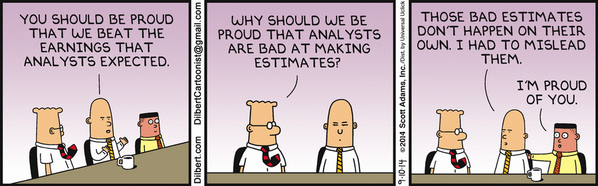
Euro Area Seeks Greece Roadmap to May Agreement
Greece Flashes Warning Signals About Its Debt
Bond Yields Vanish Across Euro Zone on Grexit Worries
For the People’s Bank of China, Bond Buying Is Both Easy and Hard
China Really Wants a Rising Stock Market
China’s Reserve Cut Move Boosts Oil Price
Prologis, Norway Buy KTR Real Estate for $5.9 Billion
Liberty Global’s Subsidiary Telenet to Acquire BASE
Comcast, Time Warner Cable to Meet Regulators in Bid to Save Merger
Morgan Stanley Profit Jumps 60% on Trading Revenue
Shanghai GM to Spend $16 Billion Developing New Vehicles
Europe’s Used Jets Luring U.S. Bargain Buyers With Strong Dollar
Cullen Roche: Finding Religion on “Crowding Out”
Jeff Miller: Weighing the Week Ahead: A Geopolitical Risk to U.S. Stocks?
Be sure to follow me on Twitter.
-
Archives
- July 2026
- June 2026
- May 2026
- April 2026
- March 2026
- February 2026
- January 2026
- December 2025
- November 2025
- October 2025
- September 2025
- August 2025
- July 2025
- June 2025
- May 2025
- April 2025
- March 2025
- February 2025
- January 2025
- December 2024
- November 2024
- October 2024
- September 2024
- August 2024
- July 2024
- June 2024
- May 2024
- April 2024
- March 2024
- February 2024
- January 2024
- December 2023
- November 2023
- October 2023
- September 2023
- August 2023
- July 2023
- June 2023
- May 2023
- April 2023
- March 2023
- February 2023
- January 2023
- December 2022
- November 2022
- October 2022
- September 2022
- August 2022
- July 2022
- June 2022
- May 2022
- April 2022
- March 2022
- February 2022
- January 2022
- December 2021
- November 2021
- October 2021
- September 2021
- August 2021
- July 2021
- June 2021
- May 2021
- April 2021
- March 2021
- February 2021
- January 2021
- December 2020
- November 2020
- October 2020
- September 2020
- August 2020
- July 2020
- June 2020
- May 2020
- April 2020
- March 2020
- February 2020
- January 2020
- December 2019
- November 2019
- October 2019
- September 2019
- August 2019
- July 2019
- June 2019
- May 2019
- April 2019
- March 2019
- February 2019
- January 2019
- December 2018
- November 2018
- October 2018
- September 2018
- August 2018
- July 2018
- June 2018
- May 2018
- April 2018
- March 2018
- February 2018
- January 2018
- December 2017
- November 2017
- October 2017
- September 2017
- August 2017
- July 2017
- June 2017
- May 2017
- April 2017
- March 2017
- February 2017
- January 2017
- December 2016
- November 2016
- October 2016
- September 2016
- August 2016
- July 2016
- June 2016
- May 2016
- April 2016
- March 2016
- February 2016
- January 2016
- December 2015
- November 2015
- October 2015
- September 2015
- August 2015
- July 2015
- June 2015
- May 2015
- April 2015
- March 2015
- February 2015
- January 2015
- December 2014
- November 2014
- October 2014
- September 2014
- August 2014
- July 2014
- June 2014
- May 2014
- April 2014
- March 2014
- February 2014
- January 2014
- December 2013
- November 2013
- October 2013
- September 2013
- August 2013
- July 2013
- June 2013
- May 2013
- April 2013
- March 2013
- February 2013
- January 2013
- December 2012
- November 2012
- October 2012
- September 2012
- August 2012
- July 2012
- June 2012
- May 2012
- April 2012
- March 2012
- February 2012
- January 2012
- December 2011
- November 2011
- October 2011
- September 2011
- August 2011
- July 2011
- June 2011
- May 2011
- April 2011
- March 2011
- February 2011
- January 2011
- December 2010
- November 2010
- October 2010
- September 2010
- August 2010
- July 2010
- June 2010
- May 2010
- April 2010
- March 2010
- February 2010
- January 2010
- December 2009
- November 2009
- October 2009
- September 2009
- August 2009
- July 2009
- June 2009
- May 2009
- April 2009
- March 2009
- February 2009
- January 2009
- December 2008
- November 2008
- October 2008
- September 2008
- August 2008
- July 2008
- June 2008
- May 2008
- April 2008
- March 2008
- February 2008
- January 2008
- December 2007
- November 2007
- October 2007
- September 2007
- August 2007
- July 2007
- June 2007
- May 2007
- April 2007
- March 2007
- February 2007
- January 2007
- December 2006
- November 2006
- October 2006
- September 2006
- August 2006
- July 2006
- June 2006
- May 2006
- April 2006
- March 2006
- February 2006
- January 2006
- December 2005
- November 2005
- October 2005
- September 2005
- August 2005
- July 2005
 Eddy Elfenbein is a Washington, DC-based speaker, portfolio manager and editor of the blog Crossing Wall Street. His