-
The Dollar and Euro Move Near Parity
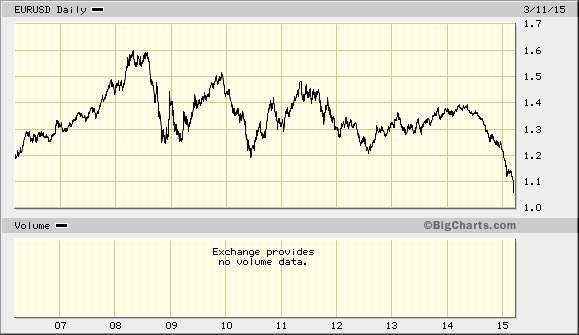
Posted by Eddy Elfenbein on March 11th, 2015 at 9:25 amThanks to the start of European QE, and the prospect for higher rates soon in the U.S., the dollar has been surging against the euro. Ten months ago, one euro was worth $1.39. Today that same euro gets you just $1.06. That’s a 12-year low. Now people are wondering if we’ll hit parity soon.
Interest rates in Europe are becoming a joke. The 10-year bond in Germany just fell to 0.2%. In other words, you get 2% combined for the entire life of the bond!
Adding to the dollar’s rally is next week’s Fed meeting. The talk on Wall Street is that the Fed will abandon its “patient” language which will set the stage for rate hikes. The last time the Fed raised interest rates was June 2006.
-
Morning News: March 11, 2015
Posted by Eddy Elfenbein on March 11th, 2015 at 7:09 amEx-Soviet Republics Feeling Putin’s Ruble Pain Now
China Data Paint Gloomy Picture
China to Increase Scrutiny of New Zealand Milk
Euro Nears Parity With U.S. Dollar
Crude Falls to One-Month Low as Glut Seen Growing, Dollar Gains
History Suggests OPEC’s Days Could Be Numbered
Next Step in Global Cost and Efficiency Program
Banking Arbitration Hurts Consumers, Regulator Says
Alibaba in Talks to Invest in Indian Online Marketplace Snapdeal
Ineos to Acquire Stakes in Igas, a Boost to British Shale Gas
UBS Poaches Bank of Montreal Oil Banking Team
Retiring Google CFO Writes The Best ‘Spend More Time With Family’ Memo Ever
Credit Writedowns: Five Investing Themes That Need Further Examination
Howard Lindzon: Charles Schwab versus The Robo’s and Wealthfront…
Be sure to follow me on Twitter.
-
The S&P 500 Loses 1.70%
Posted by Eddy Elfenbein on March 10th, 2015 at 7:20 pmToday was a rough day for the stock market. The Dow lost 332 points. The S&P 500 lost 35.27 points or 1.70%. The trading year is still young, but today was the second-worst day this year for the S&P 500. Friday was the third-worst.
The S&P 500 dropped below its 50-day moving average, and it’s not too far from 2,001.28 which is the current 200-DMA.
Since the bull market started six years and one day ago, the S&P 500 has fallen 5% or more 12 separate times. Each time it has rallied to a new high. At today’s close, we’re down 3.46% from the last closing high.
Here’s a chart of the 12 dips, along with what might become Lucky #13:
Low Date High Low Loss 30-Mar-09 832.86 787.53 -5.44% 10-Jul-09 946.21 879.13 -7.09% 30-Oct-09 1,097.91 1,036.19 -5.62% 8-Feb-10 1,150.23 1,056.74 -8.13% 2-Jul-10 1,217.28 1,022.58 -15.99% 16-Mar-11 1,343.01 1,256.88 -6.41% 3-Oct-11 1,363.61 1,099.23 -19.39% 1-Jun-12 1,419.04 1,278.04 -9.94% 15-Nov-12 1,465.77 1,353.33 -7.67% 24-Jun-13 1,669.16 1,573.09 -5.76% 3-Feb-14 1,848.38 1,741.89 -5.76% 15-Oct-14 2,011.36 1,862.49 -7.40% 10-Mar-14 2,117.39 2,044.16 -3.46% It’s odd how January was quite bad, then February was very good, and now March looks soggy. Calendar months are apparently becoming feast or famine.
Breaking down the market, the low vol stocks fell much less than high beta stocks. Of course, that’s what they’re supposed to do but it appeared particularly dramatic today. The S&P 500 Low Vol Index fell just 1.18% today while the High Beta Index lost 2.18%. They were exactly 1% apart.
The big-cap S&P 100 fell 1.81% while the smaller-cap Russell 2000 lost 1.24%. The Tech Sector was the big loser with a loss of 2.19%. Financials were just behind at 2.12%. Utilities fared the best with a loss of just 0.16%. Bonds did quite well. The Long Bond ETF (TLT) gained 1.32% today.
Not too long ago, crude oil appeared to be recovering. Not anymore. Spot West Texas fell to $48.76 today. That’s the lowest close in a month.
The Buy List had another good day — and by that, I mean we sucked a little bit less than everybody else. Our Buy List lost “only” 1.59% today which is the fifth day in a row we’ve beaten the S&P 500. Unfortunately, three of those days were losses, and Qualcomm’s dividend news wasn’t enough to beat the anti-tech trend today. QCOM lost 1.13% today which was one of the better results in the large-cap tech sector.
Specialty Drug Spending
Posted by Eddy Elfenbein on March 10th, 2015 at 12:59 pmThe S&P 500 Falls Below Its 50-DMA
Posted by Eddy Elfenbein on March 10th, 2015 at 12:16 pm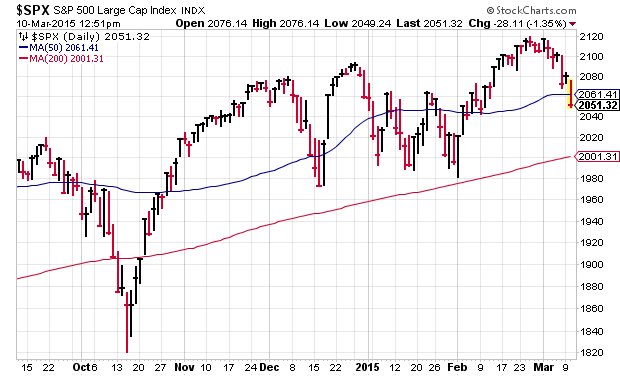
The Market Can Rally Past Profits
Posted by Eddy Elfenbein on March 10th, 2015 at 11:17 amOver at Bloomberg, Lu Wang notes that the market can and has rallied past its peak profitability:
Even if corporate profitability peaked today in the U.S., the market would rally for another year.
That’s the finding of Jason Trennert, the chief investment strategist at Strategas Research Partners in New York, who studied the relationship between equities and earnings margins since 1949. On average, the peak in profit margins came four quarters before the market’s top, the study shows.
(…)
Thanks to near-record low interest rates, stagnant pay and more than $2 trillion of share buybacks, chief executive officers have increased profit by an average 15 percent a year since 2009, three times faster than sales.
Operating margins for S&P 500 companies, the difference between revenue and expenses, climbed to a record 10.1 percent in the third quarter of 2014 and probably slipped to 9 percent in the final three months, data compiled by S&P Dow Jones Indices show.
Profit margins peaked in September 2006 during the last bull market, four quarters before the S&P 500 reached an all-time high in October 2007, data compiled by Strategas show. The equity gauge’s record in March 2000 came 10 quarters after corporate profitability hit a high. The shortest gap occurred in 1973, when there was only one quarter between peaks of margins and the market.
“I’d follow the trend of margins,” Trennert said. “They’re not noisy and there are clear cycles.”
Morning News: March 10, 2015
Posted by Eddy Elfenbein on March 10th, 2015 at 7:13 amDraghi Urged Greece to Allow Troika Back Before It’s Too Late
A Tap on Brakes for China Car Sales
Russia’s Well for Corporate Bailouts Appears to Be Running Dry
New Zealand Market Shudders at Threat to Dairy Industry
Brent Oil Futures Fall Below $58 as Dollar Hits 11-Year High
Gold Drops to Three-Month Low on Dollar, U.S. Rate Expectations
Obama Directing Changes to Make Student Loan Navigation Easier
Former SEC Director Rips the Red Tape Off His Mouth
New Credit Suisse Boss Has Plenty of Challenges in His In-Tray
GM Sets Buyback, Placating Activists
Under-Fire Uber Pledges to Enlist 1 Million Female Drivers By 2020
Lovin’ Goes Only So Far as McDonald’s Sales Slide Again
7 Reasons People Think They Can Ignore Warren Buffett’s Advice
Joshua Brown: The Riskalyze Report: Advisors Buy the Corporate Bond Dip
Cullen Roche: Tax Loss Harvesting – Too Good to Be True?
Be sure to follow me on Twitter.
Qualcomm Raises Their Dividend by 14%
Posted by Eddy Elfenbein on March 9th, 2015 at 6:06 pmIn Friday’s CWS Market Review, I said that Qualcomm (QCOM) may soon be raising its dividend. Good timing! After the closing bell today, Qualcomm announced a 14% dividend increase plus a share buyback program of $15 billion. They plan to spend $10 billion of that within the next year. For comparison, Qualcomm currently has a market cap of $120 billion.
The quarterly dividend will rise from 42 to 48 cents per share. That’s $1.92 per share on the year which works out to a yield of 2.64% based on today’s closing price.
The company added:
”Our business continues to generate substantial operating cash flow, and today’s announcement represents an important step in returning that cash to our owners while still preserving the strategic flexibility needed to drive stockholder value through growth,” said Steve Mollenkopf, CEO of Qualcomm Incorporated. “I am pleased that we continue to build on our track record of returning capital to stockholders, having exceeded each of our capital return commitments in 2014 and returned approximately $37 billion to stockholders since these programs began in 2003.”
The shares are up 3% in the after-hours market. Qualcomm said they intend to return 75% of their free cash flow to shareholders in the form of dividends and share buybacks. Last year, they returned 93% to investors.
Curiously, Qualcomm said, “The Company plans to finance the capital return program primarily by accessing the public debt markets in 2015.” If it’s all coming out of free cash, then why do they need to tap the bond market? Qualcomm currently has more than $30 billion in cash. I assume it’s a repatriation issue, but the press release doesn’t make that clear.
Mark Haines Calls the Bottom; March 10, 2009
Posted by Eddy Elfenbein on March 9th, 2015 at 12:49 pmiDow
Posted by Eddy Elfenbein on March 9th, 2015 at 11:07 amForty years ago last Thursday, Steve Wozniak went to a meeting of the Homebrew Computer Club. He came away so impressed that it led him to build the Apple 1. Forty years and one day later, it was announced that Apple (AAPL) is being added to the Dow Jones Industrial Average.
A lot can be said about how the Dow is not a very good index, and I agree, but it still represents the apex of American business. Next year the Dow will be celebrating its 120th anniversary. Just being that old deserves some respect.
Last year, Apple split its stock 7-for-1. At the time, I thought this was a play to get in the Dow.
In Apple’s case, they could be playing to get into the Dow Jones 30. Since the Dow is a price-weighted index, a $560 share price would have an outsized influence on the index. But an $80 value could be more reasonable in the eyes of the index keepers. Right now, Travelers (TRV) is the smallest company in the Dow. In fact, if its market cap were to double, it would still be the smallest company in the Dow. Apple is worth more than 15 times Travelers, so I think TRV is a top candidate to get the boot.
I was wrong about Travelers. It’s AT&T (T) that’s getting the boot. The Dow is calculated by adding up the prices of all 30 stocks and dividing by a current divisor. If you’re curious, the divisor is published each day in the WSJ. It’s currently 0.15571590501117. More simply, each $1 in a Dow stock is worth about 6.42 points.
The Dow doesn’t change very often. They made no changes to the index between 1939 and 1956 and that was a great time for the market. They made a big change in 1959 when they added and deleted five stocks. After that, no changes were made until 1976.
AT&T was added to the index in 1999 when it was SBC Communications. It later bought the legacy AT&T and took its name. The original AT&T (meaning Ma Bell) was added to the Dow in 1916 when the index expanded from 12 to 20 stocks. That remained in the index past the break up of AT&T. It wasn’t removed from the index until 2004 when SBC bought it.
Verizon remains in the Dow. The company was formed when a Baby Bell (Bell Atlantic) merged with GTE. So some of the old AT&T lives on in the Dow, but after nearly 100 years, the name AT&T is no longer in the Dow Industrials.
While it’s true the Dow isn’t a great index, sometimes people pile on. It generally follows the S&P 500 pretty closely. Personally, I prefer the S&P 500, which just celebrated its 58th birthday last week.
-
Archives
- July 2026
- June 2026
- May 2026
- April 2026
- March 2026
- February 2026
- January 2026
- December 2025
- November 2025
- October 2025
- September 2025
- August 2025
- July 2025
- June 2025
- May 2025
- April 2025
- March 2025
- February 2025
- January 2025
- December 2024
- November 2024
- October 2024
- September 2024
- August 2024
- July 2024
- June 2024
- May 2024
- April 2024
- March 2024
- February 2024
- January 2024
- December 2023
- November 2023
- October 2023
- September 2023
- August 2023
- July 2023
- June 2023
- May 2023
- April 2023
- March 2023
- February 2023
- January 2023
- December 2022
- November 2022
- October 2022
- September 2022
- August 2022
- July 2022
- June 2022
- May 2022
- April 2022
- March 2022
- February 2022
- January 2022
- December 2021
- November 2021
- October 2021
- September 2021
- August 2021
- July 2021
- June 2021
- May 2021
- April 2021
- March 2021
- February 2021
- January 2021
- December 2020
- November 2020
- October 2020
- September 2020
- August 2020
- July 2020
- June 2020
- May 2020
- April 2020
- March 2020
- February 2020
- January 2020
- December 2019
- November 2019
- October 2019
- September 2019
- August 2019
- July 2019
- June 2019
- May 2019
- April 2019
- March 2019
- February 2019
- January 2019
- December 2018
- November 2018
- October 2018
- September 2018
- August 2018
- July 2018
- June 2018
- May 2018
- April 2018
- March 2018
- February 2018
- January 2018
- December 2017
- November 2017
- October 2017
- September 2017
- August 2017
- July 2017
- June 2017
- May 2017
- April 2017
- March 2017
- February 2017
- January 2017
- December 2016
- November 2016
- October 2016
- September 2016
- August 2016
- July 2016
- June 2016
- May 2016
- April 2016
- March 2016
- February 2016
- January 2016
- December 2015
- November 2015
- October 2015
- September 2015
- August 2015
- July 2015
- June 2015
- May 2015
- April 2015
- March 2015
- February 2015
- January 2015
- December 2014
- November 2014
- October 2014
- September 2014
- August 2014
- July 2014
- June 2014
- May 2014
- April 2014
- March 2014
- February 2014
- January 2014
- December 2013
- November 2013
- October 2013
- September 2013
- August 2013
- July 2013
- June 2013
- May 2013
- April 2013
- March 2013
- February 2013
- January 2013
- December 2012
- November 2012
- October 2012
- September 2012
- August 2012
- July 2012
- June 2012
- May 2012
- April 2012
- March 2012
- February 2012
- January 2012
- December 2011
- November 2011
- October 2011
- September 2011
- August 2011
- July 2011
- June 2011
- May 2011
- April 2011
- March 2011
- February 2011
- January 2011
- December 2010
- November 2010
- October 2010
- September 2010
- August 2010
- July 2010
- June 2010
- May 2010
- April 2010
- March 2010
- February 2010
- January 2010
- December 2009
- November 2009
- October 2009
- September 2009
- August 2009
- July 2009
- June 2009
- May 2009
- April 2009
- March 2009
- February 2009
- January 2009
- December 2008
- November 2008
- October 2008
- September 2008
- August 2008
- July 2008
- June 2008
- May 2008
- April 2008
- March 2008
- February 2008
- January 2008
- December 2007
- November 2007
- October 2007
- September 2007
- August 2007
- July 2007
- June 2007
- May 2007
- April 2007
- March 2007
- February 2007
- January 2007
- December 2006
- November 2006
- October 2006
- September 2006
- August 2006
- July 2006
- June 2006
- May 2006
- April 2006
- March 2006
- February 2006
- January 2006
- December 2005
- November 2005
- October 2005
- September 2005
- August 2005
- July 2005
 Eddy Elfenbein is a Washington, DC-based speaker, portfolio manager and editor of the blog Crossing Wall Street. His