-
February ISM = 52.9
Posted by Eddy Elfenbein on March 2nd, 2015 at 10:05 amThe February ISM came in at 52.9. That’s low but still in the comfort zone. The ISM has now fallen for four straight months. The “danger area” is around the mid-40s so we’re still above that.
-
Growing Divide at the FOMC
Posted by Eddy Elfenbein on March 2nd, 2015 at 9:54 amThe Federal Open Market Committee is an unusual organization in that it has members from the Federal Reserve Board and also the regional bank presidents. They’re not the same thing and they sometimes conflict.
Janet Yellen places a high premium on consensus, which is probably misplaced. In Washington, people seem to like consensus for the sake of saying they have a consensus.
Lately, however, the reserve bank presidents have grown more hawkish about monetary policy. They think interest rates will need to rise by the middle of the year. But the Fed governors are much more reluctant. I understand the hawks’ view that deflation will soon pass, but I think there needs to be more evidence of that. But there has been more evidence that workers’ pay has increased. Plus there’s been high-profile news such as the workers at Walmart getting raises.
Seven of the Fed’s current 17 members have now said they at least want the option of a June tightening on the table, or have pushed in general for an earlier increase amid an expectation that wages and inflation will turn higher.
By contrast, there’s a dwindling core of officials who say publicly that the economy and labour markets in particular still have a long way to go — only four Fed members have in recent weeks clearly said that rate hikes won’t be appropriate until much later in the year or even into 2016.
The five members of the Fed’s Washington-based board of governors, including Yellen, have spoken less definitively, though governors including Jerome Powell have said they expected strong job growth to continue. Not all of the seven who point to June vote this year on the Fed’s ten-member policy setting committee, but all participate in policy discussions.
The FOMC meets again later this month and is expected to removed the “patient” wording from its policy statement. I bet Yellen isn’t thrilled about that move but for consensus reasons, she may have to go along. The last time the Fed raised rates was June 2006. The futures market currently thinks a rate increase will come in September or October.
Why are higher rates so important? It all comes down to competition. Higher short-term rates provide strong incentive for investors’ money. When rates are at 0% and many stocks yield 2%, then the stock market is a no-brainer. But when they both get you 2%, then you need to be a lot more careful.
-
Best Month in Four Years
Posted by Eddy Elfenbein on March 2nd, 2015 at 9:28 amFriday turned out to be a very good day for our Buy List. Ross Stores (ROST) climbed 6.8% on Friday to close at a new all-time high. While the S&P 500 fell 0.07% on Friday, our Buy List advanced 0.30%.
February was a very good month for the stock market. The S&P 500 rose 5.5% for the month which was its best month since October 2011. That comes after falling 3.1% in January. For the month, our Buy List rose 8.7%. That’s very good, but as usual, I don’t want to get carried away by such short-term outperformance.
The government reported that personal income rose 0.3% in January while spending fell by 0.2%. That means that the national savings rate increased. After adjusting for inflation, which was really deflation in January, consumer spending rose by 0.3%. It’s tempting to see the virtues of one’s personal financial situation as similar to the macro-economy, but that’s not necessarily the case. We actually want to see an increase in personal spending.
The ISM report comes out later this morning. It’s fallen for the last three months.
-
Morning News: March 2, 2015
Posted by Eddy Elfenbein on March 2nd, 2015 at 7:10 amEurozone Consumer Prices Fall Again; Jobless Rate Hits Lowest Level Since 2012
European Stocks Firm After China Rate Cut
U.K. Manufacturing Growth Accelerates to Fastest in Seven Months
Mihail Fridman Says UK Threat to Block North Sea Deal ‘Not Rational’
China, Commodities Bust To Force Royal Bank of Australia’s Hand
Near Fed Majority Backs June Liftoff Yellen Hasn’t Yet Endorsed
Obamacare’s Survival Hangs on Four Words at U.S. High Court
SEC Plans to Slevel Playing Field For Newer ETF Firms
Wal-Mart’s Pay Hike Will Have Massive Ripple Effects in America
NXP’s $40 Billion Freescale Merger Fuels Chipmaker Deal Frenzy
Wells Fargo Puts a Ceiling on Subprime Auto Loans
Apple’s Looming Watch Spurs Frenzy of Upgrades for Android Timepieces
Berkshire Insurance ‘Superstar’ Could Fill Buffett’s Shoes
Jeff Miller: Weighing the Week Ahead: Will the Economic News Alter Fed Policy?
Epicurean Dealmaker: Uncle Warren Explains It All to You
Be sure to follow me on Twitter.
-
Finally, a Raise
Posted by Eddy Elfenbein on March 1st, 2015 at 7:37 pmAmerican workers are finally getting something they haven’t had in a long time — a raise.
Here’s CNBC’s Alex Rosenberg:
After years of seeing salaries stagnate, U.S. earners are finally starting to make slightly more, with signs pointing to further wage increases to come. Yet the additional compensation could be bad news for the businesses that find themselves forced to pay up. The extra labor expense is expected to cut into profit margins, and consequently diminish returns for investors, according to some analysts.
“What’s happening is that Wall Street and Main Street have switched places,” Eddy Elfenbein of Crossing Wall Street wrote to CNBC. “Workers are finally getting wages while corporate profit growth has stalled. In the early stages of the recovery, it was the other way around—profits soared while jobs stagnated.”
Indeed, employee compensation is finally showing signs of life.
In a much heralded boost, average hourly earnings for private workers rose to $24.75 in January, a 2.2 percent year-over-year increase. And thanks to a mix of higher wages and more people working, total compensation of employees in the fourth quarter rose 4.7 percent year over year, according to the revised U.S. growth report report released on Friday.
Here’s the monthly increase in real average hourly earnings:
-
Warren Buffett’s Shareholder Letter
Posted by Eddy Elfenbein on February 28th, 2015 at 9:14 amHere’s the latest shareholder letter from Warren Buffett.
-
Q4 GDP Revised Down to +2.2%
Posted by Eddy Elfenbein on February 27th, 2015 at 9:30 am -
CWS Market Review – February 27, 2015
Posted by Eddy Elfenbein on February 27th, 2015 at 7:08 am“A person who has not made peace with his losses is likely to accept gambles
that would be unacceptable to him otherwise.” – Daniel KahnemanThe author and investor James O’Shaughnessy tells the story of a study done by Fidelity Investments. The company wanted to find out what group of its clients did the best. As it turns out, the most successful group of Fidelity investors wasn’t men or women. It wasn’t young or old. It wasn’t big portfolios or small investors. No. It was people who had forgotten they had Fidelity accounts.
That’s even lazier than buy-and-hold! It’s buy-and-forget-you-ever-bought. I can’t say I’m surprised. The reason is simple. To be a good investor, you have to counter many of your natural inclinations like getting rattled in a bear market or finding comfort in following the crowd. I’m sure the people who watched their accounts every day were far more inclined to buy and sell at the wrong times, while the blissfully ignorant stayed wisely quiet.
We’re coming up on the sixth anniversary of this bull market, and it’s interesting to see how wrong people have been. Consider this headline from the day the bear market ended:
There may have been a case for Dow 5,000, but it was fantastically wrong. The Dow closed that day at 6,547.05. A year later, the Dow had climbed more than 4,000 points to reach 10,564.38. Was that enough to silence the doubters? Not at all. Check out this headline from the Wall Street Journal exactly one year later:
I’m sure people were worried, but as they say, the market climbs a wall of worry. The bull market wasn’t even close to its peak in 2010. On Wednesday of this week, the Dow closed at an all-time high of 18,224.57. That’s more than 72% higher than when people were “worried.” As well as the Dow has done, the S&P 500 has done even better, and our Buy List has done better than both. But I envy those folks at Fidelity. They don’t know what they don’t know they’re missing.
Ross Stores Creams Earnings and Raises Dividend
I was reminded of the Fidelity study when Ross Stores (ROST) released a blow-out earnings report on Thursday. For their fiscal Q4, Ross earned $1.20 per share, which beat estimates by nine cents per share. Previously, the company had given us guidance of $1.05 to $1.09 per share, so they’re crushing their own forecasts. Going into this earnings report, I was actually a bit worried that Ross had gotten ahead of itself. No need to worry. In the after-hours session, the shares jumped more than 4% to $103 per share. What surprises me most isn’t that optimistic reaction to Ross now, but how down everyone was on Ross last summer.
In May, Ross projected fiscal-year earnings between $4.09 and $4.21 per share. I kept saying I liked the stock (here’s one example), but it kept falling. By July, the stock dropped below $62 per share. That was cheap even if Ross’s guidance was accurate, and I knew they were low-balling us. Now here we are seven months later. The fiscal year is over, and Ross made $4.42 per share. The stock is up to $103 per share. And that’s not all. Ross just increased their quarterly dividend by 18% to 23.5 cents per share.
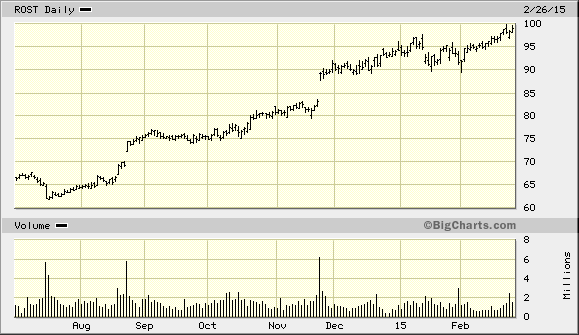
Last week, I asked for some feedback on the newsletter. The responses I got were great. A number of you wanted to see more details on why I decide to like a particular stock. So this week, let’s dig a little bit into the numbers at Ross, and I’ll show you why this is such a strong company. For the quarter, net sales rose by 11%. With retailers, the key metric to watch is same-store sales. For Q4, Ross’s same-store sales rose by 6%. That’s a very strong number, and it’s doubtful they’ll be able to maintain that pace. Lower gas prices probably helped. For the entire year, same-store sales were up 3%.
CEO Barbara Rentler said, “We are pleased with our fourth-quarter sales and earnings, both of which were well ahead of our expectations, as our value offering on a wide assortment of name-brand bargains and gifts resonated well with our customers. Our 2014 fourth-quarter operating margin grew 45 basis points to 13.1%, benefiting from slightly higher merchandise gross margin and leverage on expenses from our robust comparable-sales gain.”
She added, “For the 2014 fiscal year, our earnings per share rose a solid 14% on top of strong multi-year increases. In addition, our fiscal 2014 operating margin increased 35 basis points to 13.5%.”
For newer investors, it’s always good to see an increase in a company’s operating margin. That means that the company is being more efficient in running its business. It also suggests that the company is holding a stronger position in their market. You have to understand that margins are very tight in retail. It’s all about cost control and managing your inventory. Last year, Walmart’s (WMT) net profit margin was just 3.3%. Most people don’t realize how small it is. With economics like that, you have to watch every penny, and things can get even tighter at the at the deep-discount end where Ross lives. Their customers are very price conscious. They’re looking for a deal, and if they don’t find it at Ross, they’ll go somewhere else. It’s just that simple.
Last year, Ross’s net profit margin was 8.4%. That’s up from 8.2% in 2013. That may sound small, but it was enough to turn a 7.9% increase in sales into a 10.4% increase in net earnings. On top of that, the number of shares declined by 3.1%, so earnings-per-share rose by 13.9%. These are the factors that separate the outstanding companies from the also-rans.
Ross also said their board has approved a program to buy back $1.4 billion worth of stock over the next two years. At the current price, that’s about 7% of the outstanding shares. I’m not a big fan of share buybacks; I’d much rather have the cash as a dividend, but this shows you how profitable Ross is. This is a 27% increase over the previous repurchase program. I also like that Ross actually reduces share count where many other companies use share buybacks to mask their executive compensation.
For the new fiscal year, which ends in January 2016, Ross sees same-store sales rising by 1% to 2%. That’s a modest forecast, but it’s safe to be conservative. Ross sees full-year EPS ranging between $4.60 and $4.80. That’s up from $4.42 per share last year. For Q1, which ends on May 2, Ross sees same-store sales rising by 2% to 3% and earnings-per-share coming in between $1.21 and $1.26. That’s up from $1.15 for last year’s Q1. This week, I’m raising my Buy Below on Ross Stores by $11 to $107 per share.
Express Scripts Is a Buy up to $89 per Share
On Monday, Express Scripts (ESRX) reported Q4 earnings of $1.39 per share. That was one penny more than estimates. The pharmacy-benefits manager had given guidance of $1.36 to $1.40 per share. For the year, ESRX earned $4.88 per share. That wraps up another solid year for them.
For the year, they had net cash flow of $4.5 billion. Investors tend to fixate on earnings. While that’s important, you should also pay attention to a company’s operating cash flow. That’s the lifeblood of any enterprise.
CEO George Paz said, “We believe our growth- and focused-acquisition approach has positioned us uniquely in the healthcare services landscape to improve health outcomes and lower cost in an aligned model that keeps our clients and patients first, but also returns exceptional results to our shareholders.”
What’s always impressed me about Express Scripts is how they’ve been able to consistently grow their earnings. Since 2008, their EPS have been $1.55, $1.79, $2.50, $2.97, $3.74, and $4.33 to $4.88. As an investor, that’s exactly what I like to see: consistent increases. This is another reason why I like consumer staples stocks and healthcare stocks. Even the best cyclical stocks will see some ups and downs to their earnings trend. After all, that’s why they’re called cyclicals.
In last week’s issue, I told you I was expecting Express Scripts to give 2015 earnings guidance of $5.35 per share, give or take. They were a little more optimistic. For 2015, ESRX said they expect earnings to range between $5.35 and $5.49 per share. That’s a 10% to 13% increase over last year’s earnings.
On Tuesday, the shares gapped up to $88.83, which is a new all-time high. But the shares pulled back later this week to close at $84.54 on Thursday. That means the shares are going for less than 16 times forward earnings. That’s a good deal. This week, I’m bumping up my Buy Below on Express Scripts to $89 per share.
The Market Wants Patience and They Want It Right Now
The earnings outlook has gotten much more subdued this year. The Q4 earnings season is just about over; 90% of the earnings reports are in. The S&P 500 grew its earnings by 4.3% last quarter. This quarter, however, analysts expect earnings to fall by 4.5%. A major reason for the earnings dip is the strong dollar, and we’ve seen that reflected in several of our earnings reports. Wall Street now expects 2015 earnings of $118.32 for the S&P 500. That’s less than a 5% increase over 2014’s earnings. Only five months ago, Wall Street was expecting 2015 earnings of $136.07.
This week, Janet Yellen testified on Capitol Hill about the Federal Reserve’s outlook for monetary policy. The Fed had already sent a reassuring message to investors, saying that the Fed will be “patient” in moving to raise interest rates. I think that helped spark the latest rally, as the S&P 500 just made another all-time high. The Nasdaq Composite rallied for 10-straight days, and it’s closing in on its all-time high from 15 years ago.
Yellen reaffirmed the Fed’s policy this week. In short, the markets want patience, and they want it right now. In my eyes, it’s hard for anyone to be worried about the Fed’s sparking inflation. Prices are falling. The latest CPI report showed that prices fell 0.7% in January. In the last three months, the seasonally-adjusted CPI is down 1.3%.
Sure, a lot of that is energy, but the “core rate,” which excludes food and energy prices, rose by just 0.2% last month. As low as that was, it was higher than expectations of a 0.1% increase.
Despite the Fed’s rhetoric, I don’t see them raising rates soon. Even if they do raise rates, they’ll need to do it several times before it has an impact on the investing climate. The current low-rate climate is a boon for investors.
The Turnaround at Cognizant
Before I go, I want to raise my Buy Below for Cognizant Technology Solutions (CTSH). The story here is very similar to what we’ve seen at Ross Stores. A few months ago, Wall Street hated Cognizant. The shares got nailed for a 12.6% loss on August 6.
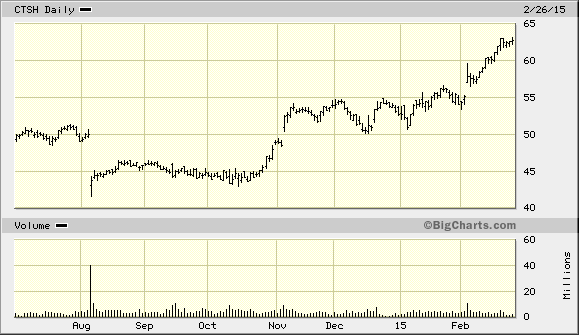
What was their crime? It wasn’t earnings. Those were actually quite good. Nor was it their earnings guidance. Instead, Wall Street didn’t like Cognizant’s sales guidance. Some people you just can’t reach. In the CWS Market Review from August 8, I stuck by CTSH and told folks not to panic. In the seven months since the plunge, CTSH is up 44%. In fact, it’s up more than 25% since the day before the plunge.
Cognizant is now our top performer this year. This week, I’m raising my Buy Below to $66 per share.
That’s all for now. Next week is the first trading week of March, and we’ll get those important turn-of-the-month econ reports. ISM and personal income come out on Monday. Tuesday is auto sales. Look for good numbers from Ford. Wednesday is the Fed’s Beige Book and the ADP jobs reports. Thursday is factory orders, and that leads us up to the big day, which is Jobs Day on Friday. The government will report on the labor market on Friday morning. Be sure to keep checking the blog for daily updates. I’ll have more market analysis for you in the next issue of CWS Market Review!
– Eddy
-
Morning News: February 27, 2015
Posted by Eddy Elfenbein on February 27th, 2015 at 7:03 amGermany Supports Extension of Greek Bailout Programme
Setbacks for Tsipras Stir Discord in Greek Ruling Party
Figures Show Continued Unevenness in Japan’s Recovery
India Growth to Top 8% in 2015/2016, Says Government
Saudis’ Oil Price War Is Paying Off
U.S.’s New Fraud Chief Will Enforce Laws He Was Paid to Blunt
Republicans Pledge to Fight FCC’s Open-Web Rules
Lloyds Banking Group Returns to Profit and Resumes Dividend Payments
Barnes & Noble to Keep Nook Digital Business After All
Airbus to Increase Short-Haul Aircraft Production
IBM Pumps $4 Billion Into Cloud, Mobile Initiatives
SeaWorld Attendance Falls 4%; PETA Attributes Drop to ‘Blackfish’
Credit Writedowns: When Do We Decide That Europe Must Restructure Much of Its Debt?
Be sure to follow me on Twitter.
-
RIP: Irving Kahn
Posted by Eddy Elfenbein on February 26th, 2015 at 5:03 pmIrving Kahn has died at the age of 109. He was a student of Benjamin Graham and later, chairman emeritus of Kahn Brothers Group Inc. He started working on Wall Street in 1928.
The crash of 1929, Mr. Kahn told an interviewer in 2012, taught him that “the gambling nature of Wall Street has little or no interest in the serious, underlying nature of businesses.” He described rapid trading, then and now, as “crazy competition that had no connection to the real facts.”
His central goal as an investor, he said, was always “to know much more about the stock I’m buying than the man who’s selling does.”
For Mr. Kahn, the most important quality an investor could possess was patience. “You gain much more by slow investing and concentrating on what you know,” he said in 2012, “than on fast investing, which is nothing more than gambling.”
In an article in the Financial Analysts Journal in 1977, Mr. Kahn set out seven “guidelines for intelligent investing.” Among them: “Don’t depend on recent or current figures to forecast future prices….Capital is always at risk unless you buy better than average values….Don’t trust quarterly earnings….Look beyond the one or two largest companies in a given industry.”
He concluded, “The analyst must both practice, and to his client preach, patience.”
Kahn’s sister also lived to 109. His brother died at 101 and another sister lived to 103.
Asked on Thursday if he had any thoughts on Mr. Kahn, Warren Buffett —who also studied under Mr. Graham—joked, “I’d rather have Irving’s thoughts on longevity.”
-
Archives
- September 2026
- August 2026
- July 2026
- June 2026
- May 2026
- April 2026
- March 2026
- February 2026
- January 2026
- December 2025
- November 2025
- October 2025
- September 2025
- August 2025
- July 2025
- June 2025
- May 2025
- April 2025
- March 2025
- February 2025
- January 2025
- December 2024
- November 2024
- October 2024
- September 2024
- August 2024
- July 2024
- June 2024
- May 2024
- April 2024
- March 2024
- February 2024
- January 2024
- December 2023
- November 2023
- October 2023
- September 2023
- August 2023
- July 2023
- June 2023
- May 2023
- April 2023
- March 2023
- February 2023
- January 2023
- December 2022
- November 2022
- October 2022
- September 2022
- August 2022
- July 2022
- June 2022
- May 2022
- April 2022
- March 2022
- February 2022
- January 2022
- December 2021
- November 2021
- October 2021
- September 2021
- August 2021
- July 2021
- June 2021
- May 2021
- April 2021
- March 2021
- February 2021
- January 2021
- December 2020
- November 2020
- October 2020
- September 2020
- August 2020
- July 2020
- June 2020
- May 2020
- April 2020
- March 2020
- February 2020
- January 2020
- December 2019
- November 2019
- October 2019
- September 2019
- August 2019
- July 2019
- June 2019
- May 2019
- April 2019
- March 2019
- February 2019
- January 2019
- December 2018
- November 2018
- October 2018
- September 2018
- August 2018
- July 2018
- June 2018
- May 2018
- April 2018
- March 2018
- February 2018
- January 2018
- December 2017
- November 2017
- October 2017
- September 2017
- August 2017
- July 2017
- June 2017
- May 2017
- April 2017
- March 2017
- February 2017
- January 2017
- December 2016
- November 2016
- October 2016
- September 2016
- August 2016
- July 2016
- June 2016
- May 2016
- April 2016
- March 2016
- February 2016
- January 2016
- December 2015
- November 2015
- October 2015
- September 2015
- August 2015
- July 2015
- June 2015
- May 2015
- April 2015
- March 2015
- February 2015
- January 2015
- December 2014
- November 2014
- October 2014
- September 2014
- August 2014
- July 2014
- June 2014
- May 2014
- April 2014
- March 2014
- February 2014
- January 2014
- December 2013
- November 2013
- October 2013
- September 2013
- August 2013
- July 2013
- June 2013
- May 2013
- April 2013
- March 2013
- February 2013
- January 2013
- December 2012
- November 2012
- October 2012
- September 2012
- August 2012
- July 2012
- June 2012
- May 2012
- April 2012
- March 2012
- February 2012
- January 2012
- December 2011
- November 2011
- October 2011
- September 2011
- August 2011
- July 2011
- June 2011
- May 2011
- April 2011
- March 2011
- February 2011
- January 2011
- December 2010
- November 2010
- October 2010
- September 2010
- August 2010
- July 2010
- June 2010
- May 2010
- April 2010
- March 2010
- February 2010
- January 2010
- December 2009
- November 2009
- October 2009
- September 2009
- August 2009
- July 2009
- June 2009
- May 2009
- April 2009
- March 2009
- February 2009
- January 2009
- December 2008
- November 2008
- October 2008
- September 2008
- August 2008
- July 2008
- June 2008
- May 2008
- April 2008
- March 2008
- February 2008
- January 2008
- December 2007
- November 2007
- October 2007
- September 2007
- August 2007
- July 2007
- June 2007
- May 2007
- April 2007
- March 2007
- February 2007
- January 2007
- December 2006
- November 2006
- October 2006
- September 2006
- August 2006
- July 2006
- June 2006
- May 2006
- April 2006
- March 2006
- February 2006
- January 2006
- December 2005
- November 2005
- October 2005
- September 2005
- August 2005
- July 2005
 Eddy Elfenbein is a Washington, DC-based speaker, portfolio manager and editor of the blog Crossing Wall Street. His