-
Morning News: January 29, 2015
Posted by Eddy Elfenbein on January 29th, 2015 at 7:10 amCarney Says ECB QE Not Enough Without Fiscal Support
Fed Upbeat on U.S. Economy, Cites Strong Job Gains
Ford Fourth-Quarter Profit Slumps 98%
The One Missing Ingredient In Facebook’s All-Out Drive For TV Ad Dollars
McDonald’s Promotes Easterbrook to Supersize His U.K. Success
Alibaba Holiday-Quarter Revenue Disappoints
Time Warner Cable Gains Subscribers; Results Miss
Potash Corp’s Profit Beats as Potash Sales Rise, Costs Fall
Thermo Fisher Fourth-Quarter Results Top Expectations on Life Tech Buy
Boeing Says Dreamliner to Yield More Cash in ’15
Shell to Cut Spending by $15 Billion Over Three Years
Nokia’s Network Unit Beats on North America Growth
Diageo Reports Better Quarter But US And China Still Drag
Cullen Roche: The Fed’s “Crazy Train” and the Stability that Breeds Instability
Jeff Carter: Great Advice For Entrepreneurs (and Investors)
Be sure to follow me on Twitter.
-
Qualcomm Had Good Earnings But Poor Guidance
Posted by Eddy Elfenbein on January 28th, 2015 at 9:15 pmAfter the bell, Qualcomm ($QCOM) reported Q4 earnings of $1.34 per share which was nine cents better than estimates.
Underlining the strength of broader phone demand, and illustrating how much most phone makers still depend on its chips, Qualcomm topped estimates for fiscal first-quarter profit and gave a rosy forecast for the current period.
A record quarter for Apple Inc.’s iPhone, which uses a Qualcomm modem chip, helped the chipmaker’s earnings. For the period ended Dec. 28, Qualcomm’s net income rose to $1.97 billion, or $1.17 a share, from $1.88 billion, or $1.09, a year earlier. Sales rose 7.2 percent to $7.1 billion. Excluding certain costs, profit was $1.34 a share. Analysts on average had projected profit of $1.25 a share on sales of $6.94 billion.
Profit before some items in the second quarter, which ends in March, will be $1.28 to $1.40 a share, the company said Wednesday. Sales will be $6.5 billion to $7.1 billion. On average, analysts projected profit of $1.28 a share and revenue of $6.72 billion, according to data compiled by Bloomberg.
The problem is that the company lowered their full-year guidance:
Sales for fiscal 2015 will be $26 billion to $28 billion, the San Diego-based company said in a statement. Profit excluding certain costs for the year will be $4.75 to $5.05 a share. The company previously projected as much as $28.8 billion in revenue and $5.35 in per-share profit.
The stock fell 8.3% in the after-hours market.
-
What Does the Futures Market Expect and When Does it Expect it?
Posted by Eddy Elfenbein on January 28th, 2015 at 2:55 pmAs readers of my blog know, I’m a big fan of Bespoke Investment Group. They always have great research and info. Lately, Bespoke has been running a “Countdown to Liftoff” chart. This is based on Fed Funds futures and it shows how much time the futures market thinks there is between now and the first Fed rate hike.
I suggested slightly altering the chart to show the y-axis as a date. Bespoke was good enough to pass along their data, so here’s what the chart looks like.
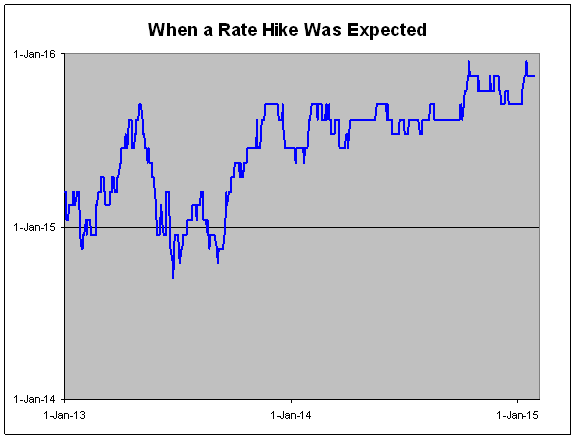
This chart may look a bit off at first because both axes are dates, but bear with me. The x-axis shows the date. The y-axis indicates when people thought the first rate hike was coming.
Starting in the fourth quarter of 2013, the market was expecting the first rate hike by mid-2015. In March 2014, Yellen sent the market into a tizzy with her “something on the order of six months” remark, referring to the period between the end of QE and the first rate increase.
That remained the case all the way through September of last year when August 2015 was seen as I-Day. Lately, however, the first rate hike expectation is beginning to drift back. The market currently sees a rate hike in November 2015. After today’s Fed news, I think we’re soon going to see the futures market point to 2016.
-
Today’s Fed Statement
Posted by Eddy Elfenbein on January 28th, 2015 at 2:02 pmHere’s today’s Fed statement:
Information received since the Federal Open Market Committee met in December suggests that economic activity has been expanding at a solid pace. Labor market conditions have improved further, with strong job gains and a lower unemployment rate. On balance, a range of labor market indicators suggests that underutilization of labor resources continues to diminish. Household spending is rising moderately; recent declines in energy prices have boosted household purchasing power. Business fixed investment is advancing, while the recovery in the housing sector remains slow. Inflation has declined further below the Committee’s longer-run objective, largely reflecting declines in energy prices. Market-based measures of inflation compensation have declined substantially in recent months; survey-based measures of longer-term inflation expectations have remained stable.
Consistent with its statutory mandate, the Committee seeks to foster maximum employment and price stability. The Committee expects that, with appropriate policy accommodation, economic activity will expand at a moderate pace, with labor market indicators continuing to move toward levels the Committee judges consistent with its dual mandate. The Committee continues to see the risks to the outlook for economic activity and the labor market as nearly balanced. Inflation is anticipated to decline further in the near term, but the Committee expects inflation to rise gradually toward 2 percent over the medium term as the labor market improves further and the transitory effects of lower energy prices and other factors dissipate. The Committee continues to monitor inflation developments closely.
To support continued progress toward maximum employment and price stability, the Committee today reaffirmed its view that the current 0 to 1/4 percent target range for the federal funds rate remains appropriate. In determining how long to maintain this target range, the Committee will assess progress–both realized and expected–toward its objectives of maximum employment and 2 percent inflation. This assessment will take into account a wide range of information, including measures of labor market conditions, indicators of inflation pressures and inflation expectations, and readings on financial and international developments. Based on its current assessment, the Committee judges that it can be patient in beginning to normalize the stance of monetary policy. However, if incoming information indicates faster progress toward the Committee’s employment and inflation objectives than the Committee now expects, then increases in the target range for the federal funds rate are likely to occur sooner than currently anticipated. Conversely, if progress proves slower than expected, then increases in the target range are likely to occur later than currently anticipated.
The Committee is maintaining its existing policy of reinvesting principal payments from its holdings of agency debt and agency mortgage-backed securities in agency mortgage-backed securities and of rolling over maturing Treasury securities at auction. This policy, by keeping the Committee’s holdings of longer-term securities at sizable levels, should help maintain accommodative financial conditions.
When the Committee decides to begin to remove policy accommodation, it will take a balanced approach consistent with its longer-run goals of maximum employment and inflation of 2 percent. The Committee currently anticipates that, even after employment and inflation are near mandate-consistent levels, economic conditions may, for some time, warrant keeping the target federal funds rate below levels the Committee views as normal in the longer run.
Voting for the FOMC monetary policy action were: Janet L. Yellen, Chair; William C. Dudley, Vice Chairman; Lael Brainard; Charles L. Evans; Stanley Fischer; Jeffrey M. Lacker; Dennis P. Lockhart; Jerome H. Powell; Daniel K. Tarullo; and John C. Williams.
-
Morning News: January 28, 2015
Posted by Eddy Elfenbein on January 28th, 2015 at 7:05 amGerman Consumer Sentiment to Reach 13-Year High in February
China Accuses Alibaba Of Lax Merchant Control, Tells It To Stop Being Arrogant
Alibaba Creates a Consumer Credit Rating Service
London’s Canary Wharf: Qatar Bid Wins Battle
Consumer Confidence in U.S. Rises More Than Forecast on Jobs
Morgan Stanley: The Fed Isn’t Raising Rates Until March 2016
Obama Proposes Offshore Drilling From Virginia to Georgia
Apple Smashes Forecasts, Selling 74.5 Million iPhones In Q1
TE Connectivity to Sell Broadband Network Unit to CommScope
Nintendo’s Outlook Disappoints and Mario Can’t Save Wii U
Roche Earnings Stagnate for First Time in Three Years on Costs
H&M Posts Rise in Quarterly Profit, Plans 400 New Stores
In DuPont Fight, Activist Investor Picks a Strong Target
Ben Carlson: Would Keynes Have Been Fired As a Money Manager Today?
Roger Nusbaum: 11 Investing and Personal Finance Hacks
Be sure to follow me on Twitter.
-
Stryker Earns $1.44 per Share
Posted by Eddy Elfenbein on January 27th, 2015 at 4:14 pmStryker ($SYK) just reported Q4 earnings of $1.44 per share. That was one penny below expectations. For all of 2014, the company made $4.73 per share. Here’s the outlook for 2015:
We expect 2015 constant currency sales growth in the range of 5.5% to 7.0%, including organic sales growth in the range of 4.5% to 6.0%. Based on current foreign currency exchange rates we expect adjusted diluted net earnings per share to be in the range of $1.05-$1.10 and $4.90-$5.10 in the first quarter and the full year, respectively. If foreign currency exchange rates hold near current levels, we expect sales in the first quarter and full year of 2015 to be negatively impacted by approximately 3% to 4% and adjusted diluted net earnings per share to be negatively impacted by approximately $0.08 and $0.30 in the first quarter and the full year, respectively.
Wall Street had been expecting $1.17 per share for Q1, and $5.14 for the whole year.
Shorter version: Business is going well but the strong dollar is causing some pain.
-
My Watch List
Posted by Eddy Elfenbein on January 27th, 2015 at 1:08 pmBelow is my latest Watch List. This is my unofficial list of high-quality stocks I like to follow. If a stock is on this list, then there’s a very good chance that it’s in the upper 5% of well-run companies on Wall Street. This is the elite.
I’m often asked how I go about selecting the stocks for my Buy List. It’s actually very simple. I have this Watch List of stocks and if one of them falls down to a very attractive price, then it becomes a contender for the new Buy List. I like to think of the Watch List as the minor leagues for the Buy List. Strong prospects earn their way up the ladder.
The Watch List is very informal. Unlike the Buy List, I’m constantly adding and deleting names. In fact, I have a bad habit of letting the Watch List grow too large. I often find myself adding three names for every one I delete. It’s simply not possible to follow 130 stocks.
Every few months I promise myself that this will be the time to trim down the Watch List. Well, I actually did it this time! Over the past several weeks, I trimmed the Watch List down to 76 names.
Symbol Stock ABC AmerisourceBergen ABT Abbott Laboratories ADS Alliance Data Systems AL Air Lease AME Ametek ANSS Ansys ANTM Anthem APH Amphenol AZO AutoZone BCPC Balchem BDX Becton, Dickinson BIIB Biogen Idec CATM Cardtronics CTAS Cintas CERN Cerner CHD Church & Dwight CL Colgate-Palmolive COST Costco CPRT Copart CVS CVS Health DHR Danaher DKS Dick’s Sporting Goods DLX Deluxe EV Eaton Vance FAST Fastenal FDS FactSet Research Systems FL Foot Locker FTI FMC Technologies GGG Graco GPN Global Payments GWW W.W. Grainger HEI HEICO HSIC Henry Schein HSNI HSN Inc HSY Hershey HUB-B Hubbell ICE Intercontinental Exchange IDXX IDEXX Laboratories IEX IDEX IFF International Flavors & Fragrances INTU Intuit IPCM IPC Healthcare IT Gartner JBHT JB Hunt Transport Services JKHY Jack Henry & Associates MDT Medtronic MIDD Middleby MKC McCormick MTD Mettler-Toledo International MWIV MWI Veterinary Supply NKE Nike NTCT NetScout Systems OSIS OSI Systems PB Prosperity Bancshares PSA Public Storage PZZA Papa John’s International RAI Reynolds American RMD ResMed ROL Rollins SBUX Starbucks SEIC SEI Investments SJI South Jersey Industries SLGN Silgan Holdings SRCL Stericycle STJ St. Jude Medical SWI SolarWinds TJX TJX TMO Thermo Fisher Scientific TSCO Tractor Supply TXRH Texas Roadhouse TYL Tyler Technologies V Visa VFC V.F. Corp VSI Vitamin Shoppe WEX WEX ZMH Zimmer Holdings Spies and Finance
Posted by Eddy Elfenbein on January 27th, 2015 at 11:48 amYesterday, the FBI arrested a Russian businessman named Evgeny Buryakov and charged him with being an agent of Russian intelligence.
Buryakov was in the U.S. on “non-official status,” meaning he didn’t have diplomatic immunity, while his two co-conspirators (Igor Sporyshev and Victor Podobnyy) had official status but they had already split back to Mother Russia.
Reading the details of their story, it’s pretty embarrassing. These guys come across more like Boris Badenov rather than international men of mystery. The spies are on the phone complaining about their jobs.
While it’s easy to dismiss these buffoons as merely buffoons, noted strategy analyst John Schindler cautions that there’s something more sinister afoot. Bear in mind that Vladimir Putin is a former KGB officer and that he takes spy warfare seriously. Putin believes Russia is in a Holy War with the west, the U.S. especially, and he intends to win.
Schindler notes that the important part of the story, the part that we ought to be paying attention to, is that the spies were targeting the U.S. financial infrastructure. They were looking for information on topics like high-frequency trading and automated trading algorithms. Basically, anything that could be used to destabilize our financial markets.
As with the Illegals Network in 2010, journalists and commentators who are ignorant of Russian espionage tradecraft are blowing this story off as being of little consequence, even comedic. There is, however, nothing funny about this case. In the first place, it shows that the Kremlin continues to collect economic intelligence in the West, using various covers to steal information of many sorts. This is a big win for the FBI and U.S. counterintelligence, but luck was on our side here, and that cannot be counted on.
Moreover, Illegals have many purposes, including functioning as long-term sources to maintain agent networks in the event of war, when diplomatic facilities close and Legals get pulled home. Given the parlous state of relations between the West and Russia now, this is not a theoretical concern. The Kremlin, unlike most Western intelligence services, tends towards the long-view and worst-case planning with utmost seriousness.
Most individual investors are unaware of how much modern trading is dominated by machines. These are highly sophisticated operations. Whenever you buy a stock, it’s very likely you’re buying it from a machine. Whenever you sell a stock, it’s very likely a machine bought it from you. There’s a vast army of computers that do nothing all day but trade at insanely high speeds to eek out a micro-penny’s profit on each trade. The worry is that once one robot starts selling massively, it could trigger all the other robots to sell as well.
Could this really happen? I don’t know, but we’ve had Flash Crashes before. It’s realistic enough that the Russians were looking into it. The trio was especially interested in ETFs (exchange traded funds). On the other hand, rather than them attacking us, they have been interested in finding out if we had been attacking them.
The irony here is that it’s been the Russian system that’s been destabilized. The Russian economy has been clobbered by the recent fall in oil. The ruble has been smashed and the Russian Fed has responded by jacking up interest rates. As I’ve noted before, the Russian ETF ($RSX) is in a severe bear market. Capital outflows ballooned from $60 billion in 2013 to $150 billion last year.
It may soon get worse for Russia. Yesterday, S&P cut Russia’s bond rating to junk (and someone may have known). The U.S. wants to kick Russia out of the SWIFT banking network. This is the standardized network that lets banks conduct international transactions. This is a big deal as it would isolate the Russian economy even more. Dmitry Medvedev said that Russia’s reaction would be “unlimited.” The fear is that with a busted up financial system, the Russian Fed won’t be able to conduct monetary policy.
In 2009, a computer programmer (and Russian immigrant) named Sergey Aleynikov was arrested and accused of improperly copying computer codes that could be used to destabilize the markets. This was the inspiration for Michael Lewis’s “Flash Boys.” After years of legal battles, Aleynikov’s case was ultimately thrown out, although his life was nearly ruined.
This is a secret world of spycraft and high finance. We may never know exactly what’s going on. In the meantime, it’s best to remember those haunting words by T.S. Eliot, himself a Lloyd’s Bank employee:
Between the order
And the confirmation
Between the bid
And the ask
Falls the shadow.Morning News: January 27, 2015
Posted by Eddy Elfenbein on January 27th, 2015 at 7:07 amGreece’s Odd-Couple Only Agrees About Ending Austerity
Russia’s Downgrade Has Important Political Implications
British Economy Brows at Best Annual Rate Since 2007
Doubts Grow About Mid-Year Rate Hike, But Fed Won’t Express Any
Oil Price Recovers as Dollar Weakens Against Euro
Winklevoss Twins: Bitcoin Will Explode Beyond $1 Trillion
Wall Street Left With Skeleton Crews Down as Blizzard Bears Down
Price Caps Leave Blizzard Riders Out in the Cold
IBM Dismisses Forbes Report of Massive Layoffs
Philips Lags Behind Its Profit Targets as Earnings Slide
Ericsson Hurt by North American Slowdown
Novartis Upbeat Despite Weaker Profit
Shake-Up at Mattel as Barbie Loses Her Appeal
Jeff Carter: First Regulated Bitcoin Exchange
Joshua Brown: QOTD: Is Fundamental Indexing Passive or Active?
Be sure to follow me on Twitter.
Microsoft Earns 71 Cents per Share
Posted by Eddy Elfenbein on January 26th, 2015 at 4:59 pmMicrosoft reported fiscal Q2 earnings of 71 cents per share. That matched Wall Street’s consensus.
The company’s bottom line has been hit in recent quarters by expenses related to job cuts started last summer and the Nokia mobile phone business that it acquired in April. The July plans included up to 18,000 jobs cuts, or about 14% of its workforce at the time, largely to clear up overlap with the Nokia businesses.
For the period ended Dec. 31, Microsoft reported a profit of $5.86 billion, or 71 cents a share, down from $6.56 billion, or 78 cents a share, a year earlier. Microsoft said its per-share earnings in the latest quarter were hurt by 2 cents from costs related to integration and restructuring.
Revenue increased to $26.47 billion from $24.52 billion.
Analysts polled by Thomson Reuters expected per-share profit of 71 cents and revenue of $26.29 billion.
The stock is down 3% after hours.
-
Archives
- July 2026
- June 2026
- May 2026
- April 2026
- March 2026
- February 2026
- January 2026
- December 2025
- November 2025
- October 2025
- September 2025
- August 2025
- July 2025
- June 2025
- May 2025
- April 2025
- March 2025
- February 2025
- January 2025
- December 2024
- November 2024
- October 2024
- September 2024
- August 2024
- July 2024
- June 2024
- May 2024
- April 2024
- March 2024
- February 2024
- January 2024
- December 2023
- November 2023
- October 2023
- September 2023
- August 2023
- July 2023
- June 2023
- May 2023
- April 2023
- March 2023
- February 2023
- January 2023
- December 2022
- November 2022
- October 2022
- September 2022
- August 2022
- July 2022
- June 2022
- May 2022
- April 2022
- March 2022
- February 2022
- January 2022
- December 2021
- November 2021
- October 2021
- September 2021
- August 2021
- July 2021
- June 2021
- May 2021
- April 2021
- March 2021
- February 2021
- January 2021
- December 2020
- November 2020
- October 2020
- September 2020
- August 2020
- July 2020
- June 2020
- May 2020
- April 2020
- March 2020
- February 2020
- January 2020
- December 2019
- November 2019
- October 2019
- September 2019
- August 2019
- July 2019
- June 2019
- May 2019
- April 2019
- March 2019
- February 2019
- January 2019
- December 2018
- November 2018
- October 2018
- September 2018
- August 2018
- July 2018
- June 2018
- May 2018
- April 2018
- March 2018
- February 2018
- January 2018
- December 2017
- November 2017
- October 2017
- September 2017
- August 2017
- July 2017
- June 2017
- May 2017
- April 2017
- March 2017
- February 2017
- January 2017
- December 2016
- November 2016
- October 2016
- September 2016
- August 2016
- July 2016
- June 2016
- May 2016
- April 2016
- March 2016
- February 2016
- January 2016
- December 2015
- November 2015
- October 2015
- September 2015
- August 2015
- July 2015
- June 2015
- May 2015
- April 2015
- March 2015
- February 2015
- January 2015
- December 2014
- November 2014
- October 2014
- September 2014
- August 2014
- July 2014
- June 2014
- May 2014
- April 2014
- March 2014
- February 2014
- January 2014
- December 2013
- November 2013
- October 2013
- September 2013
- August 2013
- July 2013
- June 2013
- May 2013
- April 2013
- March 2013
- February 2013
- January 2013
- December 2012
- November 2012
- October 2012
- September 2012
- August 2012
- July 2012
- June 2012
- May 2012
- April 2012
- March 2012
- February 2012
- January 2012
- December 2011
- November 2011
- October 2011
- September 2011
- August 2011
- July 2011
- June 2011
- May 2011
- April 2011
- March 2011
- February 2011
- January 2011
- December 2010
- November 2010
- October 2010
- September 2010
- August 2010
- July 2010
- June 2010
- May 2010
- April 2010
- March 2010
- February 2010
- January 2010
- December 2009
- November 2009
- October 2009
- September 2009
- August 2009
- July 2009
- June 2009
- May 2009
- April 2009
- March 2009
- February 2009
- January 2009
- December 2008
- November 2008
- October 2008
- September 2008
- August 2008
- July 2008
- June 2008
- May 2008
- April 2008
- March 2008
- February 2008
- January 2008
- December 2007
- November 2007
- October 2007
- September 2007
- August 2007
- July 2007
- June 2007
- May 2007
- April 2007
- March 2007
- February 2007
- January 2007
- December 2006
- November 2006
- October 2006
- September 2006
- August 2006
- July 2006
- June 2006
- May 2006
- April 2006
- March 2006
- February 2006
- January 2006
- December 2005
- November 2005
- October 2005
- September 2005
- August 2005
- July 2005
 Eddy Elfenbein is a Washington, DC-based speaker, portfolio manager and editor of the blog Crossing Wall Street. His