-
High Beta Pain
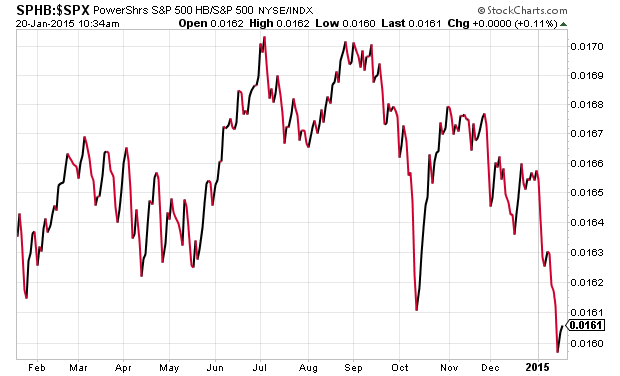
Posted by Eddy Elfenbein on January 20th, 2015 at 11:06 amStocks with higher betas have been lagging badly this year. They’re doing a little better today, but it’s been a rough ride since September. Here’s the High Beta ETF ($SPHB) divided by the S&P 500.
-
Denmark Goes More Negative
Posted by Eddy Elfenbein on January 20th, 2015 at 10:49 amThe dramatic move by the Swiss National Bank shook up currency traders. Now it’s Denmark’s turn. After all, they face the same pressures from the ECB. The Nationalbank, Denmark’s Fed, cut rates on CDs to -0.2% from -0.05%.
Both the Swiss and Danish authorities, trying to keep their currencies — and exports — globally competitive, acted pre-emptively before a meeting of the European Central Bank on Thursday in Frankfurt. At that meeting, the bank’s policy makers are widely expected to announce a program of large-scale bond buying, an action that could further push down the value of the euro, which has been weakening for months.
A weakening euro has the effect of making other European currencies, like the Swiss franc and Danish krone, relatively stronger — which effectively raises the prices of products priced in francs or kroner on the global market.
-
30-Year Yield Hits All-Time Low
Posted by Eddy Elfenbein on January 20th, 2015 at 10:39 amThis is going to be a busy week for the stock market. Of course, earnings season is starting to heat up, and analysts have been slashing their forecasts in a serious way. For the rest of this year, we’re probably looking at growth of 3% to 5%. On our Buy List, eBay reports tomorrow and Signature Bank follows on Thursday.
The Federal Reserve meets again next week and I’ll be curious to hear if there’s any change in direction. To put it bluntly, the strong dollar has already done a lot of the Fed’s tightening work for them. Last week’s inflation report showed that prices are falling. It’s hard to argue for higher rates when you have deflation. On top of that, the latest industrial production report was pretty weak.
Last night, Jon Hilsenrath of the Wall Street Journal had an article saying that the Fed is on track for a rate hike later this year. I’m not so sure but it’s strongly assumed on Wall Street that Hilsenrath is the unofficial mouthpiece for the Fed.
The latest from the futures market shows that investors are beginning to think a rate hike won’t happen this year. The futures market sees rates reaching 0.41% by the end of this year. The Fed sees short-term interest rates hitting 2.5% by the end of 2016. But the futures market says it’ll be 1.1%. Personally, I side with the futures. The five-year forward inflation expectations rate is now below 2%. Last week, the yield on the 30-year Treasury got down to 2.35%. That’s the lowest since the Treasury started issuing those bonds regularly in 1977.
Stock markets in Europe are edging to their highest level in years on anticipation of the ECB’s big announcement on Thursday. Draghi is set to start buying some bonds. We’re going to find out the details this week. My fear is that the market is setting itself up for a disappointment if the number’s not large enough.
Here’s the 30-year Treasury yield:
Here’s the Five-Year Forward Inflation Expectation Rate:
-
Morning News: January 20, 2015
Posted by Eddy Elfenbein on January 20th, 2015 at 7:22 amIMF Lowers Global Growth Forecast by Most in Three Years
Young People Want a Say in Davos
China’s 2014 Economic Growth Misses Target, Hits 24-Year Low
U.S. Solar Industry Sees Growth, But Also Some Uncertainty
Morgan Stanley Profit Rises As Legal Costs Fall
Shake Shack Unveils a Pricing Range For Its Planned IPO
Johnson & Johnson’s 2014 Revenue Rose and Profits Soared
Delta Results Helped by Falling Fuel Prices
Halliburton Boosts Fourth-Quarter Profit
SAP Expects Shift to Cloud to Weigh on Earnings Growth
Facebook Says it Adds More Than $200 Billion to Global Economy
Twitter Ups Ante to Boost India Biz; Buys Bangalore Start Up
DreamWorks Animation’s Box-Office Flops May Result in 400 Job Cuts
Jeff Carter: People Focus on Bitcoin Currency, But the Magic is The BlockChain
Cullen Roche: Milton Friedman Might Have Won the Battle, But He’s Losing the War
Be sure to follow me on Twitter.
-
Morning News: January 19, 2015
Posted by Eddy Elfenbein on January 19th, 2015 at 7:04 amKey ECB Meeting to Pose Test of Central Bank Unity, Power
BOJ Showing Liquidity Trap Holds Warning for ECB
China Cracks Nearly 8%; FIIs May Find Safe Haven in Indian Markets
One in Five Distressed Corporate Bonds Are Made in Moscow
Richest 1% Will Own More Than the Rest By 2016
Oil Finally Pays Out for Bulls After First Gain of Year
LNG to Snap 4-Year Run as Sub-$10 Price Seen Amid Oil’s Drop
Don’t Expect Help From the Underfunded IRS
Uber Partners With Korean Taxi Company to Comply With Local Rules
Sharp Expects to Miss Full-Year Earnings Outlook
Facebook Hiring Spree Hints at Ambitions in Virtual Reality
Asia’s Richest Man Said To Be In Talks To Buy U.K.’s O2
Jeff Miller: Weighing the Week Ahead: The Message from Fourth Quarter Earnings
Joshua Brown: Permit Me a Few Victory Laps…
Epicurean Dealmaker: Passing Fair
Be sure to follow me on Twitter.
-
MLK’s “Street Sweeper” Speech
Posted by Eddy Elfenbein on January 18th, 2015 at 2:05 pmI’ve always felt this was one of Martin Luther King’s best and most under-appreciated speeches:
-
Workers Got a Raise…in Real Terms
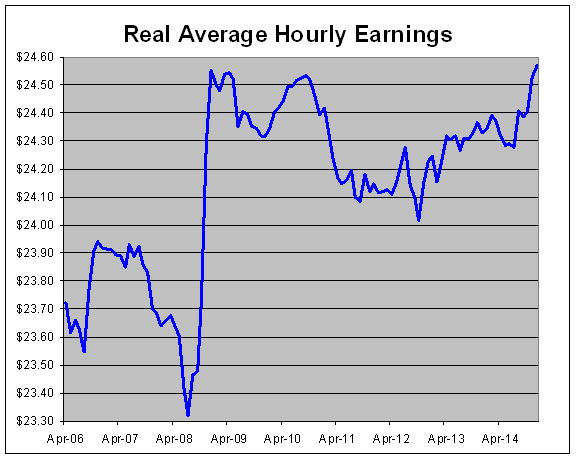
Posted by Eddy Elfenbein on January 16th, 2015 at 9:43 amOne item in last week’s jobs report was a disappointment: average hourly earnings fell 0.2% to $24.57. This morning we learned that consumer prices fell by 0.4% in December. We had deflation. That means that workers got a raise in real terms.
The data series only goes back to 2006, but real AHE earnings actually hit a new high in December.
-
CWS Market Review – January 16, 2015
Posted by Eddy Elfenbein on January 16th, 2015 at 7:09 am“There’s no shame in losing money on a stock. Everybody does it.
What is shameful is to hold on to a stock, or worse, to buy more
of it, when the fundamentals are deteriorating.” – Peter LynchThe stock market has suddenly gotten a lot more volatile. We went all of 2014 without a losing streak of more than three days. Since Christmas, we’ve had two five-day losing streaks. So far, the U.S. stock market has lost nearly $1 trillion this year.
Last year was the calmest year for stocks since 2006. The average daily change for the S&P 500 in 2014 was 0.53%. So far this year, we’re running at more than twice that. If you recall, the S&P 500 had a three-month stretch last year when it didn’t close up or down by more than 1% in a single day; but in the last five weeks, it’s happened eight times. On Thursday, the S&P 500 closed below 2,000 for the first time in a month. This is the index’s worst start for the year since 2009.

So what’s behind the market’s vicissitude? There are several events coming together, but most of them are a result of our good friend, the Strong Dollar Trade. I’ve written about this before, but every investor needs to understand what this means. Just this week, the euro slumped to a nine-year low against the dollar. The Swiss National Bank responded by scrapping the franc’s price cap against the euro. All over the globe, forex trading went bonkers. Within minutes, the franc skyrocketed 38%.
The rising dollar is putting a lot of pressure on commodities which are priced in dollars. On Tuesday, spot West Texas Intermediate broke below $45 per barrel. Then on Wednesday, copper plunged 5.3% for its biggest loss in nearly six years.
Underlying the Strong Dollar Trade is the belief that the U.S. economy is semi-strong while Europe and Asia are weak. But our economy might not be as healthy as we thought. We just learned that last month’s retail sales were the weakest in a year. This week marked the beginning of Q4 earnings season, and we’re starting to see how the soaring greenback has impacted different companies.
Confused? Don’t be. I’m pleased to report that our Buy List is well-positioned for whatever the market throws our way. In this week’s CWS Market Review, we’ll take a closer look at the earnings outlook and what it means for us. We’ll also break down the latest ructions in Europe. Later on, I’ll discuss the latest earnings report from Wells Fargo ($WFC). The big bank is doing well in a challenging environment for banks. I’ll also preview upcoming Buy List earnings reports from eBay and Signature Bank. But first, let’s take a look at how the Strong Dollar Trade is impacting the world.
Looking at the Fourth-Quarter Earnings Season
The Q4 earnings season has officially begun. This is an important earnings season because it’s our first look at how the plunge in oil has affected the corporate bottom line. In the weeks leading up to earnings season, analysts had been slashing their estimates, especially for energy stocks.
In October, Wall Street had been expecting earnings to rise by 8.5% for Q4 and by 9.5% for Q1. That’s been pared back a lot. The Street now expects earnings growth of 2.0% for Q4 and 2.8% for Q1. As you might guess, energy is mostly to blame. From the end of June to the end of December, full-year 2015 earnings estimates for energy stocks dropped by 28.9%. For the rest of the S&P 500, estimates dropped by 1.5%. Actually, that probably understates the impact of energy, since the mega-caps like Chevron ($CVX) and Exxon ($XOM) aren’t down nearly much as many of the small- and mid-cap energy stocks.
The irony is that if OPEC hadn’t been so greedy and let oil shoot over $100 per barrel, then no one would have put so much money and effort into fracking or horizontal drilling. It’s now a game of who’s going to blink first, the shale guys or OPEC. All across Wall Street, oil experts are playing a guessing game of “how low can it go.” Goldman said that oil will have to be near $40 to fend off new supplies. Bank of America and Societe Generale say that oil’s going below $40. Barron’s speculates that oil could hit $20 per barrel.
AAA said that the average price at the pump is $2.101 per gallon. That’s the cheapest gasoline has been since May 2009. OPEC has shown every sign that they’re cool with this drop and that they’re ready to let oil slide down even more. Neither side is ready to blink. In December, Iraq exported more oil than it had since the 1980s.
As I see it, a black swan is a white swan that got doused with $44 oil. Experts estimate that the supply of crude is outpacing demand by two million barrels every day. The oil bear has put the squeeze on the Russian bear. The situation in Russia is so bad that Mikhail Prokhorov, one of the big-time oligarchs, is selling his majority stake in the Brooklyn Nets. Does plunging oil hurt stocks? We don’t have a precise answer, but previous oil bears have been good for stocks.
We can assume that lower oil is very good for consumers, and that’s been helping retail stocks like Ross Stores ($ROST). But we got a surprise this week from a weak retail sales report for December. Sure, more people are working, but last week’s jobs report showed that average hourly earnings fell in December. There’s also the fear that the oil bust could lead to a collapse in capex spending. That’s a fancy way of saying that energy companies won’t shell out as much money for new projects since oil’s so cheap. That could also lead to layoffs in the energy sector.
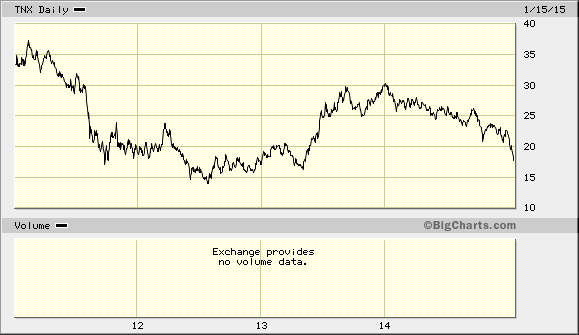
The lousy average hourly earnings data may cause the Federal Reserve to rethink any rate-hike plans. The Strong Dollar Trade really overwhelms everything. Wholesale inflation just recorded its biggest drop in three years. Charles Evans, the president of the Chicago Fed, said that inflation may not hit 2% until 2018. Evans doesn’t want to see rates go up until next year at the earliest. He may be right. It looks like the Strong Dollar Trade is already doing its own monetary tightening, beating Yellen to the punch. That’s why the bond market continues to rally. This week, the yield on the 10-year Treasury dipped below 1.80% for the first time since May 2013 (see below). The yield on longer-dated bonds has fallen even more. The spread between the 10- and 30-year yields is at a six-year low.
Wall Street can be unforgiving if a stock misses earnings. On Wednesday, JPMorgan Chase ($JPM), a former Buy List stock, got nailed for a 3.5% loss after the bank missed the Street’s earnings consensus by 12 cents per share. JPM’s legal costs were $2.9 billion last year. I realize that sounds bad, but it’s an improvement over the $11.1 billion from 2013. Bank of America ($BAC) and Citigroup ($C) have also been weak. On Thursday, Best Buy ($BBY) got taken to the woodshed after they warned of tough times ahead. Stryker ($SYK) just said that the strong dollar will nick this year’s earnings by 20 cents per share. The previous forecast was 10 to 12 cents per share.
The real pain lately has been among “high beta” stocks, meaning the stocks that go up the most when the market goes up. Many richly valued Internet stocks like Twitter ($TWTR), Google ($GOOGL), Netflix ($NFLX), Priceline ($PCLN) and Amazon ($AMZN) have been poor performers. Investors should continue to concentrate on high-quality stocks like the ones on our Buy List. Two stocks on our Buy List that look especially attractive right now are Qualcomm ($QCOM) and Hormel Foods ($HRL). Now let’s look at Europe’s fight against slipping into deflation.
Europe’s Battle Against Deflation
Europe can’t seem to catch a break. The economy in the Old World is still flat on its face. Unemployment in the eurozone is 11.5%, and the latest stats show that Europe now faces a real threat of deflation. Mario Draghi, the head of the ECB, recently said, “If inflation remains low for a long time, people might expect prices to fall even further and postpone their spending.” A deflationary spiral is a central banker’s worst nightmare.
Draghi has been fighting intransigent European (read, German) politicians to get behind his efforts to do a large-scale Quantitative Easing, just like Bernanke did, but for Europe. Only since the latest batch of lousy economic stats has he finally prevailed. Like Bernanke, Draghi has cut rates down to nothing, and Europe is nowhere close to the ECB’s 2% target for inflation. Five-year bond yields in Germany, Finland and Switzerland have all turned negative. That means, you have to pay for the privilege of lending the government your own money!
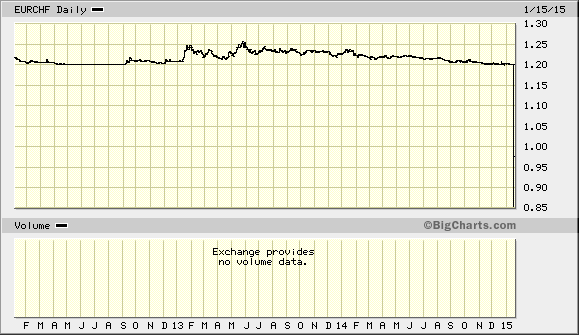
The ECB’s next meeting is on Thursday, January 22, and that’s when Draghi will unveil his stimulus plan. This is part of the reason why the euro’s been tanking against the dollar, and why the Swiss Fed decided to abandon its currency cap (see the crazy chart below). The Swiss National Bank lowered interest rates from -0.5% to -0.75%. Now there’s the question of a price tag for Draghi’s bond-buying. Analysts have been kicking around numbers from 500 billion to 800 billion euros. Some say it could even be one trillion euros. I think Draghi is a very determined guy. Remember, he’s the one who said in 2012 that he’ll do “whatever it takes” to save the euro.
What’s Draghi going to buy? Well, that’s a really good question. His problem is that he’s going to have to buy enough bonds to make an impact, but that will mean he’ll have to buy bonds of more profligate countries, which opens him up to the charges of rewarding poor decisions. My view is that if Draghi has broad enough support from the important people, he can win his fight against deflation.
Europe’s problems don’t end there. On January 25, the Sunday following the ECB meeting, Greek voters go to the polls. The far-left Syriza party, led by the charismatic Alexis Tsipras, is expected to do well. Syriza has promised to bail out of Greece’s bailout.
The problem for investors is that that could trigger a nasty chain reaction. Europe lent Greece 240 billion euros in exchange for the government’s implementing austerity policies. Those policies are hugely unpopular. Germany has made it clear that they won’t be blackmailed by Greece, and they’re fine with Greece exiting the euro. This could turn into a massive headache for everyone. Honestly, I don’t see it coming to that, but it’s not a far-fetched scenario. Hopefully, some sort of compromise will be worked out. Now let’s look at the first earnings report from our Buy List this earnings season.
Wells Fargo Earned $1.02 per Share for Q4
On Wednesday, Wells Fargo ($WFC) led off earnings season for our Buy List. The San Francisco bank reported earnings of $1.02 per share, which matched Wall Street’s view. Net income rose slightly from $5.37 billion to $5.38 billion. This was Wells’s 18th consecutive quarter of profit growth.
Wells was much more fortunate than other big banks (like JPM) because they focus more on deposits and lending rather than trading. Looking at the top line, WFC’s revenue rose 4% to $21.44 billion. The Street had been expecting $21.24 billion. Wells clearly benefited from loan growth. Total average loans rose 4% to $849.4 billion. On the downside, Wells said that expenses rose to their highest point in two years.
WFC’s net interest margin (that’s the key metric for any bank) fell a bit to 3.04%. That’s still good. For the whole year, Wells had net income of $21.82 billion on revenue of $84.35 billion. That’s an increase of 4% and 1%, respectively. For the year, Wells earned $4.10 per share.
Overall, I’m pleased with their performance, and I recognize that the environment is less friendly towards banking. Last year, Wells’s return on equity was 13.7%. That compares well with JPM, which had an ROE of 9.8%. So far this year, the S&P Bank Index is down 8.8%, while shares of WFC are down 6.5%. This is why we focus on high-quality companies; they do better when times are rough.
Wells Fargo is also being hurt by a sluggish housing market, but I think that will gradually improve over the next several quarters. The stock got nicked after the earnings report, so this week I’m lowering my Buy Below on Wells Fargo to $54 per share.
Earnings Preview for eBay and Signature Bank
We have two more Buy List earnings reports coming next week. eBay reports Q4 earnings on Wednesday, January 21, and Signature Bank, a new member of our Buy List, reports earnings on Thursday, January 22. (You can see a complete Earnings Calendar for our Buy List stocks
here.)Three months ago, eBay ($EBAY) had a good earnings report. The online-auction house earned 68 cents per share, which was a penny more than expectations. Quarterly revenue rose 12% to $4.4 billion. The report pleased Wall Street. From the October low to the December high, shares of eBay soared 25%.
I was a little disappointed by their guidance for Q4. eBay said they see earnings ranging between 88 and 91 cents per share. Frankly, I think that’s too low. I’m expecting a modest earnings beat. On the revenue side, eBay sees the numbers as ranging between $4.85 billion and $4.95 billion. Again, that strikes me as conservative.
Here’s my view: eBay is a very solid business. Last year, they probably generated more than $3.5 billion in EBITDA. Also, they have more than $15 billion cash in the bank. Of course, eBay also has the PayPal spinoff planned for the latter half of 2015. Revenues at PayPal are growing at more than 20% per year. eBay continues to be a buy up to $60 per share.
Signature Bank ($SBNY) is one of the five new members of our Buy List this year. Signature isn’t very well-known, but it may be the quietest success story in banking. They’re rarely in the news, and that’s exactly how they like it. But their performance tells the story. Signature’s loan-delinquency rate is about one-tenth of the industry average. They also keep a tight rein on overhead, which runs about 40% below industry average.
Three months ago, Signature reported Q3 earnings of $1.52 per share, which was six cents better than estimates. That was their 20th-straight quarter of record earnings. Earnings for Q3 grew by 27.7%. Shares of SBNY have drifted lower recently with other banking stocks. I started Signature with a Buy Below of $133, but I may tighten it up after next week’s earnings report.
That’s all for now. The stock market is closed on Monday in honor of Dr. Martin Luther King’s birthday. Earnings season heats up next week. On our Buy List, eBay and Signature Bank are due to report. We’ll also get important reports on housing starts, building permits and inventories on crude oil. On Thursday, the ECB has its big meeting to introduce its asset-buying program. Be sure to keep checking the blog for daily updates. I’ll have more market analysis for you in the next issue of CWS Market Review!
– Eddy
-
Morning News: January 16, 2015
Posted by Eddy Elfenbein on January 16th, 2015 at 6:58 amEurope Car Sales Rise First Time Since 2007 on Renault
Euro’s March Lower Getting Boost From Swiss Bankers
Cheaper Oil Tames U.S. Producer Inflation; Jobless Claims Up
Schlumberger Cuts 9,000 Jobs as Oil-Price Ax Falls
Kinder Morgan: What Is The Impact Of The Shrinking Brent/WTI Spread?
Citigroup Profit Plunges on Weak Trading and Legal Costs
How Target Botched a $7 Billion Rollout
Luxembourg Backed ‘Cosmetic’ Amazon Deal in 11 Days, EU Says
Best Buy Battered After Soft Sales Forecast, But Optimists Still Abound
Greece’s Eurobank, Alpha Bank Ask Central Bank for Emergency Liquidity Assistance
Dish, Fox News Reach New Deal, Ending Weeks-Long Blackout
RadioShack Prepares to File for Bankruptcy
Jeff Carter: Who Needs a Bank?
Howard Lindzon: The State of the Markets…2015
Be sure to follow me on Twitter.
-
The Swiss Fed Gives Up
Posted by Eddy Elfenbein on January 15th, 2015 at 11:11 amThe central bank of Switzerland has spent a ton of money trying not to let the franc fall below 1.20 to the euro. But Mario Draghi is determined to weaken the euro in order to save Europe.
Today, the Swiss finally gave up and abandoned their price cap. This chart tells it all.
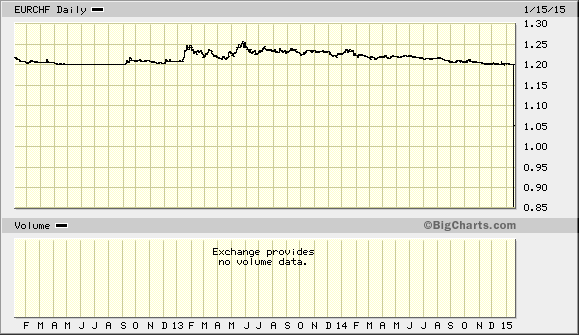
The Swiss ETF ($EWL) is doing well today. Until May, EWL had largely kept pace with the American market. But since May, it’s lagged badly. The last few days, however, have been quite good.
-
Archives
- September 2026
- August 2026
- July 2026
- June 2026
- May 2026
- April 2026
- March 2026
- February 2026
- January 2026
- December 2025
- November 2025
- October 2025
- September 2025
- August 2025
- July 2025
- June 2025
- May 2025
- April 2025
- March 2025
- February 2025
- January 2025
- December 2024
- November 2024
- October 2024
- September 2024
- August 2024
- July 2024
- June 2024
- May 2024
- April 2024
- March 2024
- February 2024
- January 2024
- December 2023
- November 2023
- October 2023
- September 2023
- August 2023
- July 2023
- June 2023
- May 2023
- April 2023
- March 2023
- February 2023
- January 2023
- December 2022
- November 2022
- October 2022
- September 2022
- August 2022
- July 2022
- June 2022
- May 2022
- April 2022
- March 2022
- February 2022
- January 2022
- December 2021
- November 2021
- October 2021
- September 2021
- August 2021
- July 2021
- June 2021
- May 2021
- April 2021
- March 2021
- February 2021
- January 2021
- December 2020
- November 2020
- October 2020
- September 2020
- August 2020
- July 2020
- June 2020
- May 2020
- April 2020
- March 2020
- February 2020
- January 2020
- December 2019
- November 2019
- October 2019
- September 2019
- August 2019
- July 2019
- June 2019
- May 2019
- April 2019
- March 2019
- February 2019
- January 2019
- December 2018
- November 2018
- October 2018
- September 2018
- August 2018
- July 2018
- June 2018
- May 2018
- April 2018
- March 2018
- February 2018
- January 2018
- December 2017
- November 2017
- October 2017
- September 2017
- August 2017
- July 2017
- June 2017
- May 2017
- April 2017
- March 2017
- February 2017
- January 2017
- December 2016
- November 2016
- October 2016
- September 2016
- August 2016
- July 2016
- June 2016
- May 2016
- April 2016
- March 2016
- February 2016
- January 2016
- December 2015
- November 2015
- October 2015
- September 2015
- August 2015
- July 2015
- June 2015
- May 2015
- April 2015
- March 2015
- February 2015
- January 2015
- December 2014
- November 2014
- October 2014
- September 2014
- August 2014
- July 2014
- June 2014
- May 2014
- April 2014
- March 2014
- February 2014
- January 2014
- December 2013
- November 2013
- October 2013
- September 2013
- August 2013
- July 2013
- June 2013
- May 2013
- April 2013
- March 2013
- February 2013
- January 2013
- December 2012
- November 2012
- October 2012
- September 2012
- August 2012
- July 2012
- June 2012
- May 2012
- April 2012
- March 2012
- February 2012
- January 2012
- December 2011
- November 2011
- October 2011
- September 2011
- August 2011
- July 2011
- June 2011
- May 2011
- April 2011
- March 2011
- February 2011
- January 2011
- December 2010
- November 2010
- October 2010
- September 2010
- August 2010
- July 2010
- June 2010
- May 2010
- April 2010
- March 2010
- February 2010
- January 2010
- December 2009
- November 2009
- October 2009
- September 2009
- August 2009
- July 2009
- June 2009
- May 2009
- April 2009
- March 2009
- February 2009
- January 2009
- December 2008
- November 2008
- October 2008
- September 2008
- August 2008
- July 2008
- June 2008
- May 2008
- April 2008
- March 2008
- February 2008
- January 2008
- December 2007
- November 2007
- October 2007
- September 2007
- August 2007
- July 2007
- June 2007
- May 2007
- April 2007
- March 2007
- February 2007
- January 2007
- December 2006
- November 2006
- October 2006
- September 2006
- August 2006
- July 2006
- June 2006
- May 2006
- April 2006
- March 2006
- February 2006
- January 2006
- December 2005
- November 2005
- October 2005
- September 2005
- August 2005
- July 2005
 Eddy Elfenbein is a Washington, DC-based speaker, portfolio manager and editor of the blog Crossing Wall Street. His