-
Dividends Rose 10% in Q4
Posted by Eddy Elfenbein on January 5th, 2015 at 1:08 pmI often tell investors that dividends are easily the most important and most overlooked part of investing. Dividends tend to grow and reinvesting those dividends gets you more shares which begets you still more dividends. The effect may be small each week, but it adds up. Consider that in the last 20 years, the S&P 500 price index is up 348%. But the Total Return Index, which includes dividends, is up 555%.
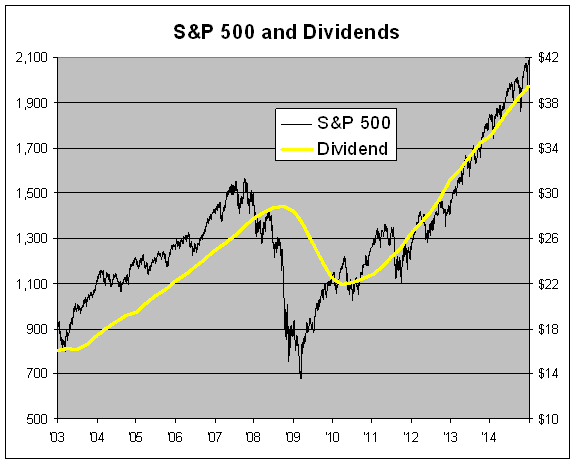
The numbers are in for the fourth quarter and dividends paid out by companies in the S&P 500 rose by 9.96% over last year’s Q4. That’s actually the second-slowest growth rate in the last 16 quarters. The slowest was Q4 of 2013 which came one year after the big dividend surge in late 2012 to pay out dividends before the tax rate went up. In the last four years, dividends paid out by the S&P 500 are up more than 73%.
For the year, the S&P 500 paid out $39.44 in index-adjusted dividends. That’s an increase of 12.72% over 2013. But here’s what interesting: The S&P 500 price index rose 11.39% last year. In other words, dividends grew faster than prices. That means the S&P 500 ended the year with a slightly higher dividend yield than it started the year. Despite all the talk of a stock bubble, at least one measure of the market’s valuation moved lower.
As I’ve pointed out before, for most of the last 12 years, the S&P 500 hasn’t strayed very far from a trailing dividend yield of 2%. The only exception was during the worst of the financial crisis, but once the storm passed, the market quickly moved back to 2%. It’s also interesting that the dividend payout ratio (the percent of profits being paid out as a dividend) has hovered near 33% for the last two years.
-
Ford Down 3.5% Today
Posted by Eddy Elfenbein on January 5th, 2015 at 10:28 amShares of Ford are down 3.5% after the stock was downgraded by an analyst at Citigroup. The analyst kept the price target the same at $17 per share but lowered Ford to “neutral” from “buy.” Ford also reported December sales growth of 1%.
Ford Motor posted its best December sales figure since 2005. Ford’s U.S. sales rose 1% to 220,671 vehicles. But overall 2014 sales were flat vs. a year ago at 2.48 million vehicles on a planned 15% reduction in daily rental sales.
(…)
“Demand for the all-new F-150 also is very high, and it now is the fastest-turning vehicle in Ford showrooms, averaging just five days on dealer lots in December,” said John Felice, Ford vice president, U.S. Marketing, Sales and Service in the release.
F-Series sales total 74,355 vehicles in December and 753,851 vehicles for 2014 as lower gas prices helped boost demand for larger trucks and SUVs.
-
The Euro Falls to Nine-Year Low
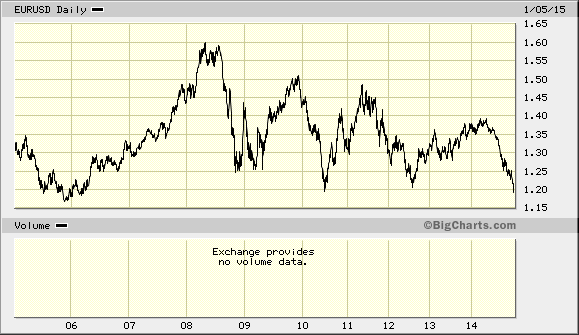
Posted by Eddy Elfenbein on January 5th, 2015 at 9:46 amThe euro (aka the German peso) has fallen to a nine-year low against the dollar. The currency dropped down to $1.1924. Today we learned that German inflation is at its weakest since 2009. Brent crude just dropped below $55 per barrel, and West Texas is below $52.
-
Explaining Our Methodology
Posted by Eddy Elfenbein on January 5th, 2015 at 9:24 amI wanted to make a few comments about our Buy List’s methodology. As I’ve found out, if you have a publicly-available free Buy List that’s done very well, some unpleasant people will call you a fraud or a liar. They’ll question your math or a bunch of other things.
There’s not much you can do about cranks, but I’ve always gone out of my way to make our Buy List as transparent as possible. The set-and-forget rules are about as simple as you can get. I even take the extra step of making my new buys public two weeks before the changes take effect. You’d think that would mollify some people. Not so.
Long story short, it’s a good time to restate what my goal is with the Buy List. I want to show regular investors that a disciplined approach can prosper and even beat the market. That’s why I do a few other things with my Buy List that I don’t often highlight. For example, I try to make sure that the Buy List is easy to replicate. This characteristic doesn’t get as much attention as it should. We don’t select any oddball foreign stocks or trade in unusual commodities or currencies. We don’t use margin, options or ETFs. There’s no shorting. Nor do we speculate on the North Bulgarian exchange in New Zealand pesos or anything like that. Around here, we keep it straightforward.
Also, nearly all our companies are at least mid-caps, and many are large-cap blue-chip names. We don’t dabble in IPOs or thinly traded pink sheets. I always have the average investor in mind. The companies on our Buy List also have pretty standard operations. And of course, we keep our trading to a minimum.
At the beginning of each year, I assume the Buy List is equally weighted among the 20 stocks. I also treat each year’s Buy List as a separate entity. In other words, we start over again at 0% at the start of each year. Here I can understand how some people might disagree with this decision.
My rationale is this: if I treated the Buy List as one never-ending unit, I could show that we’ve made huge long-term gains in a stock like Fiserv, but very few blog readers have been following us the entire time. It’s a question of making things as comprehensible as possible for as many folks as possible. (Honestly, I can see tracking the Buy List either way, but I think the separate year-by-year approach is the easiest and fairest.)
Occasionally I list our full nine-year total returns, but that means an investor rebalanced the portfolio at the end of each calendar year. I don’t think it’s wrong to do this, but I want to make it clear what it means.
Every so often, we’ve had spin-offs or buyouts. I try to deal with these as best I can. Years ago, we got cash for our Biomet shares. I distributed that cash into the 19 remaining Buy List stocks. When Golden West Financial was bought out, we got shares of Wachovia, and that became a new member of the Buy List.
I’ve always been careful to detail on the blog how all the calculations are made. Later this year, eBay will hopefully spin off PayPal. If all goes well, we’ll get the shares, and I’ll decide what to do with them in December. As always, the decisions I make are designed to make investing as easy as possible for average investors.
-
Morning News: January 5, 2015
Posted by Eddy Elfenbein on January 5th, 2015 at 7:02 amGerman Savers Brace for $2.3 Trillion ECB Question on QE
Germany Should Not Scoff At Greece
China Eases Export Controls on Rare Earths After Losing WTO Case
China Stocks Start 2015 With a Bang
Japan December Final Manufacturing PMI Shows Sustained Growth
Oil Extends Decline From 5 1/2-Year Low as Glut Persists
Nissan Exceeds Analyst Estimates to Finish Best U.S. Year
BMW to Pay $820 Million in Subsidies to China Dealers Amid Slowdown
American Airlines Pilots’ Union Agrees to 23% Pay Rise
Amazon Sellers Sold Record-Setting More Than 2 Billion Items Worldwide in 2014
Berkshire Soars as Buffett Shifts Focus From Stocks to Takeovers
PlayStation 4 Faces Resurgent Rivals in Xbox One and Wii U
Target CEO $47 Million Retirement Illustrates 401(k) Gap
Jeff Miller: Time For the “January Effect”?
Epicurean Dealmaker: Nerd Intersectionality
Be sure to follow me on Twitter.
-
Super Dollar
Posted by Eddy Elfenbein on January 2nd, 2015 at 2:08 pmThe Great Greenback Rallies continues. The U.S. dollar just hit an 11.5-year high.
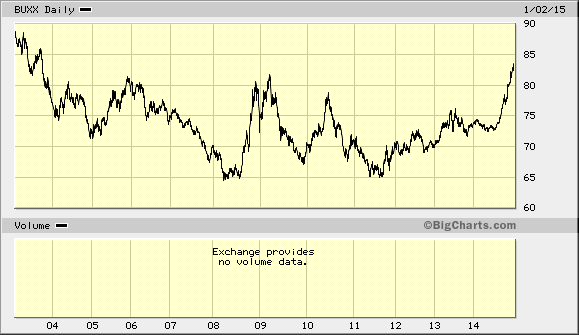
Note that this is the WSJ Dollar Index, which is a bit different from DXY, which is the more-cited dollar index.
-
December ISM = 55.5
Posted by Eddy Elfenbein on January 2nd, 2015 at 12:19 pmThe ISM report for December came in a bit light this morning at 55.5 versus the expected 57.6. But the important thing is that it’s still higher than 50 which it has been for 65 of the last 66 months.
The ISM is a dispersion index which means that any reading greater than 50 means the manufacturing sector of the economy is expanding.
-
Morning News: January 2, 2015
Posted by Eddy Elfenbein on January 2nd, 2015 at 7:24 amMerkel Ally Urges ECB Not to Buy Struggling States’ Bonds
Euro Falls Against Dollar as European Central Bank Hints of Stimulus
Euro Forecasters See More Pain After Worst Year Since 2005
To Rescue Economy, Japan Turns to Supermom
Macau Gambling Revenue Suffers First Full-Year Fall
Russia Oil Output Hits Post-Soviet High, Small Firms Help
Crude Oil Trades Near 5 1/2-Year Low Amid Manufacturing Weakness
Sterling Sinks to 16-month Low After UK Manufacturing Miss
Walgreen-Alliance Boots Deal is Complete
Hyundai-Kia Sees Slowest Sales Growth in 12 years in 2015
Giving Chickens Breathing Room Will Cost Consumers
DARPA Plans Autonomous ‘Flying Insect’ Drones With Skills to Match Birds of Prey
Hotels Make Internet Free, But Tighten Cancellation Policies
Joshua Brown: Good Times Teach Only Bad Lessons
Cullen Roche: 2014 Portfolio Review – What Strategies Worked & Didn’t Work
Be sure to follow me on Twitter.
-
CWS Market Review – January 1, 2015
Posted by Eddy Elfenbein on January 1st, 2015 at 7:42 amHappy New Year!
The 2014 trading year is officially on the books. It was another profitable year for our Buy List. I want to thank everyone for their support. We again showed that a set-and-forget portfolio of high-quality stocks can do well.
Here are the final numbers. For the year, our Buy List gained 10.26%. Including dividends, we were up 11.80%.
Unfortunately, we were beaten out by the S&P 500, but it was close. For 2014, the S&P 500 gained 11.39%—13.69% when you include dividends. For those who care about such things, the Buy List’s “beta” was 0.9361.
Nine of our Buy List stocks were up more than 20%. There was nearly a four-way tie for our top-performing stocks of the year. Ultimately, Medtronic ($MDT) edged out Ross Stores ($ROST), 25.81% to 24.80%, while DirecTV ($DTV) and Stryker ($SYK) were right behind, tied at 25.54%. Fifteen of our 20 stocks made money last year. The biggest loser was IBM ($IBM), which lost 14.46%.
Over the nine-year history of our Buy List, our total compounded gain, including dividends, is 151.28%. For the S&P 500, the nine-year total return is 99.64%.
Details of Last Year’s Buy List
The chart below details the Buy List’s performance. I’ve listed each stock, along with the number of shares and the starting and ending prices. For tracking purposes, I assume the Buy List is a $1 million portfolio that starts equally divided among the 20 stocks.
Stock Shares 12/31/2013 Beginning 12/31/2014 Ending Profit/Loss AFL 748.5030 $66.80 $50,000.00 $61.09 $45,726.05 -8.55% BBBY 622.6650 $80.30 $50,000.00 $76.17 $47,428.39 -5.14% CA 1,485.8841 $33.65 $50,000.00 $30.45 $45,245.17 -9.51% CTSH 990.2952 $50.49 $50,000.00 $52.66 $52,148.95 4.30% BCR 373.3015 $133.94 $50,000.00 $166.62 $62,199.50 24.40% DTV 724.0081 $69.06 $50,000.00 $86.70 $62,771.50 25.54% EBAY 911.2448 $54.87 $50,000.00 $56.12 $51,139.06 2.28% ESRX 711.8451 $70.24 $50,000.00 $84.67 $60,271.92 20.54% FISV 846.7401 $59.05 $50,000.00 $70.97 $60,093.14 20.19% F 3,240.4407 $15.43 $50,000.00 $15.50 $50,226.83 0.45% IBM 266.5671 $187.57 $50,000.00 $160.44 $42,768.03 -14.46% MCD 515.3045 $97.03 $50,000.00 $93.70 $48,284.03 -3.43% MDT 871.2319 $57.39 $50,000.00 $72.20 $62,902.94 25.81% MSFT 1,336.5410 $37.41 $50,000.00 $46.45 $62,082.33 24.16% MOG-A 735.9435 $67.94 $50,000.00 $74.03 $54,481.90 8.96% ORCL 1,306.8479 $38.26 $50,000.00 $44.97 $58,768.95 17.54% QCOM 673.4007 $74.25 $50,000.00 $74.33 $50,053.87 0.11% ROST 667.2895 $74.93 $50,000.00 $94.26 $62,898.71 25.80% SYK 665.4245 $75.14 $50,000.00 $94.33 $62,769.49 25.54% WFC 1,101.3216 $45.40 $50,000.00 $54.82 $60,374.45 20.75% Total $1,000,000 $1,102,635.22 10.26% Note that Cognizant Technology Solutions ($CTSH) split its shares 2-for-1 on March 10. The results above have been adjusted for the stock split.
Starting Prices and Shares for the 2014 Buy List
Here are the starting prices and number of shares for the 2015 Buy List. For tracking purposes, I assume the Buy List is a $1 million portfolio that’s equally divided among 20 stocks. Whenever I discuss how well our Buy List is doing, this is what I’m referring to:
Company Ticker Price Shares Balance AFLAC AFL $61.09 818.4646 $50,000.00 Ball Corp. BLL $68.17 733.4605 $50,000.00 Bed Bath & Beyond BBBY $76.17 656.4264 $50,000.00 Cognizant Technology Solutions CTSH $52.66 949.4873 $50,000.00 CR Bard BCR $166.62 300.0840 $50,000.00 eBay EBAY $56.12 890.9480 $50,000.00 Express Scripts ESRX $84.67 590.5279 $50,000.00 Fiserv FISV $70.97 704.5230 $50,000.00 Ford Motor F $15.50 3,225.8065 $50,000.00 Hormel Foods HRL $52.10 959.6929 $50,000.00 Microsoft MSFT $46.45 1,076.4263 $50,000.00 Moog MOG-A $74.03 675.4019 $50,000.00 Oracle ORCL $44.97 1,111.8523 $50,000.00 Qualcomm QCOM $74.33 672.6759 $50,000.00 Ross Stores ROST $94.26 530.4477 $50,000.00 Signature Bank SBNY $125.96 396.9514 $50,000.00 Snap-on SNA $136.74 365.6575 $50,000.00 Stryker SYK $94.33 530.0541 $50,000.00 Wabtec WAB $86.89 575.4402 $50,000.00 Wells Fargo WFC $54.82 912.0759 $50,000.00 There are five new stocks and five stocks that I’m removing. The five new stocks are Ball Corp. ($BLL), Hormel Foods ($HRL), Signature Bank ($SBNY), Snap-on ($SNA) and Wabtec ($WAB).
The five deletions are CA Technologies ($CA), DirecTV ($DTV), IBM ($IBM), McDonald’s ($MCD) and Medtronic ($MDT).
The average market cap is $69 billion. That ranges from a high of $382 billion for Microsoft ($MSFT) to $3 billion for Moog ($MOG-A).
Thirteen of the twenty stocks pay dividends. The total yield of the Buy List is 1.06%.
Only three stocks have been on the Buy List all ten years: AFLAC ($AFL), Bed Bath & Beyond ($BBBY) and Fiserv ($FISV). Stryker ($SYK) and Moog ($MOG-A) are both making their eighth appearance.Buy Below Prices for the New Buys
Now let me give you the Buy Below prices for our five new buys. Remember, these aren’t price targets. They’re guidelines for new entry.
I’m starting Ball Corp. ($BLL) out as a buy up to $72 per share. This is a good stock for conservative investors. Ball also pays a very small dividend. I’m going to initiate Hormel Foods ($HRL) with a Buy Below of $56. By the way, Hormel reports on a Jan-Apr-July-Oct Cycle, so its earnings will come a bit after most of our other stocks. Signature Bank ($SBNY) is a buy up to $133. I’d like to see SBNY start paying a dividend soon. Snap-on ($SNA) is a buy anytime you see it below $143 per share. Lastly, I rate Wabtec ($WAB) a buy up to $90 per share. This week, I’m also raising the Buy Below on Ross Stores ($ROST) to $96 per share.
On Thursday, January 8, Bed Bath & Beyond ($BBBY) will report earnings for its fiscal third quarter. This covers September, October and November. On the last earnings call, BBBY said they expect Q3 to range between $1.17 and $1.21 per share. Interestingly, they also gave guidance for Q4 which they see ranging between $1.78 and $1.83 per share. The fourth quarter is the biggie for Bed Bath. For the entire year, management said they see earnings coming in between $5.00 and $5.08 per share.
I was impressed with this guidance. Buybacks are helping out a lot. My numbers pretty much match up with what the company is saying. If they hit $5.08 for the year, that means the stock is going for 15 times earnings, which is hardly overpriced. Last week, Barron’s ran a feature on BBBY and noted that the company has ramped up its Internet presence. For now, I’m going to keep a fairly tight Buy Below on BBBY. Let’s see how Q4 is shaping up. Bed Bath & Beyond remains a buy up to $77 per share.
That’s all for now. The market is closed on Thursday for New Year’s Day, but Friday will be a full work day. At 10 a.m., the December ISM will come out. Next Friday, we’ll get some of the key turn-of-the-month econ reports like Trade Balance and Factory Orders. The latest Fed minutes come out on Wednesday. This all leads up to the big jobs report next Friday. Be sure to keep checking the blog for daily updates. I’ll have more market analysis for you in the next issue of CWS Market Review!
– Eddy
Morning News: January 1, 2015
Posted by Eddy Elfenbein on January 1st, 2015 at 7:05 amS&P 500 Erases Monthly Gain on Final Day of 2014 Trading
Sector-By-Sector Breakdown of 2014’s Market Moves
Commodities Head for Record Losing Run on Oil, Strong Dollar
The Euro Currency Prepares To Say Adieus To One Country While Welcoming In Another
How Putin Forged a Pipeline Deal That Derailed
China December Factory PMIs Suggest Economy Cooling Further, More Stimulus Expected
U.S. Jobless Claims Rise, But Labor Market Still Firming
Orbitz and United Are Suing a 22-Year-Old Who Figured Out How to Game Airlines
U.S. Drone Rules Remain in the Hangar in 2014
Ambac Sues Bank of America Over Countrywide Mortgage Bonds
Apple Customers Sue Over Shortage of Storage Space in iOS 8
Verso Settles With U.S. Department of Justice Regarding Pending Acquisition of NewPage
Jeff Miller: 2014 in Review: Hot or Not?
Roger Nusbaum: MLPs Weren’t Supposed to Decline
Be sure to follow me on Twitter.
-
Archives
- August 2026
- July 2026
- June 2026
- May 2026
- April 2026
- March 2026
- February 2026
- January 2026
- December 2025
- November 2025
- October 2025
- September 2025
- August 2025
- July 2025
- June 2025
- May 2025
- April 2025
- March 2025
- February 2025
- January 2025
- December 2024
- November 2024
- October 2024
- September 2024
- August 2024
- July 2024
- June 2024
- May 2024
- April 2024
- March 2024
- February 2024
- January 2024
- December 2023
- November 2023
- October 2023
- September 2023
- August 2023
- July 2023
- June 2023
- May 2023
- April 2023
- March 2023
- February 2023
- January 2023
- December 2022
- November 2022
- October 2022
- September 2022
- August 2022
- July 2022
- June 2022
- May 2022
- April 2022
- March 2022
- February 2022
- January 2022
- December 2021
- November 2021
- October 2021
- September 2021
- August 2021
- July 2021
- June 2021
- May 2021
- April 2021
- March 2021
- February 2021
- January 2021
- December 2020
- November 2020
- October 2020
- September 2020
- August 2020
- July 2020
- June 2020
- May 2020
- April 2020
- March 2020
- February 2020
- January 2020
- December 2019
- November 2019
- October 2019
- September 2019
- August 2019
- July 2019
- June 2019
- May 2019
- April 2019
- March 2019
- February 2019
- January 2019
- December 2018
- November 2018
- October 2018
- September 2018
- August 2018
- July 2018
- June 2018
- May 2018
- April 2018
- March 2018
- February 2018
- January 2018
- December 2017
- November 2017
- October 2017
- September 2017
- August 2017
- July 2017
- June 2017
- May 2017
- April 2017
- March 2017
- February 2017
- January 2017
- December 2016
- November 2016
- October 2016
- September 2016
- August 2016
- July 2016
- June 2016
- May 2016
- April 2016
- March 2016
- February 2016
- January 2016
- December 2015
- November 2015
- October 2015
- September 2015
- August 2015
- July 2015
- June 2015
- May 2015
- April 2015
- March 2015
- February 2015
- January 2015
- December 2014
- November 2014
- October 2014
- September 2014
- August 2014
- July 2014
- June 2014
- May 2014
- April 2014
- March 2014
- February 2014
- January 2014
- December 2013
- November 2013
- October 2013
- September 2013
- August 2013
- July 2013
- June 2013
- May 2013
- April 2013
- March 2013
- February 2013
- January 2013
- December 2012
- November 2012
- October 2012
- September 2012
- August 2012
- July 2012
- June 2012
- May 2012
- April 2012
- March 2012
- February 2012
- January 2012
- December 2011
- November 2011
- October 2011
- September 2011
- August 2011
- July 2011
- June 2011
- May 2011
- April 2011
- March 2011
- February 2011
- January 2011
- December 2010
- November 2010
- October 2010
- September 2010
- August 2010
- July 2010
- June 2010
- May 2010
- April 2010
- March 2010
- February 2010
- January 2010
- December 2009
- November 2009
- October 2009
- September 2009
- August 2009
- July 2009
- June 2009
- May 2009
- April 2009
- March 2009
- February 2009
- January 2009
- December 2008
- November 2008
- October 2008
- September 2008
- August 2008
- July 2008
- June 2008
- May 2008
- April 2008
- March 2008
- February 2008
- January 2008
- December 2007
- November 2007
- October 2007
- September 2007
- August 2007
- July 2007
- June 2007
- May 2007
- April 2007
- March 2007
- February 2007
- January 2007
- December 2006
- November 2006
- October 2006
- September 2006
- August 2006
- July 2006
- June 2006
- May 2006
- April 2006
- March 2006
- February 2006
- January 2006
- December 2005
- November 2005
- October 2005
- September 2005
- August 2005
- July 2005
 Eddy Elfenbein is a Washington, DC-based speaker, portfolio manager and editor of the blog Crossing Wall Street. His