-
Morning News: November 19, 2014
Posted by Eddy Elfenbein on November 19th, 2014 at 7:03 amIndia’s Strong Growth to Depend on Modi-Led Reforms: OECD
Russia and Venezuela to Fight Low Oil Prices
Bank of Japan Rebels Switch Over to Back Extended Easing
Differences Appear Within Majority of Bank of England Rate Setters
Yellen Inherits Greenspan’s Conundrum as Long Rates Sink
Economists Call October Inflation Measure ‘Distorted,’ a ‘Statistical Quirk’
Black Friday Isn’t Dead! It’s Just Evolving With Shoppers
Xiaomi Stake Said to Value IQiyi at Up to $3 Billion
Uber’s Media Revenge Fiasco: What Went Wrong and How to Fix It
Home Depot Warns There’ll Be More Costs Due to Its Data Breach
Wells Fargo Unit to Launch Europe Infrastructure Fund, Target $1 Billion
Exercise in a Bottle Is Next Food Frontier for Nestle
Ranbaxy May Be Making a Huge Mistake by Suing All-Powerful U.S. FDA
Roger Nusbaum: A Yield Play Without Any Yield?
Epicurean Dealmaker: What Is It Like to Be a Banker?
Be sure to follow me on Twitter.
-
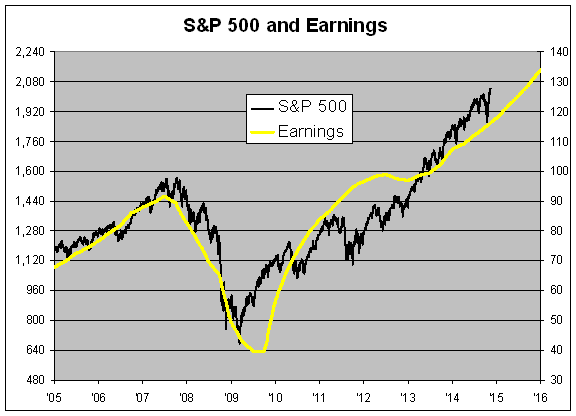
The S&P 500 and Its Earnings
Posted by Eddy Elfenbein on November 18th, 2014 at 12:04 pmHere’s a look at the S&P 500 along with its earnings. The S&P 500 is in black and it follows the left scale. The earnings line is in yellow and it follows the right scale. The two lines are scaled at a ratio of 16-to-1. That means that whenever the lines cross, the market’s P/E Ratio is 16.
-
Medtronic Meets Earnings
Posted by Eddy Elfenbein on November 18th, 2014 at 10:15 amThis morning, Medtronic ($MDT) reported fiscal Q2 earnings of 96 cents per share. That’s a decent number. The company hit the consensus forecast right on the head. Medtronic earned 91 cents per share in last year’s Q3.
More importantly, the company said that the Covidien ($COV) deal is still on track. The company hopes to close out the deal early next year. Medtronic will reincorporate in Ireland and the new name will be Medtronic PLC.
Quarterly sales came in at $4.37 billion which was a shade more than the consensus of $4.36 billion. The medical devices company reiterated its full-year earnings outlook of $4.00 to $4.10 per share. The company has already earned $1.89 per share for the first half of its fiscal year which ends in April.
“Our second quarter performance was strong and well balanced across our businesses and geographies,” said Omar Ishrak, Medtronic chairman and chief executive officer. “Revenue growth was at the upper end of our full-year revenue outlook and within our mid-single digit baseline goal, reflecting the strong execution of our global organization.”
The shares have popped a little bit today. Shares of MDT have been as high as $72.26 this morning which is a gain of 4.4%.
-
Morning News: November 18, 2014
Posted by Eddy Elfenbein on November 18th, 2014 at 7:07 amAs Japan Falls Into Recession, Europe Looks to Avoid It
UK Inflation Rate Rises to 1.3% in October
Flash Boys Raising Volatility in Wild New Treasury Market
FHA is Back in the Black – But Not Out of the Woods
Halliburton May Sell Fewer Baker Assets Than Expected
Actavis Surges to Top Drugmaker Ranks With Acquisitions
Home Depot Profit Tops Estimates on Customer Traffic Gain
Toyota Tackles Chicken And Egg With Rollout Plan for Hydrogen-Powered Mirai
DreamWorks: Too Greedy For A Deal?
SunEdison and TerraForm Buy First Wind, Gaining a Toehold in Turbines
Urban Outfitters Reports Earnings Miss, Sales Decline At Namesake Brand
U.S. Mobile Payments Market to Boom by 2019, Research Firm Says
Latest Madoff Fraud Deal Pushes Amount Recovered to Over $10 Billion
Edward Harrison: Banks, Japanese Trade, the Currency Wars and Deflation
Edward Hugh: Abenomics 2.0 – Just What Are They Trying to Achieve?
Be sure to follow me on Twitter.
-
James Gandolfini on Sesame Street
Posted by Eddy Elfenbein on November 17th, 2014 at 5:39 pm -
Some Fun Market Stats
Posted by Eddy Elfenbein on November 17th, 2014 at 12:12 pmHere are some fun stats I recently found.
So far this year, the S&P 500 is up 12.73% on Tuesday and Wednesday. The rest of the week, the index is down -2.10%.
Here’s how it works out:
Monday: -0.89%
Tuesday: 8.12%
Wednesday: 4.27%
Thursday: -4.66%
Friday: 3.59%I also found that the best seven days of the last seven years comprised the S&P 500’s entire gain. The rest of the time, the index was net flat.
That’s a good example of a stat that’s true, but it’s a bit misleading. For one, it excludes dividends. Even with low yields, dividends add up after seven years.
Also, the last seven years haven’t been that good for the market. Add in a very volatile time in 2008 and the stat isn’t that hard to believe. All seven days came within an unpleasant six-month period, and five of the seven came during a six-week stretch.
-
Stock Returns and 5-Year TIPs
Posted by Eddy Elfenbein on November 17th, 2014 at 10:25 amHere’s a remarkable stat I just found. Since 2003, when the yield on the 5-year TIPs is 1.11% or less, the Wilshire 5000 Total Return Index has had an average annualized return of 22.5%.
But when the yield on the 5-year TIPS is 1.12% or more, the Wilshire 5000 has averaged -5.0% per year.
The difference is quite striking. I should warn you that that’s a small sample size. Unfortunately, TIPs are fairly new so the data doesn’t go back that far. Intuitively, this relationship makes sense. When real bond yields are high, investors will ditch stocks in favor of bonds. Conversely, when real bond yield are in the dumps, investors will naturally turn to stocks.
Since 2003, the 5-year TIPs has been 1.11% or less, 58.1% of the time. It’s been 1.12% or more, 41.9% of the time.
The good news is that real bond yields are still quite low. The five-year TIPs is currently barely positive (0.16% on Thursday). That’s up from the spring of 2013 when the 5-year TIPs were near -1.5%.
The 5-year TIPs last yielded 1.12% or more on September 4, 2009. If this relationship is to be trusted, it means the stock rally still has room to run.
-
Industrial Production Fell 0.1% in October
Posted by Eddy Elfenbein on November 17th, 2014 at 9:41 amWe got a little surprise this morning when the Industrial Production report for October showed a 0.1% decline.
Output fell 0.1 percent after a 0.8 percent increase in September that was smaller than previously estimated, figures from the Federal Reserve in Washington showed today. The median forecast in a Bloomberg survey of 83 economists projected a 0.2 percent gain. Factory production rose 0.2 percent, matching the prior month’s advance that was also revised down.
-
Four Straight Under 0.1% Moves
Posted by Eddy Elfenbein on November 17th, 2014 at 8:27 amOh dear lord, this market has been sound asleep. Here are the five closings, in order, for the S&P 500 last week; 2,038.26, 2,039.68, 2,038.25, 2,039.33 and 2,039.82.
Someone check for a pulse.
The S&P 500 has finished the day, up or down, by less than 0.1% for four straight days. That’s the longest such streak in more than 35 years.
Since October 17, we’ve had only one day down of more than 0.3%. On Friday, the S&P 500 closed above its five-day moving average for the 21st day in a row.
This has been a cat’s-feet rally, but the market is taking a rest after a hectic few weeks. Bloomberg notes that from October 15 to November 11, the market staged its biggest 20-day rally in more than two years.
-
Morning News: November 17, 2014
Posted by Eddy Elfenbein on November 17th, 2014 at 6:52 amCarney Says Fixed Pay May Be Next Target After Bonus Curbs
France, a Tax Haven? Yes, for Companies From Microsoft to Huawei
Japan’s Economy Makes Surprise Fall Into Recession
Australia, China Deepen Ties With Landmark Free-Trade Deal
Link Opens Between Hong Kong and Shanghai Stock Markets
Tiger Economy Loses Its Roar as Thailand’s Exports Slump
Crude Oil Prices Fall Sharply as OPEC Meeting Awaited
Allergan Near Buyout of Up to $65 Billion to Escape Valeant, Ackman
Halliburton to Buy Baker Hughes for $34.6 Billion
Apple Adds Chinese Payment System UnionPay to App Store
Pfizer Dampens Astra Bid Hopes By Signing German Merck Cancer Deal
Boeing Deepens Supply Relationship With Toray
The World Could Be Heading Toward a Global Shortage of Chocolate
Howard Lindzon: Peak America? Peak Internet Freedom? Peak Lindzon?
Jeff Miller: Weighing the Week Ahead: Time to Buy Commodities?
Be sure to follow me on Twitter.
-
Archives
- September 2026
- August 2026
- July 2026
- June 2026
- May 2026
- April 2026
- March 2026
- February 2026
- January 2026
- December 2025
- November 2025
- October 2025
- September 2025
- August 2025
- July 2025
- June 2025
- May 2025
- April 2025
- March 2025
- February 2025
- January 2025
- December 2024
- November 2024
- October 2024
- September 2024
- August 2024
- July 2024
- June 2024
- May 2024
- April 2024
- March 2024
- February 2024
- January 2024
- December 2023
- November 2023
- October 2023
- September 2023
- August 2023
- July 2023
- June 2023
- May 2023
- April 2023
- March 2023
- February 2023
- January 2023
- December 2022
- November 2022
- October 2022
- September 2022
- August 2022
- July 2022
- June 2022
- May 2022
- April 2022
- March 2022
- February 2022
- January 2022
- December 2021
- November 2021
- October 2021
- September 2021
- August 2021
- July 2021
- June 2021
- May 2021
- April 2021
- March 2021
- February 2021
- January 2021
- December 2020
- November 2020
- October 2020
- September 2020
- August 2020
- July 2020
- June 2020
- May 2020
- April 2020
- March 2020
- February 2020
- January 2020
- December 2019
- November 2019
- October 2019
- September 2019
- August 2019
- July 2019
- June 2019
- May 2019
- April 2019
- March 2019
- February 2019
- January 2019
- December 2018
- November 2018
- October 2018
- September 2018
- August 2018
- July 2018
- June 2018
- May 2018
- April 2018
- March 2018
- February 2018
- January 2018
- December 2017
- November 2017
- October 2017
- September 2017
- August 2017
- July 2017
- June 2017
- May 2017
- April 2017
- March 2017
- February 2017
- January 2017
- December 2016
- November 2016
- October 2016
- September 2016
- August 2016
- July 2016
- June 2016
- May 2016
- April 2016
- March 2016
- February 2016
- January 2016
- December 2015
- November 2015
- October 2015
- September 2015
- August 2015
- July 2015
- June 2015
- May 2015
- April 2015
- March 2015
- February 2015
- January 2015
- December 2014
- November 2014
- October 2014
- September 2014
- August 2014
- July 2014
- June 2014
- May 2014
- April 2014
- March 2014
- February 2014
- January 2014
- December 2013
- November 2013
- October 2013
- September 2013
- August 2013
- July 2013
- June 2013
- May 2013
- April 2013
- March 2013
- February 2013
- January 2013
- December 2012
- November 2012
- October 2012
- September 2012
- August 2012
- July 2012
- June 2012
- May 2012
- April 2012
- March 2012
- February 2012
- January 2012
- December 2011
- November 2011
- October 2011
- September 2011
- August 2011
- July 2011
- June 2011
- May 2011
- April 2011
- March 2011
- February 2011
- January 2011
- December 2010
- November 2010
- October 2010
- September 2010
- August 2010
- July 2010
- June 2010
- May 2010
- April 2010
- March 2010
- February 2010
- January 2010
- December 2009
- November 2009
- October 2009
- September 2009
- August 2009
- July 2009
- June 2009
- May 2009
- April 2009
- March 2009
- February 2009
- January 2009
- December 2008
- November 2008
- October 2008
- September 2008
- August 2008
- July 2008
- June 2008
- May 2008
- April 2008
- March 2008
- February 2008
- January 2008
- December 2007
- November 2007
- October 2007
- September 2007
- August 2007
- July 2007
- June 2007
- May 2007
- April 2007
- March 2007
- February 2007
- January 2007
- December 2006
- November 2006
- October 2006
- September 2006
- August 2006
- July 2006
- June 2006
- May 2006
- April 2006
- March 2006
- February 2006
- January 2006
- December 2005
- November 2005
- October 2005
- September 2005
- August 2005
- July 2005
 Eddy Elfenbein is a Washington, DC-based speaker, portfolio manager and editor of the blog Crossing Wall Street. His