-
25 Years Ago
Posted by Eddy Elfenbein on November 9th, 2014 at 12:54 pm -
October NFP = 214,000
Posted by Eddy Elfenbein on November 7th, 2014 at 8:32 amLast month, the unemployment rate fell to 5.756%. The economy created 214,000 net new jobs last month. Revisions added another 31,000.
Th economy is finally creating new jobs, not just watching people leave the workforce.
The jobs/civilian population percent is up to 59.23%. That’s the highest in more than five years. A year ago, it was down to 58.24%, so we’re seeing real improvement, but we have a long way to go.
Put it this way: to have the same jobs/population percentage as five years ago, we’d need to have 8.7 million more jobs, or 13.8 million fewer people.
-
CWS Market Review – November 7, 2014
Posted by Eddy Elfenbein on November 7th, 2014 at 7:10 am“Experience is the name everyone gives to their mistakes.” – Oscar Wilde
The stock market rally isn’t showing any signs of slowing down. On Thursday, the S&P rallied to yet another new all-time high. The index finished the day at 2,031.21 for its eleventh daily gain in the last 16 trading sessions. The Dow Jones Industrial Average hit its 21st record close of the year.
The S&P 500 is now up 9.9% on the year. Of course, nearly every penny of that has come in the last three weeks. On October 15, the S&P 500 was up just 0.76% on the year. I continue to be impressed by the market’s resiliency. On Wednesday, the S&P 500 along with the Dow Industrials, Dow Transports and Dow Utilities all closed at record highs. That hasn’t happened in more than 16 years.
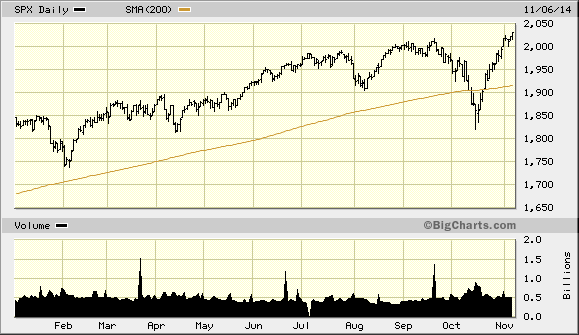
Our Buy List continues to do well, but I have to face the fact that we’re most likely going to underperform the market this year, though not by much. The last time we trailed the market was 2006. Through Thursday, our set-and-forget Buy List is up 6.3% on the year which is about 3.6% points behind the overall market.
The big news this week was the mid-term elections. The Republicans took over the U.S. Senate and they look to have a generational high in the House. There’s been a lot of “what this means” chatter, most of it is sadly mistaken. I’ll give you my thoughts in a bit. I’ll also highlight the last batch of earnings reports. We had some strong reports from Moog and Cognizant, but Qualcomm was our big dud. I’ll run through the details. I’ll also bring you-up-to-speed on the last economic reports. But first, let’s look at how the shakeup in Washington affects our portfolios.
What the GOP Wave Means for Investors
Richard Nixon was once asked what he would do if he weren’t president. Nixon said that he’d probably be down on Wall Street buying stocks. That led one old-time Wall Streeter to say that if Nixon weren’t president he, too, would be buying stocks.
I live a few blocks from the White House and I’m guessing President Obama didn’t have an enjoyable evening on Tuesday night. The Republicans rolled up some impressive victories. We don’t have all the results in yet, but it appears that the GOP will have 53 seats in the Senate and about 250 seats in the House. The latter figure will be their best showing in 86 years. The Republicans also did quite well at the state and local levels.
So what does this all mean for the stock market and our portfolios? Honestly, it doesn’t mean much. One of the great myths about the stock market is that it cares about politics. It’s just not so. By politics, I mean the daily back-and-forth between the two major parties. The market is mostly non-partisan although there are some exceptions.
Let me be clear that the government policy does impact the economy, and by extension, the stock market. But those policy decisions are usually well removed from the standard partisan debate. Of course, what the Federal Reserve does is important, but that’s rarely an election issue. Plus, there’s no reason to think that a change on Capitol Hill will have a great impact on monetary policy.
Mitch McConnell, the new Senate majority leader, quickly made it clear that there would be no government shutdown; nor would he try to abolish all of Obamacare. The government shutdown is a good example of a partisan effort that riled investors, but even that didn’t last long.
One issue that may be positive for our Buy List is an attempt by Congress to repeal the medical device tax. This impacts companies like Medtronic, Stryker and CR Bard. Interestingly, all of those stocks did well on Wednesday. This week, I’m also raising some Buy Below prices for our healthcare stocks (details to follow).
If the American people gave the Radical Marxist Socialist I Hate My Parents party a big majority in Congress, then sure, it would change things. But let’s remember that 89 senators from last session will be returning next year. What we call a big shakeup is when there are 11 new faces. Of course, that’s exactly how the system was designed. The changing passions of the people are supposed to be muted in the halls of government. Contrast that with Wall Street which is nothing but the passion of the people. Or at least, of traders.
I see too many investors let their political leanings interfere with their investments. That’s a bad move. The stock market has done well under both parties and it’s done poorly under both parties. Trying to build an investing strategy based on politics misses what truly drives the market.
There are some people who claim that DC gridlock is good for the market because nothing gets done. Perhaps, but that’s a very minor factor. The stock market will continue to be driven by the fundamentals. That’s why I talk so much about earnings. A lousy stock can rally on terrible earnings. Or in the case of Amazon, not much earnings at all. But a company with decent earnings will eventually do well. It just takes some patience.
Speaking of earnings, let’s look at this earnings season. We’re nearing the end of Q3 earnings season and 80% of companies in the S&P 500 have topped expectations while 61% have topped their sales estimates. Those are good results, but again, these companies are beating reduced estimates.
Wall Street continues to be buoyed by the Strong Dollar Trade. In Europe, Mario Draghi is increasingly frustrated with the Continent’s sluggish economy. He’s willing to follow more unconventional policies to get the European economy back on its feet. That probably means he won’t mind seeing the euro drift lower. The euro just fell to a two-year low against the dollar. We’re also seeing the same thing in Japan. All of this is propelling the dollar higher.
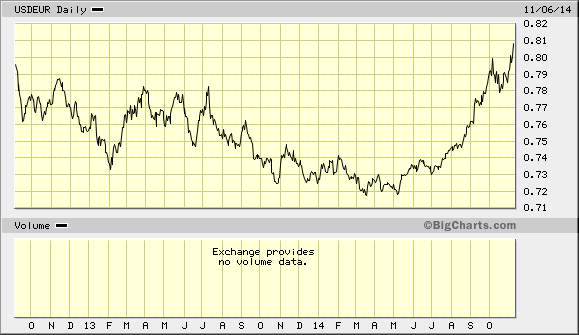
Investors need to understand the impact of the Strong Dollar Trade because that’s been the dominant theme in the markets. The price of gold seems to be in freefall. (Silver, too.) Energy stocks can’t catch a break. Oil is now below $78 per barrel. That’s down $25 per barrel in four months. Small-caps had a brief outperformance surge last month, but that seems to have passed. I should note that the relative performance of active managers tends to be strongly correlated with the relative performance of the small-cap sectors. Note that the Strong Dollar Trade isn’t necessarily good for the overall market. Rather, it makes its impact felt within the market.
The economic news was mixed this week. On the plus side, the ISM Manufacturing Index is still holding up well. The ISM for October was 59.0 which is tied for the best in the last three years. The bad news was that Construction Spending dropped 0.4% in September.
The October jobs report is due out Friday morning. Traditionally, the monthly jobs report has been the most important economic report on the calendar. While it’s still a biggie, I think it’s not quite as important as it used to be. I expect the October report to be a continuation of the trend that’s been in place for several months now, meaning about 200,000 to 250,000 new jobs each month. The ADP report said that the economy created 230,000 private sector jobs last month. Also, the initial claims reports have been quite strong. Now let’s look at some of our recent earnings reports.
Moog Soars to a New High
Shortly after I sent out last week’s CWS Market Review, Moog ($MOG-A) reported its fiscal Q4 earnings. The company had a very good quarter. For Q4, Moog earned $1.12 per share which was four cents better than estimates.
CEO John Scannell said, “Earnings were up and cash flow was very strong. Our financial position allowed us to buy back 4 million shares of stock. In a year with little top-line growth, our employees put in a tremendous effort to deliver on our commitments to both our customers and our investors and I thank them for their hard work and dedication. As we look forward, we are projecting a stronger fiscal ’15 with earnings per share of $4.25, up 21% from fiscal ’14 on sales growth of about 1%.”
For the fiscal year, Moog earned $3.52 per share which is an increase from $3.26 the year before. Additionally, Moog expects to make $4.25 per share this coming year. The shares have rallied impressively over the past few weeks. I’m raising my Buy Below on Moog to $78 per share.
Cognizant Rallies 21% in 13 Days
Our big star this earnings season was Cognizant Technology Solutions ($CTSH). The IT outsourcer raked in 66 cents per share last quarter which was seven cents better than estimates. Quarterly revenues jumped 11.9% to $2.58 billion.
For Q4, Cognizant sees earnings of at least 63 cents per share. Wall Street had only been expecting 59 cents per share. That would bring full-year earnings to at least $2.57 per share. CTSH also said they expect revenues to range between $2.61 and $2.64 billion. That was above the Street’s forecast of $2.59 billion. When CTSH was hit three months ago, it was due to concerns about their top-line growth.
“Revenue growth was slightly ahead of our revised forecast and, as expected, non-GAAP operating margins were within our target range of 19-20% as we absorbed the impact of annual wage increases during Q3,” said Karen McLoughlin, Chief Financial Officer. “Our balance sheet remains strong as cash and short term investments increased during the quarter by almost $500 million to $4.6 billion. Later this quarter, we anticipate utilizing $1.7 billion of this cash, in addition to $1 billion of floating rate debt through a syndicated term loan, to fund the previously announced acquisition of TriZetto.”
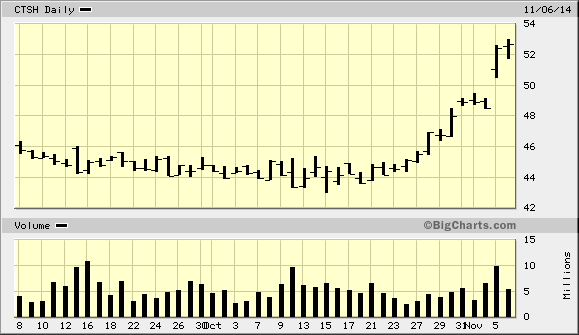
In the 11 days going into the earnings report, Cognizant rallied 11%. Then it jumped another 8% after the earnings announcement. It’s about time this stock got some love. I’m raising my Buy Below on Cognizant to $55 per share.
Qualcomm Disappoints
After IBM, we had been having a great run through earnings season, but Qualcomm ($QCOM) had to trip us up. The chipmaker reported fiscal Q4 earnings of $1.26 per share. That missed consensus by five cents per share. Revenue rose 3% to $6.69 billion which was below consensus estimates of $7.016 billion. The stock was dinged for an 8.6% loss on Thursday.
Let’s run through some numbers. For this quarter (ending in December), Qualcomm sees EPS ranging between $1.18 and $1.30. Wall Street had been expecting $1.43 per share. They expect sales to range between $6.6 billion and $7.2 billion.
The big headache for Qualcomm is their conflict with the Chinese government, and there’s not much the company can do. My guess is that the Chinese government will level a big fine on them, and they’ll have to pay it and move on. Qualcomm also disclosed that it’s facing anti-trust investigations by the FTC and by the EU.
For this current fiscal year (ending September 2015), Qualcomm expects earnings between $5.05 and $5.35 per share, and revenue between $26.8 billion and $28.8 billion. Wall Street had been expecting earnings of $5.58 per share on sales of $28.91 billion.
Let’s remember that Qualcomm has tons of cash, no debt and strong free cash flow. They’re not going broke anytime soon. Still, this was a painful report. I’m lowering my Buy Below price on Qualcomm to $75 per share.
DirecTV Is a Buy up to $90 per Share
DirecTV ($DTV) had another good quarter. The satellite-TV operator earned $1.33 per share for Q3 which was three cents better than estimates. Revenue came in at $8.37 billion which was $60 million better than estimates.
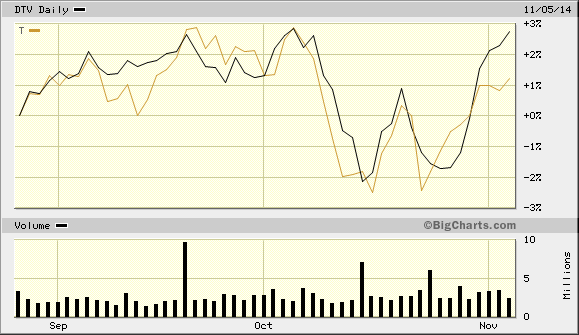
As I’ve mentioned before, shares of DTV and AT&T are basically joined at the hip. After AT&T’s poor earnings report, its shares fell below $34.90 which is the lower bound of the merger deal.
Here’s how it works: The merger deal calls for DTV shareholders to get $28.50 in cash, plus 1.905 shares of AT&T if that stock goes below $34.90. In simpler terms, if AT&T hits $34.90 or more, then the merger price for DTV is $95. Recently, AT&T fell as low as $33.10 per share. Fortunately, it’s recovered so that good for DTV. DirecTV remains a good buy up to $90 per share.
Buy List Updates
I also want to highlight a few more of our Buy List stocks. CA Technologies ($CA) and eBay ($EBAY) have bounced back impressively since mid-October. Shares of CA are up more than 16% since October 16.
Bed Bath & Beyond ($BBBY) continues to recover. On Thursday, the stock got as high as $69.98 per share. That’s a seven-month high! This is exactly why I like to stick with strong companies when they hit rough patches. I’m raising my Buy Below on BBBY to $72 per share.
Also in the retail sector, Ross Stores ($ROST) just touched a new 52-week high. Ross reports earnings later this month. I’m keeping our Buy Below at $83 per share.
Shares of Microsoft ($MSFT) just closed at a 14-year high. The stock has had an incredible run this year. The stock is now a 30% winner on the year for us. MSFT is a buy up to $50 per share.
Our healthcare stocks have been doing very well lately. I want to raise a few of our Buy Below prices. This week, I’m raising the Buy Below on Medtronic ($MDT) to $70 per share. I’m lifting CR Bard ($BCR) to $165 per share. I’m raising Stryker ($SYK) to $90 per share. Finally, I’m raising Express Scripts ($ESRX) to $80 per share.
That’s all for now. Next week should be mostly quiet. Most of the earnings reports are in, but we’ll get a few key economic reports. I’ll be most interested to see the Retail Sales report which comes out on Monday. With gas prices down, that gives consumers more money which they tend to spend quickly. This will also give us a hint of how optimistic shoppers are going into the all-important holiday shopping season. Be sure to keep checking the blog for daily updates. I’ll have more market analysis for you in the next issue of CWS Market Review!
– Eddy
-
Morning News: November 7, 2014
Posted by Eddy Elfenbein on November 7th, 2014 at 6:52 amDraghi Stoking Investor Bets on Stimulus
Russian Rouble Fall Stokes Currency Crisis Worries
In Ukraine Crisis, U.S. Businesses Face Tit-for-Tat Response to Sanctions
Australia Leads Asian Shares Higher
Japan Nuclear Reactors Approved For Restart
Mexico Suddenly Canceled Its Multi-Billion-Dollar Deal For A Bullet Train
Fannie Mae Official Details Plans on Low-Down-Payment Mortgages
Most Weekly Money Flow to Tech Since ’13 Signaling Growth
Lessons From Home Depot: Expect Hackers To Crack More Retailers This Holiday Season
Arcelor Counting on U.S. Demand as Europe, China Weaken
Bank of America Taking $400 Million Litigation Charge
Coke Takes Cue From Narendra Modi’s Suggestion; May Launch Fizzy Fruit Drink By Next Summer
Disney Profit Meets Estimates With Help From ‘Guardians’ Film
Credit Writedowns: China, Europe, and Optimal Currency Zones
Be sure to follow me on Twitter.
-
DirecTV Earns $1.33 per Share
Posted by Eddy Elfenbein on November 6th, 2014 at 11:13 amDirecTV ($DTV) just reported Q3 earnings of $1.33 per share which was three cents better than expectations.
The provider of satellite TV services posted revenue of $8.37 billion in the period, also surpassing Street forecasts. Analysts expected $8.31 billion, according to Zacks.
DirecTV shares have risen 27 percent since the beginning of the year, while the Standard & Poor’s 500 index has risen 9.5 percent. The stock has risen 38 percent in the last 12 months.
Look at how closely DTV has tracked AT&T over the last several weeks.
-
Morning News: November 6, 2014
Posted by Eddy Elfenbein on November 6th, 2014 at 6:33 amDraghi Tests Limits of Power as ECB Enters 2014 Endgame
German Factory Orders Rise Less Than Forecast as Growth Stalls
Credit Agricole Slams Government Policy as Weak France Drags on Q3 Banking Results
Companies Sign Secret Tax Deals With Luxembourg
John Sfakianakis on Falling Oil Prices’ Impact on the Middle East
Time Warner Profit Beats Third-Quarter Estimates
America’s Big Car Comeback and the Twilight of Pure Driving
Tesla Pledges to Boost Output as Loss Widens
Whole Foods Shares Are Soaring
Siemens Says Profits Jump 25% in Year Ended September
Chinese PC Maker Lenovo Reports 19% Rise in Profits
AstraZeneca Lifts Sales Forecast as Nexium Keeps on Giving
Qualcomm Says FTC Is Investigating It
Roger Nusbaum: Will Robo Advisors Kill The Financial Services Industry?
Cullen Roche: Thoughts on the Inherent “Unfairness” of Capitalism
Be sure to follow me on Twitter.
-
Ireland Isn’t in the UK
Posted by Eddy Elfenbein on November 5th, 2014 at 5:40 pmFor the record, the Republic of Ireland is not part of the UK.
-
Qualcomm Misses Earnings
Posted by Eddy Elfenbein on November 5th, 2014 at 4:28 pmQualcomm ($QCOM) just reported fiscal Q4 earnings of $1.26 per share. That’s five cents below estimates. Revenue rose 3% to $6.69 billion which was below consensus estimates of $7.016 billion. For the year, Qualcomm earned $5.27 per share which was an increase of 17% from last year.
For this quarter (ending in December), Qualcomm sees EPS ranging between $1.18 and $1.30. Wall Street had been expecting $1.43 per share. They expect sales to be between $6.6 billion and $7.2 billion.
For this current fiscal year, Qualcomm expects earnings between $5.05 and $5.35 per share, and revenue between $26.8 billion and $28.8 billion.
-
Q3 Earnings Season Calendar
Posted by Eddy Elfenbein on November 5th, 2014 at 10:08 amWe’re now in third quarter earnings season. Sixteen of our 20 Buy List stocks have quarters that ended in September. Here’s a list of each stock’s projected earnings date along with Wall Street’s current estimates and the earnings results. Please note that some of these dates may change.
 Eddy Elfenbein is a Washington, DC-based speaker, portfolio manager and editor of the blog Crossing Wall Street. His