• Alessio Rastani Three Years On
    Posted by on September 26th, 2014 at 10:42 am

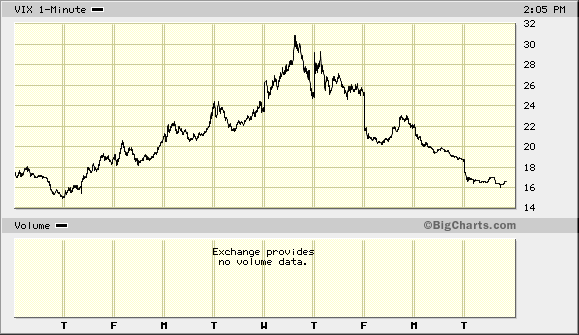
    Three years ago today, the BBC interviewed a trader named Alessio Rastani who told them that the stock market was toast.

    Rastani’s comments were ridiculous and ill-informed. Nevertheless, this got a great deal of attention at the time and many people viewed him as a hero. Occupy Wall Street had started just a few days before. Rastani was clever enough to play to his base, “The Governments don’t rule the world, Goldman Sachs rules the world.” Yeah, right.

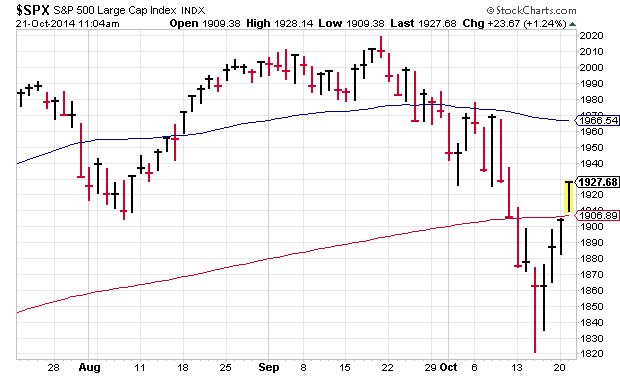
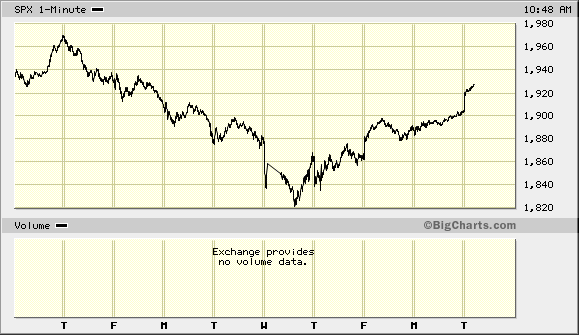
    Now, with the benefit of hindsight, we can see how wrong he was. The October 3rd low was just days away. The S&P 500 is up 69% from the time of his interview. Rastani’s remarks were so absurd that some people thought it was a joke. The BBC even released a statement saying that he’s really a trader.

    Here’s a transcript of the interview with the BBC:

    Alessio Rastani: …it’s gonna crash and it’s gonna fall pretty hard. Because markets are ruled right now by fear. Investors and the big money, the smart money …I’m talking about the big funds, the hedge funds, the institutions, they don’t buy this rescue plan. They basically know that the market is toast. They know that the stock market is finished, the Euro as far as they’re concerned they don’t really care, they’re moving their money away to safer assets like Treasury bonds, 30 year bonds, and the US dollar. So it’s not gonna work.

    Maxine Croxall: We keep hearing that whatever the politicians are suggesting — it’s all been rather wooly — isn’t right. Can you pin down exactly what would keep investors happy, make them feel more confident?

    Alessio Rastani: Ah, that’s a tough one. Personally, it doesn’t matter. I’m a trader, I don’t really care about that kind of stuff. If I see an opportunity to make money, I go with that. So for most traders we don’t really care that much how they’re going to fix the economy, how they’re going to fix the whole situation. Our job is to make money from it and personally I’ve been dreaming of this moment for three years. Personally, I have a confession to make, I go to bed every night and I dream of another recession. I dream of another moment like this. Why? Because people don’t seem to maybe remember, but the ’30’s depression, the Depression of the ’30’s wasn’t just about a market crash. There were some people who were prepared to make money from that crash and I think anybody can do that. It isn’t just for some people in the elite, anybody can actually make money, it’s an opportunity. When the market crashes, when the Euro and the big stock markets crash, if you know what to do, if you have the right plan to set up you can make a lot of money from this. For example, hedging strategies is one, then investing in bonds, Treasury bonds that sort of stuff.

    Maxine Croxall: If you could see the people around me, jaws have collectively dropped at what you’ve just said. I mean we appreciate your candor, but it doesn’t help the rest of us does it, or the rest of the Eurozone.

    Alessio Rastani: I will say this, listen. I would say this to everybody who’s watching this, this economic crisis is like a cancer. If you just wait and wait thinking this is going to go away, just like a cancer it’s gonna grow and it will be too late. What I would say to everybody is get prepared. This is not a time right now to wishful think that the Government is going to sort things out. The Governments don’t rule the world, Goldman Sachs rules the world. Goldman Sachs does not care about this rescue package neither does the big funds. So actually, I would actually tell people, I want to help people. People can make money from this, it isn’t just traders. What they need to do is learn about how to make money from a downward market. The first thing people should do is protect their assets, protect what they have because in less than 12 months, my prediction is that savings of millions of people is gonna vanish and this is just the beginning. So I would say, be prepared and act now. The biggest risk people can take right now is not acting.

    Maxine Croxall: Alessio Rastani thank you very much for talking with us.

    If you read this closely, you’ll notice he doesn’t say anything substantive. People are afraid because people are afraid, markets are going down because they’re going down.

    To be perfectly clear, I’m not opposed to having negative voices in the media. Nor am I opposed to having people with terrible track records in the media. People who have been wrong are wrong, but can be right on the big picture.

    What I’m opposed to is having frivolous voices in the media. Rastani had nothing to say. It’s cynicism dressed up as wisdom masquerading as investment advice. The dance of the perma-bear never ends. They always have an excuse and never have a time horizon. “It’s even worse now.” “The Fed has only delayed the pain.” And their rotten calls always find a way to slip down the memory hole.

    big09262014b

  • Q2 GDP Revised to +4.6%
    Posted by on September 26th, 2014 at 8:52 am

    This morning, the government revised second-quarter GDP growth up to 4.6%. This means that last quarter was the best for economic growth since the first quarter of 2006. This was a revision up from the previous report which had Q2 growth of 4.2%.

    The final upward revision reflected new-found strength in business investment, which grew at an annual rate of 9.7 percent in the second quarter. The result is better than the government’s previous estimate of 8.1 percent, bolstered by both investment in structures and equipment.

    The revision showed that export sales grew at an 11.1 percent rate in the second quarter, stronger than a previous 10.1 percent estimate, another factor helping to boost growth.

    Consumer spending, which accounts for more than two-thirds of economic activity grew at a 2.5 percent annual rate, unchanged from the previous estimate but double the 1.2 percent growth in consumer spending in the first quarter.

    image1435

  • CWS Market Review – September 26, 2014
    Posted by on September 26th, 2014 at 7:05 am

    “The stock market is designed to transfer money from the active to the patient.”
    – Warren Buffett

    This market continues to be dominated by the strong U.S. dollar. This is a very important point that all investors need to understand. There’s barely a sector of the market that’s not being impacted by the rallying greenback. The difference is that lately, the market’s no longer going higher.

    On Thursday, the stock market had its second-biggest drop in the last 24 weeks. The S&P 500 lost 1.62% to close at 1,965.99. That’s a five-week low. The Dow slipped below 17,000, and the Nasdaq Composite was especially hard hit. That index closed below 4,500 for the first time since mid-August.

    It was only one week ago that the market reached its “Alibaba Peak.” Last Friday morning, the S&P 500 touched its all-time intra-day high of 2,019.26, and 122 minutes later, Alibaba made its market debut. That may not be a coincidence.

    On Thursday, the dollar index broke out to a four-year high, and you can see the evidence everywhere. The yield spread between U.S. and German bonds reached a 15-year high. Gold dropped below $1,210 per ounce for the first time this year, and the small-cap Russell 2000 Index is now down 8.1% since July 3.

    sc09262014

    In this week’s CWS Market Review, I want to take a closer look at an important issue that has been driving the stock market: share buybacks. For years, Corporate America has been buying back its own shares at an impressive pace. Now, however, the buyback party looks to be coming to an end—and that might be good news. I’ll explain why in a bit.

    Later on, we’ll take a look at the solid earnings report from Bed Bath & Beyond. The home-furnishings stores leaped more than 7% on Wednesday after they reported strong quarterly earnings. Speaking of buybacks, a few weeks ago, BBBY went to the bond market to borrow money so they could buy back gobs of their shares, and that’s what helped drive their earnings success. Or I should say their earnings-per-share success. We’ll also take a look at Medtronic’s tax inversion and the dividend increase from McDonald’s (their 38th in a row). But first, let’s look at what’s driving all these buybacks.

    Why Share Buybacks Are Beginning to Fade

    Anyone else remember when companies used to have lots of shares outstanding? Every quarter, the number of shares has slowly been getting smaller. More and more companies have been using their cash hordes to repurchase their own shares. The benefit for shareholders comes down to simple math. Having fewer shares helps your earnings-per-share, and investors like that. Howard Silverblatt, the main stat guy at S&P, notes that 295 companies in the S&P 500 reduced their share count last quarter.

    On one hand, fewer shares is a good thing for investors, as it makes their holdings more valuable. But my take is that I’d prefer to see companies use their cash to expand their operations. That’s the best way to reinvest shareholder money: grow the business. But I can’t fault companies for buying back so much stock. What’s the point of keeping your cash in the bank, where you’d get 0.01%? After all, stocks are cheap and buyback announcements make for great PR.

    I have two major complaints with share buybacks. One is that companies shouldn’t be in the stock market game. It’s a great idea to buy back a stock that’s cheap, assuming it rallies later on. But a lot of companies have tossed enormous sums of money at very expensive stocks, only to watch those assets fall. Cisco Systems is a perfect example. Remember a bank called Lehman Brothers? They used to be in the news a lot a few years ago. Anyway, Lehman spent $1 billion buying its own stock during the six months leading up to May 2008. I wince whenever I think about that. The Economist notes, “In all, America’s financial sector repurchased $207 billion of shares between 2006 and 2008. By 2009 taxpayers had had to inject $250 billion into the banks to save them.”

    I’m also leery of companies sitting on too much cash. Peter Lynch has referred to this as the “Bladder Theory of Corporate Finance.” Even Apple got complaints from investors like Carl Icahn and David Einhorn for the size of its cash position, and it´s promised to return more money to shareholders. I also don’t like how many companies issue huge amounts of stock options for executive compensation, but they use share buybacks to mask how much they’re diluting their share base. There are exceptions like DirecTV which actually reduce their share count.

    But we need to consider the fact that buybacks are popular with investors. Merrill Lynch found that companies with the largest buybacks crushed the market last year. But this year, the biggest repurchasers are performing nearly the same as the rest of the market. Actually, slightly worse. Perhaps, buybacks have lost their cool.

    That could be the case. There are early indications that the buyback fever is fading. In Q2, companies in the S&P 500 bought back $116.2 billion worth of stock. That’s a decrease of 1.6% over last year, and a drop of 27.1% from Q1. Of course, stock prices are higher as well.

    But that’s not all. Ironically, this could be an optimistic sign, because it means that companies are spending more money on growing their operations. Or, as crazy as this may sound, actually giving raises to their employees! When the financial crisis hit, buybacks were a no-brainer. Also, companies tend to be conservative with their dividend increases because it looks especially bad if you have to cut them later on. It’s generally assumed that a company will maintain its current dividend indefinitely.

    There´s basic economics at work here. The U.S. economy has added close to nine million jobs in the last five years (we’ll get another jobs report next week). Those new jobs are an investment in a company’s future, and it’s encouraging to see firms take a more optimistic view of their future. A few days ago, Tesla said it’s building a new battery factory in Nevada. In response, the stock soared. In retrospect, the buyback craze was a result of low prices, low interest rates and a dragging economy. That’s coming to an end, and so, too, is the buyback frenzy. Now let’s take a look at a slumbering Buy List stock that’s taken full advantage of share buybacks.

    Bed Buyback & Beyond

    After the closing bell on Tuesday, Bed Bath & Beyond ($BBBY) reported earnings for its fiscal second quarter. Earnings announcements have been rather nerve-wracking for the home-furnishings chain; the stock has plunged after the last three earnings reports.

    I’m pleased to say that that streak has come to an end. Shares of BBBY jumped more than 7.4% on Wednesday after Bed Bath & Beyond reported quarterly earnings of $1.17 per share. The company had previously said that earnings would range between $1.08 and $1.16 per share. Last week, I said that I expected earnings in the top end of that range, so the results were even better than I was expecting.

    What’s interesting about BBBY’s earnings is the impact of buybacks. The company has been gobbling up its own shares at a furious pace. Net earnings fell 10.2% from the same quarter one year ago; however, there were 10.7% fewer shares. Presto! Earnings-per-share rose.

    Bed Bath & Beyond recently floated a $1.5 billion bond offering to fund its share buybacks. Last quarter, BBBY spent $1 billion to buy back 16.9 million shares. Working out the math, that means they paid less than $60 per share on average, so they’re already in the money. Once again, it’s basic economics. The bond deal cost BBBY 4.38%, so it’s not exactly a back breaker. In fact, Standard & Poor raised their rating on Bed Bath & Beyond to AAA- from BBB+.

    big.chart09262014

    I’ve often said that I’m not a big fan of share buybacks, but I’ll give credit to BBBY for being another firm that´s actually reducing its share count. The company isn’t finished with buybacks either. There’s still another $1.8 billion remaining in the current buyback program. BBBY projects its share count will fall by another 13 million by the end of the fiscal year.

    Bed Bath & Beyond gave us guidance for Q3 and Q4. For the third quarter, which ends in November, Bed Bath sees earnings ranging between $1.17 and $1.21 per share. For Q4, which is the all-important holiday season, they see earnings ranging between $1.78 and $1.83 per share. For the entire year, their earnings forecast is $5.00 to $5.08. BBBY sees comparable-store sales rising by 2% to 3% in Q3 and 4% to 5% in Q4.

    The full-year forecast is the first time they’ve given us a specific EPS range, but it exactly comports with the “mid-single-digits” language they’ve used for several months. Not once have they budged from that forecast. Since the company made $4.79 per share last year, the current EPS guidance translates to annualized growth of 4.4% to 6.1%.

    Adding up the two quarterly guidance ranges gives us a full-year range of $5.04 to $5.13. I’m probably reading too much into that, but it’s something to note. Overall, this was a solid quarter for BBBY. The stock remains a good buy up to $70 per share.

    Medtronic Down on Tax-Inversion Rules

    This week, Medtronic ($MDT) learned an important lesson that many of us have known for a long time—you simply can’t become Irish because you feel it. Shares of MDT dropped close to 3% on Tuesday, and still more on Wednesday and Thursday, after the government announced new rules for “tax inversions.” That’s what Medtronic is trying to do as it buys Ireland’s Covidien ($COV) and moves its HQ to the Emerald Isle. The move would cut their tax bill by a good amount.

    I’ll be honest with you—I don’t know what impact the new rules will have on the MDT/COV deal, and it sounds like no one else knows at this point either. The lawyers are still looking it over. The key issue is a company’s holding of cash outside the United States. In Medtronic’s case, they hold close to $14 billion outside the country. Medtronic wants to loan some of that to their new parent, but the new rules might stop that.

    Bloomberg reported that Medtronic released a statement saying, “We are studying the Treasury’s actions. We will release our perspective on any potential impact on our pending acquisition of Covidien following our complete review.” Don’t let the recent sell-off rattle you. Medtronic remains a buy up to $67 per share.

    McDonald’s Raises Its Dividend for the 38th Year in a Row

    I wanted to say a quick word about McDonald’s ($MCD), which has been a problem child this year. The company has been trying to right itself after several missteps. The results don’t yet reflect this, and the last sales report was truly terrible.

    In the CWS Market Review from three weeks ago, I said I was concerned that Mickey D’s wouldn’t raise their dividend this year. I’m pleased to say that that wasn’t the case. Last week, McDonald’s announced that they’re raising their quarterly dividend from 81 to 85 cents per share. The burger giant aims to return $18 billion to $20 billion to shareholders from 2014 through 2016. The new dividend is payable on December 15 to shareholders of record as of December 1. Going by the new dividend and Thursday’s closing price, McDonald’s now yields 3.61%. McDonald’s remains a conservative buy up to $101 per share.

    Two more things to mention. DirecTV ($DTV) shareholders approved the AT&T merger with 99% of the vote. Also, Cognizant Technology Solutions ($CTSH) is very cheap at the moment. The shares are at a seven-week low. If you can pick up CTSH below $45, that’s a very good purchase.

    That’s all for now. The third quarter comes to a close next Tuesday. After that, we’ll get the important turn-of-the-month economic reports. The September ISM report comes out on Wednesday. There’s a chance it could hit a 10-year high. Also on Wednesday, we’ll get the ADP jobs report. Then on Friday will be the official jobs report from the government. The last report was on the weak side. I doubt that’s the start of a trend. Be sure to keep checking the blog for daily updates. I’ll have more market analysis for you in the next issue of CWS Market Review!

    – Eddy

  • Morning News: September 26, 2014
    Posted by on September 26th, 2014 at 6:26 am

    Euro at Lowest Since 2012 on Draghi’s Dovish Comments

    Draghi’s Trillion-Euro Pump Finds Blockage in Spain

    S&P Upgrades India Rating Outlook

    Modi Faces U.S. Damages Case Over Gujarat Riots

    Russia: Putin’s Power Politics

    Dollar Stands Tall; Asian Shares End Week on Low Note

    A Year Later, Most Mega IPOs Are Mega Laggards

    S&P Dow Jones Indices Says Alibaba to Be Added to China-50 Index

    Difficult Decision For Yahoo: What Should It Do With Proceeds From Alibaba Share Sale?

    Banana Group Fyffes Offers Chiquita Bigger Slice of Merger Deal

    How Nike, Inc. Just Sprinted Past Expectations

    Boards Of Hyundai Motor Affiliates Approve Signing Of $10 Billion Land Deal

    BlackBerry Reports Smaller Quarterly Loss

    Michael Pettis: On the Global Economy and Economics

    Joshua Brown: Stocks Take Off Their Beer Goggles

    Be sure to follow me on Twitter.

  • Dollar Hits Four-Year High
    Posted by on September 25th, 2014 at 2:56 pm

    The strong dollar keeps getting stronger. The yield spread between U.S. and German bonds reached a 15-year high. The dollar index just hit a fresh four-year high today:

    big09252014

  • Morning News: September 25, 2014
    Posted by on September 25th, 2014 at 6:52 am

    China Considering Replacing Central Bank Head

    Eurozone Credit Squeeze Eases

    Lithuania Feels Squeeze in Sanctions War With Russia

    Mars Mission: Investors See ‘Mangalyaan Success’ as India Growth Story Model

    R.B.S. Chairman to Step Down

    U.S. New-Home Sales Surge 18% in August

    Wal-Mart Really Wants To Be Your Bank, Retailer Launches Mobile Checking Account

    Apple CEO Cook Goes From Record Sales to IPhone Stumbles

    SEC Probe Adds to Pimco’s Troubles

    H&M Third-Quarter Profitability Declines on Garment Costs

    Can Pilots Cause Air France KLM To Crash?

    BP: Has the Stock Market Overreacted?

    U.S. Online-Education Company Udacity Raises $35 MIllion for ‘Nanodegrees’

    Cullen Roche: “The Passive/Active Distinction is About Cost”

    Jeff Carter: What Important Truth Do Very Few People Agree With You On?

    Be sure to follow me on Twitter.

  • Johnson & Johnson Hits New All-Time
    Posted by on September 24th, 2014 at 5:42 pm

    Many healthcare stocks have been doing quite well lately. I just noticed that Johnson & Johnson ($JNJ) closed at a new all-time high today of $108.54. I’ve followed JNJ for many years (and it used to be on our Buy List), I’ve noticed that is has traditionally split its shares when it has gotten close to $100 per share. We may see a split announcement soon.

    I think it’s interesting to note that JNJ went nowhere for more than 10 years. It hit a high in March 2002, and it was still trading below that in June 2012. But that was a great time to buy.

    JNJ’s long-term record is amazing. On May 26, 1970, JNJ was going for 78 cents per share (that’s adjusted 48-for-1 in stock splits). That’s a gain of nearly 140 fold in 44 years, which does include dividends.

    image1434

  • Highlights for BBBY’s Conference Call
    Posted by on September 24th, 2014 at 11:56 am

    There was a lot of good info in yesterday’s earnings call with Bed Bath & Beyond. Seeking Alpha has the transcript here, but I wanted to post some highlights. This is a scatter shot of different quotes from different people:

    Standard & Poor’s has raised our credit ratings to single A-minus from Triple B+, which speaks to the strength of our company and our future prospects.

    Net sales for the fiscal second-quarter or approximately $2.9 billion, approximately 4.3% higher than in the prior year net sales of approximately $2.8 billion. Of this increase, approximately 78% is attributable to the increase in comp sales and approximately 22% is primarily from new stores offset by a decrease in shipping income.

    Second-quarter comparable sales increased by approximately 3.4% compared with an increase of 3.7% last year.

    Turning to the balance sheet, during the second-quarter we received $1.5 billion from the notes offering of which $1.1 billion was subsequently used to fund our accelerated share repurchase program, which commenced during the second-quarter, and is expected to be completed before the end of the calendar year.

    During the second-quarter, we completed our previous $2.5 billion share repurchase program, which was approved in 2012 and began to repurchase shares under our new $2 billion authorization program approved in July 2014. This new authorization had a remaining balance of approximately $1.8 billion at the end of the quarter and which we currently plan to complete during fiscal 2016.

    Turning to the remainder of the year, our current models for each quarter and full-year include the following; one, for the fiscal third quarter, we are modeling comparable sales to increase in the range of 2% to 3%. For the fourth quarter, we are modeling comparable sales to increase in the range of 4% to 5%. This will bring the modeled full-year comp sales to a range of 2.6% to 3.1%.

    We are modeling diluted weighted average shares outstanding to be approximately 184 million for the third quarter, 178 million for the fourth quarter, and 189 million for full year.

    Based on these and other planning assumptions, we are modeling net earnings per diluted share to be approximately $1.17 to $1.21 for the third quarter, and approximately $1.78 to $1.83 for the fourth quarter bringing the full-year modeled net earnings per diluted share to a range of $5 to $5.08.

    Here are the sales and earnings figures for the past few quarters:

    Quarter Sales Gross Profit Operating Profit Net Profit EPS
    May-99 $356,633 $146,214 $28,015 $17,883 $0.06
    Aug-99 $451,715 $185,570 $53,580 $33,247 $0.12
    Nov-00 $480,145 $196,784 $50,607 $31,707 $0.11
    Feb-00 $569,012 $238,233 $77,138 $48,392 $0.17
    May-00 $459,163 $187,293 $36,339 $23,364 $0.08
    Aug-00 $589,381 $241,284 $70,009 $43,578 $0.15
    Nov-01 $602,004 $246,080 $64,592 $40,665 $0.14
    Feb-01 $746,107 $311,802 $101,898 $64,315 $0.22
    May-01 $575,833 $234,959 $45,602 $30,007 $0.10
    Aug-01 $713,636 $291,342 $84,672 $53,954 $0.18
    Nov-02 $759,438 $311,030 $83,749 $52,964 $0.18
    Feb-02 $879,055 $370,235 $132,077 $82,674 $0.28
    May-02 $776,798 $318,362 $72,701 $46,299 $0.15
    Aug-02 $903,044 $370,335 $119,687 $75,459 $0.25
    Nov-03 $936,030 $386,224 $119,228 $75,112 $0.25
    Feb-03 $1,049,292 $443,626 $168,441 $105,309 $0.35
    May-03 $893,868 $367,180 $90,450 $57,508 $0.19
    Aug-03 $1,111,445 $459,145 $155,867 $97,208 $0.32
    Nov-04 $1,174,740 $486,987 $161,459 $100,506 $0.33
    Feb-04 $1,297,928 $563,352 $231,567 $144,248 $0.47
    May-04 $1,100,917 $456,774 $128,707 $82,049 $0.27
    Aug-04 $1,273,960 $530,829 $189,108 $120,008 $0.39
    Nov-05 $1,305,155 $548,152 $190,978 $121,927 $0.40
    Feb-05 $1,467,646 $650,546 $283,621 $180,980 $0.59
    May-05 $1,244,421 $520,781 $150,884 $98,903 $0.33
    Aug-05 $1,431,182 $601,784 $217,877 $141,402 $0.47
    Nov-06 $1,448,680 $615,363 $205,493 $134,620 $0.45
    Feb-06 $1,685,279 $747,820 $304,917 $197,922 $0.67
    May-06 $1,395,963 $590,098 $148,750 $100,431 $0.35
    Aug-06 $1,607,239 $678,249 $219,622 $145,535 $0.51
    Nov-07 $1,619,240 $704,073 $211,134 $142,436 $0.50
    Feb-07 $1,994,987 $862,982 $309,895 $205,842 $0.72
    May-07 $1,553,293 $646,109 $154,391 $104,647 $0.38
    Aug-07 $1,767,716 $732,158 $211,037 $147,008 $0.55
    Nov-08 $1,794,747 $747,866 $203,152 $138,232 $0.52
    Feb-08 $1,933,186 $799,098 $259,442 $172,921 $0.66
    May-08 $1,648,491 $656,000 $118,819 $76,777 $0.30
    Aug-08 $1,853,892 $739,321 $187,421 $119,268 $0.46
    Nov-08 $1,782,683 $692,857 $136,374 $87,700 $0.34
    Feb-09 $1,923,274 $785,058 $231,282 $141,378 $0.55
    May-09 $1,694,340 $666,818 $142,304 $87,172 $0.34
    Aug-09 $1,914,909 $773,393 $222,031 $135,531 $0.52
    Nov-09 $1,975,465 $812,412 $245,611 $151,288 $0.58
    Feb-10 $2,244,079 $955,496 $370,741 $226,042 $0.86
    May-10 $1,923,051 $775,036 $225,394 $137,553 $0.52
    Aug-10 $2,136,730 $874,918 $296,902 $181,755 $0.70
    Nov-10 $2,193,755 $896,508 $305,110 $188,574 $0.74
    Feb-11 $2,504,967 $1,076,467 $461,052 $283,451 $1.12
    May-11 $2,109,951 $857,572 $288,948 $180,578 $0.72
    Aug-11 $2,314,064 $950,999 $371,636 $229,372 $0.93
    Nov-11 $2,343,561 $958,693 $357,020 $228,544 $0.95
    Feb-12 $2,732,314 $1,163,669 $550,765 $351,043 $1.48
    May-12 $2,218,292 $887,199 $313,398 $206,836 $0.89
    Aug-12 $2,593,015 $1,032,669 $365,137 $224,330 $0.98
    Nov-12 $2,701,801 $1,074,010 $361,649 $232,750 $1.03
    Feb-13 $3,401,477 $1,394,877 $598,034 $373,872 $1.68
    May-13 $2,612,140 $1,032,971 $323,101 $202,490 $0.93
    Aug-13 $2,823,672 $1,113,484 $389,766 $249,304 $1.16
    Nov-13 $2,864,837 $1,121,690 $374,647 $227,197 $1.12
    Feb-14 $3,203,314 $1,297,437 $527,073 $333,299 $1.60
    May-14 $2,656,698 $1,030,885 $300,701 $187,052 $0.93
    Aug-14 $2,944,905 $1,134,045 $368,741 $223,953 $1.17
  • Morning News: September 24, 2014
    Posted by on September 24th, 2014 at 7:15 am

    Draghi Helps Halt European Stock Sell-Off; Oil Slips

    German Business Confidence at Lowest Level in Over a Year, Ifo Survey Shows

    RBS’s Citizens Arm Raises $3 Billion in U.S. IPO Below Range

    Treasury’s Clampdown on Tax Inversions Takes Bite Out of Share Prices

    Dallas Fed Hires Search Firm to Find Fisher Replacement

    Yellen Warns on Market Calm Before ’Considerable Time’ Up

    Impact of Home Depot Breach on Rise

    PayPal Takes Baby Step Toward Bitcoin, Partners With Cryptocurrency Processors

    GM Expects to Sell Over 3 Million Cars in China This Year

    Air France Low-Cost Europe Plan Withdrawn, Minister Says

    Where Profit Margins Are Hefty, Online Upstarts Muscle In

    Pimco Total Return ETF Drawing SEC Scrutiny, WSJ Reports

    Soda Makers Pledge to Cut Calories 20% By 2025. Is It Too Late?

    Howard Lindzon: Robinhood…The Future of Mobile Brokerage

    Cullen Roche: Warren Buffett Is Right To Hate Gold

    Be sure to follow me on Twitter.

  • Bed Buyback & Beyond!
    Posted by on September 23rd, 2014 at 4:55 pm

    Earnings are out for Bed Bath & Beyond ($BBBY) and they were quite good. The company earned $1.17 per share last quarter. If you recall, the home furnishings company had given us a range of $1.08 to $1.16 per share, so they beat their own estimates.

    The reason for the earnings beat is quite simple—they bought back a ton of shares. Last quarter, the company bought back $1 billion worth of stock, or 16.9 million shares. Net earnings fell 10%, but earnings-per-share increased by one penny.

    For fiscal Q3, which ends in November, the company sees earnings ranging between $1.17 and $1.21 per share. They also gave us fiscal Q4 guidance of $1.78 to $1.83 per share (you can see how important the holiday shopping season is for them).

    For the entire year, BBBY sees earnings coming in between $5.00 and $5.08 per share. Looking at the two separate quarterly guidance ranges adds up to $5.04 to $5.13 per share. The stock is currently up $5.01 to $67.70 per share in the after-hours market. That’s a gain of 8%.