-
Morning News: September 11, 2014
Posted by Eddy Elfenbein on September 11th, 2014 at 5:16 amChina August Inflation Cools More Than Expected, Gives Room for More Stimulus
RBS Warns It Would Relocate to England if Scots Vote Yes
Australia Jobs Rise by Most on Record, in Huge Surprise
Wholesale Inventories Barely Budge
First Rise in Foreclosure Auctions in Nearly Four Years
Fed’s Rate Guidance on Chopping Block, New Exit Plan Nears
Alibaba Is Bringing Luxury, Fast, to China’s Middle Class
Twitter to Raise $1.3 Billion Through Debt Offerings
Number Of Aging Americans Paying Student Loans Soars
Krispy Kreme Profit Rises 22% on Sales Growth
Cereals Struggle in the U.S. as Tastes and Rituals Change
Munger Hosts Groupies, Mocks Wall Street, Praises Buffett
Robert Seawright: Beguiled by Narrative
Jeff Carter: Chicago Booth’s Cliff Asness Talks About His Journey and Efficient Markets
Be sure to follow me on Twitter.
-
Same Industry, Very Different Results
Posted by Eddy Elfenbein on September 10th, 2014 at 2:35 pmSometimes a picture does say it all. Check out this chart comparing Lowe’s ($LOW, gold line) with Home Depot ($HD, black line).
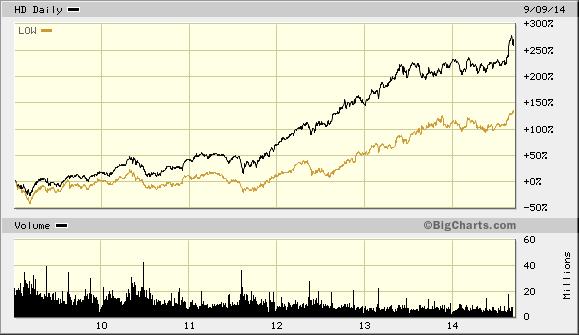
Notice how the daily cracks and burps are nearly identical. But over the long term, these stocks are very different. This is an important lesson with investing. Daily movements are strongly impacted by a company’s industry, but that impact drains little by little each day.
When most novice investors go about investing, they naturally ask, “what does the company do?” As odd as this sounds, that’s not as important as you’d think. Instead, the really important question is, how well do they do it?
With investing, you hear a lot of talk about “portfolio defense.” In the end, I think the best portfolio defense is owning a really good company.
-
1-, 2- and 3-Year Treasuries
Posted by Eddy Elfenbein on September 10th, 2014 at 9:20 amEd Bradford, the brilliant bond tweeter (@fullcarry), noted this morning that the part of the yield curve between one and three years out is now the steepest part of the curve. This is where we investors can try to figure out what the Fed has up its sleeve.
Check out this chart:
You can see how the one-year yield (the black line) has stayed pretty flat. But the two- and three-year yield (blue and red lines respectively) have gradually inched higher. In short, the market thinks higher rates are coming — not now, but soon.
Meanwhile, longer-term rates have been moving in the other direction — they’ve been coming down. As of yesterday’s close, the 10-year yield was 54 basis points below where it was at the end of last year. The 20-year yield is down 75 basis points and the 30-year is down by 73 basis points. Low long-term rates hit bottom on the Thursday before Labor Day and have come up some.
-
Morning News: September 10, 2014
Posted by Eddy Elfenbein on September 10th, 2014 at 6:59 amDraghi’s Case For Quantitative Easing in Europe
Money Supply Growth Slows in China
France to Miss Deficit Target, Lowers Growth Projections
Fed Proposes New Rule, and Wall St. Banks Feel the Pressure
Fed Weighs Change to Rate Guidance for Added Flexibility
U.S. States Probe Home Depot Breach, Senators Seek FTC Investigation
McDonald’s Warns Supplier Scandal Hurts 3Q Results; Shares Tank
Rocket Internet Seeks to Raise Nearly $1 Billion in German IPO
Apple Gives NFC Chip Technology a Prized Seal of Approval
Dollar General Commences Cash Tender Offer for Family Dollar Shares
Barnes & Noble Fights Book Decline by Selling More Toys
Alibaba Already Has Enough Orders To Cover Its Record-Breaking $21 Billion IPO, Sources Say
Economy, Beware: Singles Are Taking Over America
Joshua Brown: The Next Crash is Coming – Person With Web Access
Jeff Carter: Preserving the Floor Traders
Be sure to follow me on Twitter.
-
Worst Day in Five Weeks
Posted by Eddy Elfenbein on September 9th, 2014 at 4:07 pmToday was the worst day for the U.S. stock market since August 5th. The arresting part of that statement isn’t today’s loss but how subdued the market has been for the last five weeks. The S&P 500 lost a mere 0.65% today which brought the S&P 500 back down to 1,988.44. That really ain’t much.
Our Buy List didn’t fall as much as the overall market, but it was not an easy day. Only four Buy List stocks closed higher for the day. McDonald’s was especially weak as the fast food giant reported terrible sales for August. It was their worst sales slump in more than ten years. MCD also said that problems with their supplier in China will take off 15 to 20 cents per share in Q3 earnings. The yield on MCD is now yielding 3.56%.
Shares of eBay also took a hit but that wasn’t because of anything they did. Instead, Apple announced its new Apple Pay which would be a direct competitor of PayPal. That could be more reason for eBay to consider selling off PayPal.
-
Morning News: September 9, 2014
Posted by Eddy Elfenbein on September 9th, 2014 at 7:02 amU.S. Consumer Credit Soars In July With Biggest Gain Since ’01
Alibaba’s Jack Ma Begins Wooing Wall Street Investors For IPO
Amazon Cuts Struggling Phone’s Price to 99 Cents
Home Depot Data Breach Could Be the Largest Yet
Rakuten of Japan to Buy Ebates, a U.S. Rebate Site, for $1 Billion
GE Lighting Seen Following Appliances in Consumer Exit
General Mills to Buy Natural Foods Company Annie’s
PayPal’s Support Is the Best Thing That Could Happen to Bitcoin
Treasury Chief Urges Reforms to Keep Firms From Dodging U.S. Taxes
Campbell Soup Swings to Profit on Higher Sales
Gambling Panel Weighs Wynn, Mohegan Sun Proposals
Chick-Fil-A Rules the Roost, Even 6 Days A Week
Martoma, SAC Capital Ex-Trader, Gets 9 Years in Prison
Roger Nusbaum: AdvisorShares Weekly Market Review – Week Ending 9/5/2014
Credit Writedowns: Income Inequality, Corporate Inversions and Financial Engineering
Be sure to follow me on Twitter.
-
Colgate-Palmolive Drops on Triclosan
Posted by Eddy Elfenbein on September 8th, 2014 at 3:04 pmColgate-Palmolive ($CL) is one of my favorite boring stocks. The shares usually don’t move around much. Lately, however, CL has badly lagged the market.
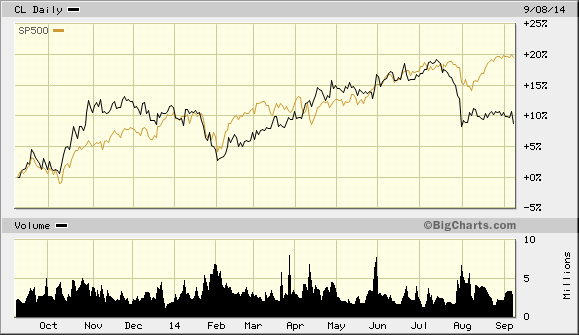
That may not seem like a lot but it’s a big deal for Colgate.
What’s going on? It’s hard to say exactly what event causes a certain move, but it appears that investors may be freaked out by triclosan. Or as Newsweek phrased it, “Is Cancer Lurking in Your Toothpaste?”
Triclosan is a chlorinated aromatic compound: very basically, two benzene rings (a sturdy hydrocarbon, with six atoms of carbon and hydrogen each) linked by an oxygen atom, with three chlorine atoms protruding like spokes, as well as a lone hydroxyl group (oxygen + hydrogen). First used in the 1970s in hospitals, it has since become a widespread antimicrobial agent. Not only is triclosan present in Colgate Total and many household soaps, but it can also be found in coolers, odor-protected shoes and makeup, according to Mae Wu, a lawyer with the Natural Resources Defense Council. She says that triclosan is “all over the place,” even if, as she notes, we had “been doing fine without it” for several centuries of human-microbial cohabitation of the planet.
“Triclosan is 110 percent marketing,” says Michael Osterholm, who heads the Center for Infectious Disease Research and Policy at the University of Minnesota. Osterholm, who helped Minnesota become the first state to ban most uses of triclosan. He told me the compound has been superseded by superior, safer antimicrobial agents, and Procter and Gamble has begun advertising its Crest toothpaste as being “100% triclosan free.” That may also be a triumph of marketing, but one that could lead more people to question the presence of triclosan in household items, thereby forcing Colgate’s hand.
I confess that I don’t know anything about triclosan or its effects, but I do know something investor behavior. They like to sell first and look for facts later. I’m always on the lookout for opportunities when good companies run into fixable problems.
-
Ford Drops on Downgrade
Posted by Eddy Elfenbein on September 8th, 2014 at 2:53 pmShares of Ford Motor ($F) are down today after the stock was downgraded by Morgan Stanley. They cut it from from Overweight to Underweight and lowered their price target to $16 per share.
The stock is back below $16.80 per share which is a very attractive price. Make no mistake, Ford’s business is doing very well. We’ll find out more in about six weeks when they report again. The stock is currently going for about 8.6 times next year’s earnings.
-
Gold Adjusted for Inflation
Posted by Eddy Elfenbein on September 8th, 2014 at 12:07 pmHere’s a look at the price of gold adjusted for inflation. We just passed the third anniversary of gold’s peak. It’s been rough since then. However, the ten years prior to that were great. Alas, things change.
Adjusting for inflation, gold peaked at over $2,000 per ounce in 1980. The low price in 2001 would be about $350 in today’s money.
-
The Bull Market Turns 2,000 Days Old
Posted by Eddy Elfenbein on September 8th, 2014 at 11:46 amBespoke Investment Group points out that the bull market is now 2,000 days old. That makes it older than SnapChat and Tinder combined. It’s also the fourth-longest bull market since 1928.
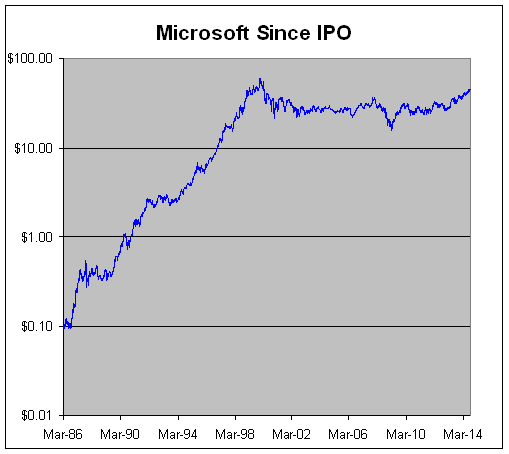
The stock market is down in early trading today. One exception is Microsoft ($MSFT) which jumped as high as $46.80 per share. The software giant is now at a 14.5-year high. The last time MSFT was this high was March 31, 2000. The stock hit its all-time peak on December 27, 1999 when it closed at $59.56 per share.
The all-time low came in March 1986, a few days after the IPO, when MSFT closed at nine cents per share. At the time, that was $26 per share but it needs to be adjusted for several splits totaling 288-for-1. The stock vaulted more than 650-fold within 14 years of its IPO. Only now are we within reasonable distance of that all-time high.
-
Archives
- September 2026
- August 2026
- July 2026
- June 2026
- May 2026
- April 2026
- March 2026
- February 2026
- January 2026
- December 2025
- November 2025
- October 2025
- September 2025
- August 2025
- July 2025
- June 2025
- May 2025
- April 2025
- March 2025
- February 2025
- January 2025
- December 2024
- November 2024
- October 2024
- September 2024
- August 2024
- July 2024
- June 2024
- May 2024
- April 2024
- March 2024
- February 2024
- January 2024
- December 2023
- November 2023
- October 2023
- September 2023
- August 2023
- July 2023
- June 2023
- May 2023
- April 2023
- March 2023
- February 2023
- January 2023
- December 2022
- November 2022
- October 2022
- September 2022
- August 2022
- July 2022
- June 2022
- May 2022
- April 2022
- March 2022
- February 2022
- January 2022
- December 2021
- November 2021
- October 2021
- September 2021
- August 2021
- July 2021
- June 2021
- May 2021
- April 2021
- March 2021
- February 2021
- January 2021
- December 2020
- November 2020
- October 2020
- September 2020
- August 2020
- July 2020
- June 2020
- May 2020
- April 2020
- March 2020
- February 2020
- January 2020
- December 2019
- November 2019
- October 2019
- September 2019
- August 2019
- July 2019
- June 2019
- May 2019
- April 2019
- March 2019
- February 2019
- January 2019
- December 2018
- November 2018
- October 2018
- September 2018
- August 2018
- July 2018
- June 2018
- May 2018
- April 2018
- March 2018
- February 2018
- January 2018
- December 2017
- November 2017
- October 2017
- September 2017
- August 2017
- July 2017
- June 2017
- May 2017
- April 2017
- March 2017
- February 2017
- January 2017
- December 2016
- November 2016
- October 2016
- September 2016
- August 2016
- July 2016
- June 2016
- May 2016
- April 2016
- March 2016
- February 2016
- January 2016
- December 2015
- November 2015
- October 2015
- September 2015
- August 2015
- July 2015
- June 2015
- May 2015
- April 2015
- March 2015
- February 2015
- January 2015
- December 2014
- November 2014
- October 2014
- September 2014
- August 2014
- July 2014
- June 2014
- May 2014
- April 2014
- March 2014
- February 2014
- January 2014
- December 2013
- November 2013
- October 2013
- September 2013
- August 2013
- July 2013
- June 2013
- May 2013
- April 2013
- March 2013
- February 2013
- January 2013
- December 2012
- November 2012
- October 2012
- September 2012
- August 2012
- July 2012
- June 2012
- May 2012
- April 2012
- March 2012
- February 2012
- January 2012
- December 2011
- November 2011
- October 2011
- September 2011
- August 2011
- July 2011
- June 2011
- May 2011
- April 2011
- March 2011
- February 2011
- January 2011
- December 2010
- November 2010
- October 2010
- September 2010
- August 2010
- July 2010
- June 2010
- May 2010
- April 2010
- March 2010
- February 2010
- January 2010
- December 2009
- November 2009
- October 2009
- September 2009
- August 2009
- July 2009
- June 2009
- May 2009
- April 2009
- March 2009
- February 2009
- January 2009
- December 2008
- November 2008
- October 2008
- September 2008
- August 2008
- July 2008
- June 2008
- May 2008
- April 2008
- March 2008
- February 2008
- January 2008
- December 2007
- November 2007
- October 2007
- September 2007
- August 2007
- July 2007
- June 2007
- May 2007
- April 2007
- March 2007
- February 2007
- January 2007
- December 2006
- November 2006
- October 2006
- September 2006
- August 2006
- July 2006
- June 2006
- May 2006
- April 2006
- March 2006
- February 2006
- January 2006
- December 2005
- November 2005
- October 2005
- September 2005
- August 2005
- July 2005
 Eddy Elfenbein is a Washington, DC-based speaker, portfolio manager and editor of the blog Crossing Wall Street. His