-
Job Openings Hit Seven-Year High
Posted by Eddy Elfenbein on June 10th, 2014 at 12:02 pmAt noon, the stock market is down but not by much. There’s been a lot of talk recently about the ultra low VIX level. The VIX is currently at 11.23, which is quite low, but remember that the VIX only looks one month ahead while stock prices are theoretically supposed to discount to eternity.
I’ve looked at the numbers and found that the VIX isn’t that strongly correlated with a good or bad market. The closest I’ve found is that a low VIX, below 13, is somewhat good for the market. Since 1990, the S&P 500 has gained 11.79% annualized when the VIX is below 13, and 6.36% annualized when it’s 13 or more.
What I think low volatility means is that the market has settled on a trend, whatever it may be, and sees it playing out for a while.
There’s not much in the way of economic news today. One report we got was on job openings. The number of job openings nearly hit a seven-year high in April. There are now 4.46 million jobs waiting to be filled which is the highest since September 2007.
Another report said that small businesses are the most optimistic they’ve been since 2007. It’s interesting how many data series have been making seven-year highs. Last week, non-farm payrolls finally took out its pre-recession high.
On our Buy List, most stocks are quiet but CR Bard ($BCR) and Cognizant Technology Solutions ($CTSH) are both down more than 3% today. CTSH was downgraded by Susquehanna to neutral from positive.
Facebook ($FB) is up on the news that PayPal’s president is jumping ship to FB. PayPal, of course, is a subsidiary of eBay ($EBAY). I don’t think this means much for eBay but its shares are down about 2% today.
-
Morning News: June 10, 2014
Posted by Eddy Elfenbein on June 10th, 2014 at 6:43 amEuropean Commission: ICAP May Have Broken EU Antitrust Rules
Why Troubled Euro Zone Bonds Are Outperforming Treasurys
Euronext Value Could Reach About $2.4 Billion in I.P.O.
China Now Has More Millionaires Than Any Country but the U.S.
Natural Gas Slips From One-Month High on Milder Weather
3 Reasons Why the Dow Doesn’t Deserve to Be at 17,000
Merck Bids $3.8 Billion for an Edge in Hepatitis
MetLife Announces Share Repurchase
What Apple’s Stock Split Means for You
Family Dollar Thwarts Icahn With ‘Poison Pill’
Eyeing PayPal, Amazon Makes Online Payment Push
Howard Lindzon: The Joe DiMaggio Stock Market
Joshua Brown: Turn Down For What!
Be sure to follow me on Twitter.
-
The Venezuelan Economy
Posted by Eddy Elfenbein on June 9th, 2014 at 10:21 amFrom Bloomberg:
Prostitutes more than double their earnings by moonlighting as currency traders in Puerto Cabello. They are the foreign exchange counter for sailors in a country where buying and selling dollars in the streets is a crime — and prostitution isn’t. Greenbacks in the black market are worth 11 times more than the official rate as dollars become more scarce in an economy that imports 70 percent of the goods it consumes.
“The dollar is king these days, but having them comes at a price,” Elena, who uses an alias to protect her identity, said late last month in a room she rents in a Puerto Cabello brothel. “Yes, we got dollars to afford the things our families need, but we have to sell our bodies for it.”
-
The Stock Market Is Up 10 of 12 Days
Posted by Eddy Elfenbein on June 9th, 2014 at 10:04 amThe stock market has risen for 10 of the last 12 trading days, and it’s up again this morning. The big news this morning is that Apple ($AAPL) has now split 7-for-1. The stock is currently at $92 per share. It’s currently the most valuable company in the world with a market cap of more than $550 billion. The combined value of Apple and Exxon ($XOM) comes to $1 trillion.
There’s not a lot of movement on our Buy List this morning, although I’ll point out that Ford ($F) is over $17 per share, and Bed Bath & Beyond ($BBBY) is up to $62.72, which is the highest price in about a month. Oracle ($ORCL) and Wells Fargo ($WFC) are both at new 52-week highs.
On Friday, the Volatility Index ($VIX) dropped down to 10.73. That was the lowest figure in seven years. The VIX is up to 11.12 this morning.
-
Morning News: June 9, 2014
Posted by Eddy Elfenbein on June 9th, 2014 at 6:42 amBrightening Global Economy Puts FTSE Within Reach of Multi-Year Highs
Lagarde Says IMF ‘Got It Wrong’ on Rallying U.K. Economy
Ukraine Gas Talks Resume in Brussels to Avoid Cut-off This Week
Japan Growth Picks Up More Than Estimated on Investment
China’s Yuan Bounces After Another Surprise Strong Fix Against Dollar
U.S. Crude Rises as China Exports Gain Steam
President’s Speech: 6 Agendas of Modi Government That Will Make The Common Man Happy
Tyson Wins Battle to Buy Hillshire
Hertz’s Accounting Woes Wider Than Thought
Time Inc. to Set a Lonely Course After a Spinoff
Amazon Expands Middleman Role in Latest Online Payments Push
McClendon Firm to Buy Leases in Permian Basin for $2.5 Billion
Rogue Vietnam Banker Jailed For 30 Years Over $1 Billion Fraud
Cullen Roche: Low Global Inflation Means “Accommodative Policy” is Here to Stay
Jeff Miller: Weighing the Week Ahead: Time for a Market Breakout?
Be sure to follow me on Twitter.
-
Mickey Mantle Day, 45 Years Ago
Posted by Eddy Elfenbein on June 7th, 2014 at 4:02 pmMickey Mantle showed up for spring training in 1969 and realized he couldn’t play another season. At 37, the Mick realized he was too old: “I can’t play anymore. I don’t hit the ball when I need to. I can’t steal when I need to. I can’t score from second base when I need to. I have to quit.”
On June 8, the Yankees held Mickey Mantle Day at Yankee Stadium.
-
Apple Splits!
Posted by Eddy Elfenbein on June 6th, 2014 at 5:56 pmShares of Apple ($AAPL) closed today at $645.57. On Monday morning, there will be seven times the number of shares outstanding and the stock price should fall by 6/7ths.
Today’s closing price works out to $92.22 post split. The split puts Apple’s share price roughly in the range of many stocks in the Dow.
There are currently 861.38 shares outstanding of Apple. That will increase to 6.029 billion.

-
Medtronic’s CEO on CNBC
Posted by Eddy Elfenbein on June 6th, 2014 at 1:25 pm -
May NFP = +217K
Posted by Eddy Elfenbein on June 6th, 2014 at 8:57 amThe U.S. economy created 217,000 new jobs last month. The unemployment rate stayed at 6.3%. Expectations were for an increase of 215,000. Private payrolls grew by 216,000 compared with expectations of 210,000.
Nonfarm payrolls finally topped the peak from January 2008. In 25 months, the U.S. economy lost 8.71 million jobs. In the next 51 months, we gained 8.81 million jobs. So in 76 months, we’ve gained 98,000 jobs.
-
CWS Market Review – June 6, 2014
Posted by Eddy Elfenbein on June 6th, 2014 at 7:12 am“I don’t expect the consensus to be right. I’m just surprised by how wrong it has been.” – Jim Bianco
This has been a remarkably efficient stock market. I say that because it’s effortlessly made fools of everyone.
Remember all that talk about “a bubble” and that we’re “due for a correction”? Well, apparently Mr. Market wasn’t cc’d on that. On Thursday, the S&P 500 rallied for the 14th time in the last 19 sessions. The index hit yet another all-time high. (I was particularly impressed when it blew past the historically significant 1,929 marker.)
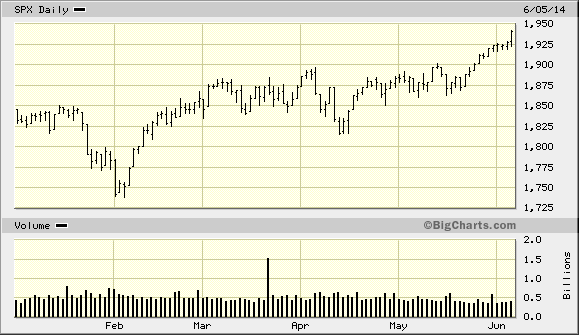
As we look at this rally, we have to keep in mind all the negative news that could have tripped us up—like the lousy Q1 GDP report, or the ongoing tensions in Ukraine. None of that seems to matter. Everyone, it seemed, was expecting a mass rotation out of bonds. Didn’t happen. Instead, bond yields have plummeted this year.
Despite the market’s resiliency, what’s truly been remarkable is how little trading volume there’s been. In less-technical terms, where the heck did everybody go? Trading volume has plunged, and the bull just doesn’t care. In this week’s CWS Market Review, we’ll take a look at what this low-volume, low-volatility rally means for us and our Buy List.
I’ll also highlight some of the recent economic news. We had some interesting drama on our Buy List recently. Shares of Stryker spiked after the company denied a report that they were looking to buy Smith & Nephew. Then another one of our Buy List stocks, Medtronic, had the same rumor hit them! What’s going on? I’ll untangle it all in a bit. But first, let’s look at where the economy stands.
Finally, an All-Time High for Jobs
On the first business day of each month, the Institute for Supply Management releases its Manufacturing Index. I like to keep a close eye on the ISM report for a few reasons. One is that it comes out so quickly. A lot of economic reports come weeks after the fact. It’s also one of the econ reports that’s not endlessly revised.
The ISM also has a good track record of lining up with recessions and expansions. Here’s how it works: Any number above 50 means that the manufacturing sector is expanding, while readings below 50 mean it’s contracting. When the index is below 45, it usually corresponds to a recession. The ISM Index has been 49.0 or better for the last 59 months in a row, which lines up exactly with the current expansion.
On Monday, ISM had some problems. They had to revise their May report not once, but twice. It’s embarrassing, but they finally settled on a figure of 55.4, which was only 0.1 below what Wall Street had been expecting. That’s a decent number, and it suggests that the manufacturing sector is still healthy. For now, I don’t believe there’s a risk of an imminent recession.
On Monday, we also learned that construction spending rose by 0.2% in April. Frankly, that was a bit weak. Economists had been expecting an increase of 0.7%. Also on Monday, we learned that housing inventory is up 10.5% from a year ago. This is very important, since there was so much overbuilding during the expansion. All that excess inventory had to be burned off. Inventory is still quite low, and prices have been rising. Housing isn’t the biggest part of the economy, but it’s probably the biggest part in determining the direction of the economy.
Then on Tuesday, carmakers reported good sales for the month of May. Sales for GM rose 13%, and sales for Chrysler rose 17%. Sales at Ford ($F) rose only 3%, but that’s actually a decent performance. Ford’s been cutting back on its incentives in an attempt to manage its inventory. This was the best May for Ford in ten years. On Thursday, shares of Ford got as high as $16.89, which is a six-month high. I like this stock a lot. Ford remains a solid buy up to $18 per share.
Now about the jobs report. As usual, I’m writing this newsletter to you early on Friday morning, and the big jobs report will come out later this morning. In fact, it’s probably out by the time you’re reading this (check the blog for updates). It’s always a hazard guessing how many new jobs were created. The government is very clear that their estimates have a very wide error range (the standard deviation has been 236,000), but that doesn’t stop Wall Street from playing the guessing game. What’s more important to me, however, is the general trend of new jobs. Fortunately, that’s been rather good lately. Of course, there are still lots of unemployed folks out there, especially long-term unemployed.
On Wednesday, ADP, the private-payroll folks, said that 179,000 private-sector jobs were created last month. That was below expectations, but I should caution you that ADP doesn’t have a great track record as a bellwether for the government’s report. On Thursday, the Labor Department said that unemployment claims rose to 312,000 last week. That’s a good number. Since this number bounces around a lot, economists like to focus on the four-week moving average, which is now at a seven-year low.
It’s very likely that Friday’s jobs report will show that we finally surpassed the peak employment set in January 2008. In other words, it’s taken us six and a half years to create a few thousand jobs. As rough as that sounds, the economy lost 8.7 million jobs in 25 months. It then took another 51 months, more than twice as long, to make them all back. Wall Street has high expectations for this report. The current consensus is for 213,000 jobs. The economy added 288,000 jobs in April.
Also on Thursday, the Federal Reserve released the big “Flow of Funds” report. This is always an interesting report to see. According to the Fed, U.S. household net worth rose to $81.8 trillion at the end of Q1. In the last five years, our net wealth has risen by more than $26 trillion.
Overall, the broad economy appears to be doing well. More folks on the Street expect GDP for Q2 to be over 3%. It could be as high as 4%. One of the better economist reports is the Fed’s Beige Book. It’s a bit on the wonky side, but it has some good tidbits. The most recent Beige Book reported growth in all 12 of the Fed’s regions.
Another one of my favorite economic indicators is the yield spread between the two- and ten-year Treasuries. While the 10-year has rallied this year, it still yields 219 basis points more than the two-year. That’s a big gap. Whenever that spread turns negative, you can be sure the economy will soon hit a rough patch. The 2-10 spread has a much better track record than a lot of highly paid folks on Wall Street. The 2-10 has been over 200 basis points every day for nearly a year.
Hey, Where Did Everybody Go?
On Thursday, the S&P 500 closed at 1,940.46, which is another all-time high. But what’s interesting is that the market has rallied on very low volatility and low volume. The trading volume has declined remarkably. On Wednesday, trading in the S&P 500 ETF ($SPY) hit a new low for the year.
Last month, an average of 1.8 billion shares were traded in the S&P 500 companies. That’s the lowest volume in six years. During May, an average of $26 billion was traded each day in S&P 500 companies. That’s down from $32 billion in April.
Also, the market’s breadth continues to narrow. On May 23, the S&P 500 made a new high, but only 24 stocks in the index made a new 52-week high. I’ll warn you that these are traditionally negative signs; the problem is that you never know when the trouble will begin.
Earlier this week, the Volatility Index ($VIX) dropped down to 11.29, which is the lowest level in more than a year. (Warning: math stuff ahead.) If you’ve ever wondered what the VIX is, it’s the market’s estimate of the S&P 500’s standard deviation over the next month. The hitch is that it’s expressed in annualized terms. To turn it into a monthly figure, just divide the VIX by the square root of 12, which is 3.46. So the current VIX of 11.68 means that traders think the S&P 500 will move up or down by 3.37%, or about 65 points, over the coming month.
Only two years ago, the European bond market was ready to sink into the Adriatic. Now bond yields in the Old World are at their lowest point since the Battle of Waterloo. Mario Draghi just dropped the deposit rate from 0% to -0.1%. The European Central Bank is now the first major central bank in the world to go to negative interest rates. So much of the European economy is still in shambles. In 1914, Lord Grey famously said, “the lamps are going out all over Europe.” This time, it’s not a metaphor.
On this side of the pond, the market still seems reasonably priced despite the rally. Analysts on Wall Street currently expect earnings this year for the S&P 500 of $119.82. The estimate for next year is $137.38, but that’s probably too high. As long as yields stay low, the spreads are wide, and the economy is generating more than 150,000 new jobs each month, then the bull case is intact.
As always, investors should focus on high-quality stocks like the ones on our Buy List. As long as they’re below my Buy Below price, I think they’re good buys. Right now, I especially like AFLAC ($AFL), Bed Bath & Beyond ($BBBY), Ford ($F), Oracle ($ORCL) and Wells Fargo ($WFC).
Smith & Nephew & Stryker & Medtronic
Here’s a bit of an odd story. Last week, the Financial Times reported that Stryker ($SYK) was looking to bid on Smith & Nephew ($SNN), a British orthopedics company. But Stryker was all, “um…no, we’re not planning any bid.”
Here it gets a little confusing. Stryker had been interested in SNN, but they were only in the evaluating stage. Now that Stryker has said they’re not going to make a bid, according to British law, they can’t bid for six months. But SNN is allowed to go to them.
Once Stryker pulled itself out of the running, shares of SYK shot up. I mentioned this in last week’s issue, and I raised our Buy Below. Stryker has continued to rally, and it recently broke $86 per share. Stryker continues to be a good buy up to $87 per share.
This week, another of our Buy List companies is rumored to be very interested in Smith & Nephew, and this time it’s Medtronic ($MDT). But Medtronic is much more serious about a deal than Stryker ever was. With the implementation of the Affordable Care Act, everyone is looking to cut costs. This is driving pressure for medical-device makers to merge. Everyone wants to have “scale.” With a merger, Medtronic could also lower its tax bill by moving its HQ overseas. (That’s right, Her Majesty’s corporate tax is lower than Uncle Sam’s. Someone alert George III.)
So far, Medtronic has not commented, but I think a deal is a very real possibility. Usually, the acquiring firm sees its share price drop, but when the news broke yesterday, shares of Medtronic gapped up about $3 per share. The stock pulled back on Thursday, but it’s still higher than when the news broke.
I can’t say I’m a big fan of this deal, but I recognize that this, or something very similar, will have to happen. Medtronic remains a good buy up to $65 per share.
Buy List Update
Our Buy List has been uncharacteristically sluggish lately. For the year, the S&P 500 is up 4.98%, while our Buy List is up 2.67% (not including dividends). Of course, that’s not a huge deficit, and I think we can make it up by the year’s end, but it’s not how our Buy List usually behaves.
I don’t shy away from highlighting underperformance, but I don’t get rattled by it, either. The problem has mostly been very recent. Since May 12, the S&P 500 is up by 2.31%, while the Buy List has barely budged, up 0.19%. A lot of this reflects the changing character of the rally. As we’ve discussed before, fewer and fewer stocks are leading the market higher.
What’s interesting is that 11 of our 20 Buy List stocks are actually leading the market this year. The problem is that a small number of big losers like Bed Bath & Beyond and CA Technologies have weighed heavily on our gains.
Before I go, I want to tighten up two of our Buy Below prices. I’m dropping CA Technologies ($CA) down to $31 per share, and I’m also lowering eBay ($EBAY) to $55 per share. I still like both stocks, but I want our Buy Belows to more closely reflect the current prices.
That’s all for now. Next week is a slow week for the market. The only big economic report will be Thursday’s report on retail sales. The earnings reports for companies with quarters ending in May will start to come in. We have two of those of our Buy List: Bed Bath & Beyond and Oracle. Both are due to report later this month. I also expect to hear dividend news soon from CR Bard and Medtronic. Be sure to keep checking the blog for daily updates. I’ll have more market analysis for you in the next issue of CWS Market Review!
– Eddy
-
Archives
- September 2026
- August 2026
- July 2026
- June 2026
- May 2026
- April 2026
- March 2026
- February 2026
- January 2026
- December 2025
- November 2025
- October 2025
- September 2025
- August 2025
- July 2025
- June 2025
- May 2025
- April 2025
- March 2025
- February 2025
- January 2025
- December 2024
- November 2024
- October 2024
- September 2024
- August 2024
- July 2024
- June 2024
- May 2024
- April 2024
- March 2024
- February 2024
- January 2024
- December 2023
- November 2023
- October 2023
- September 2023
- August 2023
- July 2023
- June 2023
- May 2023
- April 2023
- March 2023
- February 2023
- January 2023
- December 2022
- November 2022
- October 2022
- September 2022
- August 2022
- July 2022
- June 2022
- May 2022
- April 2022
- March 2022
- February 2022
- January 2022
- December 2021
- November 2021
- October 2021
- September 2021
- August 2021
- July 2021
- June 2021
- May 2021
- April 2021
- March 2021
- February 2021
- January 2021
- December 2020
- November 2020
- October 2020
- September 2020
- August 2020
- July 2020
- June 2020
- May 2020
- April 2020
- March 2020
- February 2020
- January 2020
- December 2019
- November 2019
- October 2019
- September 2019
- August 2019
- July 2019
- June 2019
- May 2019
- April 2019
- March 2019
- February 2019
- January 2019
- December 2018
- November 2018
- October 2018
- September 2018
- August 2018
- July 2018
- June 2018
- May 2018
- April 2018
- March 2018
- February 2018
- January 2018
- December 2017
- November 2017
- October 2017
- September 2017
- August 2017
- July 2017
- June 2017
- May 2017
- April 2017
- March 2017
- February 2017
- January 2017
- December 2016
- November 2016
- October 2016
- September 2016
- August 2016
- July 2016
- June 2016
- May 2016
- April 2016
- March 2016
- February 2016
- January 2016
- December 2015
- November 2015
- October 2015
- September 2015
- August 2015
- July 2015
- June 2015
- May 2015
- April 2015
- March 2015
- February 2015
- January 2015
- December 2014
- November 2014
- October 2014
- September 2014
- August 2014
- July 2014
- June 2014
- May 2014
- April 2014
- March 2014
- February 2014
- January 2014
- December 2013
- November 2013
- October 2013
- September 2013
- August 2013
- July 2013
- June 2013
- May 2013
- April 2013
- March 2013
- February 2013
- January 2013
- December 2012
- November 2012
- October 2012
- September 2012
- August 2012
- July 2012
- June 2012
- May 2012
- April 2012
- March 2012
- February 2012
- January 2012
- December 2011
- November 2011
- October 2011
- September 2011
- August 2011
- July 2011
- June 2011
- May 2011
- April 2011
- March 2011
- February 2011
- January 2011
- December 2010
- November 2010
- October 2010
- September 2010
- August 2010
- July 2010
- June 2010
- May 2010
- April 2010
- March 2010
- February 2010
- January 2010
- December 2009
- November 2009
- October 2009
- September 2009
- August 2009
- July 2009
- June 2009
- May 2009
- April 2009
- March 2009
- February 2009
- January 2009
- December 2008
- November 2008
- October 2008
- September 2008
- August 2008
- July 2008
- June 2008
- May 2008
- April 2008
- March 2008
- February 2008
- January 2008
- December 2007
- November 2007
- October 2007
- September 2007
- August 2007
- July 2007
- June 2007
- May 2007
- April 2007
- March 2007
- February 2007
- January 2007
- December 2006
- November 2006
- October 2006
- September 2006
- August 2006
- July 2006
- June 2006
- May 2006
- April 2006
- March 2006
- February 2006
- January 2006
- December 2005
- November 2005
- October 2005
- September 2005
- August 2005
- July 2005
 Eddy Elfenbein is a Washington, DC-based speaker, portfolio manager and editor of the blog Crossing Wall Street. His