-
BBBY’s Planning Assumptions
Posted by Eddy Elfenbein on April 10th, 2014 at 8:48 amBed Bath & Beyond ($BBBY) said they see first first-quarter earnings ranging between 92 and 96 cents per share. Furthermore, they project earnings for the entire year to rise by “mid single digits.” That’s based on several planning assumptions which they laid out in their conference call. Here’s a summary (this is edited down from the transcript via Seeking Alpha):
1. Q1 comparable stores sales growth of 1% to 2.5%. For the full year growth of approximately 3%.
2. Consolidated net sales growth of 2% to 3.5% for the first quarter and approximately 4% for the full year.
3. Depreciation for fiscal 2014 is expected to be approximately $240 million.
4. Assuming these sales levels, we are modeling deleverage for both gross profit and SG&A for the fiscal first quarter and full year. Contributing to the modeled gross profit deleverage on an assumed continuation and the shift of the mix of merchandise sold to lower margin categories and an increase in coupon expense. The modeled SG&A deleverage includes increases in technology expense and depreciation related to our ongoing investments.
5. Our annual interest line will include approximately $9.2 million in interest expense, substantially resulting from the inclusion of sale lease backed obligations related to certain distribution centers.
6. The first quarter and full year tax provisions are estimated to be in the mid to high 30s percentage range with expected variability as distinct tax events occur.
7. We expect to generate positive operating cash flow and to continue to fund operations entirely from internally generated sources.
8. We plan to continue to repurchase shares under our $2.5 billion repurchase program, which we estimate to be completed during fiscal 2015. However, this repurchase program may be influenced by several factors including business and market conditions.
9. We anticipate opening approximately 30 new stores companywide.
10. We expect to continue our program of renovating or repositioning stores within markets when appropriate.
11. Capital expenditures are planned to be approximately $350 million, which remain subject to the timing and composition of projects. Projected capital expenditures include the significant level of investment we will be making in our initiatives and primarily include the addition of new functionality to our selling websites, mobile sites and apps; development work necessary for a new and more robust point-of-sale system; deploying systems and equipment to our stores; equipping our new IT data center; opening an additional distribution facility for direct-to-customer and store fulfillment as well as new stores and existing store refurbishments.
The company is financially strong. BBBY has a cash balance of $943 million and shareholder equity is $3.9 billion.
-
Morning News: April 10, 2014
Posted by Eddy Elfenbein on April 10th, 2014 at 7:00 amGreek Bond Sale Said to Top $4 Billion in Return to Market
What History Tells Us About the Carry Trade
Hong Kong, Chinese Stocks Rally on Cross-Border Investment Plan
Environment for Emerging Economies Turns More Challenging: IMF
Federal Reserve Officials Feared Sending the Wrong Message on Rates
Banks Pushing Court Foreclosures Means More Inventory
Tough Swap Standards Drive Up Trade Costs 92-Fold
$772 Million Penalty for Bank of America Credit Card Practices
PC Sales See Modest Drop Amid Windows XP Replacements
Fast Retailing Cuts Profit Forecast Amid Waning Japan Demand
Walmart Plans to Offer Organic Foods For Less
IGate’s Quarterly Results Beat Estimates
Jeff Carter: Electronic Systems Do Fail
Cullen Roche: The Rise of the Secular Stagnationist
Be sure to follow me on Twitter.
-
Bed Bath & Beyond Earns $1.60 for Q4
Posted by Eddy Elfenbein on April 9th, 2014 at 4:19 pmBed Bath & Beyond ($BBBY) just reported Q4 earnings of $1.60 per share. That’s inline with consensus. The home furnishings store estimated that lousy weather cost them six to seven cents per share last quarter. Quarterly sales dropped 5.8% to $3.203 billion while comparable store sales increased 1.7%.
For the year, BBBY made $4.79 per share which is up from $4.56 in the year before. For Q1, BBBY expects 92 to 96 cents per share. They expect earnings to rise by “mid single digits” for this year. If we take that to mean 4% to 6%, then it works out to a range of $4.98 to $5.08 per share. Wall Street had been expecting $5.27 per share.
The shares are down 4% in the after-hours market. One bright spot is that last quarter, they bought 7.5 million shares for $532 million.
-
Fed Minutes Lift the Market
Posted by Eddy Elfenbein on April 9th, 2014 at 3:52 pmThe market was rattled three weeks ago after the last Federal Reserve meeting. Today, the Fed released the minutes of their March 18-19 meeting (the full transcripts won’t be released for another five years).
I should back up and explain that we’re in an unusual moment in the economy. The Fed has made it clear that it intends to continue its tapering policy this year, and nothing’s going to shake them off that path. As a result, the actual Fed meetings aren’t as important as they used to be. In their place, I think investors are placing greater weight on the more detailed Fed minutes, which come out three weeks after each meeting.
What spooked investors in March was the Fed’s SEP, their Summary of Economic Projections. When that came out, it was widely interpreted as being a chance to a more hawkish stance, meaning that the Fed was leaning towards raising rates sooner than expected. But in the Fed minutes we learned that some Fed members were concerned that the SEP would be incorrectly interpreted as hawkish.
Here’s the relevant part, and I apologize for the econo-speak:
A number of participants noted the overall upward shift since December in participants’ projections of the federal funds rate included in the March SEP, with some expressing concern that this component of the SEP could be misconstrued as indicating a move by the Committee to a less accommodative reaction function. However, several participants noted that the increase in the median projection overstated the shift in the projections. In addition, a number of participants observed that an upward shift was arguably warranted by the improvement in participants’ outlooks for the labor market since December and therefore need not be viewed as signifying a less accommodative reaction function.
In other words, there was no change at all in the Fed’s thinking. As a result of today’s minutes, the stock market has gapped higher and the S&P 500 is still holding on to those gains. The index is back over 1,871. Small-caps and Cyclicals are leading the charge, and Growth is crushing Value today (although both are up). But remember that Value been owning Growth for the last month.
Stay tuned: BBBY reports after the close.
-
Morning News: April 9, 2014
Posted by Eddy Elfenbein on April 9th, 2014 at 6:37 amGerman Exports Drop More Than Forecast in February
Greece to Announce Details of Long-Term Bond
In New Tack, I.M.F. Aims at Income Inequality
Fed Could Cut Rates to Combat Joblessness: Kocherlakota
Banks Ordered to Add Capital to Limit Risks
Investors’ Appetite for I.P.O.s Seems to Ebb
Banana Supplies Seen by UN’s FAO at Risk After Disease Spreads
Gold Near Two-Week High as Investors Await Fed Minutes
Alcoa Sees Almost Decade-Long Aluminum Surplus Ending
In Smartphone Mass-market, Samsung, Apple Have Margins on Their Minds
GM Fined by U.S. Safety Agency for Incomplete Answers
BMW, Daimler Upbeat About Luxury Car Outlook
NY Times is Dead Wrong About Warren Buffett
Roger Nusbaum: What Wildland Firefighting Teaches About Investing
Joshua Brown: Anxiety of the HENRYs
Be sure to follow me on Twitter.
-
The Rebound in Greece
Posted by Eddy Elfenbein on April 8th, 2014 at 4:17 pmRemember how Greece was going under? Two years later, Hugo Dixon describes the rebound as astonishing. Once the 10-year bond was at 30%. Now, it’s at 6.2%:
Two of the country’s big four banks – Piraeus and Alpha – have raised 3 billion euros of equity between them in recent weeks to reinforce their balance sheets after a stress test orchestrated by the central bank. Eurobank, another big lender, is planning to follow suit with a 3 billion euro issue later this month.
The changed mood in the markets is mainly down to external factors: the European Central Bank’s promise to “do whatever it takes” to save the euro two years ago; and the more recent end of investors’ love affair with emerging markets, meaning the liquidity sloshing around the global economy has been hunting for bargains in other places such as Greece.
That said, the centre-right government of Antonis Samaras has surprised observers at home and abroad by its ability to continue with the fiscal and structural reforms started by his predecessors. The most important successes have been reform of the labour market, which has restored Greece’s competiveness, and the achievement last year of a “primary” budgetary surplus before interest payments.
-
Results on My World’s Simplest Stock Valuation Measure
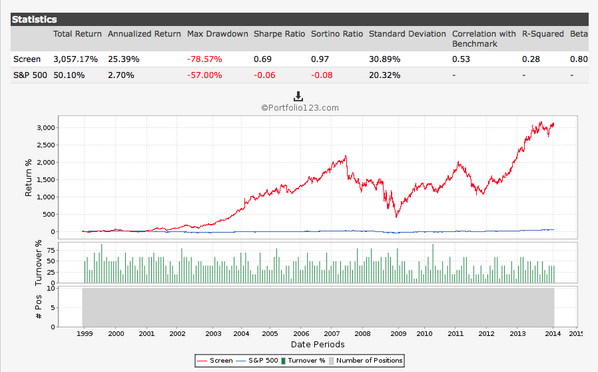
Posted by Eddy Elfenbein on April 8th, 2014 at 10:47 amTwo years ago, I unveiled my “World’s Simplest Stock Valuation Measure,” which is:
Growth Rate/2 + 8 = PE Ratio
Reader Brett Michael did some-backtesting and found that the equation works very well. It beat the market by 61-fold.
-
Nasdaq Drops 4.6% in Three Days
Posted by Eddy Elfenbein on April 8th, 2014 at 10:01 amThe stock market is flattish so far this morning. Friday and Monday were pretty ugly days, especially for momentum stocks. In the last three days, the Nasdaq has dropped 4.6%. That’s its worst three-day loss since 2011.
The key aspect of the recent market action is that it’s a valuation-based rotation. By that, I mean that stocks with high valuations have been clobbered, and that pretty much includes the entire biotech sector.
But here’s the interesting part—the rotation is not a cyclical one. Many of the economically sensitive stocks have barely budged. The Morgan Stanley Cyclical Index ($CYC) continues to move up to relative strength highs.
I’ll give you a perfect example. While the Nasdaq has moved down, IBM ($IBM) has been just fine. The rotation isn’t affecting tech, it’s affecting highly valued tech. Check this out from Bloomberg:
The Nasdaq Composite Index trades at 32 times reported earnings of the companies in the index, compared with 17 times for the S&P 500. The 100 biggest companies in the Nasdaq gauge trade 64 percent above the S&P 500 relative to sales and 149 percent higher relative to estimated revenue, data compiled by Bloomberg show.
I should point out that many traders are clearly nervous. On Friday, the Nasdaq 100 fell the most in two years. The volume of puts on the Nasdaq 100 ETF ($QQQ) topped 1 million. That’s the most since the Flash Crash four years ago.
-
Morning News: April 7, 2014
Posted by Eddy Elfenbein on April 7th, 2014 at 6:31 amDraghi’s $1.4 Trillion Question Lingers as ECB Mulls QE
New French Finance Minister Promises ‘Tough, Brave’ Decisions on Deficit
Jobs Rich Irish Mystery Confounds Shrinking Economy
Japan, Australia Clinch Trade Deal as U.S.-Tokyo Talks Heat Up
World Bank Trims China, East Asia 2014 Growth Forecasts
Libya Oil Sales to Rise as Rebels Surrender Two Ports
Oil, Gas Play Second Fiddle to Nigeria’s Services Sector
SEC Forms Squad to Examine Private Funds
Gravity Hits Highflying Tech Stocks
Holcim to Merge With Lafarge to Create Biggest Cement Maker
Roche to Pay $450 Million for IQuum
Ranbaxy Shareholders Cheer $3.2-Billion Deal With Sun Pharma; Stock Can Rally Another 20%
Credit Suisse Is Said to Be Facing Double-Barreled Inquiries
Credit Writedowns: Ten Lessons From Charles Keating on Corporatism and Control Fraud
Jeff Miller: Weighing the Week Ahead: Fluff or Fundamentals?
Be sure to follow me on Twitter.
-
The Growth/Value Divide Continues
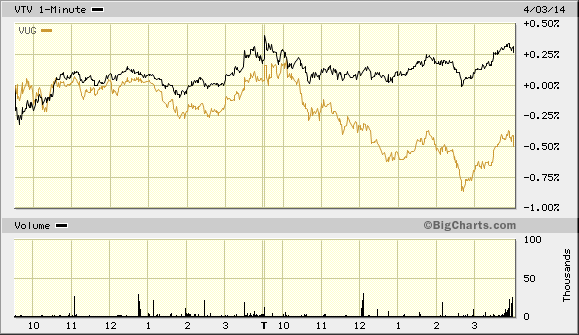
Posted by Eddy Elfenbein on April 4th, 2014 at 1:20 pmCheck out the divergence between Value (black) and Growth (gold).
-
Archives
- September 2026
- August 2026
- July 2026
- June 2026
- May 2026
- April 2026
- March 2026
- February 2026
- January 2026
- December 2025
- November 2025
- October 2025
- September 2025
- August 2025
- July 2025
- June 2025
- May 2025
- April 2025
- March 2025
- February 2025
- January 2025
- December 2024
- November 2024
- October 2024
- September 2024
- August 2024
- July 2024
- June 2024
- May 2024
- April 2024
- March 2024
- February 2024
- January 2024
- December 2023
- November 2023
- October 2023
- September 2023
- August 2023
- July 2023
- June 2023
- May 2023
- April 2023
- March 2023
- February 2023
- January 2023
- December 2022
- November 2022
- October 2022
- September 2022
- August 2022
- July 2022
- June 2022
- May 2022
- April 2022
- March 2022
- February 2022
- January 2022
- December 2021
- November 2021
- October 2021
- September 2021
- August 2021
- July 2021
- June 2021
- May 2021
- April 2021
- March 2021
- February 2021
- January 2021
- December 2020
- November 2020
- October 2020
- September 2020
- August 2020
- July 2020
- June 2020
- May 2020
- April 2020
- March 2020
- February 2020
- January 2020
- December 2019
- November 2019
- October 2019
- September 2019
- August 2019
- July 2019
- June 2019
- May 2019
- April 2019
- March 2019
- February 2019
- January 2019
- December 2018
- November 2018
- October 2018
- September 2018
- August 2018
- July 2018
- June 2018
- May 2018
- April 2018
- March 2018
- February 2018
- January 2018
- December 2017
- November 2017
- October 2017
- September 2017
- August 2017
- July 2017
- June 2017
- May 2017
- April 2017
- March 2017
- February 2017
- January 2017
- December 2016
- November 2016
- October 2016
- September 2016
- August 2016
- July 2016
- June 2016
- May 2016
- April 2016
- March 2016
- February 2016
- January 2016
- December 2015
- November 2015
- October 2015
- September 2015
- August 2015
- July 2015
- June 2015
- May 2015
- April 2015
- March 2015
- February 2015
- January 2015
- December 2014
- November 2014
- October 2014
- September 2014
- August 2014
- July 2014
- June 2014
- May 2014
- April 2014
- March 2014
- February 2014
- January 2014
- December 2013
- November 2013
- October 2013
- September 2013
- August 2013
- July 2013
- June 2013
- May 2013
- April 2013
- March 2013
- February 2013
- January 2013
- December 2012
- November 2012
- October 2012
- September 2012
- August 2012
- July 2012
- June 2012
- May 2012
- April 2012
- March 2012
- February 2012
- January 2012
- December 2011
- November 2011
- October 2011
- September 2011
- August 2011
- July 2011
- June 2011
- May 2011
- April 2011
- March 2011
- February 2011
- January 2011
- December 2010
- November 2010
- October 2010
- September 2010
- August 2010
- July 2010
- June 2010
- May 2010
- April 2010
- March 2010
- February 2010
- January 2010
- December 2009
- November 2009
- October 2009
- September 2009
- August 2009
- July 2009
- June 2009
- May 2009
- April 2009
- March 2009
- February 2009
- January 2009
- December 2008
- November 2008
- October 2008
- September 2008
- August 2008
- July 2008
- June 2008
- May 2008
- April 2008
- March 2008
- February 2008
- January 2008
- December 2007
- November 2007
- October 2007
- September 2007
- August 2007
- July 2007
- June 2007
- May 2007
- April 2007
- March 2007
- February 2007
- January 2007
- December 2006
- November 2006
- October 2006
- September 2006
- August 2006
- July 2006
- June 2006
- May 2006
- April 2006
- March 2006
- February 2006
- January 2006
- December 2005
- November 2005
- October 2005
- September 2005
- August 2005
- July 2005
 Eddy Elfenbein is a Washington, DC-based speaker, portfolio manager and editor of the blog Crossing Wall Street. His