-
The S&P 500’s New High
Posted by Eddy Elfenbein on February 25th, 2014 at 11:01 amI neglected to mention this yesterday but the S&P 500 broke out to a new all-time high. At its peak, the index reached 1,858.71.
Alas, it was not to stay. There was a late-day sell-off yesterday and the selling continued into this morning. We’ve recovered a bit and still have a good shot of closing above 1,848.38, which is the all-time closing high from January 15.

We’re coming up on the fifth anniversary of this bull market. The intra-day low of 666.79 came on March 6, 2009 (a Friday). The lowest close came the following Monday, March 9, when the S&P 500 ended the day at 676.53.
-
Preview of Buffett’s Shareholder Letter
Posted by Eddy Elfenbein on February 25th, 2014 at 10:55 amCNN/Money has an exclusive excerpt from this year’s shareholder letter from Warren Buffett. This letter is eagerly awaited each year by investors. It always contains fascinating nuggets of investing wisdom.
In this except, Buffett lists some important fundamentals of investing:
You don’t need to be an expert in order to achieve satisfactory investment returns. But if you aren’t, you must recognize your limitations and follow a course certain to work reasonably well. Keep things simple and don’t swing for the fences. When promised quick profits, respond with a quick “no.”
Focus on the future productivity of the asset you are considering. If you don’t feel comfortable making a rough estimate of the asset’s future earnings, just forget it and move on. No one has the ability to evaluate every investment possibility. But omniscience isn’t necessary; you only need to understand the actions you undertake.
If you instead focus on the prospective price change of a contemplated purchase, you are speculating. There is nothing improper about that. I know, however, that I am unable to speculate successfully, and I am skeptical of those who claim sustained success at doing so. Half of all coin-flippers will win their first toss; none of those winners has an expectation of profit if he continues to play the game. And the fact that a given asset has appreciated in the recent past is never a reason to buy it.
With my two small investments, I thought only of what the properties would produce and cared not at all about their daily valuations. Games are won by players who focus on the playing field — not by those whose eyes are glued to the scoreboard. If you can enjoy Saturdays and Sundays without looking at stock prices, give it a try on weekdays.
Forming macro opinions or listening to the macro or market predictions of others is a waste of time. Indeed, it is dangerous because it may blur your vision of the facts that are truly important. (When I hear TV commentators glibly opine on what the market will do next, I am reminded of Mickey Mantle’s scathing comment: “You don’t know how easy this game is until you get into that broadcasting booth.”)
For anyone looking to learn more about investing, I recommend checking out Buffett’s shareholder letters. You can find a collection here.
-
How to Hedge Our Buy List
Posted by Eddy Elfenbein on February 25th, 2014 at 10:49 amDavid Pinsen has an interesting post at Seeking Alpha on how investors can hedge our Buy List. According to David our “portfolio has a negative hedging cost, meaning you would effectively be getting paid to hedge.”
I want to be clear that the expected return figures are his not mine. Nevertheless, David writes:
(F)or an investor who is only willing to risk a 10% decline, features a lower potential return, as you might expect: 6.87% over six months. That potential return is what the portfolio will return if each of its underlying securities achieves its expected return. But in the worst-case scenario — if every one of these securities went to zero before their hedges expired — the investor’s downside would be strictly limited to a decline of 9.81%.
-
Morning News: February 25, 2014
Posted by Eddy Elfenbein on February 25th, 2014 at 6:58 amRate Hike in Second Quarter 2015 ‘Not Unreasonable’ – Bank of England’s McCafferty
India to Block U.S. Trade Probes, Ready for Fight at WTO
Foreign Trade Drives Fourth Quarter German Growth as Domestic Demand Disappoints
Yuan Drops Most Since 2010 on Speculation PBOC Wants Volatility
China’s Twitter-like Sina Weibo Concedes Slowing Growth
LinkedIn to Expand in China, Goals Are ‘Aligned’ With Government’s
Top Bitcoin Exchange MtGox Goes Offline
Mark Zuckerberg Says WhatsApp Worth More Than $19 Billion
Facebook’s WhatsApp Adding Voice Calls
Icahn Targets Silicon Valley Directors’ Club
BASF Sees 2014 Earnings Gain as Quarterly Profits Rise
Men’s Wearhouse Raises Bid for Rival, Rips Bauer Deal
Target Push Into Canada Stumbles
Jeff Carter: ICE Chief Takes Lead On Market Reform
Jeff Miller: Weighing The Week Ahead: Does Weakness In Housing Threaten The Economy And Stocks?
Be sure to follow me on Twitter.
-
Morning News: February 24, 2014
Posted by Eddy Elfenbein on February 24th, 2014 at 6:43 amDraghi Says ECB Prepared to Add Stimulus If Deflation Risks Rise
Emerging Stocks Drop as China Growth Concern; Ukraine Bonds Jump
Greece to Resume Talks With Bailout Inspectors on Monday
Can The Fed Stop The Next Recession? Business Can’t Bank On It
Netflix to Pay Comcast for Smoother Streaming
HSBC Profits Tick Higher in 2013 Helped by Cost Cuts
Keystone Review Goes to PSC Faulted Over Campaign Cash
China’s Sina Plans U.S. IPO for Weibo
Dixons Discusses Possible Merger With Carphone Warehouse
Mt Gox Resigns From Bitcoin Foundation
Will Betting Bitcoins Ever Happen in Las Vegas?
Yahoo Aims to More Deftly Blend Ads With Content
Woes of Megacity Driving Signal Dawn of ‘Peak Car’ Era
John Hempton: The Really Strange Comcast-Netflix Deal
Cullen Roche: Can We All Agree to Stop Comparing Everything to the S&P 500?
Be sure to follow me on Twitter.
-
“The Lady And The Stock Exchange”
Posted by Eddy Elfenbein on February 21st, 2014 at 11:55 pm -
CWS Market Review – February 21, 2014
Posted by Eddy Elfenbein on February 21st, 2014 at 7:18 am“Someone will always be getting richer faster than you. This is not a tragedy.” – Charlie Munger
Frankly, there wasn’t much important news on Wall Street this week. The markets were closed on Monday for Presidents’ Day, and earnings season is just about over.
But there’s a lurking danger whenever there’s a dearth of news. Traders don’t like a news vacuum, and that creates an environment where routine events are greatly hyped beyond their true importance. Traders need something to trade on, and if someone doesn’t give it to them, they’ll invent it. It’s either that, or watch curling.
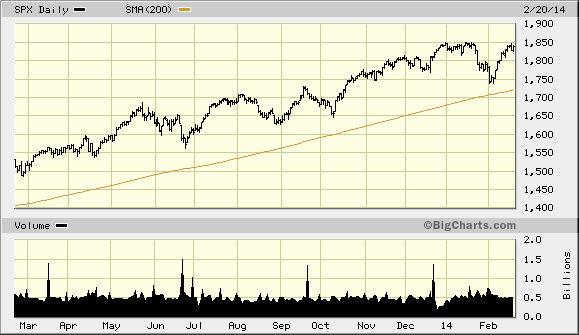
What we saw this week was that everyone, it seemed, had an opinion on a series of mega-deals. Last week, Comcast said it’s hooking up with Time Warner Cable. Later we heard that Apple’s M&A people were talking with Tesla (dream on!). Then came the blockbuster deal: Facebook is buying WhatsApp for $16.4 billion (possibly as much as $19 billion if you include restricted stock).
WhatsApp has a grand total of 55 employees, and last year they brought in $20 million in revenue (not profits—revenue). Five years ago, WhatsApp’s CEO, Jan Koum, applied for a job at Facebook. He was rejected. Now he’s a billionaire several times over.
Is all this crazy? In my opinion, probably, but it’s added some mid-winter excitement, that’s for sure. After the deal was announced, Facebook’s stock opened lower, then rallied throughout the day, and ultimately closed higher by more than 2%.
Now some professional scolders are saying that these crazy deals are the signs of a frothy bull market. While some of these deals are hard to justify, I don’t think the entire market can be judged a bubble.
Sure, there are some trouble spots. The Q4 earnings season was decent, but it was hardly spectacular. The crummy weather has hurt a lot of retailers. Even Walmart, the big daddy of retailers, missed earnings by 25 cents per share. You don’t see that a lot. Plus, there are still troubles in many emerging markets. The news out of China is disappointing, and of course, the violence in Ukraine is heart-wrenching.
In this week’s CWS Market Review, I want to cover some of the overlooked news. The minutes from January’s Fed meeting came out this week, and if you look past the talking heads, it’s clear they’re talking about ditching the Evans Rule. That’s a big deal, and I’ll explain what that means in a bit.
We also had an outstanding earnings reports from DirecTV. The satellite-TV stock crushed estimates by 23 cents per share. The shares raced 3% higher on Thursday to hit a new all-time high. I have my new Buy Below for you (you can see our complete Buy List here. We also got good earnings reports from Medtronic and Express Scripts. I’ll also preview next week’s earnings report from Ross Stores. But first, let’s take a closer look at what’s on the Fed’s mind.
The Debate Raging within the Federal Reserve
There’s a debate raging within the Federal Reserve as to what to do about the “Evans Rule.” This was guidance adopted by the Fed, at the urging of Chicago Fed President Charles Evans, as to what specific metric would cause the Fed to raise short-term interest rates. The Fed said that it would use an unemployment rate of 6.5%. Previous Fed Chairman Ben Bernanke was careful to warn that this was a threshold and not a trigger.
The problem is that unemployment has already declined to 6.6%, and no one’s even close to raising interest rates. Most FOMC members don’t see a rate increase happening until 2015 or 2016. There are even some folks who say that low rates are here to stay and the Fed’s use of Quantitative Easing will become its primary tool to fine-tune the economy. That’s probably too extreme, but it’s being talked about.
The minutes released this week covered the Fed’s January meeting. Interestingly, the Fed`s members were surprised at the economy’s strength. That obviously contributed to the decision to gradually pare back their massive bond-buying program. But what’s interesting is that the central bank is showing no signs of backing away from taper plans, even though the last two jobs reports weren’t so hot.
Strangely, the Fed is as undecided about when to raise short-term rates as it is stubborn about tapering. In fact, the Fed may even back away from using a specific number, like Evans had suggested, and fall back on using garbled econo-speak. The plus is that this doesn’t lead the markets to false expectations. Some FOMC members favor this direction but it adds a layer of opaqueness to the Fed’s deliberations.
The Fed may elect to lower the threshold. Narayana Kocherlakota, the president of the Minneapolis Fed, wants to go down to 5.5%. I think some voting members want to get rid of a precise number altogether. As I said, markets will find something to fret about. Of course, all of this is complicated by the Fed`s having a new boss in Janet Yellen. The Fed’s next meeting, and the first one under Yellen, will be on March 18 and 19.
What this means for investors: The Fed is still clearly on the side of investors. Quantitative Easing is with us, and will be for several more months. The pace of stimulus, however, will gradually decline. The curveball about QE is that it impacts the long end of the yield curve, while traditional Fed stimulus is at the short end. Higher long-term rates could impede sectors like housing, but I doubt we’ll see much impact, although we’ve seen mortgage financing take a hit. The simple fact is that housing inventory is lean, and the market needs more homes. Bad weather may delay that fact, but it won’t change it.
This is good news for the economy and for the stock market in general. I think it’s very likely that 2014 will be one of the strongest years for economic growth in a long time. I won’t go so far as predicting a bond market sell-off, but I do think the long end of the curve is a bad place for investors. The yields are just too measly, and the math is squarely on the side of stock “longs.” Continue to focus your portfolio on high-quality stocks such as our Buy List. If the Evans Rule is altered or dropped, it could propel the market much higher. Now let’s look at some of our Buy List earnings from this week.
Medtronic Is a Buy up to $61 per Share
On Tuesday, Medtronic ($MDT) reported fiscal Q3 earnings of 91 cents per share, which matched expectations. In last week’s CWS Market Review, I said that was my estimate as well. Quarterly revenues rose by 3.4% to $4.16 billion, which was $10 million more than forecast. Medtronic is one of those stable-growth companies. It’s not blistering growth, but it’s steady.
Medtronic also narrowed its full-year guidance from $3.80 – $3.85 per share to $3.81 – $3.83 per share. Note that their fiscal year ends in April. For the first three quarters of this fiscal year, MDT earned $2.70 per share, so that implies fiscal Q4 earnings of $1.11 – $1.13 per share. Wall Street had been expecting $1.12 per share.
Overall, this was a good quarter for Medtronic. Sales of their diabetes products rose by 16%. The medical-devices company was particularly strong in emerging markets, where sales rose by 10%. MDT expects to do even better in EM in the coming quarters.
Even though these results were almost exactly what I had expected, the stock dropped nearly 3% after the report came out, then rallied the rest of the week. By the closing bell on Thursday, the shares were 40 cents higher than they were before the report. Naturally, this makes no sense, but it’s what markets do (remember what I had said about Facebook earlier). In any event, Medtronic remains a high-quality buy up to $61 per share.
DirecTV Smashes Wall Street’s Earnings Estimate
In last week’s CWS Market Review, I said that Wall Street’s consensus was too low on DirecTV’s ($DTV) earnings. I was right about that. On Thursday, the satellite-TV company reported Q4 earnings of $1.53 per share, which was 23 cents better than expectations.
This was an outstanding quarter for DTV. The shares gapped up 3% on Thursday to a new all-time high. Latin America continues to be a growth powerhouse. Last year, revenues there were up 10%, and they added 1.2 million net subscribers. This is especially good since the macro picture is, shall we say, less than clear in some parts of Latam. The company plans to add another one million new Latin American subscribers this year.
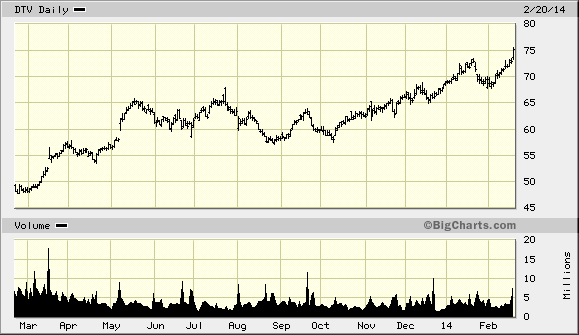
The U.S. wasn’t so bad either. DTV added 93,000 new American subscribers. Analysts were expecting an increase of just 21,000. DirecTV also announced a buyback program of $3.5 billion. I’ve long been a critic of shareholder repurchases, but DTV is one of the few companies that do it right. They actually reduce their overall share count. Imagine that! Over the last seven years, DTV’s share count is down by 57%. Working out the math, a $3.5 billion buyback is roughly 9% of DTV’s market cap. I’m raising our Buy Below on DirecTV to $80 per share.
Express Scripts Is a Buy up to $83 per Share
On Thursday, Express Scripts ($ESRX) reported that it earned $1.12 per share for the fourth quarter. That also hit expectations on the nose. This really wasn’t a major surprise, since in October, the pharmacy-benefit manager told us to expect Q4 earnings to range between $1.09 and $1.13 per share.
I was especially curious to hear what ESRX had to say in the way of guidance. For all of 2014, they see earnings ranging between $4.88 and $5 per share. Those are very good numbers, and it gives the stock a reasonable valuation. The Street’s consensus had been for $4.93 per share. In a press release, Express Scripts said it’s “targeting annual earnings per share growth of 10 per cent to 20 per cent for the next several years.”
Previously, I said I wanted to see the earnings report before I decided to alter our Buy Below price. Now I see it, and I’m pleased with what I see. This week, I’m raising our Buy Below on ESRX to $83 per share.
Preview of Ross Stores, and a Few New Buy Below Prices
We have one earnings report due next week, from Ross Stores ($ROST). I like Ross a lot; it’s one of my favorite deep-discount retailers. That’s why I was so surprised when they gave a dour outlook for Q4 earnings. Ross said to expect fourth-quarter earnings (their Q4 covers November-December-January) to range between 97 cents and $1.01 per share. Wall Street had been expecting $1.09 per share.
Wall Street didn’t like that at all. ROST dropped from a high of $82 just prior to Thanksgiving to less than $66 in early February. The question is, how much of this is due to Ross, and how much is due to a lousy environment for retail? Like I said, even Walmart is having trouble. It appears that lousy weather has hurt shopping across broad stretches of the country.
Ross is due to report earnings next Thursday, February 27. I think investors are looking past the Q4 numbers and want to see any guidance for 2014. I’m inclined to think that ROST’s problems are sector-related and not specific to them. Ross Stores continues to be a good buy up to $74 per share.
Before I go, I want to make a few Buy Below adjustments. Stryker ($SYK) continues to do very well for us. A few weeks ago, the company beat earnings and guided higher. The stock hit another 52-week high this week. Remember that after the earnings report, the stock fell, which should tell you all you need to know about the market’s short-term judgment. This week, I’m raising our Buy Below on Stryker to $87 per share.
Two weeks ago, I lowered the Buy Below on Fiserv ($FISV) after the stock missed earnings by a penny. I’ve mulled this over, and I think I acted too rashly. FISV is a dependable stock, and it’s rallied for six of the last seven days. I’m lifting my Buy Below on Fiserv to $60 per share.
I’m pleased to see CR Bard ($BCR) rebound so well. Since February 3, shares of Bard have rallied 12%, and the stock just hit a brand-new 52-week high. Look for another dividend increase this spring. I’m raising our Buy Below on BCR to $144 per share.
Finally, I’m keeping our Buy Below for Cognizant Technology ($CTSH) at $104 per share, but remember that it’s going to split 2 for 1 in early March. Our Buy Below will split along with it. Until then, CTSH remains a very good buy up to $104 per share, and $52 per share post-split.
That’s all for now. Next week is the final trading week of February. On Tuesday, the Consumer Confidence report comes out. Thursday is the Durable-Goods report, and after the bell, we’ll hear Q4 earnings results from Ross Stores. On Friday, the government will revise the Q4 GDP report. The initial report said the economy grew by 3.2% during the last three months of 2013. Be sure to keep checking the blog for daily updates. I’ll have more market analysis for you in the next issue of CWS Market Review!
– Eddy
-
Morning News: February 21, 2014
Posted by Eddy Elfenbein on February 21st, 2014 at 6:57 amG20: Pressure Mounts on Delegates to Agree to Meaningful Global Strategies
January Retail Sales in UK Fall Back After Exceptional December
Ukraine Credit Rating Cut by S&P as Violence Continues
Yanukovych Offers Snap Presidential Vote to End Crisis
Royal Bank of Scotland to Slash Headcount by Up to a Quarter in Revamp
Consumer Prices Edge Up, Moving Closer to Fed Target
Study Finds Greater Income Inequality in Nation’s Thriving Cities
Firm Stops Giving High-Speed Traders Direct Access to Releases
Founders of an Anti-Facebook Are Won Over
Hewlett-Packard Sales, Profit Exceed Estimates on Server Demand
Groupon Shares Drop as Forecast Trails Estimates on Expenses
Chevron’s Free Pizza Offer Only Feeds Public’s Distrust
Does Bitcoin Really Need the Winkdex?
Joshua Brown: Truer Words Were Never Spoken
Epicurean Dealmaker: Venn Diagram
Be sure to follow me on Twitter.
-
A Zero-Commission Brokerage?
Posted by Eddy Elfenbein on February 20th, 2014 at 3:19 pm -
The Five-Year Itch
Posted by Eddy Elfenbein on February 20th, 2014 at 10:22 amI caution against reading too much into this, but two recent bull markets have had five-year lifespans.
By closing low to closing high:
Low: August 12, 1982
High: August 25, 1987Low: October 9, 2002
High October 9, 2007Low: March 9, 2009
High: ?????
-
Archives
- June 2026
- May 2026
- April 2026
- March 2026
- February 2026
- January 2026
- December 2025
- November 2025
- October 2025
- September 2025
- August 2025
- July 2025
- June 2025
- May 2025
- April 2025
- March 2025
- February 2025
- January 2025
- December 2024
- November 2024
- October 2024
- September 2024
- August 2024
- July 2024
- June 2024
- May 2024
- April 2024
- March 2024
- February 2024
- January 2024
- December 2023
- November 2023
- October 2023
- September 2023
- August 2023
- July 2023
- June 2023
- May 2023
- April 2023
- March 2023
- February 2023
- January 2023
- December 2022
- November 2022
- October 2022
- September 2022
- August 2022
- July 2022
- June 2022
- May 2022
- April 2022
- March 2022
- February 2022
- January 2022
- December 2021
- November 2021
- October 2021
- September 2021
- August 2021
- July 2021
- June 2021
- May 2021
- April 2021
- March 2021
- February 2021
- January 2021
- December 2020
- November 2020
- October 2020
- September 2020
- August 2020
- July 2020
- June 2020
- May 2020
- April 2020
- March 2020
- February 2020
- January 2020
- December 2019
- November 2019
- October 2019
- September 2019
- August 2019
- July 2019
- June 2019
- May 2019
- April 2019
- March 2019
- February 2019
- January 2019
- December 2018
- November 2018
- October 2018
- September 2018
- August 2018
- July 2018
- June 2018
- May 2018
- April 2018
- March 2018
- February 2018
- January 2018
- December 2017
- November 2017
- October 2017
- September 2017
- August 2017
- July 2017
- June 2017
- May 2017
- April 2017
- March 2017
- February 2017
- January 2017
- December 2016
- November 2016
- October 2016
- September 2016
- August 2016
- July 2016
- June 2016
- May 2016
- April 2016
- March 2016
- February 2016
- January 2016
- December 2015
- November 2015
- October 2015
- September 2015
- August 2015
- July 2015
- June 2015
- May 2015
- April 2015
- March 2015
- February 2015
- January 2015
- December 2014
- November 2014
- October 2014
- September 2014
- August 2014
- July 2014
- June 2014
- May 2014
- April 2014
- March 2014
- February 2014
- January 2014
- December 2013
- November 2013
- October 2013
- September 2013
- August 2013
- July 2013
- June 2013
- May 2013
- April 2013
- March 2013
- February 2013
- January 2013
- December 2012
- November 2012
- October 2012
- September 2012
- August 2012
- July 2012
- June 2012
- May 2012
- April 2012
- March 2012
- February 2012
- January 2012
- December 2011
- November 2011
- October 2011
- September 2011
- August 2011
- July 2011
- June 2011
- May 2011
- April 2011
- March 2011
- February 2011
- January 2011
- December 2010
- November 2010
- October 2010
- September 2010
- August 2010
- July 2010
- June 2010
- May 2010
- April 2010
- March 2010
- February 2010
- January 2010
- December 2009
- November 2009
- October 2009
- September 2009
- August 2009
- July 2009
- June 2009
- May 2009
- April 2009
- March 2009
- February 2009
- January 2009
- December 2008
- November 2008
- October 2008
- September 2008
- August 2008
- July 2008
- June 2008
- May 2008
- April 2008
- March 2008
- February 2008
- January 2008
- December 2007
- November 2007
- October 2007
- September 2007
- August 2007
- July 2007
- June 2007
- May 2007
- April 2007
- March 2007
- February 2007
- January 2007
- December 2006
- November 2006
- October 2006
- September 2006
- August 2006
- July 2006
- June 2006
- May 2006
- April 2006
- March 2006
- February 2006
- January 2006
- December 2005
- November 2005
- October 2005
- September 2005
- August 2005
- July 2005
 Eddy Elfenbein is a Washington, DC-based speaker, portfolio manager and editor of the blog Crossing Wall Street. His