-
Morning News: March 19, 2014
Posted by Eddy Elfenbein on March 19th, 2014 at 7:20 amWest Readies Tighter Sanctions After Russia Seals Crimea Claim
Goldman Sachs Rules at the Bank of England
Vietnam Ramps Up Measures to Clean Up Bad Banking Debt
What to Watch From the Fed Meeting
Trading Probe Breaks String of Gains for U.S. Exchange Operators
New Alliances in Battle for Corporate Control
Snowden Has One Very Important And Potentially Devastating Question to Answer
J.P. Morgan Agrees to Sell Commodities Business
Toyota and Justice Department Said to Reach $1.2 Billion Settlement in Criminal Case
The Biggest Threat To The U.S. Auto Industry From GM’s Recalls
BMW Sees ‘Clear Growth’ in 2014 Pretax Profit
Oracle Quarterly Results Disappoint Wall Street; Shares Fall
Luck Vs. Skill: What Bill Gross and Bill Miller Have in Common
Cullen Roche: Will the Bank of England’s Report on Endogenous Money Change Anything?
Howard Lindzon: The Era of Curation and Verticalization…My Interview with Michael Covel
Be sure to follow me on Twitter.
-
Oracle’s Q4 Guidance: 92 to 99 Cents Per Share
Posted by Eddy Elfenbein on March 18th, 2014 at 11:14 pmFrom Oracle‘s ($ORCL) conference call.
As we said before, we are committed to returning value to our shareholders through earnings growth, stock repurchases and a dividend. This quarter we repurchased 55.4 million shares for a total of $2 billion.
Over the last 12 months we have repurchased nearly 360 million shares for a total of $10.7 billion and reducing our — reduced our share count by 5%. We also paid out more than $1.6 billion in dividends this fiscal year so far.
Stock repurchases and dividends have totaled more than 85% of free cash flow over the last 12 months and the Board of Directors declared a quarterly dividend of $0.12 per share.
Now to the guidance and if currency were to stay where it is today than the impact of currency would be minimal, of course, this could change quickly. New software license and cloud subscription revenue growth is expected to range from zero to 10%. Hardware product revenue growth is expected to range from zero to 10%.
As a result, total revenue growth on both GAAP and non-GAAP basis is expected to range from 3% to 7% in reported dollars. Non-GAAP EPS is expected to be somewhere between $0.92 and $0.99 in constant dollars and in reported dollars. GAAP EPS is expected to be $0.79 to $0.86.
Now I want to remind you the last year we recognized an acquisition-related benefit of $269 million in connection with the Pillar Data Systems earn-out, excluding that benefit GAAP EPS last Q4 would have been $0.74.
This guidance assumes a GAAP tax rate of 21.5% and a non-GAAP tax rate of 23.5%, and of course it may end up being different.
Wall Street had been expecting 96 cents per share.
-
Oracle Earned 68 Cents Per Share
Posted by Eddy Elfenbein on March 18th, 2014 at 4:59 pmOracle‘s ($ORCL) earnings are out. The company earned 68 cents per share for fiscal Q3, which is at the low end of their range of 68 to 72 cents per share. Revenue came in at $9.31 billion which was below consensus of $9.36 billion.
Net income in the third quarter rose 2.4 percent to $2.57 billion, or 56 cents a share. New software-license and cloud-subscription sales, a closely watched indicator of future revenue, rose 3.6 percent to $2.42 billion, the company said today.
Oracle is the second-largest maker of business applications behind SAP AG, and it entered the computer-server market with the 2010 acquisition of Sun Microsystems. Hardware product sales rose 8 percent to $725 million during the quarter.
Oracle is under pressure in its three main businesses, Thill said. Microsoft Corp. has gained ground in database software, along with newer companies such as MongoDB Inc. and Couchbase Inc. that are chipping away at more established providers. Other customers are leaving Oracle because they’re putting data in the cloud with vendors like Amazon.com Inc.
In business applications, programs that handle tasks like finance, client management and human resources, customers are defecting to cloud-based suppliers like Salesforce.com (CRM) and Workday. In hardware, Oracle has “missed more quarters than they’ve made,” Thill said.
The stock is down about 5% in the after-hours market.
-
Stocks Climb as Invasion Fears Fade
Posted by Eddy Elfenbein on March 18th, 2014 at 11:32 amThe stock market is working its way higher again today. The S&P 500 cracked 1,870 earlier today. The good news is that tensions in Eastern Europe seem to be falling lower. Shares of the Russian ETF ($RSK) are up another 3.3% today. It’s up more than 11% from last Thursday’s low. We also got a favorable report on housing starts.
This is the first day of the two-day Fed meeting. All the action, however, will come tomorrow when the Fed releases its statement, updates its forecasts and Janet Yellen holds her first press conference.
On our Buy List, Microsoft ($MSFT), of all stocks, is doing very well today. The shares are up nearly 4% and it’s close to hitting $40. The company may introduce Office for Apple’s iPad next week.
Microsoft Chief Executive Officer Satya Nadella will begin unveiling his vision for the company when he debuts a version of Office for Apple Inc.’s iPad and offer some features of the application for free at an event next week, said people with knowledge of the announcement.
The Redmond, Washington-based company will introduce Office for the iPad with limited capabilities that can be upgraded to premium versions requiring a subscription to the Office 365 Internet-based software, said the people, who asked not to be identified because the plans aren’t public. At the event, which will be held March 27 in San Francisco, Nadella will also discuss his commitment to software services that work on Microsoft’s Windows and rival operating systems, the people said yesterday.
Microsoft last closed above $40 in July 2000.
-
Morning News: March 18, 2014
Posted by Eddy Elfenbein on March 18th, 2014 at 6:45 amPutin’s Motives Rooted in History Remain a Mystery Abroad
Germany’s Top Court Upholds Legality of ESM Rescue Fund
Bank of England Names Two New Deputy Governors
Fed Seen Adopting Qualitative Rate Guidance as Job Market Gains
With Alibaba IPO Official, Pressure Mounts on Yahoo
GM Stock Unfazed by Recall Saga; CEO Mary Barra Issues Video Apology
Hertz Will Spin Off Equipment Rental Unit to Focus on Cars
Massachusetts to Cut Ties With CGI Group Over Troubled Online Health Exchange
Quiznos Files for Bankruptcy; Can it Ever Compete With Subway?
Walmart to Offer Customers Credit for Used Video Games
Tesla Fights For a Place to Park
Bitcoin Revelation Under Scrutiny
$1 Billion Contest: Some Already Cashing In
Jeff Carter: Is There Something Amiss?
Be sure to follow me on Twitter.
-
The Return of Bank Dividends
Posted by Eddy Elfenbein on March 17th, 2014 at 2:24 pmThe largest U.S. banks are currently going through another round of “stress tests” in order to prove to the Federal Reserve that they can withstand another financial crisis. Of course, this test comes seven years after it was truly needed. The test results will be made known on March 20 and March 26.
The immediate effect for investors is that some of these banks will get the green light to raise their dividends and increase share buybacks. Citigroup and Bank of America, for example, only pay out one penny per quarter. Citi is expected to earn nearly $5 per share this year, and BAC is projected to make $1.32 per share. In 2011, BAC asked the Fed if they could do a modest dividend increase. The Fed said no.
The truth is that nowadays these banks are quite profitable. Of course, we don’t know which banks could fail the test. The largest banks will most certainly pass, but this test includes some smaller ones and I’m sure someone will be left out. I suspect Citigroup will jack up its dividend soon, but that will also be complicated by a recent $400 million fraud decision. The unknown legal bills will weigh on several other banks as well.
The six largest U.S. banks may return $47.8 billion starting in April, the estimates show. That compares with $23.6 billion for the prior year, according to Stifel Financial Corp.’s KBW unit. The firms gave back $66.4 billion in the 2007 calendar year, data compiled by Bloomberg show.
“The dividends and buybacks — the sheer size of them — suggest there is plenty of profit to play with,” David Ellison, a Boston-based mutual-fund manager specializing in financial stocks at Hennessy Advisors Inc., said in a phone interview. “It shows that if a bank is run appropriately, it’s very profitable.”
I’ve told investors that in light of the uncertainty, the best way to value these banks is by the dividend yield (though that’s not the only way). The issue is that many of the other traditional valuation metrics don’t work well with the big banks.
I would be very careful about committing any funds to financials right now. It’s not that there’s long-term danger, but whoever fails the test will surely be punished by the market.
-
AwesomePennyStocks Come to an End
Posted by Eddy Elfenbein on March 17th, 2014 at 11:54 amSometimes the frauds committed on Wall Street are so comical that you have to wonder how anyone could have fallen for something so silly. Yet it’s also sad that gullible investors get wiped out.
Bloomberg has a story today on the fall of AwesomePennyStocks and its 26 year-old mystery man. You can read the whole story here, but here’s a sample:
The promotion cited by the SEC involved America West Resources Inc., a Salt Lake City-based coal company. AwesomePennyStocks and another list called PennyStocksUniverse sent messages promoting the company’s shares on Feb. 23, 2012, according to the SEC.
The stock rose as high as $1.80 from 29 cents as more than 7.8 million shares were traded, more than double the total volume in the prior year, the agency said. Babikian sold at least 1.3 million shares for $1.9 million, according to the SEC. America West filed for bankruptcy protection last year.
-
Stocks Rise on Strong Industrial Production
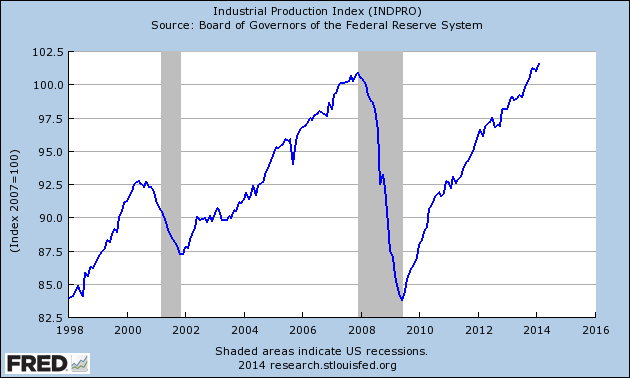
Posted by Eddy Elfenbein on March 17th, 2014 at 11:15 amThe stock market is bouncing back today after a rough end to last week. Investors were ignited this morning by a stronger-than-expected report on industrial production. This is one of those reports that track the rise and fall of the economy well.
Industrial production jumped 0.6% last month. Economists were only expecting an increase of 0.1%. Manufacturing output, which is the largest part of industrial production, rose by 0.8%. That’s its biggest gain since August. This is also more evidence that the weather-related sluggishness is probably behind us (though I’m writing this as we got a late season snow here in DC).
The rising tension in Ukraine is, of course, on everyone’s mind. It appears that Crimea is done, and it’s now part of Russia. The worry is that Putin will ratchet up and launch an invasion of Eastern Ukraine. That’s a nightmare scenario. On one hand, that’s an irrational move on his part, but on the other, Colonel Putin doesn’t seem to play by reason. Interestingly, the Polish ETF (EPOL) is very strong today, up 2.7%. Even the Russia ETF ($RSX) is showing some strength, which may hint that the worst is over. RSX had been getting crushed this year.
Our Buy List is also having a good day. CR Bard (BCR) continues to be remarkably strong. The stock got as high as $147.82 today which is another all-time high. Qualcomm is also having a good day for us, but that’s really making up for the weakness it showed on Thursday and Friday. Most of the tech world is waiting for Oracle’s earnings report tomorrow. Or more accurately, they’re waiting for Oracle’s guidance for the current quarter.
-
Morning News: March 17, 2014
Posted by Eddy Elfenbein on March 17th, 2014 at 6:58 amQE Not the Only Option for ECB on Inflation
As Giant U.S. IPO Nears, Alibaba’s China E-commerce Crown Slips
Indian Solar Power: Cost of Production Dropped 60%; Price to Equal Thermal Power’s in Three Years
Commodities Cushioned From Crimea Crisis by Ample Supply
New York Strips London of Mantle as World’s Top Financial Center
U.S. Navy Seizes Tanker, Foiling Libya Rebel Attempt to Sell Oil
Federal Reserve Officials Weighing How to Retool Rate Guidance
U.S. Lags as Commercial Drones Take Off Around Globe
Rosneft to Buy Stake in Pirelli as Tiremaker’s Owners Reorganize
Toyota Unit Shuts 2 Factories in India
Vodafone to Buy Spanish Cable Operator Ono
Quiznos Files Pre-Packaged Chapter 11 Plan After Debt Deal
Candy Crush Saga Prices Initial Public Offering At Up To $7.6 Billion
Credit Writedowns: Capex May Be Behind the Sudden Improvement in U.S. Loan Growth
Jeff Miller: Weighing the Week Ahead: Yellen Takes The Stage
Be sure to follow me on Twitter.
-
The Leprechaun Brothers
Posted by Eddy Elfenbein on March 16th, 2014 at 11:39 am
-
Archives
- September 2026
- August 2026
- July 2026
- June 2026
- May 2026
- April 2026
- March 2026
- February 2026
- January 2026
- December 2025
- November 2025
- October 2025
- September 2025
- August 2025
- July 2025
- June 2025
- May 2025
- April 2025
- March 2025
- February 2025
- January 2025
- December 2024
- November 2024
- October 2024
- September 2024
- August 2024
- July 2024
- June 2024
- May 2024
- April 2024
- March 2024
- February 2024
- January 2024
- December 2023
- November 2023
- October 2023
- September 2023
- August 2023
- July 2023
- June 2023
- May 2023
- April 2023
- March 2023
- February 2023
- January 2023
- December 2022
- November 2022
- October 2022
- September 2022
- August 2022
- July 2022
- June 2022
- May 2022
- April 2022
- March 2022
- February 2022
- January 2022
- December 2021
- November 2021
- October 2021
- September 2021
- August 2021
- July 2021
- June 2021
- May 2021
- April 2021
- March 2021
- February 2021
- January 2021
- December 2020
- November 2020
- October 2020
- September 2020
- August 2020
- July 2020
- June 2020
- May 2020
- April 2020
- March 2020
- February 2020
- January 2020
- December 2019
- November 2019
- October 2019
- September 2019
- August 2019
- July 2019
- June 2019
- May 2019
- April 2019
- March 2019
- February 2019
- January 2019
- December 2018
- November 2018
- October 2018
- September 2018
- August 2018
- July 2018
- June 2018
- May 2018
- April 2018
- March 2018
- February 2018
- January 2018
- December 2017
- November 2017
- October 2017
- September 2017
- August 2017
- July 2017
- June 2017
- May 2017
- April 2017
- March 2017
- February 2017
- January 2017
- December 2016
- November 2016
- October 2016
- September 2016
- August 2016
- July 2016
- June 2016
- May 2016
- April 2016
- March 2016
- February 2016
- January 2016
- December 2015
- November 2015
- October 2015
- September 2015
- August 2015
- July 2015
- June 2015
- May 2015
- April 2015
- March 2015
- February 2015
- January 2015
- December 2014
- November 2014
- October 2014
- September 2014
- August 2014
- July 2014
- June 2014
- May 2014
- April 2014
- March 2014
- February 2014
- January 2014
- December 2013
- November 2013
- October 2013
- September 2013
- August 2013
- July 2013
- June 2013
- May 2013
- April 2013
- March 2013
- February 2013
- January 2013
- December 2012
- November 2012
- October 2012
- September 2012
- August 2012
- July 2012
- June 2012
- May 2012
- April 2012
- March 2012
- February 2012
- January 2012
- December 2011
- November 2011
- October 2011
- September 2011
- August 2011
- July 2011
- June 2011
- May 2011
- April 2011
- March 2011
- February 2011
- January 2011
- December 2010
- November 2010
- October 2010
- September 2010
- August 2010
- July 2010
- June 2010
- May 2010
- April 2010
- March 2010
- February 2010
- January 2010
- December 2009
- November 2009
- October 2009
- September 2009
- August 2009
- July 2009
- June 2009
- May 2009
- April 2009
- March 2009
- February 2009
- January 2009
- December 2008
- November 2008
- October 2008
- September 2008
- August 2008
- July 2008
- June 2008
- May 2008
- April 2008
- March 2008
- February 2008
- January 2008
- December 2007
- November 2007
- October 2007
- September 2007
- August 2007
- July 2007
- June 2007
- May 2007
- April 2007
- March 2007
- February 2007
- January 2007
- December 2006
- November 2006
- October 2006
- September 2006
- August 2006
- July 2006
- June 2006
- May 2006
- April 2006
- March 2006
- February 2006
- January 2006
- December 2005
- November 2005
- October 2005
- September 2005
- August 2005
- July 2005
 Eddy Elfenbein is a Washington, DC-based speaker, portfolio manager and editor of the blog Crossing Wall Street. His