-
Morning News: January 31, 2014
Posted by Eddy Elfenbein on January 31st, 2014 at 7:05 amFall in Eurozone Inflation Rate Fuels Deflation Concerns
BBVA, Spanish Peers Post 2013 Earnings Recovery
US Downgrades India’s Air Safety Rating to Sub-Saharan Standards
Economy Grew 3.2% in Fourth Quarter, Fueling Hopes for Faster Recovery
A Guide to Obama’s Plan for Retirement Savings
Amazon Looks at Boosting Prime Fee, as Earnings Miss
Exxon Stumblies as Major Oil Producers Try To Find Footing
Honda Q3 Profit Doubles, Sales Get Weak Yen Boost
Zynga Announces NaturalMotion Acquisition Alongside Layoffs
Microsoft Seen Testing Insider Nadella’s Will to Revamp
To Grow, Bitcoin May Need to Shed Its World of Intrigue
For Millions, the Super Bowl Action Will Be on Twitter
Cullen Roche: When the Foundation of Modern Econ Begins to Crumble…
Jeff Miller: When Good Models Go Bad
Be sure to follow me on Twitter.
-
Report: Satya Nadella to Be Microsoft CEO
Posted by Eddy Elfenbein on January 30th, 2014 at 7:55 pmReports are coming out that Microsoft ($MSFT) is about to name Satya Nadella as their new CEO:
The board of directors at Microsoft is preparing to tap Satya Nadella as CEO Steve Ballmer’s successor and is holding discussions to replace Chairman Bill Gates, according to a report.
A candidate to replace Gates as chairman, John Thomson, the software giant’s lead independent director, has emerged as well, according to Bloomberg News, citing people briefed on the process.
USA TODAY could not independently confirm the decision. Microsoft did not immediately respond to a request for comment.
As of Thursday night, Microsoft’s board was meeting. An announcement was expected as soon as Friday. Microsoft shares were up 1%, to $37.20, in after-hours trading.
Should Ballmer and Gates depart, the software giant would be without its two most recognizable figures for the first time in its 39-year history.
The report said that Nadella jumped forward as the front runner in recent weeks as Ballmer’s replacement. However, the plans aren’t finalized, according to the report.
Nadella, who joined Microsoft in 1992, is in charge of the company’s enterprise and cloud businesses.
-
Q4 GDP = 3.2%
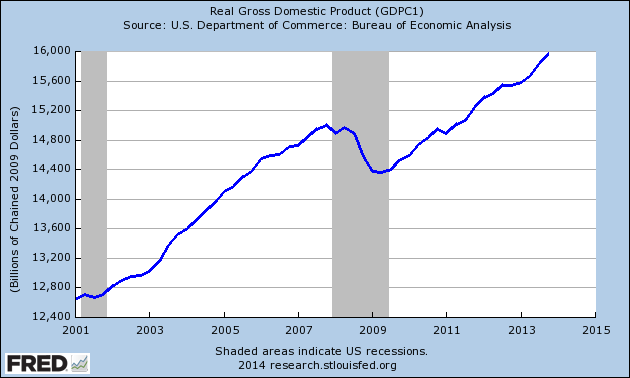
Posted by Eddy Elfenbein on January 30th, 2014 at 8:49 amThe government just reported that the economy expanded by 3.2% in the last three months of 2013. That’s one of the better growth rates in the past few years.
This also breaks a small three-quarter streak of accelerating growth rates. For all of 2013, the economy grew by 1.9%. This was the eighth-straight year that GDP grew by less than 2.8%.
-
Morning News: January 30, 2014
Posted by Eddy Elfenbein on January 30th, 2014 at 7:14 amGlobal Markets Slip After Fed’s Decision on Stimulus
Europe’s New Volcker Rule Enrages Everyone Equally
Calm Broken in Markets Amid Concern of Emerging Contagion
Spain Says Post-Recession Recovery Speeds Up End 2013
Lenovo Swallows Motorola: Indigestion Coming?
Google Still Wins by Selling Motorola for Cheap
Facebook Shares Surge On First Ever $1 Billion Mobile Ad Revenue Quarter
Time Warner Cable Reports 2013 Fourth-Quarter and Full-Year Results
Dassault Systèmes and Accelrys to Join Forces
Royal Dutch Shell Halts Alaska Exploration as Profits Fall
BSkyB Revenue Increases as It Signs Up Record TV Customers
Diageo Boss: ‘Emerging Markets Remain Attractive’
Target Says Criminals Attacked With Stolen Vendor Credentials
Roger Nusbaum: Do Portfolio Diversifiers Belong in Client Portfolios?
The Reformed Broker: Games People Play: That 1929 Analogy
Be sure to follow me on Twitter.
-
Qualcomm Earns $1.26 Per Share
Posted by Eddy Elfenbein on January 29th, 2014 at 4:05 pmQualcomm ($QCOM) just reported fiscal Q1 (Dec) earnings of $1.26 per share which was eight cents more than the Street was expecting:
Qualcomm Incorporated, a leading developer and innovator of advanced wireless technologies, products and services, today announced results for the first quarter of fiscal 2014 ended December 29, 2013.
“We are pleased with the start to our fiscal year, with record results in quarterly revenues, device sales reported by licensees and MSM chip shipments,” said Dr. Paul E. Jacobs, Chairman and CEO of Qualcomm. “Looking forward, we expect our performance to reflect the continued strong global growth of smartphones, our chipset leadership position and our competitive strengths in 3G/4G technologies and products.”
(…)
Non-GAAP First Quarter Results*
Non-GAAP results exclude the QSI (Qualcomm Strategic Initiatives) segment and certain share-based compensation, acquisition-related items and tax items.
Revenues: $6.62 billion, up 10 percent y-o-y and 2 percent sequentially.
Operating income: $1.85 billion, down 24 percent y-o-y and 5 percent sequentially.
Net income: $2.16 billion, down 2 percent y-o-y and up 19 percent sequentially.
Diluted earnings per share: $1.26, even y-o-y and up 20 percent sequentially.
Effective tax rate: 18 percent.
Detailed reconciliations between results reported in accordance with GAAP and Non-GAAP results are included within this news release.
* The following should be considered in regards to the year-over-year and sequential comparisons:
The first quarter of fiscal 2014 results included:
$665 million gain ($430 million after tax), or $0.25 per share, in discontinued operations associated with the sale of substantially all of the operations of our Omnitracs division; and
$444 million charge ($346 million after tax), or $0.20 per share, that resulted from an impairment charge on certain property, plant and equipment related to our QMT division.
The fourth quarter of fiscal 2013 results included:
$173 million charge (before and after tax), or $0.10 per share, related to the verdict in our litigation with ParkerVision.
First Quarter Key Business Metrics
MSMTM chip shipments: 213 million units, up 17 percent y-o-y and 12 percent sequentially.
September quarter total reported device sales: approximately $61.6 billion, up 16 percent y-o-y and 2 percent sequentially.
September quarter estimated 3G/4G device shipments: approximately 276 to 280 million units, at an estimated average selling price of approximately $219 to $225 per unit.
Cash and Marketable Securities
Our cash, cash equivalents and marketable securities totaled $31.6 billion at the end of the first quarter of fiscal 2014, compared to $28.4 billion a year ago and $29.4 billion at the end of the fourth quarter of fiscal 2013. On January 22, 2014, we announced a cash dividend of $0.35 per share payable on March 26, 2014 to stockholders of record as of the close of business on March 5, 2014.
For fiscal Q2 (ending March), QCOM sees revenues between $6.1 billion and $6.7 billion, and EPS between $1.15 and $1.25. Wall Street had been expecting $1.26 per share.
They kept their full-year revenue guidance the same at $26 billion to $27.5 billion, but they raised their full-year EPS guidance range by five cents; from $4.95 to $5.15, to $5.00 to $5.20. Wall Street had been expecting $5.09 per share.
The shares are up about 2% after hours.
-
Today’s Fed Statement: More Tapering
Posted by Eddy Elfenbein on January 29th, 2014 at 2:02 pmInformation received since the Federal Open Market Committee met in December indicates that growth in economic activity picked up in recent quarters. Labor market indicators were mixed but on balance showed further improvement. The unemployment rate declined but remains elevated. Household spending and business fixed investment advanced more quickly in recent months, while the recovery in the housing sector slowed somewhat. Fiscal policy is restraining economic growth, although the extent of restraint is diminishing. Inflation has been running below the Committee’s longer-run objective, but longer-term inflation expectations have remained stable.
Consistent with its statutory mandate, the Committee seeks to foster maximum employment and price stability. The Committee expects that, with appropriate policy accommodation, economic activity will expand at a moderate pace and the unemployment rate will gradually decline toward levels the Committee judges consistent with its dual mandate. The Committee sees the risks to the outlook for the economy and the labor market as having become more nearly balanced. The Committee recognizes that inflation persistently below its 2 percent objective could pose risks to economic performance, and it is monitoring inflation developments carefully for evidence that inflation will move back toward its objective over the medium term.
Taking into account the extent of federal fiscal retrenchment since the inception of its current asset purchase program, the Committee continues to see the improvement in economic activity and labor market conditions over that period as consistent with growing underlying strength in the broader economy. In light of the cumulative progress toward maximum employment and the improvement in the outlook for labor market conditions, the Committee decided to make a further measured reduction in the pace of its asset purchases. Beginning in February, the Committee will add to its holdings of agency mortgage-backed securities at a pace of $30 billion per month rather than $35 billion per month, and will add to its holdings of longer-term Treasury securities at a pace of $35 billion per month rather than $40 billion per month. The Committee is maintaining its existing policy of reinvesting principal payments from its holdings of agency debt and agency mortgage-backed securities in agency mortgage-backed securities and of rolling over maturing Treasury securities at auction. The Committee’s sizable and still-increasing holdings of longer-term securities should maintain downward pressure on longer-term interest rates, support mortgage markets, and help to make broader financial conditions more accommodative, which in turn should promote a stronger economic recovery and help to ensure that inflation, over time, is at the rate most consistent with the Committee’s dual mandate.
The Committee will closely monitor incoming information on economic and financial developments in coming months and will continue its purchases of Treasury and agency mortgage-backed securities, and employ its other policy tools as appropriate, until the outlook for the labor market has improved substantially in a context of price stability. If incoming information broadly supports the Committee’s expectation of ongoing improvement in labor market conditions and inflation moving back toward its longer-run objective, the Committee will likely reduce the pace of asset purchases in further measured steps at future meetings. However, asset purchases are not on a preset course, and the Committee’s decisions about their pace will remain contingent on the Committee’s outlook for the labor market and inflation as well as its assessment of the likely efficacy and costs of such purchases.
To support continued progress toward maximum employment and price stability, the Committee today reaffirmed its view that a highly accommodative stance of monetary policy will remain appropriate for a considerable time after the asset purchase program ends and the economic recovery strengthens. The Committee also reaffirmed its expectation that the current exceptionally low target range for the federal funds rate of 0 to 1/4 percent will be appropriate at least as long as the unemployment rate remains above 6-1/2 percent, inflation between one and two years ahead is projected to be no more than a half percentage point above the Committee’s 2 percent longer-run goal, and longer-term inflation expectations continue to be well anchored. In determining how long to maintain a highly accommodative stance of monetary policy, the Committee will also consider other information, including additional measures of labor market conditions, indicators of inflation pressures and inflation expectations, and readings on financial developments. The Committee continues to anticipate, based on its assessment of these factors, that it likely will be appropriate to maintain the current target range for the federal funds rate well past the time that the unemployment rate declines below 6-1/2 percent, especially if projected inflation continues to run below the Committee’s 2 percent longer-run goal. When the Committee decides to begin to remove policy accommodation, it will take a balanced approach consistent with its longer-run goals of maximum employment and inflation of 2 percent.
Voting for the FOMC monetary policy action were: Ben S. Bernanke, Chairman; William C. Dudley, Vice Chairman; Richard W. Fisher; Narayana Kocherlakota; Sandra Pianalto; Charles I. Plosser; Jerome H. Powell; Jeremy C. Stein; Daniel K. Tarullo; and Janet L. Yellen
This is pretty much what I expected. The only minor surprise was that Narayana Kocherlakota didn’t dissent. Binyamin Appelbaum of the NYT tweeted: “Kocherlakota told me he would only dissent if he thought doing so would influence his colleagues. Apparently he decided it wouldn’t.”
-
Triumph Group Bombs
Posted by Eddy Elfenbein on January 29th, 2014 at 12:21 pmIn the CWS Market Review from December 27, I listed some of the finalists for this year’s Buy List. One of them was Triumph Group ($TGI), which is a maker of aerospace parts.
I’m glad we didn’t choose Triumph Group because it just bombed earnings. Earnings for Q4 came in 24 cents below expectations ($0.99 versus $1.23). Triumph also lowered this year’s guidance from $5.25 per share to $4.75 per share. The stock has been down as much as 19% today.
Triumph Group is a well-run company and I suspect they’ll come back. This is one to keep an eye on.
-
Morning News: January 29, 2014
Posted by Eddy Elfenbein on January 29th, 2014 at 6:40 amImpact of Turkey Rate Decision Fades Fast
EU Unveils Plan to Ban Banks’ Proprietary Trading
‘Fragile Five’ Is the Latest Club of Emerging Nations in Turmoil
Obama Seeks Trade Deals Sought by Biggest U.S. Companies
New York State Regulator Promises Tough Bitcoin Rules
LG Beats Its Rivals in Q4 Smartphone Sales
Pressure Builds for Apple to Overhaul or Expand Product Portfolio
Sony Credit Cut To Junk Status As Smartphones ‘Cannibalize’ Its TV And PC Businesses
American Airlines, US Airways Report Combined $1.95 Billion earnings for 2013
Fiat Scraps Dividend After Chrysler Buy
McDonald’s Seeks to Out-Latte Starbucks Amid Coffee Wars
Ford Posts Higher Profit But Faces Pressure in U.S.
Another Score for Crowdfunding: Indiegogo Raises $40 Million
Russia Bucks the Trend – Talks the Ruble Lower
Credit Writedowns: Turkey Moves, Focus Shifts to Fed
Be sure to follow me on Twitter.
-
MyRA
Posted by Eddy Elfenbein on January 28th, 2014 at 10:16 pmFrom President Obama’s State of the Union address:
Let’s do more to help Americans save for retirement. Today, most workers don’t have a pension. A Social Security check often isn’t enough on its own. And while the stock market has doubled over the last five years, that doesn’t help folks who don’t have 401ks. That’s why, tomorrow, I will direct the Treasury to create a new way for working Americans to start their own retirement savings: MyRA. It’s a new savings bond that encourages folks to build a nest egg. MyRA guarantees a decent return with no risk of losing what you put in. And if this Congress wants to help, work with me to fix an upside-down tax code that gives big tax breaks to help the wealthy save, but does little to nothing for middle-class Americans. Offer every American access to an automatic IRA on the job, so they can save at work just like everyone in this chamber can. And since the most important investment many families make is their home, send me legislation that protects taxpayers from footing the bill for a housing crisis ever again, and keeps the dream of homeownership alive for future generations of Americans.
I don’t know the details yet, but I’m having a hard time imagining what the benefits could be.
-
The Small-Cap Value Rally
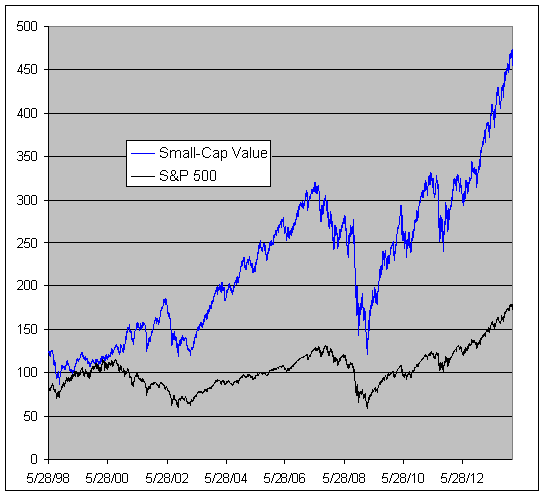
Posted by Eddy Elfenbein on January 28th, 2014 at 4:05 pmIn reference to yesterday’s post on the small-cap premium, I want to look at the performance of small-cap value stocks compared with the rest of the market.
The difference is quite startling. This chart below has the Vanguard 500 Index Fund (VFINX) in black along with the Vanguard Small-Cap Value Index Fund ($VISVX) in blue. Both include dividends. I also set both funds to 100 on April 8, 1999, which was the start of small-cap outperformance.
-
Archives
- June 2026
- May 2026
- April 2026
- March 2026
- February 2026
- January 2026
- December 2025
- November 2025
- October 2025
- September 2025
- August 2025
- July 2025
- June 2025
- May 2025
- April 2025
- March 2025
- February 2025
- January 2025
- December 2024
- November 2024
- October 2024
- September 2024
- August 2024
- July 2024
- June 2024
- May 2024
- April 2024
- March 2024
- February 2024
- January 2024
- December 2023
- November 2023
- October 2023
- September 2023
- August 2023
- July 2023
- June 2023
- May 2023
- April 2023
- March 2023
- February 2023
- January 2023
- December 2022
- November 2022
- October 2022
- September 2022
- August 2022
- July 2022
- June 2022
- May 2022
- April 2022
- March 2022
- February 2022
- January 2022
- December 2021
- November 2021
- October 2021
- September 2021
- August 2021
- July 2021
- June 2021
- May 2021
- April 2021
- March 2021
- February 2021
- January 2021
- December 2020
- November 2020
- October 2020
- September 2020
- August 2020
- July 2020
- June 2020
- May 2020
- April 2020
- March 2020
- February 2020
- January 2020
- December 2019
- November 2019
- October 2019
- September 2019
- August 2019
- July 2019
- June 2019
- May 2019
- April 2019
- March 2019
- February 2019
- January 2019
- December 2018
- November 2018
- October 2018
- September 2018
- August 2018
- July 2018
- June 2018
- May 2018
- April 2018
- March 2018
- February 2018
- January 2018
- December 2017
- November 2017
- October 2017
- September 2017
- August 2017
- July 2017
- June 2017
- May 2017
- April 2017
- March 2017
- February 2017
- January 2017
- December 2016
- November 2016
- October 2016
- September 2016
- August 2016
- July 2016
- June 2016
- May 2016
- April 2016
- March 2016
- February 2016
- January 2016
- December 2015
- November 2015
- October 2015
- September 2015
- August 2015
- July 2015
- June 2015
- May 2015
- April 2015
- March 2015
- February 2015
- January 2015
- December 2014
- November 2014
- October 2014
- September 2014
- August 2014
- July 2014
- June 2014
- May 2014
- April 2014
- March 2014
- February 2014
- January 2014
- December 2013
- November 2013
- October 2013
- September 2013
- August 2013
- July 2013
- June 2013
- May 2013
- April 2013
- March 2013
- February 2013
- January 2013
- December 2012
- November 2012
- October 2012
- September 2012
- August 2012
- July 2012
- June 2012
- May 2012
- April 2012
- March 2012
- February 2012
- January 2012
- December 2011
- November 2011
- October 2011
- September 2011
- August 2011
- July 2011
- June 2011
- May 2011
- April 2011
- March 2011
- February 2011
- January 2011
- December 2010
- November 2010
- October 2010
- September 2010
- August 2010
- July 2010
- June 2010
- May 2010
- April 2010
- March 2010
- February 2010
- January 2010
- December 2009
- November 2009
- October 2009
- September 2009
- August 2009
- July 2009
- June 2009
- May 2009
- April 2009
- March 2009
- February 2009
- January 2009
- December 2008
- November 2008
- October 2008
- September 2008
- August 2008
- July 2008
- June 2008
- May 2008
- April 2008
- March 2008
- February 2008
- January 2008
- December 2007
- November 2007
- October 2007
- September 2007
- August 2007
- July 2007
- June 2007
- May 2007
- April 2007
- March 2007
- February 2007
- January 2007
- December 2006
- November 2006
- October 2006
- September 2006
- August 2006
- July 2006
- June 2006
- May 2006
- April 2006
- March 2006
- February 2006
- January 2006
- December 2005
- November 2005
- October 2005
- September 2005
- August 2005
- July 2005
 Eddy Elfenbein is a Washington, DC-based speaker, portfolio manager and editor of the blog Crossing Wall Street. His