-
Oracle Earns 69 Cents Per Share
Posted by Eddy Elfenbein on December 18th, 2013 at 4:49 pmOracle ($ORCL) just reported earnings of 69 cents per share which was two cents better than expectations.
The company reported a 1 percent decrease in new software sales and Internet-based software subscriptions for the quarter.
Oracle had forecast that new software sales and subscriptions would be between down 4 percent and up 6 percent in the second quarter, which ended in November. Investors scrutinize new software sales because they generate high-margin, long-term maintenance contracts and are an important indicator of future profit.
Revenue from Oracle’s hardware systems products, which it acquired through the $5.6 billion purchase of Sun Microsystems in 2010, fell 3 percent to $714 million in the second quarter.
Oracle’s hardware revenue has fallen since it bought Sun, with Ellison saying much of that decline is due to phasing out older low-margin systems in favor Oracle’s premium hardware.
Oracle had forecast that hardware product revenue for the November quarter would decline as much as 9 percent or grow as much as 1 percent.
The shares initially rose in the after-hours session, but then they gave back those gains. They’ll offer guidance during the conference call.
-
The Fed Tapers! $10 Billion Reduction
Posted by Eddy Elfenbein on December 18th, 2013 at 2:01 pmInformation received since the Federal Open Market Committee met in October indicates that economic activity is expanding at a moderate pace. Labor market conditions have shown further improvement; the unemployment rate has declined but remains elevated. Household spending and business fixed investment advanced, while the recovery in the housing sector slowed somewhat in recent months. Fiscal policy is restraining economic growth, although the extent of restraint may be diminishing. Inflation has been running below the Committee’s longer-run objective, but longer-term inflation expectations have remained stable.
Consistent with its statutory mandate, the Committee seeks to foster maximum employment and price stability. The Committee expects that, with appropriate policy accommodation, economic growth will pick up from its recent pace and the unemployment rate will gradually decline toward levels the Committee judges consistent with its dual mandate. The Committee sees the risks to the outlook for the economy and the labor market as having become more nearly balanced. The Committee recognizes that inflation persistently below its 2 percent objective could pose risks to economic performance, and it is monitoring inflation developments carefully for evidence that inflation will move back toward its objective over the medium term.
Taking into account the extent of federal fiscal retrenchment since the inception of its current asset purchase program, the Committee sees the improvement in economic activity and labor market conditions over that period as consistent with growing underlying strength in the broader economy. In light of the cumulative progress toward maximum employment and the improvement in the outlook for labor market conditions, the Committee decided to modestly reduce the pace of its asset purchases. Beginning in January, the Committee will add to its holdings of agency mortgage-backed securities at a pace of $35 billion per month rather than $40 billion per month, and will add to its holdings of longer-term Treasury securities at a pace of $40 billion per month rather than $45 billion per month. The Committee is maintaining its existing policy of reinvesting principal payments from its holdings of agency debt and agency mortgage-backed securities in agency mortgage-backed securities and of rolling over maturing Treasury securities at auction. The Committee’s sizable and still-increasing holdings of longer-term securities should maintain downward pressure on longer-term interest rates, support mortgage markets, and help to make broader financial conditions more accommodative, which in turn should promote a stronger economic recovery and help to ensure that inflation, over time, is at the rate most consistent with the Committee’s dual mandate.
The Committee will closely monitor incoming information on economic and financial developments in coming months and will continue its purchases of Treasury and agency mortgage-backed securities, and employ its other policy tools as appropriate, until the outlook for the labor market has improved substantially in a context of price stability. If incoming information broadly supports the Committee’s expectation of ongoing improvement in labor market conditions and inflation moving back toward its longer-run objective, the Committee will likely reduce the pace of asset purchases in further measured steps at future meetings. However, asset purchases are not on a preset course, and the Committee’s decisions about their pace will remain contingent on the Committee’s outlook for the labor market and inflation as well as its assessment of the likely efficacy and costs of such purchases.
To support continued progress toward maximum employment and price stability, the Committee today reaffirmed its view that a highly accommodative stance of monetary policy will remain appropriate for a considerable time after the asset purchase program ends and the economic recovery strengthens. The Committee also reaffirmed its expectation that the current exceptionally low target range for the federal funds rate of 0 to 1/4 percent will be appropriate at least as long as the unemployment rate remains above 6-1/2 percent, inflation between one and two years ahead is projected to be no more than a half percentage point above the Committee’s 2 percent longer-run goal, and longer-term inflation expectations continue to be well anchored. In determining how long to maintain a highly accommodative stance of monetary policy, the Committee will also consider other information, including additional measures of labor market conditions, indicators of inflation pressures and inflation expectations, and readings on financial developments. The Committee now anticipates, based on its assessment of these factors, that it likely will be appropriate to maintain the current target range for the federal funds rate well past the time that the unemployment rate declines below 6-1/2 percent, especially if projected inflation continues to run below the Committee’s 2 percent longer-run goal. When the Committee decides to begin to remove policy accommodation, it will take a balanced approach consistent with its longer-run goals of maximum employment and inflation of 2 percent.
Voting for the FOMC monetary policy action were: Ben S. Bernanke, Chairman; William C. Dudley, Vice Chairman; James Bullard; Charles L. Evans; Esther L. George; Jerome H. Powell; Jeremy C. Stein; Daniel K. Tarullo; and Janet L. Yellen. Voting against the action was Eric S. Rosengren, who believes that, with the unemployment rate still elevated and the inflation rate well below the federal funds rate (Note: The Fed said strike those last three words) target, changes in the purchase program are premature until incoming data more clearly indicate that economic growth is likely to be sustained above its potential rate.
-
Barry Ritholtz Chats With Morgan Housel
Posted by Eddy Elfenbein on December 18th, 2013 at 9:41 am -
Nicholas Financial To Be Bought Out!
Posted by Eddy Elfenbein on December 18th, 2013 at 7:48 amNicholas Financial, Inc. (the “Company”) (NICK) announced today that it has signed an arrangement agreement dated December 17, 2013 (the “Arrangement Agreement”) whereby the Company has agreed to sell all of its issued and outstanding Common shares to an indirect wholly-owned subsidiary of Prospect Capital Corporation (“Prospect”), pursuant to a plan of arrangement (the “Arrangement”) under the Business Corporations Act (British Columbia).
Prospect (PSEC) (www.prospectstreet.com) is a closed-end investment company that lends to and invests in private and public middle market businesses. Prospect’s investment objective is to generate both current income and long-term capital appreciation through debt and equity investments.
Prospect has elected to be treated as a business development company under the Investment Company Act of 1940 (“1940 Act”). Prospect is required to comply with a series of regulatory requirements under the 1940 Act as well as applicable NASDAQ, federal and state rules and regulations. Prospect has elected to be treated as a regulated investment company under the Internal Revenue Code of 1986. Failure to comply with any of the laws and regulations that apply to Prospect could have an adverse effect on Prospect and its shareholders.
Pursuant to the terms of the Arrangement, the Company’s shareholders are to receive (subject to applicable dissenter’s rights under the Business Corporation Act (British Columbia)), in exchange for each Common share of the Company held immediately prior to the effective time of the Arrangement, the number of shares of common stock of Prospect (or fraction thereof) determined by dividing US $16.00 by the volume-weighted average price, or VWAP, of Prospect common stock for the twenty (20) trading days prior to and ending on the trading day immediately preceding the effective time of the Arrangement. In addition, each and every option to acquire Common shares of the Company outstanding immediately prior to the effective time of the Arrangement will be cancelled or transferred by the holder thereof to the Company (subject to applicable dissenters’ rights under the Business Corporations Act (British Columbia)) in exchange for a cash amount equal to the amount by which (i) the product obtained by multiplying (x) the number of Common shares of the Company underlying each option by (y) $16.00 exceeds (ii) the aggregate exercise price payable under such option.
The transactions contemplated by the Arrangement Agreement will not be consummated unless certain conditions typical for this type of transaction are either satisfied or waived prior to closing. These conditions include, among other things, that the Arrangement Agreement and the transactions contemplated thereby are approved by the securityholders of the Company in accordance with the Business Corporations Act (British Columbia) and the Company’s Articles. An information circular providing further information regarding the Arrangement Agreement and the parties thereto will be mailed to securityholders of the Company in advance of the special meeting thereof expected to be held for the purpose of approving, among other things, the Arrangement Agreement and the Arrangement contemplated thereby.
Nicholas Financial (NICK) will be bought out by Prospect Capital (PSEC) for $16 per share. The deal is expected to close in April. Note that shareholders won’t be getting cash but whatever shares of PSEC $16 works out to. You won’t be taxed when you get the shares of PSEC.
I have to admit that I’m baffled by this. I think NICK is very much selling itself short. I can’t think of another company that sold itself for 10 times trailing earnings, and a dividend yield of 3%. Management clearly wanted out. Only two months ago, NICK traded for as much as $17.20 per share. Sixteen dollars is a premium of less than 5%.
-
Morning News: December 18, 2013
Posted by Eddy Elfenbein on December 18th, 2013 at 7:13 amU.K. Unemployment Unexpectedly Falls to Four-Year Low
Bitcoin Price Halves as China Clampdown Escalates
Merkel Urges EU Treaty Change in First Speech of New Term
Fed Said to Delay Bank Leverage Cap Until Basel Completed
Fed Faces Tough Call on Bond Buying as Economy Strengthens
Gold Climbs in London Before Fed’s Decision: Palladium Advances
Consumer Prices Stay Nearly Flat
Insurers Wary of New Obamacare Fix for January Health Plans
Herbalife Investors Win Battle
BP Flags Gulf of Mexico Find, $1.08 Billion Brazil Writedown
William Morris Said to Have Won Auction for IMG, Sports and Talent Agency
Shopping Marathons Coming: Stores Open 100+ Hours in a Row Before Christmas
Credit Writedowns: Are Equity Markets in a Massive Bubble?
Cullen Roche: Updating Warren Buffett’s Favorite Valuation Metric
Be sure to follow me on Twitter.
-
Fiserv Splits 2 for 1
Posted by Eddy Elfenbein on December 17th, 2013 at 9:06 amFiserv ($FISV) split its stock 2 for 1 this morning. The new Buy Below is $56 per share.
For tracking purposes, I assume our Buy List is a $1 million portfolio that’s equally weighted at the start of the year. For this year’s Buy List, the “buy price,” meaning the price as of the close of 2012, on Fiserv drops from $79.03 per share to $39.515 per share. The number of shares in our tracking portfolio doubles from 632.6711 to 1,265.3422 (hence to give us a $50,000 position at the beginning of the year).
-
Technological Miracles Will Keep Generating Profits and Jobs
Posted by Eddy Elfenbein on December 17th, 2013 at 7:24 amOver the weekend, I booked a pair of airline tickets from Seattle to south Florida – over 3,300 miles – for under $330, round trip, or just five cents per mile. I used the Internet to shop among competing airlines, dates, times and warm-weather transfer points. It’s tempting to complain about TSA delays, bad food and tight seating, but I appreciate these cheap, long flights – fruits of our reasonably free market in air travel.
This brings to mind an event 110 years ago this morning. At 10:30 am on December 17, 1903, two Dayton bicycle mechanics flipped a coin to see who got the first chance to fly like a bird on the beach of Kitty Hawk, North Carolina. Shortly thereafter, Orville Wright took a short (and VERY slow) flight, for a man, while creating a giant leap for mankind. He “flew” (a few feet above the sand) 40 yards in 12 seconds. That works out to 10 feet per second, or less than seven miles per hour – slower than your average jogger.
Wilbur and Orville made a total of four flights that day in 1903. The longest jaunt covered 852 feet in 60 seconds, ending in a nose dive. That’s less than 10 miles per hour. Even the lightest of today’s planes would stall at under 10 miles per hour, but the Wrights’ 605-pound bird was not much heavier than air.
For nearly five years, few believed the Wrights, because nearly everyone else failed in flight and the Wrights kept their invention under wraps, fearing patent infringement. Finally, in the summer of 1908, in France, Wilbur flew his plane 40 miles in 90 minutes, or 27 miles per hour. This flight was astounding to its viewers, but no more astounding than a half dozen other technological innovations from 1901 to 1905.
Planes, Cars, Radio and Other Innovations Took Time to Mature
America is particularly suited to invention, especially at that time in our history. In 1900, most guys had access to a shop or a tool barn, and most loved to tinker, looking for better, easier and cheaper ways to get a job done. America had a system of patents that encouraged innovation. The Wright brothers were bicycle makers first, tinkerers second. Henry Ford was a mechanic with Edison Electric in the 1890s, but he was also a nocturnal tinkerer. He spent nights reading manuals about the new internal combustion engine. Ford asked for a loan in 1903, but the president of the Michigan Savings Bank told him that “the horse is here to stay, but the automobile is a novelty.” Ford failed often, but Ford Motor finally opened.
When Ford started making cars, Detroit had a speed limit of 8 miles per hour, and fines of $100 – two months’ wages – for a first infraction, so Ford’s cars and Wright’s planes were incredibly slow at first.
Innovation does not directly lead to profitable commercial applications, but innovation is vital for the continuation of long-term economic growth. Airplanes didn’t become useful or profitable until World War I forced plane makers to develop a series of technological innovations, improving speed and safety.
You can see the same delayed payoff in other early 20th Century technologies. Ford Motor incorporated in 1903, but Ford’s continuous assembly line did not emerge until 1913. Guglielmo Marconi sent the first transatlantic radio broadcast on December 12, 1901, but radio did not captivate the public until the 1920s.
In 1904, the diesel engine debuted in St. Louis. In 1905, Einstein developed the theory of relativity and several other insights, but they were not proven true until 1919 or later. For the most part, the major inventions of 1901 to 1905 did not reach the consciousness of the general public until the 1920s.
Likewise, many of the greatest breakthroughs of the 1950s and 1960s – like Xeroxing, faxing or color TV transmission – were developed in the late 1930s, but it took decades to reach commercial viability.
Ben Bernanke’s Most Important 2013 Speech was Not about QE or Tapering
Federal Reserve Chairman Ben Bernanke has taken a lot of heat for his expansive policies over the last eight years, but last May he said something far more important than anything he said before Congress or during some FOMC meeting. Four days before he introduced “tapering” last May 22, Bernanke give a commencement address at Bard College. His subject was technology, and he referred back to the time of the Wright Brothers and Henry Ford, saying that innovation didn’t die with Edison, Ford or the Wrights.
Bernanke told Bard graduates and their families that “the modern industrial era, which lasted from the mid-1800s well into the years after World War II….featured multiple innovations that radically changed everyday life, such as indoor plumbing, the harnessing of electricity for use in homes and factories, the internal combustion engine, antibiotics, powered flight, telephones, radio, television, and many more.” The result, he said, is that our output per person increased by about 30 times between 1700 and 1970.
Bernanke concluded his talk by saying that “pessimists may be paying too little attention to the strength of the underlying economic and social forces that generate innovation in the modern world…. Moreover, because of the Internet and other advances in communications, collaboration and the exchange of ideas take place at high speed and with little regard for geographic distance…. [T]he economic rewards for being first with an innovative product or process are growing rapidly. In short, both humanity’s capacity to innovate and the incentives to innovate are greater today than at any other time in history.”
Other academic experts echo Bernanke’s optimism. In a September BusinessWeek survey (“Is Innovation Leading to a New Age of Productivity in the U.S.?”), we hear from Chad Syverson, an economics professor at the University of Chicago, who has charted the cycle of productivity in the development of technology, citing the many “lags between the introduction of new technologies and productivity gains.” MIT Management Professor Erik Brynjolfsson agrees, saying: “In my papers, we found that companies that installed big, new enterprise information systems didn’t get the full benefits for five to seven years.”
Technology is vital to create future profits, but any new technology may take several years to generate profits. A Bloomberg BusinessWeek chart shows that productivity gains run in cycles. From this 50-year chart, we can see sharp declines in 1972, 1982 and 1992, followed by significant productivity booms.
Here’s a safe prediction: We don’t know what the world will look like in 50 years, but the most important innovations are probably taking shape now, in the form of the 50th or 100th failure in some university or corporate laboratory, or in some tinkerer’s garage. Creativity did not die with Steve Jobs. What we once considered wildly innovative – like phones with cameras or a talking GPS in your car – are considered normal now. What’s next? Bitcoins you can trust? 3-D imaging for something more beautiful than guns (violins, perhaps), delivered in 30 minutes by an Amazon drone? Or how about a hyper-loop bullet car taking you 300 miles in 30 minutes? Or a trip to space, orbiting the earth or shooting off to the moon?
We have no idea what tomorrow will bring, but somebody, somewhere, is inventing tomorrow today.
– Gary Alexander
-
FactSet Research Earns $1.22 Per Share
Posted by Eddy Elfenbein on December 17th, 2013 at 7:19 amFactSet Research Systems ($FDS) just reported fiscal Q1 earnings of $1.22 per share. That’s an increase of 10% over last year’s Q1. Three months ago, FDS gave us an earnings range of $1.21 – $1.24 per share, so they’re hitting their internal objectives. Technically, this was below Wall Street’s estimate of $1.24 per share.
“Our investment discipline and proven business model continues to generate shareholder value as illustrated by our 10% adjusted EPS growth. Our buy-side client base is experiencing a healthy business cycle, but we are facing a challenging sell-side environment, which reduced organic ASV,” says Philip Hadley, Chairman and CEO. “As we continue to generate record levels of quarterly free cash flow, I’m pleased to announce a $300 million expansion to our existing share repurchase program. We also completed the acquisition of Revere Data in September and acquired a 60% ownership interest in Matrix Data Limited in December 2013.“
Here are some details: Cash flow for the quarter rose 18% to $53 million. The key number to watch in FactSet’s earnings is Annual Subscription Value, or ASV. Last quarter, ASV rose 5% to $890 million. Of that $890 million, $609 million was domestic and $281 million was foreign. FactSet bought back 530,000 shares last quarter for $57.8 million. These are good numbers.
Now for Q2 guidance. FactSet revenues ranging between $225 million and $228 million. They see earnings coming in between $1.20 and $1.23. FactSet added that the ending of a tax credit for R&D should take a three-cent bite out of earnings. Wall Street’s consensus was for $1.25 per share. Overall, this was a solid quarter for FDS.
-
Morning News: December 17, 2013
Posted by Eddy Elfenbein on December 17th, 2013 at 7:03 amGermany to Propose Bundesbank Deputy for ECB Board Seat
German Investor Sentiment Hits Seven-year High in December
Turkish Police Detain High-Profile Figures in Probe Into Alleged Bribery
The Luxembourg Tax Break That Helps Firms Profit From Loss
Should Investors Trim Positions in Banks as Rate Hike Looks Imminent?
Dollar 1% From 5-Year High Versus Yen on Taper Bets; Krona Falls
Fed’s $4 Trillion Assets Draw Lawmaker Ire Amid Bubble Concern
S.E.C. Calls for Stiff Penalties Against Tourre
First Volcker Victim? Zions Dumping Its Hedge Funds
Will AIG’s $5.4 Billion ILFC Sale Lift Shares?
GlaxoSmithKline to Spend $1 Billion to Raise Stake in Indian Pharma Unit
Boeing Will Shovel Billions Of Dollars In Cash Back To Its Investors
Herbalife Clean Audit a Setback for Ackman’s Pyramid Case
Howard Lindzon: How to Move a Stock – by Carl Icahn
Joshua Brown: Sundown at the Permabear Alamo/a>
Be sure to follow me on Twitter.
-
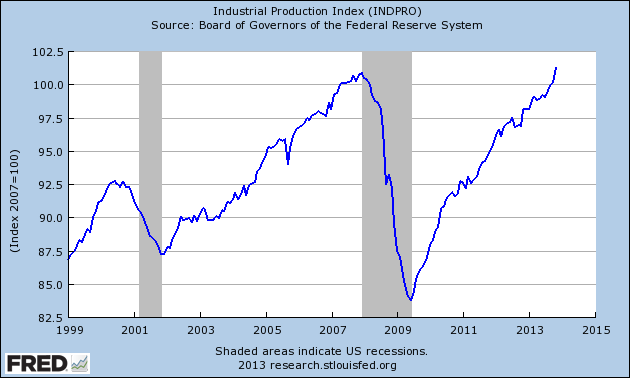
Industrial Prodcution Hits All-Time High
Posted by Eddy Elfenbein on December 16th, 2013 at 9:31 amStill more good economic news. The Industrial Production data series had been one of the major series that had failed to top its pre-Recession high. That came to an end today.
Industrial Production for November jumped 1.1% which is the largest rise in a year. It also edged out the reading from December 2007 to hit a new all-time high.
-
Archives
- June 2026
- May 2026
- April 2026
- March 2026
- February 2026
- January 2026
- December 2025
- November 2025
- October 2025
- September 2025
- August 2025
- July 2025
- June 2025
- May 2025
- April 2025
- March 2025
- February 2025
- January 2025
- December 2024
- November 2024
- October 2024
- September 2024
- August 2024
- July 2024
- June 2024
- May 2024
- April 2024
- March 2024
- February 2024
- January 2024
- December 2023
- November 2023
- October 2023
- September 2023
- August 2023
- July 2023
- June 2023
- May 2023
- April 2023
- March 2023
- February 2023
- January 2023
- December 2022
- November 2022
- October 2022
- September 2022
- August 2022
- July 2022
- June 2022
- May 2022
- April 2022
- March 2022
- February 2022
- January 2022
- December 2021
- November 2021
- October 2021
- September 2021
- August 2021
- July 2021
- June 2021
- May 2021
- April 2021
- March 2021
- February 2021
- January 2021
- December 2020
- November 2020
- October 2020
- September 2020
- August 2020
- July 2020
- June 2020
- May 2020
- April 2020
- March 2020
- February 2020
- January 2020
- December 2019
- November 2019
- October 2019
- September 2019
- August 2019
- July 2019
- June 2019
- May 2019
- April 2019
- March 2019
- February 2019
- January 2019
- December 2018
- November 2018
- October 2018
- September 2018
- August 2018
- July 2018
- June 2018
- May 2018
- April 2018
- March 2018
- February 2018
- January 2018
- December 2017
- November 2017
- October 2017
- September 2017
- August 2017
- July 2017
- June 2017
- May 2017
- April 2017
- March 2017
- February 2017
- January 2017
- December 2016
- November 2016
- October 2016
- September 2016
- August 2016
- July 2016
- June 2016
- May 2016
- April 2016
- March 2016
- February 2016
- January 2016
- December 2015
- November 2015
- October 2015
- September 2015
- August 2015
- July 2015
- June 2015
- May 2015
- April 2015
- March 2015
- February 2015
- January 2015
- December 2014
- November 2014
- October 2014
- September 2014
- August 2014
- July 2014
- June 2014
- May 2014
- April 2014
- March 2014
- February 2014
- January 2014
- December 2013
- November 2013
- October 2013
- September 2013
- August 2013
- July 2013
- June 2013
- May 2013
- April 2013
- March 2013
- February 2013
- January 2013
- December 2012
- November 2012
- October 2012
- September 2012
- August 2012
- July 2012
- June 2012
- May 2012
- April 2012
- March 2012
- February 2012
- January 2012
- December 2011
- November 2011
- October 2011
- September 2011
- August 2011
- July 2011
- June 2011
- May 2011
- April 2011
- March 2011
- February 2011
- January 2011
- December 2010
- November 2010
- October 2010
- September 2010
- August 2010
- July 2010
- June 2010
- May 2010
- April 2010
- March 2010
- February 2010
- January 2010
- December 2009
- November 2009
- October 2009
- September 2009
- August 2009
- July 2009
- June 2009
- May 2009
- April 2009
- March 2009
- February 2009
- January 2009
- December 2008
- November 2008
- October 2008
- September 2008
- August 2008
- July 2008
- June 2008
- May 2008
- April 2008
- March 2008
- February 2008
- January 2008
- December 2007
- November 2007
- October 2007
- September 2007
- August 2007
- July 2007
- June 2007
- May 2007
- April 2007
- March 2007
- February 2007
- January 2007
- December 2006
- November 2006
- October 2006
- September 2006
- August 2006
- July 2006
- June 2006
- May 2006
- April 2006
- March 2006
- February 2006
- January 2006
- December 2005
- November 2005
- October 2005
- September 2005
- August 2005
- July 2005
 Eddy Elfenbein is a Washington, DC-based speaker, portfolio manager and editor of the blog Crossing Wall Street. His