-
Is Low Vol Closet Value Investing?
Posted by Eddy Elfenbein on January 6th, 2014 at 11:57 amOne of the popular investing anomalies in recent years is the case of low-volatility stocks. It turns out that stocks that don’t move around a lot have actually performed better than the overall market. This runs counter to a lot of financial theory which holds that investors “pay” for better returns by taking on more risk, which means higher volatility. The theory sounds great and intuitively makes sense. The problem is that real world results haven’t been very cooperative.
I don’t deny results. The numbers for low vol are impressive. What I don’t get is how low vol is different from simple value investing. The two strategies may be plowing the same field. A value stock is likely to have a higher dividend yield, therefore it’s likely to have less volatility. Is low vol a reflection of value, or vice versa? I really don’t know.
Low vol strategies have not worked very well over the past several months. The chart below shows how similar low vol and value are.
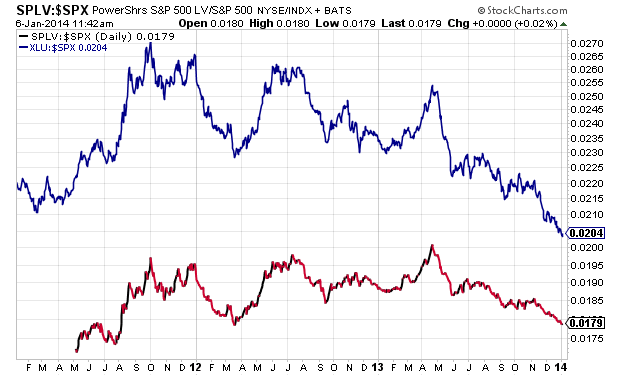
The blue line is the Utility Sector ETF ($XLU) divided by the S&P 500. The red/black line is a Low Vol ETF ($SPLV) divided by the S&P 500. The base of the two lines are different because the nominal prices are different, but the important point is the nooks and crannies of each line. They seem to match up very well.
Eric Falkenstein, who is the leading proponent of low vol investing, insists that it’s not the same as value. Perhaps there’s some subtle difference, but for most practical purposes, low vol and value appear to be the same.
-
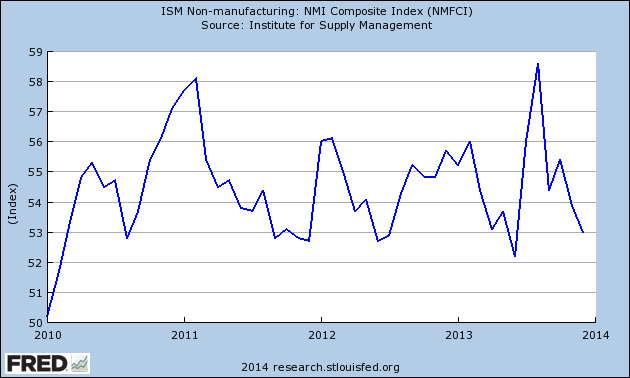
December Non-Manufacturing ISM = 53
Posted by Eddy Elfenbein on January 6th, 2014 at 11:37 amThe stock market is down again today. This could be the first time since 2005 that the S&P 500 has started the year with three straight losses. Am I worried? Not at all.
Medtronic ($MDT) is leading our Buy List today. The shares are currently up over 1.2%. Their CEO is due to speak at a healthcare conference today.
Some downgrades today are hurting a few Buy List stocks.
eBay ($EBAY), for example, is getting hit this morning for a 3% loss. The shares were downgraded at Morgan Stanley from Overweight to Equal Weight. The earnings report will come out in two weeks.
AFLAC ($AFL) is also down today. Credit Suisse downgraded AFL from Neutral from Outperform. But they raised their price target from $66 to $67 per share.
A number of analysts on Wall Street have been raising their forecasts for Q4 GDP growth. We won’t get the report until the end of the month. While I don’t place a great deal of faith in forecasts from the analyst community, it does reflect a growing sense of optimism from investors.
The ISM reported that its non-manufacturing index fell to 53 in December. The consensus on Wall Street was for 54.7.
-
Morning News: January 6, 2014
Posted by Eddy Elfenbein on January 6th, 2014 at 7:16 amEuro Zone – Reasons to Be Wary in 2014
China to Allow Up to Five Privately Funded Banks in Trial Reform
Spain’s Telefonica Denies Readying Joint Bid for TIM Brasil
Swiss National Bank Takes Hefty Gold Hit
Gold Climbs to Near 3-week High as Equities Dip; China Demand Robust
Bond Tab for Biggest Economies Seen at $7.43 Trillion in ’14
Service Sector Growth Slowed in December, PMI Survey Says
Selling Social Media Clicks Becomes Big Business
Pot Prices Double as Colorado Retailers Roll Out Green Carpet
JPMorgan Nears $2 billion settlement in a case tied to Madoff
Ford Revs Up in China, Roars Past Toyota and Honda
$1 Billion as Milestone and Omen
Men’s Wearhouse Launches Hostile Bid for Jos. A. Bank
Joshua Brown: The Only Thing We Have To Fear…
Jeff Miller: Weighing the Week Aheard: Will “Good News” Be Good For Markets?
Be sure to follow me on Twitter.
-
Dividends Rose 12% in 2013
Posted by Eddy Elfenbein on January 3rd, 2014 at 11:39 amThe fourth-quarter was another strong quarter for dividends. The S&P 500 paid out $9.52 per share in dividends (that’s an index-adjusted number). That’s an increase of 6.58% over last year’s fourth quarter. But remember that Q4 2012 saw a 22.77% surge in dividend payments to take advantage of the change in tax laws.
Dividends have now risen for 15 quarters in a row. We don’t have the final earnings numbers in yet, but dividends most likely paid out just under one third of corporate profits.
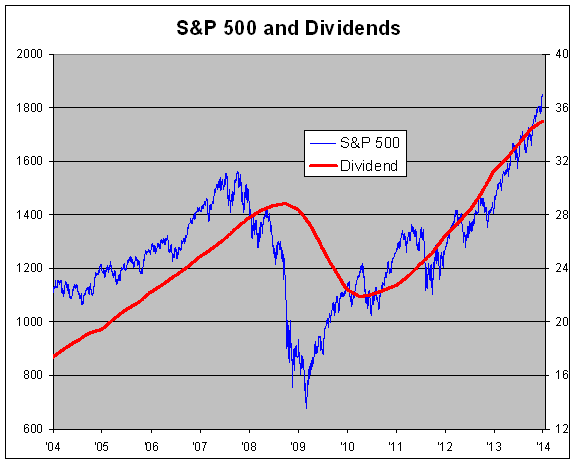
For the full year, dividends rose by 11.99%. While that’s below the 29.60% rally for the S&P 500, it’s not absurdly behind it either. In fact, dividends have actually outpaced the S&P 500 over the last three years. From the end of 2010 to the end of 2013, the S&P 500 rose 46.97% while dividends paid rose 53.95%.
Here’s a look at the S&P 500 (blue line, left scale) along with trailing four-quarter dividends (red line, right scale). The two lines are scaled at a ratio of 50-to-1. In other words, whenever the lines cross, the market’s dividend yield is exactly 2%. We also get a glimpse of how much everyone panicked in 2008 and 2009.
-
Ford’s December Sales Miss Expectations
Posted by Eddy Elfenbein on January 3rd, 2014 at 11:07 amFord Motor (F) wrapped up an excellent year for vehicle sales in 2013. Their sales for December, however, came in below expectations.
For the year, Ford sales rose by 11% to hit a six-year high. The company sold 2.5 million vehicles last year. The big winner was their F-Series pickups which rose 18%. Overall, their sales for December rose 2% to 218,058. December tends to be a big month for sales of luxury cars.
Ford is currently down one penny per share to $15.43.
-
Morning News: January 3, 2014
Posted by Eddy Elfenbein on January 3rd, 2014 at 6:49 amEuro Zone Private Loans Contraction Accelerates in November
Spanish Jobless Claims Fall Sharply in December
U.K. House Prices Cap Best Year Since 2006 as Mortgages Surge
India Leader Singh to Step Down After Vote as Gandhi Rises
From Ore to Nuggets, With Peril
For New Fed Chair Yellen, Headaches May Be Only Starting
Jobless Claims in U.S. Fall to Lowest Level in a Month
Labor Department Panel Calls for Ending Lockup for Jobs Data
Marchionne’s Fiat-Chrysler Coup the Beginning, Not The End
FireEye Buys Cyber Forensics Firm Mandiant for About $1 Billion
Macy’s, Martha Stewart Living Settle Dispute
Original Cheerios Are Now GMO-Free
Here’s The First Job Ad We’ve Seen For A Bitcoin Trader At A Hedge Fund
Jeff Carter: Do We Need to Save Silicon Valley?
Cullen Roche: The Biggest Risk in 2014: Recency Bias
Be sure to follow me on Twitter.
-
The S&P By Sectors in 2013
Posted by Eddy Elfenbein on January 2nd, 2014 at 11:23 amHere’s a look at how the different S&P 500 sectors performed last year. The big winner was Consumer Discretionary followed closely by Healthcare.
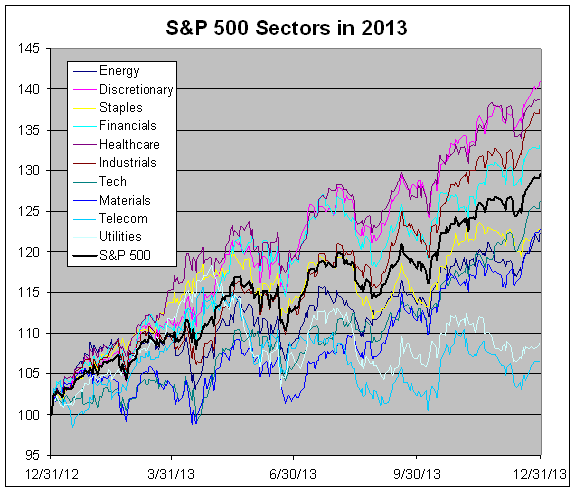
Industrials and Financials also did well. A little over a year ago, I tweeted, “I suspect an investor could buy the $XLF, then play video games for 12 months and easily beat most money managers in 2013.” That turned out to be right.
The lagging sectors were the safe havens — utilities and telecom. As I’ve said, this was the Fear Bubble deflating itself.
-
The Dow’s Average Year
Posted by Eddy Elfenbein on January 2nd, 2014 at 10:40 amWith the end of the year, I updated a few of my data files. One of these sets is the complete history of the Dow Jones going back to May 1896 (more than 32,000 trading days).
Here’s a good one. This is what the average year looks like for the Dow.
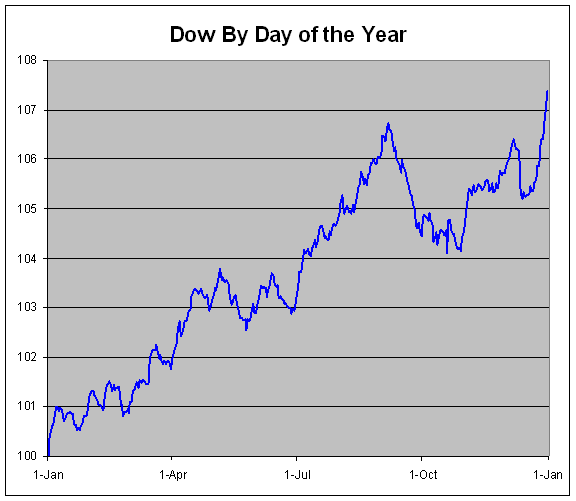
Interestingly, the second-best day of the year historically has been January 2nd. The best day is October 20th (thanks to following the big crash from October 19th). The Dow has gained an average of 0.37% on the 73 January 2nds the market has traded since 1897.
-
December ISM = 57.0
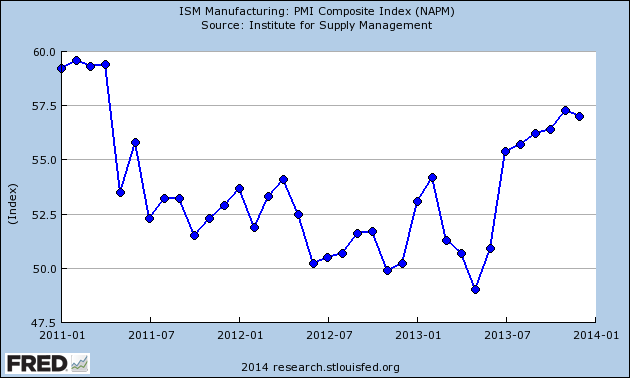
Posted by Eddy Elfenbein on January 2nd, 2014 at 10:20 amThe December ISM report just came out and it was 57.0 which is another good report. This was slightly below November’s report of 57.3, and it’s the sixth month in a row we’ve topped 55. This is good news for the economy.
The next big econ report will be next Friday’s jobs report. At the end of this month, we’ll get our first look at Q4 GDP which could be another quarter over 4%.
-
Morning News: January 2, 2014
Posted by Eddy Elfenbein on January 2nd, 2014 at 6:08 amEuro-Zone Manufacturing Grew Again in December
As Latvia Adopts Euro, Future Growth is Slowing
Euro Supporter Credit Suisse Joins Bears
Stung By Curbs, Indian Iron Ore Companies Throw in Towel
Singapore Home Prices Post First Decline in Seven Quarters
Bershidsky on Europe: Fiat to Swallow Chrysler
Samsung’s Lee Urges Shift Beyond Hardware in Apple Battle
Hyundai, Kia Face Fading Growth as Currency Tides Buoy Japan Rivals
Markets Buoyant, Merger Activity Picks Up
Human Behavior Trove Lures Economists to U.S. Tech Titans
Macau Casino Revenue Jumps 19 Percent to $45.2 Billion
Chinese Tycoon Wants to Buy the New York Times for $1 Billion or So
Lance Roberts: Correcting Some Misconceptions About A New Secular Bull Market
Howard Lindzon: The Year 2014….Here is How to Twerk and Surge Your Investing and Trading
Be sure to follow me on Twitter.
-
Archives
- September 2026
- August 2026
- July 2026
- June 2026
- May 2026
- April 2026
- March 2026
- February 2026
- January 2026
- December 2025
- November 2025
- October 2025
- September 2025
- August 2025
- July 2025
- June 2025
- May 2025
- April 2025
- March 2025
- February 2025
- January 2025
- December 2024
- November 2024
- October 2024
- September 2024
- August 2024
- July 2024
- June 2024
- May 2024
- April 2024
- March 2024
- February 2024
- January 2024
- December 2023
- November 2023
- October 2023
- September 2023
- August 2023
- July 2023
- June 2023
- May 2023
- April 2023
- March 2023
- February 2023
- January 2023
- December 2022
- November 2022
- October 2022
- September 2022
- August 2022
- July 2022
- June 2022
- May 2022
- April 2022
- March 2022
- February 2022
- January 2022
- December 2021
- November 2021
- October 2021
- September 2021
- August 2021
- July 2021
- June 2021
- May 2021
- April 2021
- March 2021
- February 2021
- January 2021
- December 2020
- November 2020
- October 2020
- September 2020
- August 2020
- July 2020
- June 2020
- May 2020
- April 2020
- March 2020
- February 2020
- January 2020
- December 2019
- November 2019
- October 2019
- September 2019
- August 2019
- July 2019
- June 2019
- May 2019
- April 2019
- March 2019
- February 2019
- January 2019
- December 2018
- November 2018
- October 2018
- September 2018
- August 2018
- July 2018
- June 2018
- May 2018
- April 2018
- March 2018
- February 2018
- January 2018
- December 2017
- November 2017
- October 2017
- September 2017
- August 2017
- July 2017
- June 2017
- May 2017
- April 2017
- March 2017
- February 2017
- January 2017
- December 2016
- November 2016
- October 2016
- September 2016
- August 2016
- July 2016
- June 2016
- May 2016
- April 2016
- March 2016
- February 2016
- January 2016
- December 2015
- November 2015
- October 2015
- September 2015
- August 2015
- July 2015
- June 2015
- May 2015
- April 2015
- March 2015
- February 2015
- January 2015
- December 2014
- November 2014
- October 2014
- September 2014
- August 2014
- July 2014
- June 2014
- May 2014
- April 2014
- March 2014
- February 2014
- January 2014
- December 2013
- November 2013
- October 2013
- September 2013
- August 2013
- July 2013
- June 2013
- May 2013
- April 2013
- March 2013
- February 2013
- January 2013
- December 2012
- November 2012
- October 2012
- September 2012
- August 2012
- July 2012
- June 2012
- May 2012
- April 2012
- March 2012
- February 2012
- January 2012
- December 2011
- November 2011
- October 2011
- September 2011
- August 2011
- July 2011
- June 2011
- May 2011
- April 2011
- March 2011
- February 2011
- January 2011
- December 2010
- November 2010
- October 2010
- September 2010
- August 2010
- July 2010
- June 2010
- May 2010
- April 2010
- March 2010
- February 2010
- January 2010
- December 2009
- November 2009
- October 2009
- September 2009
- August 2009
- July 2009
- June 2009
- May 2009
- April 2009
- March 2009
- February 2009
- January 2009
- December 2008
- November 2008
- October 2008
- September 2008
- August 2008
- July 2008
- June 2008
- May 2008
- April 2008
- March 2008
- February 2008
- January 2008
- December 2007
- November 2007
- October 2007
- September 2007
- August 2007
- July 2007
- June 2007
- May 2007
- April 2007
- March 2007
- February 2007
- January 2007
- December 2006
- November 2006
- October 2006
- September 2006
- August 2006
- July 2006
- June 2006
- May 2006
- April 2006
- March 2006
- February 2006
- January 2006
- December 2005
- November 2005
- October 2005
- September 2005
- August 2005
- July 2005
 Eddy Elfenbein is a Washington, DC-based speaker, portfolio manager and editor of the blog Crossing Wall Street. His