-
Morning News: November 27, 2013
Posted by Eddy Elfenbein on November 27th, 2013 at 7:17 amNorway Debates $800 Billion Wealth Fund’s Investment Options
I.M.F. Shifts Its Approach to Bailouts
Surfing Central Banks is a Benign ‘QE Trap’
Fed Reveals New Concerns About Long-Term U.S. Slowdown
Economic Forecast After The Federal Reserve Starts To Taper
Obama Administration Proposes New Curbs on Campaigning by Tax-Exempt Groups
Housing Overcomes Rising Rates as U.S. Permits Climb
Thanksgiving Shopping: Can It Turn Retail Revenues from Bleak to Black?
JPMorgan Tried but Failed to Satisfy Fed on Metals Warehousing
Hewlett-Packard Sales Top Estimates on Corporate Demand
Take-Two Falls After Icahn Ends Role on Board With Sale
Warren Buffett Sees Hope For Detroit
Don’t You Dare Eliminate The Penny
Cullen Roche: Goldman Sachs: 2 Macro Investment Ideas for 2014
Howard Lindzon: The Death of Television?…Death Never Looked This Good!
Be sure to follow me on Twitter.
-
On “Bubble” Warnings, Bearish Sentiment and “Black Friday”
Posted by Eddy Elfenbein on November 26th, 2013 at 1:59 pmToday, November 26, marks the day Thanksgiving was “invented” by three revered Presidents at three significant times in American history: at our nation’s birth, during the Civil War and in World War II:
- On November 26, 1789, during his first year as President under the new U.S. Constitution, George Washington declared the first national day of Thanksgiving.
- On November 26, 1863, a week after his stirring Gettysburg Address, President Abraham Lincoln proclaimed a national day of Thanksgiving, but the day was not mandated by law until 1941:
- On November 26, 1941 – 11 days before the surprise attack on Pearl Harbor – President Franklin D. Roosevelt declared the “fourth Thursday in November” as a national day of Thanksgiving.
The “fourth Thursday” falls anywhere between November 22 and 28, so this year’s Thanksgiving falls on its latest possible calendar date – November 28. Maybe that’s one reason why we keep seeing “early Black Thursday” sales advertised on TV, radio, the Internet, billboards and almost everywhere you look.
Black Friday Comes Early – and So Does Santa Claus
For 11 years, my son was store manager in a leading electronics chain, so he had to grab some short hours of sleep shortly after Thanksgiving dinner in order to get up at 2:00 am, or earlier, to rally his staff against the onslaught of hundreds of freezing but eager shoppers camped out in front of his store all night long.
That’s the “Black Friday” tradition, but all that is changing. This year, I’ve seen all kinds of early “Black Friday” sales, on line or in the stores. TIME Magazine says Black Friday now starts the Friday BEFORE Thanksgiving. USA Today reported that retailers like Sears and the Disney Store are introducing Black Friday-style “door busters” (50% or more off) starting November 19 – 10 days before Black Friday. I just got a slew of promotions from Amazon about “Black Friday Week.” In time, the Friday after Big Meal Day will just be a time to relax after you make all those special deals on-line sometime in mid-November.
In recent years, investors have imitated these savvy retailers by “stealing a march” on the competition to buy stocks before major calendar cycles begin. The January Effect, for instance, has moved back to the final week of the year, while the Santa Claus Rally begins in early December. As a result, December is now the best month of the year, as measured by the S&P 500 or Russell 1000 & 2000. December is #2 as measured by the Dow or NASDAQ, according to The Stock Trader’s Almanac, which wrote last week, “Market trading in December is holiday-inspired and fueled by a buying bias throughout the month.”
Bubble Talk & Bearish Sentiment are Usually Contrarian Buy Signals
With the market setting new highs almost every week, you might think that this “dream market” could run forever (it won’t!), but the fact that we’ve seen rising bearish sentiment and a slew of new “bubble” warnings lately is very encouraging. Growing gloominess usually means that the market will keep rising.
When investors are overly euphoric at a market peak – as in early 2000 – a crash is often imminent, but today’s average investor is very suspicious. The American Association of Individual Investors (AAII) poll has become increasingly bearish as the market has risen to new highs. Last week, bullish sentiment at AAII fell 4.8 points to 34.4%, while bearish sentiment rose for the fourth consecutive week, to 29.5%.
Although the percentage of bulls is still five points above the percentage of bears, the 34.4% bullish consensus remains four points below its average for the last 4.7 years of the current bull market.
Short-term, the market usually performs well during Thanksgiving week. Since 1945, according to Bespoke Investment Group (BIG), the S&P has averaged 0.65% gains in this holiday-shortened week. In the best years, when the S&P 500 was up over 10% going into this week, the index has done even better, averaging 0.77% gains, with positive returns 65.5% of the time. Furthermore, since the current bull market began in March of 2009, Bespoke says that the S&P 500 has averaged a gain of 4.41% from the end of Thanksgiving week through the end of the year, with positive returns every year. Bespoke added: “The last time the S&P 500 traded down from the end of Thanksgiving through year end was in 2005.”
In the Latest “Bubble” Wars, Buffett & Yellen Trump the Bubble-Bears
Now, let’s examine the latest run of “bubble” talk from a remarkable array of noted investors who have each used the “B” word recently. In fact, last week’s Barron’s cover story was titled “Bubble Trouble?”
Last Tuesday, when the Dow made its first assault on 16,000, the bears came out in force and the Dow paused in its ascent – for a New York minute. First, CNBC reported that Carl Icahn said the market “could easily have a big drop.” Icahn said valuations are rich and earnings at many companies are fueled more by low borrowing costs and buybacks than management’s efforts to boost earnings. He said “a lot of the earnings are a mirage.” Icahn, however, was merely saying that we should hedge a bit, not “sell all”: “Often when we are concerned about the market, we hedge to some extent and this is one of those times.”
A clearer voice of doom, the perennial bear Marc Faber, said on CNBC last Tuesday that he sees “a bubble in everything that relates to the financial sector.” Faber said the financial bubble is caused by central banks, and the situation may worsen with the nomination of Janet Yellen as the next Fed Chair.
A more credible warning came from Jeremy Grantham, who expressed concern that the stock market was too high. Grantham has high credibility since he predicted both the crash of 2008 and recovery of 2009. In a report titled “Breaking News! U.S. Equity Market Overvalued,” Grantham’s company, GMO, said that the S&P 500 is overvalued by about 40%. The author of this latest report, Ben Inker, head of the asset allocation group at GMO, warned that “The U.S. stock market is trading at levels that do not seem capable of supporting the type of returns that investors have gotten used to receiving from equities.”
We’re also seeing some major firms predict a market drop in 2014 – a mid-term election year, historically the best year in the four-year election cycle. Last week, Goldman Sachs said that the S&P 500 could fall 6% in the next three months and 11% over the next 12 months, to levels of 1,700 and 1,600, respectively.
Amid all this bubble talk, Janet Yellen was asked about bubbles in her confirmation hearings. To her credit, she said, “Looking at several valuation measures you would not see stock prices in territory that suggests…bubble-like conditions.” Meanwhile, Warren Buffett gave a talk at his old elementary school in Omaha, Nebraska, as part of American Education Week. He was asked what his #1 concern about the market would be, and he quipped, “I don’t have concerns about this market.” Buffet said that stocks are “in a zone of reasonableness. Five years ago,” Buffett said, “I wrote an article for The New York Times that said they were very cheap. And every now and then, you can see that that they’re very overpriced or very underpriced.” Today, “they’re definitely not way overpriced. They’re definitely not underpriced.”
“If you live long enough,” Buffett said, “you’ll see a lot higher prices. I don’t know what stocks will do next week or next month or next year, but five or 10 years from now, they are very likely to be higher.”
That’s a great quote to pin on your refrigerator – an appliance you’ll visit often this Thanksgiving week!
– Gary Alexander
-
Welcome to the New Economy
Posted by Eddy Elfenbein on November 26th, 2013 at 8:05 amConsider some recent news items:
Tiffany Profit Tops Estimates as Jeweler Raises Prices
Tiffany & Co. (TIF), the world’s second-largest luxury jewelry retailer, posted third-quarter profit that topped analysts’ estimates and boosted its annual earnings forecast as the rising U.S. stock market gave wealthy consumers the confidence to snap up higher-priced merchandise.
Wal-Mart profit beats estimates, outlook weak
Wal-Mart Stores reported quarterly earnings Thursday that topped Wall Street estimates by a penny, but the world’s largest retailer came in shy on revenue and offered a tepid outlook for the holiday selling season, noting that U.S. sales in that key span will be “relatively flat.”
Ross Stores Profit Up 7.6%, Gives Downbeat Guidance for Current Quarter
Ross Stores Inc.’s (ROST) fiscal third-quarter profit rose 7.6%, driven by a bump in sales.
However, shares of Ross were down 6.9% at $74.75 after hours as sales growth underperformed expectations and the company offered guidance for its fiscal fourth quarter below analysts’ estimates.
The company raised the low end of its per-share earnings guidance for the year by three cents to $3.83 to $3.87.
For the current quarter, the discount clothing and home-goods retailer said it expects per-share earnings of 97 cents to $1.01. Analysts polled by Thomson Reuters recently expected $1.09 a share. The company also said it expects same-store sales to be up 1% to 2% in the period, compared with 5% growth last year.
Target trims forecast as quarterly sales fall short
Target on Thursday reported comparable sales rose a smaller than expected 0.9 percent in the third quarter, blaming what it called “constrained” consumer spending, and it lowered its full-year profit forecast.
The high-end seems to be doing well, while the lower-end is having trouble.
-
Morning News: November 26, 2013
Posted by Eddy Elfenbein on November 26th, 2013 at 7:00 amBoE to Review Power Over Banks’ Balance Sheets
Sinopec Personnel Detained After Deadly Pipeline Blast
N.S.A. May Have Penetrated Internet Cable Links
Gold Fix Drawing Scrutiny Amid Knowledge Tied to Eruption
NASDAQ Touches 4000 on Mixed Day
Goldman Currency-Trading Definition Shows Disclosure Gap
China Probe May Be Aimed at Qualcomm’s 4G Royalties
Bayer Makes $2.4 Billion Takeover Bid for Norway Drug Maker Algeta
Comcast Considers Time Warner at Customer’s Expense
Remy Cointreau Hit by China Slowdown
BlackBerry Shakeup: Third Time’s a Charm?
Apple May Have Just Acquired The Final Piece It Needs To Make A Killer Apple TV
Facebook and Google Are About to Overtake All of TV in Audience Size
Cullen Roche: The Kalecki Equation: A Brief Follow-Up
Credit Writedowns: When Are Markets “Rational”?
Be sure to follow me on Twitter.
-
Cyclicals Relative Strength Hits Two-Year High
Posted by Eddy Elfenbein on November 25th, 2013 at 6:23 pmHere’s a look at one of my favorite ways to measure the stock market’s mood. It’s the Morgan Stanley Cyclical Index divided by the S&P 500.
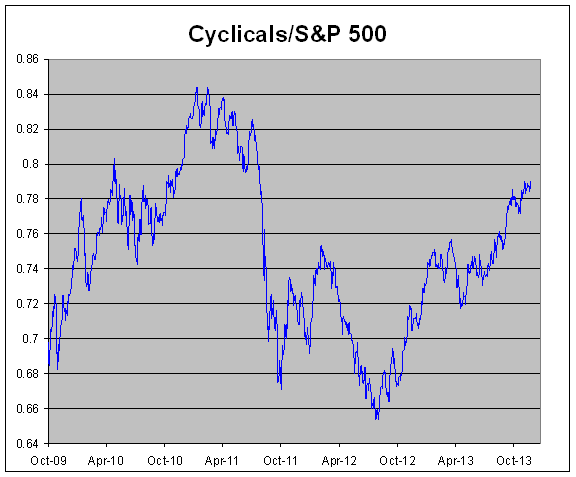
The ratio closed today at its highest point since July 26, 2011.
The ratio’s all-time high came in February 2011, but cyclicals were clobbered that summer.
What I find interesting is that, in retrospect, we can see how important Mario Draghi’s bold claim to stand behind the euro changed the direction of the market.
That came on July 26, 2012, and the cyclical’s relative performance hit bottom on August 2. Since then, the cyclical stocks have been leading the market.
-
Buy When Others are Fearful….
Posted by Eddy Elfenbein on November 25th, 2013 at 10:05 amWith all this bubble talk, I was curious to see how the stock market has performed compared with the unemployment rate. Not surprisingly, stocks have done better when unemployment is higher.
I looked at all the data from 1948 though 2012. When the unemployment rate was below 6%, stocks delivered a real annualized return of 3.19%. Below 4%, stocks have been nearly flat.
But when the unemployment rate was over 6%, the real return jumped to 14.68%.
-
Stocks to Rally on Iranian Deal
Posted by Eddy Elfenbein on November 25th, 2013 at 9:22 amThis should be a very quiet week of trading. The market looks to open higher this morning thanks to the Iranian Nuke deal this past weekend. The only news that I’m looking forward to is tomorrow’s update on Q3 GDP. Outside that, this week will probably be very dull.
I want to comment on the painful day that Ross Stores ($ROST) had on Friday. While the stock opened much lower, it gradually gained ground during the day. By the closing bell, Ross had lost 5.7%.
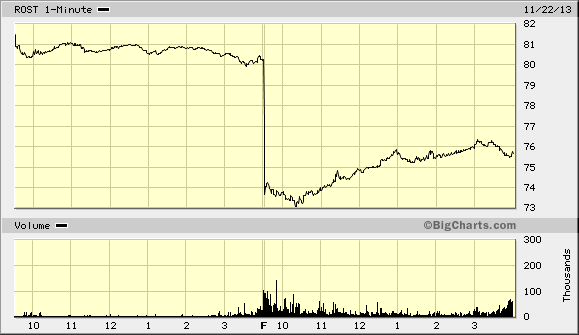
The stock is still higher than where it was one month ago, and it’s still outperformed the S&P 500 over the last two months.
-
Morning News: November 25, 2013
Posted by Eddy Elfenbein on November 25th, 2013 at 6:41 amOil Prices Plunge After Iran Nuclear Deal
Europe Twin Woes Fester in ECB’s Job-to-Inflation Fight
ECB’s Hansson Says Rate Cut Options Not Fully Exhausted
Swiss Voters Reject Strictest Executive Pay Limits in Ballot
France Seeks Grandeur Abroad As Pessimism Grows At Home
Japan Is Cool Again, According To Japan’s New ‘Cool Japan Fund’
Marathon WTO Talks Likely To Leave Questions Open For Ministers
Apple Agrees to $350 Million Deal for Israel’s PrimeSense
Peugeot Set to Benefit Most in Europe From Iran Accord
Chrysler Presses Ahead With IPO Plan
Cairn India to Spend $1 Billion on Buyback
In BItcoin’s Orbit: Rival Virtual Currencies Vie for Acceptance
Jeff Miller: Weighing the Week Ahead: Will Consumers Open Their Wallets?
Be sure to follow me on Twitter.
-
ABBA 1975
Posted by Eddy Elfenbein on November 22nd, 2013 at 4:11 pm -
CWS Market Review – November 22, 2013
Posted by Eddy Elfenbein on November 22nd, 2013 at 7:11 am“It is not the employer who pays the wages; he only handles the
money. It is the product that pays the wages.” – Henry FordSo the bubble that everyone’s predicting still hasn’t arrived. For those of us who eschew market timing, this is almost like poor Linus sitting in the Pumpkin Patch waiting for the Great Pumpkin to arrive.
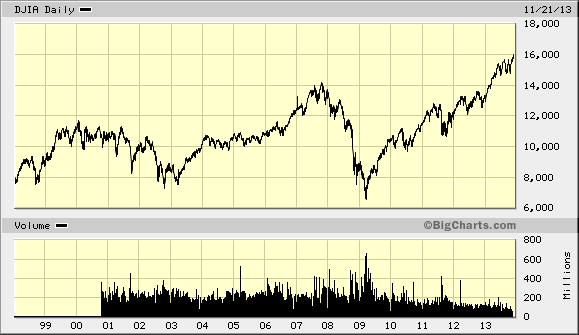
And stocks keep going up. The Dow Jones closed Thursday above 16,000 for the first time in its 117-year history. The index now stands at 16,009.99. We’ve gained nearly 9,500 points since the low from March 2009. This was a fairly quiet week, but we got a boost from our friends at the Fed, who signaled that the easy-money party will very likely continue.
Our Buy List is now up 34.24% for the year, which is another year-to-date record, and we again have our widest lead over the market this year (8.32%). Put it this way: one of our Buy List stocks could go completely bust sometime in the next six weeks, and we’d still be beating the S&P 500.
Next week is a holiday-shortened trading week. The stock market is closed all day on Thursday for Thanksgiving and will close at 1 p.m. on Friday. Trading volume is traditionally very low during Thanksgiving week. I’m taking some time off as well, so there won’t be an issue next week. I will, however, continue to update the blog if any big news hits.
I’ve been busily working on next year’s Buy List. I’ve had a lot of questions from readers, but no, I’m not going to reveal any changes just yet. As usual, fifteen of our stocks will stay, and we’ll have just five new additions and five deletions. I’ll announce the new Buy List, and CWS Market Review subscribers will be the first to know. Stay tuned in the next few weeks for more details.
In this week’s CWS Market Review, I’ll discuss our two recent earnings reports. Frankly, they were slightly on the disappointing side. Ross Stores, in particular, gave out weak guidance for Q4. The stock took a hit in the after-hours market, but it’s been a very big winner for us this year. We also had a stock split announcement from Fiserv. Later on, I’ll update the Buy Belows on several of our stocks. But first, let’s look at our recent earnings news.
Medtronic Earned 91 Cents per Share
On Tuesday, Medtronic ($MDT) reported fiscal Q2 earnings of 91 cents per share, which beat estimates by one penny per share. This was a solid quarter for MDT. Quarterly revenue rose 2.4% to $4.19 billion. Medtronic’s CEO Omar Ishrak said, “Our second-quarter revenue growth was in line with our outlook for the year, and we are performing at or better than the market in almost every one of our business lines.” That’s something nice to hear from your CEO.
I felt the company’s margins were a bit soft last quarter, but nothing dire. Not including the effects of currency, sales for Medtronic’s cardiac-rhythm disease-management segment rose by 5% to $1.27 billion. On the conference call, MDT said that gross margins will be slightly below the Street’s outlook. One weak spot was their spinal-products unit.
Most importantly, Medtronic reaffirmed their full-year guidance of $3.80 to $3.85 per share. They see revenue rising by 3% to 4%. Note that MDT’s fiscal year ends in April. The shares are close to the 52-week high from last week, which was the highest price in nearly eight years. The all-time high was $62 per share from December 2000. Medtronic remains a good buy up to $61 per share.
Ross Stores Disappoints
After the close on Thursday, Ross Stores ($ROST) reported Q3 earnings of 80 cents per share. This matched the Street’s expectation, but honestly, I had been expecting more. For comparison, the discount retailer earned 72 cents per share in last year’s Q3. So they’re still growing well, but perhaps there are still pockets of weakness among lower-end consumers.
In August, Ross said earnings would range between 75 and 78 cents per share, which I knew was a very conservative forecast. Sales for Q3 rose by 6% to $2.398 billion. The big number, however, is comparable-store sales, and that rose by 2% for the quarter. Again, that’s good but I was expecting a little more from Ross.
CEO Michael Balmuth said, “Third-quarter sales were in line with our guidance, while earnings were better than expected mainly due to above-plan merchandise gross margin. Operating margin of 11.3% was relatively flat to last year. As a percent of sales, an improvement in cost of goods sold was offset by an increase in selling, general and administrative expenses.”
Balmuth said Ross has adopted a “cautious outlook” for Q4. They see earnings for Q4, which is the all-important holiday shopping quarter, as ranging between 97 cents and $1.01 per share. The consensus on Wall Street was for $1.09 per share. That’s a pretty big miss. For the full year, Ross sees earnings coming in between $3.83 and $3.87 per share. That’s up from $3.53 per share last year, which included an extra week of business (or 10 cents per share for the bottom line).
Ross is still doing well, but I think the retail environment may not be as strong as I thought. Both Target ($TGT) and Walmart ($WMT) dropped recently on weak guidance. Ross is still a very sound stock, but I’m lowering my Buy Below to $79 per share.
Fiserv to Split 2-for-1
Fiserv ($FISV) announced this week that it will be splitting its stock 2-for-1. That means that shareholders will get twice the number of shares, and the stock will be cut in half.
There’s no change to your actual investment, but the increase in shares will help FISV’s liquidity. The split will come on December 16, so don’t be shocked when you see the lower share price. Fiserv hasn’t declared a split since 2001, but it announced six splits between 1991 and 2001 (all 3-for-2).
Last month, Fiserv released a very good earnings report for Q3. The company topped expectations by five cents per share. Plus, FISV is on its way to hitting its full-year forecast of $5.94 to $6.02 per share. I’ve been impressed that their operating margins are improving, and cash flow has been strong. This week, I’m raising my Buy Below to $112 per share. Naturally, the Buy Below will split next month along with FISV.
Several New Buy Below Prices
I also want to adjust a few of our Buy Below prices. Thanks to the recent rally, several of our stocks have run past my Buy Below prices. I want to make sure you always know what’s a good entry point for our stocks. I also want to stress that these Buy Below prices are not price targets. Many investors assume that the biggest gap between the current price and my Buy Below implies what I think the best value is. Not at all. If a stock is below the Buy Below, then it’s a Buy. Around here, we keep our system simple.
The Buy Below prices serve as guidance for current entry into a stock. I also factor in each stock’s volatility, so some Buy Belows will be tighter than others. That’s just how it is, and it’s not a judgment on a stock’s valuation.
In addition to the new Buy Below prices for Fiserv and Ross Stores, I’m lowering Nicholas Financial ($NICK) down to $17 per share. Again, that’s not a reflection on NICK’s outlook. I’m adjusting for the post-earnings slide. NICK is still a very good stock, and I hope to see a dividend increase soon.
This week, I’m raising CR Bard ($BCR) to $142 per share. This has been an excellent stock for us this year. The last earnings report was outstanding. In June, Bard raised its dividend for the 41st year in a row. Q4 should be another solid quarter for Bard.
I’m lifting the Buy Below on Harris ($HRS) to $67. Don’t let the tight range fool you; this is a very good stock. I don’t want anyone to chase it higher than they need to. As well as Harris has done for us this year (up 32.2%), it was dead money until April. That’s how some stocks roll, so we need to be prepared for down periods as well. Harris continues to be a very good buy.
Cognizant Technology Solutions ($CTSH) is one of the best values on our Buy List. They just beat earnings and raised guidance. I’m raising my Buy Below to $97 per share. Go CTSH!
I’m about fed up with writing about JPMorgan Chase ($JPM), and that’s probably how you feel about reading about them. While the bank continues to make a healthy profit, the management has been remarkably tone deaf regarding its public image. The latest failure was the absurd #askJPM stunt. Ugh! The bank finally reached a $13 billion settlement with the Federales. Some folks think they got off light. At least, the settlement is finally behind them, and that helped the shares. On Thursday, JPM hit a new 52-week high. I’m raising our Buy Below by $3 to $59 per share.
I have to confess that my opinion of Oracle ($ORCL) has improved recently. I had been unimpressed by the company’s recent performance, but I’ve learned not to count Larry Ellison out too quickly. Earnings are due out again just before New Year’s Day. ORCL told us to expect earnings to range between 64 and 69 cents per share. They should be able to top that. On Monday, the shares touched a six-month high. I’m raising my Buy Below on Oracle to $36 per share.
Keeping with tech, Microsoft ($MSFT) may be our biggest surprise all year. The tech giant has defied all predictions that it was hopelessly out of touch. The shares are up 42.2% this year so far. All eyes are on the Xbox One as the company’s first test of its One Microsoft strategy. I’m lifting our Buy Below to $40 per share.
Nothing seems to slow Moog ($MOG-A) down! The maker of flight-control systems has itself been a high-flier this year. The stock surged 4.1% on Thursday to reach yet another new all-time high. It’s our single biggest winner of the year, with a 58% gain. The shares have nearly doubled in the last 12 months. I’m raising our Buy Below on Moog to $68 per share.
Three more quick ones. I’m raising the Buy Below on Stryker ($SYK) by $1 to $76. I still like Wells Fargo ($WFC) a lot. I’m raising our Buy Below on WFC to $46 per share. Finally, I’m raising WEX Inc.’s ($WEX) Buy Below to $102 per share.
That’s all for now. Next week is Thanksgiving, so expect to see a very slow market. The stock market will be closed all day on Thursday, and it closes early on Friday. There won’t be an issue next week, but I’ll return for the first week of December. Be sure to keep checking the blog for daily updates. I’ll have more market analysis for you in the next issue of CWS Market Review. Have a Happy Thanksgiving!
– Eddy
-
Archives
- June 2026
- May 2026
- April 2026
- March 2026
- February 2026
- January 2026
- December 2025
- November 2025
- October 2025
- September 2025
- August 2025
- July 2025
- June 2025
- May 2025
- April 2025
- March 2025
- February 2025
- January 2025
- December 2024
- November 2024
- October 2024
- September 2024
- August 2024
- July 2024
- June 2024
- May 2024
- April 2024
- March 2024
- February 2024
- January 2024
- December 2023
- November 2023
- October 2023
- September 2023
- August 2023
- July 2023
- June 2023
- May 2023
- April 2023
- March 2023
- February 2023
- January 2023
- December 2022
- November 2022
- October 2022
- September 2022
- August 2022
- July 2022
- June 2022
- May 2022
- April 2022
- March 2022
- February 2022
- January 2022
- December 2021
- November 2021
- October 2021
- September 2021
- August 2021
- July 2021
- June 2021
- May 2021
- April 2021
- March 2021
- February 2021
- January 2021
- December 2020
- November 2020
- October 2020
- September 2020
- August 2020
- July 2020
- June 2020
- May 2020
- April 2020
- March 2020
- February 2020
- January 2020
- December 2019
- November 2019
- October 2019
- September 2019
- August 2019
- July 2019
- June 2019
- May 2019
- April 2019
- March 2019
- February 2019
- January 2019
- December 2018
- November 2018
- October 2018
- September 2018
- August 2018
- July 2018
- June 2018
- May 2018
- April 2018
- March 2018
- February 2018
- January 2018
- December 2017
- November 2017
- October 2017
- September 2017
- August 2017
- July 2017
- June 2017
- May 2017
- April 2017
- March 2017
- February 2017
- January 2017
- December 2016
- November 2016
- October 2016
- September 2016
- August 2016
- July 2016
- June 2016
- May 2016
- April 2016
- March 2016
- February 2016
- January 2016
- December 2015
- November 2015
- October 2015
- September 2015
- August 2015
- July 2015
- June 2015
- May 2015
- April 2015
- March 2015
- February 2015
- January 2015
- December 2014
- November 2014
- October 2014
- September 2014
- August 2014
- July 2014
- June 2014
- May 2014
- April 2014
- March 2014
- February 2014
- January 2014
- December 2013
- November 2013
- October 2013
- September 2013
- August 2013
- July 2013
- June 2013
- May 2013
- April 2013
- March 2013
- February 2013
- January 2013
- December 2012
- November 2012
- October 2012
- September 2012
- August 2012
- July 2012
- June 2012
- May 2012
- April 2012
- March 2012
- February 2012
- January 2012
- December 2011
- November 2011
- October 2011
- September 2011
- August 2011
- July 2011
- June 2011
- May 2011
- April 2011
- March 2011
- February 2011
- January 2011
- December 2010
- November 2010
- October 2010
- September 2010
- August 2010
- July 2010
- June 2010
- May 2010
- April 2010
- March 2010
- February 2010
- January 2010
- December 2009
- November 2009
- October 2009
- September 2009
- August 2009
- July 2009
- June 2009
- May 2009
- April 2009
- March 2009
- February 2009
- January 2009
- December 2008
- November 2008
- October 2008
- September 2008
- August 2008
- July 2008
- June 2008
- May 2008
- April 2008
- March 2008
- February 2008
- January 2008
- December 2007
- November 2007
- October 2007
- September 2007
- August 2007
- July 2007
- June 2007
- May 2007
- April 2007
- March 2007
- February 2007
- January 2007
- December 2006
- November 2006
- October 2006
- September 2006
- August 2006
- July 2006
- June 2006
- May 2006
- April 2006
- March 2006
- February 2006
- January 2006
- December 2005
- November 2005
- October 2005
- September 2005
- August 2005
- July 2005
 Eddy Elfenbein is a Washington, DC-based speaker, portfolio manager and editor of the blog Crossing Wall Street. His