-
Morning News: November 19, 2013
Posted by Eddy Elfenbein on November 19th, 2013 at 6:44 amO.E.C.D. Forecasts Lower Growth for Euro Zone
Wall Street Pushes Back on CFTC’s Advisory for Overseas Swaps
Alan Greenspan: Never Saw It Coming
Fed Ponders How to Temper Tapering Without Rate Increase
Regulators See Value in Bitcoin, and Investors Hasten to Agree
Was Carl Icahn Right to Put a Damper on Markets?
U.S. Poised to Announce $13 Billion JPMorgan Settlement
BNY Mellon Says $8.5 Billion BofA Deal ‘Easy Decision’
Dutch Firm to Spin Off Drug Making Business in $2.6 Billion Deal
U.S. Regulator Opens Probe of Fire in Tesla Electric Cars
Labor Panel Finds Illegal Punishments at Walmart
Hollywood Studios Facing Upheaval at Highest Levels
Joshua Brown: Dow Breaks 16,000, S&P Breaks 1,800, Whatever.
Roger Nusbaum: Markets Have More Moving Parts Than That
Be sure to follow me on Twitter.
-
Buffett Buys ExxonMobil
Posted by Eddy Elfenbein on November 18th, 2013 at 3:57 pmLast week Warren Buffett revealed that he bought a cool $3.7 billion worth of ExxonMobil ($XOM). That’s about 1% of the total company. Non-professional Investors should take note that Buffett is buying a blue-chip stock which hasn’t done very well. So many investors think you should only buy stocks near their highs.
I’ve been puzzled by XOM’s poor performance. Just a few weeks ago, I did a blog post asking “What Happened to ExxonMobil?” Since the beginning of the bull market in 2009, XOM has not only lagged the S&P 500, but it’s lagged the Energy Sector as well. I noted that if XOM had merely kept pace with the S&P 500, their market cap would be over $700 billion today.
So is it a buy now? I’m on the fence. I think the stock is cheap but I can’t say how strong the long-term potential is. But if Buffett is doing it, then it’s probably a very smart move.
-
Larry Summers at IMF Economic Forum
Posted by Eddy Elfenbein on November 18th, 2013 at 10:55 amSummers can be frustrating, but he makes some great points here.
-
What Happens to Stocks When Disaster Strikes?
Posted by Eddy Elfenbein on November 18th, 2013 at 10:06 amThis week marks the 50th anniversary of the tragic assassination of President John Fitzgerald Kennedy, followed by the shooting of his accused assassin Lee Harvey Oswald on national TV. The stock market was closed shortly after the President’s death and it remained shuttered during his funeral on Monday.
What happened next? The market went into a “free fall,” right? Nope. On Tuesday, November 26, 1963, the Dow gained 32 points (+4.5%). Then came Thanksgiving Day, after which the market rose further on Friday, gaining an impressive 5.5% in the week after the shooting of a popular President.
The Dow continued to rise in December (+1.75%), closing 1963 up 17%. These double-digit gains continued for the next two years, as the Dow rose 14.6% in 1964 and 10.9% in 1965. As it turned out, the economic benefits of the Kennedy-Johnson tax cuts in 1963-64 overrode the tragic events in Dallas.
The Market’s Main Concern on Friday, November 22, 1963
If you look at the financial press on the day the President was shot, the biggest concern on Wall Street was a Ponzi scheme in the vegetable oil market! Fifty years ago, on Tuesday, November 19, 1963, Anthony “Tino” DeAngelis and his Crude Vegetable Oil Refining Co. (CVORC) filed for bankruptcy.
That may sound innocent enough, but CVORC turned out to be a shell corporation for speculation in vegetable oil futures. As of November 19, 1963, “Tino” owed two major brokerage firms of the day (Williston & Beane, and Ira Haupt & Co.) so much margin money that it endangered the existence of both brokerage firms. On Wednesday, November 20, the New York Stock Exchange suspended both firms from trading, which put their other 9,000 speculative trading customers at risk. Even American Express was at risk for guaranteeing the warehouse receipts for all these trades. Young investor Warren Buffett used the steep plunge in American Express ($AXP) stock to buy 5% of the company for just $20 million.
On Friday morning, November 22, Merrill Lynch and others stepped up to rescue their broker brethren. Hours before the Dallas shooting, NYSE president G. Keith Funston was trying to avoid a crash caused by liquidation of the 20,700 customer accounts at Ira Haupt. Friday’s 24-point Dow decline was partly due to the vegetable oil crisis, exacerbated by the news from Dallas, which caused the market to close.
This goes to show that the worst news of the day tends to make us forget what seemed important the day before. How many people know that two famous British authors – C.S. Lewis and Aldous Huxley – also died on November 22, 1963? Their obituaries were buried in the press coverage of JFK’s death.
The Market Rose after Most Major Historical Tragedies
Think back to some of the major political or personal tragedies of the last 75 years. In most cases, the market rose for several days after the unexpected, tragic event. Here is a list of our darkest days:
1939: Hitler invaded Poland on September 1, 1939, launching World War II with shocking speed, reaching Warsaw within a week. September 1 was the Friday before Labor Day weekend, so how did the market fare when it re-opened? On Tuesday, September 5, 1939, the Dow rose 12.87 points (a massive +9.5% daily rise). In the first half of September 1939, the Dow rose a near-euphoric 14.6%.
1941: After a surprise attack on Pearl Harbor, the initial market reaction was surprisingly mild. After the Sunday morning attack of December 7, 1941, the Dow declined less than 3% on Monday, December 8 (falling from Dow 115 to 112), but then the market stayed remarkably level over the next two months, dipping briefly below 100 in April, then resuming its inexorable rise during the rest of World War II.
1962: In the week of October 22-26, 1962, the Cuban Missile Crisis brought the world to the brink of annihilation, but the stock market stayed surprisingly calm, falling less than 1% for the week, then rising strongly (+3.5%) in the two days after the threat faded. The much bigger collapse in 1962 came in the spring, when the market fell 28% after President Kennedy launched a verbal war with U.S. Steel.
1968 brought two more tragic assassinations, on April 4 (Martin Luther King, Jr.) and June 6 (Robert F. Kennedy). King was shot on a Thursday evening, spawning riots in dozens of cities. The Dow fell less than 1% the next day. The Dow rose 2.15% on the following Monday and 4.6% for week after King’s death. After RFK’s death, the market fell just 1%, but then erased that loss in the next few trading days.
1986: On January 28, the explosion of the space-shuttle Challenger on a sunny Tuesday morning had no impact on Wall Street. The market gained 1.2% that day, and it kept rising the next day, week and month.
2001: The attack on America on September 11 was targeted at our financial heart, so the market fell sharply when it re-opened the following week, but it’s important to remember that America was already in the midst of a recession and a bear market when that attack happened. Still, the market reached its September 10th levels within two months, on November 9, 2001, and it kept rising into the spring of 2002.
The lesson here is that the stock market will probably leave you plenty of room to make an orderly exit during the worst of times, but the greater investment risk you face in such traumatic times would be to sell stocks in a panic, followed by a failure to re-enter the market in time. If you assume the worst and sell all stocks after a crisis, you could miss the quick recovery as America finds strength in adversity.
– Gary Alexander of Louis Navellier’s Market Mail.
-
Morning News: November 18, 2013
Posted by Eddy Elfenbein on November 18th, 2013 at 7:00 amAbu Dhabi Banks Maneuver for $137 Billion in Asia to Africa
Spain Bank Bad Loan Ratio Climbed to 12.7% in September
RBS Says It’s In Discussions to Sell Equity Derivatives Unit
Thailand Cuts Economic Growth Forecast as Exports Falter
Oil Slips Towards $108 Ahead of Iran Nuclear Talks
Fed’s Rosengren Says Banks With Broker-Dealer Units Pose Risks
What Yellen Didn’t Tell Congress and Why It Matters
Presssure Builds to Finish Volcker Rule on Wall St. Oversight
Geithner Joins Warburg in Shift to Buyouts From Bailouts
U.S. Agencies to Say Bitcoins Offer Legitimate Benefits
Boeing, Airbus Reel in Persian Gulf Orders
Lloyds to Sell Asset Management Unit for $1.06 Billion
Larry Summers Gave An Amazing Speech On The Biggest Economic Problem Of Our Time
Jeff Miller: Weighing the Week Ahead: Can Investors Think Beyond the Bubble Machine?
Be sure to follow me on Twitter.
-
Another All-Time High
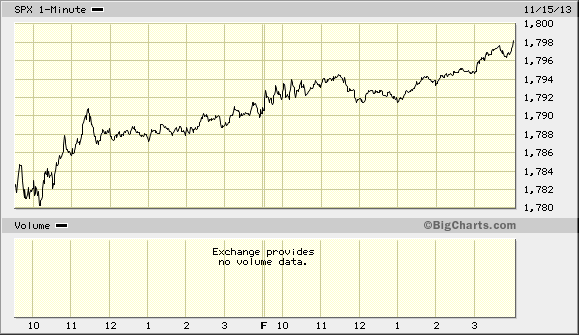
Posted by Eddy Elfenbein on November 15th, 2013 at 4:16 pmThe S&P 500 rallied into the close today. We finished the day at 1,798.18. This was our sixth-straight weekly gain. Our Buy List trailed the market today, gaining 0.32% to the S&P 500’s 0.42%.
-
Nirvana: MTV Unplugged
Posted by Eddy Elfenbein on November 15th, 2013 at 4:04 pmThis Monday marks the 20th anniversary of Nirvana’s famous concert on MTV Unplugged.
-
October Industrial Production Drops 0.1%
Posted by Eddy Elfenbein on November 15th, 2013 at 9:35 amThis morning, the Federal Reserve reported that Industrial Production fell 0.1% in October. That’s the first drop since July. IP is one of the data series that hasn’t topped its peak from 2007.
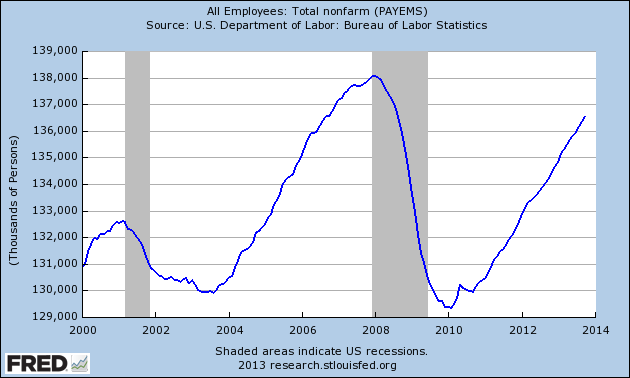
Wall Street had been expecting growth of 0.2%. The reading for September was revised to +0.7%. The IP number for October was 99.9778. The peak was 100.8200 from December 2007.
-
CWS Market Review – November 15, 2013
Posted by Eddy Elfenbein on November 15th, 2013 at 7:11 am“There are only two kinds of forecasters—those who don’t know, and
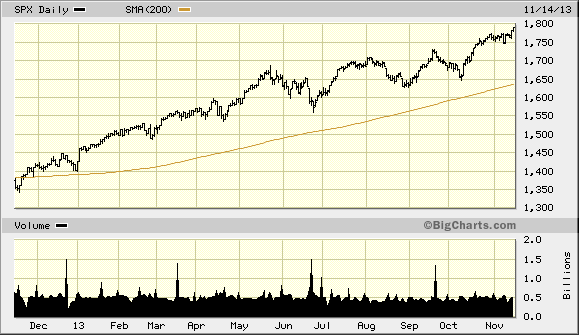
those who don’t know they don’t know.” – John Kenneth GalbraithThis has truly been a charmed stock market this year. On Thursday, the S&P 500 closed at 1,790.62, which is yet another record high. The index is now up 25.53% for the year, and it’s on track to yield its best yearly gain in a decade. The Nasdaq Composite is 25 points away from touching 4,000 for the first time in 13 years.
Last year, I thought I was being bold when I said the market could break 1,500 sometime in 2013. Sheesh, that happened before the Super Bowl, and now the S&P 500 is closing in on 1,800.
What’s remarkable about this year’s market is not only the stunning gain but also the absence of volatility. The market has gone up in a relatively steady manner. Consider that we haven’t had a daily drop of more than 1.6% in nearly five months. Compare that with the second half of 2011, when it happened 24 times. This Saturday will mark the one-year anniversary of the last time the S&P 500 closed below its 200-day moving average. As I said, it’s been a charmed market.
The market’s good fortune has led to a lot of talk, much of it careless, about the stock market being in a bubble. Even Janet Yellen was asked the great bubble question in her Congressional testimony (she said no). In this week’s CWS Market Review, I’ll take a closer look at where the market stands and investigate the issue of a possible bubble. Now that earnings season is past, this is a good time to take a step back and look at the larger picture.
I would be remiss if I didn’t point out that our Buy List continues to outpace the overall market. Through Wednesday, our Buy List beat the S&P 500 for eight straight days. This has been a very good earnings season for us. Since October 9, the Buy List has rallied 9.50%. We’re now up 33.64% on the year (not including dividends), which is 8% more than the S&P 500. This looks to be our seventh market-beating year in a row.
Now let’s turn to the broader market environment.
Is the Stock Market a Bubble?
The latest rage on Wall Street is to proclaim everything, particularly the stock market, a bubble. This is rather understandable when you consider it’s coming after two of the biggest blow-ups in Wall Street history: the Tech Bubble and the Financial Crisis. Naturally, the first sustained rally after these disasters would make anyone feel a bit nervous.
So do I think the market is in a bubble?
The answer is a bit complicated, but I’ll give you the simple version: I don’t know and I don’t care.
For one, it’s rather strange to discuss the stock market as if it were one entity. The stock market is composed of thousands of stocks. Even our Buy List, which is very diversified, contains just 20 stocks. In such a broad market, there will always be gems that the crowd overlooks. For stock pickers, that’s a good thing. I bet a monster-cap like ExxonMobil ($XOM) spends more on erasers than what little Harris ($HRS) earns in a full year. At Crossing Wall Street, we strive to be disciplined stock pickers, so the movement of the S&P 500 is of general importance to us, but it doesn’t alter our strategy of focusing on high-quality stocks going for good prices.
We should also remember that even if the stock market is overpriced, it’s still very hard to get the timing right. Lots of people were short the market going into the Financial Crisis, but it kept going higher and higher. If you’re disposed to see bubbles everywhere, then guess what: you’ll start seeing them everywhere. Remember, the trend is your frenemy. Momentum can always last longer than you expect. For example, I thought Ford Motor ($F) was a bargain at $15. I had no idea it was going to fall below $9 per share, as it did last year. As Lord Keynes famously said, “Markets can remain irrational a lot longer than you and I can remain solvent.” That’s painfully true.
Obviously, it would be great if we could always time the market perfectly, but we can’t. And no one can. I’ll go a step further. Even when disaster strikes, a buy-and-hold strategy can still serve you well. The S&P 500, including dividends, has performed reasonably well since mid-2008. That is, starting before the worst of the Financial Crisis. Time may not heal all investing wounds, but it sure can help a lot.
True market bubbles are very rare. By this, I mean to differentiate a bubble from a typical lousy market. The stock market drops every few years. That’s what markets do, and if you’re not prepared for it, you shouldn’t be in the stock market. Period. Stocks go up, and stocks go down. As Hyman Roth said, “this is the business we’ve chosen.”
The Two Kinds of Bear Markets
I think a good way of looking at bear markets is to divide them into two categories. One is where market prices shoot up far beyond values, and then reality reasserts itself. Those are your classic bubbles like 1987 or 2000. The other kind is where the value falls apart and then prices catch up. That’s what we had in 1990 and 2008. You might be surprised to hear me say that 2008 wasn’t a stock bubble. That’s true. There was a bubble in housing, but stock valuations were rather normal.
I very much doubt that we’re currently in a classic bubble. Earnings for the S&P 500 are expected to be about $107 per share (that’s an index-adjusted figure), and companies will probably pay out $35 per share in dividends. That works out to about 2%. Interestingly, the market’s dividend yield has hovered around 2% for much of the last decade, except for the most frightening parts of the Financial Crisis. Analysts currently expect the S&P 500 to earn about $121 per share next year. So even after our robust rally, the market is still going for about 14.8 times next year’s earnings estimate. That’s normal. We haven’t gone from normal valuations to sky-high ones. Rather, we’ve gone from duck-and-cover valuations to average ones.
Janet Yellen seems to agree. During her Congressional testimony this week, she was asked if the stock market was in a bubble. Yellen responded, “Stock prices have risen pretty robustly, but I think if you look at traditional valuation measures—the kind of things we monitor akin to price-equity ratios—you would not see prices that suggest bubble-like conditions.” Of course, investors should pay attention to more than a few easy-to-find ratios. But the general view indicates that equity valuations are quite normal.
Now the question that most concerns me is, are analysts too optimistic for the market’s future earnings? That’s a much more difficult question to answer, and if the answer is yes, then we have a different story. As I said, analysts see earnings coming in next year at $121, but I need to add that analysts don’t have an enviable track record with their forecasts (see the Galbraith quote above).
What concerns me most is that profit margins have grown very high and are near multi-decade highs. If (or when) we revert to the mean, then corporate profits will not grow as rapidly as the overall economy. However, the high margins may be a result of slow growth and ultra-low interest rates. We’ve never been in a situation quite like this, so the old rules may not apply.
Expect Small-Caps and Cyclicals to Lag
While I’m not a fan of market-timing, I do think it’s possible to spot areas that are due for outperformance or underperformance. In particularly, I’ve grown leery of the small-cap sector. Historically, small-cap stocks have done very well. The catch is that they’ve gone on long, multi-year runs of beating the market, then long runs of trailing. The current small-cap cycle began in April 1999.
Here’s a stunning fact: If the Dow had kept pace with the small-cap Russell 2000 since April 8, 1999, it would be over 28,000 today. I think investors should steer clear of macro bets on the small-cap sector. There are still many outstanding individual names there, but the sector as a whole needs to rest.
Related to small-caps are cyclical stocks. From a macro perspective, small-caps and cyclicals behave somewhat alike. This makes sense in that smaller companies tend to be more focused on domestic industries while mega-caps are skewed to large-scale multi-national service businesses. Cyclicals also tend to outperform when the market itself does well (hence the name “cyclicals”). Again, there are many individual cyclical names I like, such as Ford Motor ($F), but I expect the sector to lag the market for the next few years.
Updates on Some of Our Buy List Stocks
I want to caution investors not to expect more years like 2013. While I refuse to play the bubble guessing game, it’s certainly prudent for investors to grow more conservative as the rally goes on. Let’s take a look at a few of our Buy List stocks.
Despite missing earnings by one whole penny, AFLAC ($AFL) made back everything it lost and just rallied to another 52-week high. The duck stock announced that it’s expanding its buyback program by 40 million shares. Don’t chase this one. AFLAC is a good buy up to $70 per share.
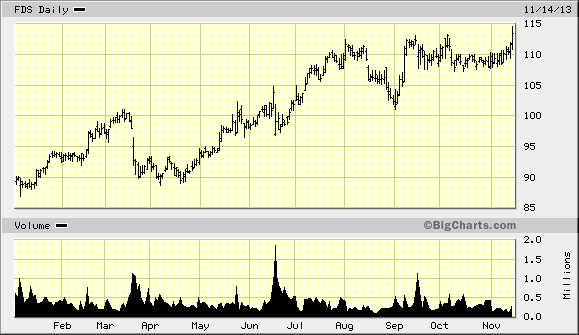
FactSet Reseatch Systems ($FDS) just hit a new 52-week high. The stock is having a very good year. We’ll get another earnings report before the end of the year. I’m raising our Buy Below to $119 per share.
Several more of our stocks hit new 52-week highs on Thursday, such as Harris ($HRS), Fiserv ($FISV), Cognizant ($CTSH) and CA Technologies ($CA). So did WEX Inc. ($WEX), which was raised to a buy by Zacks. WEX looks to crack $100 per share any day now. I was impressed to see Oracle ($ORCL) hit $35 this week for the first time since May. Oracle continues to be a very good buy up to $35 per share.
Both Ross Stores ($ROST) and Medtronic ($MDT) made new highs on Thursday, and both stocks are due to report next week. I previewed their earnings reports in last week’s CWS Market Review. This week, I’m raising the Buy Below on Medtronic to $61 per share. Expect to see another solid earnings report this Tuesday.
That’s all for now. This Wednesday, the Commerce Department will report on retail sales. Also on Wednesday, the Labor Department will release the inflation report for October. Expect to see more subdued inflation. However, the most important release will be the minutes from the Fed’s meeting three weeks ago. As expected, the Fed decided to hold off tapering, but it will be interesting to see what issues the FOMC discussed. The Street is now expecting a tapering move in March. Be sure to keep checking the blog for daily updates. I’ll have more market analysis for you in the next issue of CWS Market Review!
– Eddy
-
Morning News: November 15, 2013
Posted by Eddy Elfenbein on November 15th, 2013 at 6:26 amEU Inflation Rate Falls to Four-Year Low
Ireland Is to Exit Its Bailout, and Without a Safety Net
Japan Drastically Scales Back Greenhouse Gas Emissions Target
Spain Free-for-All Pitting Apollo Against Blackstone
Yellen Says Stronger Job Growth a Fed Imperative
Moody’s Cuts Ratings of Four Major U.S. Banks
U.S. Trade Gap Widens More Than Forecast to $41.8 Billion
Retailers Less Than Cheerful Over Christmas Sales
Billionaire Paulson Sticks With Gold Wager as Prices Rebound
After Twitter #Fail, JPMorgan Calls Off Q. and A.
Maybe Snapchat Is Crazy To Turn Down $3 Billion, But Was Facebook Nuts To Offer It?
Cisco Sales Miss Casts Shadow Over CEO’s Turnaround Plan
Cullen Roche: A Wise Way For the Fed to Taper
Jeff Carter: The Fed Can Be Wrong
Be sure to follow me on Twitter.
-
Archives
- July 2026
- June 2026
- May 2026
- April 2026
- March 2026
- February 2026
- January 2026
- December 2025
- November 2025
- October 2025
- September 2025
- August 2025
- July 2025
- June 2025
- May 2025
- April 2025
- March 2025
- February 2025
- January 2025
- December 2024
- November 2024
- October 2024
- September 2024
- August 2024
- July 2024
- June 2024
- May 2024
- April 2024
- March 2024
- February 2024
- January 2024
- December 2023
- November 2023
- October 2023
- September 2023
- August 2023
- July 2023
- June 2023
- May 2023
- April 2023
- March 2023
- February 2023
- January 2023
- December 2022
- November 2022
- October 2022
- September 2022
- August 2022
- July 2022
- June 2022
- May 2022
- April 2022
- March 2022
- February 2022
- January 2022
- December 2021
- November 2021
- October 2021
- September 2021
- August 2021
- July 2021
- June 2021
- May 2021
- April 2021
- March 2021
- February 2021
- January 2021
- December 2020
- November 2020
- October 2020
- September 2020
- August 2020
- July 2020
- June 2020
- May 2020
- April 2020
- March 2020
- February 2020
- January 2020
- December 2019
- November 2019
- October 2019
- September 2019
- August 2019
- July 2019
- June 2019
- May 2019
- April 2019
- March 2019
- February 2019
- January 2019
- December 2018
- November 2018
- October 2018
- September 2018
- August 2018
- July 2018
- June 2018
- May 2018
- April 2018
- March 2018
- February 2018
- January 2018
- December 2017
- November 2017
- October 2017
- September 2017
- August 2017
- July 2017
- June 2017
- May 2017
- April 2017
- March 2017
- February 2017
- January 2017
- December 2016
- November 2016
- October 2016
- September 2016
- August 2016
- July 2016
- June 2016
- May 2016
- April 2016
- March 2016
- February 2016
- January 2016
- December 2015
- November 2015
- October 2015
- September 2015
- August 2015
- July 2015
- June 2015
- May 2015
- April 2015
- March 2015
- February 2015
- January 2015
- December 2014
- November 2014
- October 2014
- September 2014
- August 2014
- July 2014
- June 2014
- May 2014
- April 2014
- March 2014
- February 2014
- January 2014
- December 2013
- November 2013
- October 2013
- September 2013
- August 2013
- July 2013
- June 2013
- May 2013
- April 2013
- March 2013
- February 2013
- January 2013
- December 2012
- November 2012
- October 2012
- September 2012
- August 2012
- July 2012
- June 2012
- May 2012
- April 2012
- March 2012
- February 2012
- January 2012
- December 2011
- November 2011
- October 2011
- September 2011
- August 2011
- July 2011
- June 2011
- May 2011
- April 2011
- March 2011
- February 2011
- January 2011
- December 2010
- November 2010
- October 2010
- September 2010
- August 2010
- July 2010
- June 2010
- May 2010
- April 2010
- March 2010
- February 2010
- January 2010
- December 2009
- November 2009
- October 2009
- September 2009
- August 2009
- July 2009
- June 2009
- May 2009
- April 2009
- March 2009
- February 2009
- January 2009
- December 2008
- November 2008
- October 2008
- September 2008
- August 2008
- July 2008
- June 2008
- May 2008
- April 2008
- March 2008
- February 2008
- January 2008
- December 2007
- November 2007
- October 2007
- September 2007
- August 2007
- July 2007
- June 2007
- May 2007
- April 2007
- March 2007
- February 2007
- January 2007
- December 2006
- November 2006
- October 2006
- September 2006
- August 2006
- July 2006
- June 2006
- May 2006
- April 2006
- March 2006
- February 2006
- January 2006
- December 2005
- November 2005
- October 2005
- September 2005
- August 2005
- July 2005
 Eddy Elfenbein is a Washington, DC-based speaker, portfolio manager and editor of the blog Crossing Wall Street. His