-
Peter Lynch Talks With Charlie Rose
Posted by Eddy Elfenbein on December 14th, 2013 at 2:55 pm -
How the Financial System Works
Posted by Eddy Elfenbein on December 13th, 2013 at 4:04 pm -
CWS Market Review – December 13, 2013
Posted by Eddy Elfenbein on December 13th, 2013 at 7:06 am“You don’t have to be brilliant, only a little bit wiser than the
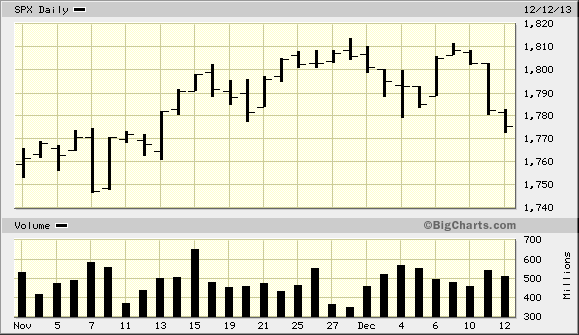
other guys, on average, for a long, long time.” – Charlie MungerDespite a strong 2013, the stock market seems to be limping into the end of the year. On Thursday, the S&P 500 dipped down to its lowest level in nearly a month. The index has lost ground on eight of the last ten days, and we’re on track for our worst weekly performance in the last 15 weeks.
Of course, since volatility is so low, the overall loss ain’t that much (see the chart below). This is a minor pullback at best. The S&P 500 is currently less than 1.8% below its all-time high close. That’s right folks, we’ve dropped all the way back to those grim and hopeless days of early November. Naturally, some folks are already calling this the beginning of a new bear market. Please: We’re trading at less than 14.5 times next year’s earnings, and estimates have been moving higher.
Before we get into this week’s issue, I want to remind you that I’ll be unveiling the 2014 Buy List in next week’s issue. As usual, I’m adding five new names to the Buy List, and I’m deleting five names. The Buy List always stays at 20 stocks.
The new Buy List takes effect on January 2nd, the first day of trading of the new year, and it’s locked and sealed for the entire year. I can’t make any changes. For tracking purposes, I assume the Buy List is a $1 million portfolio, equally divided among the 20 stocks. Whenever I mention how well (or poorly) our Buy List is doing, that’s what I’m referring to. And don’t forget that you can always see how well we’re doing by visiting the Buy List page of our website.
In this week’s issue, I want to look at more encouraging economic signs. There’s a very good chance that 2014 will be the strongest year for economic growth in quite some time. Will stocks follow? Well, that’s another matter. We’ll also take a look at upcoming earnings reports from FactSet Research Systems and Oracle. I also want to update a few other Buy List stocks. But first, let’s take a closer look at why the economy is looking up.
The Balance Sheet Recession Is Finally Over
One of the big turning points we’ve seen recently is that economic news has improved considerably. I still wouldn’t say that the economy is strong, but we’re a lot better than where we were. The key is that many of the risks that plagued us have slowly melted away. Even our hopelessly dysfunctional Congress seems to have gotten its act together and reached a deal to avert yet another government shutdown. I’ve also been pleased to see things look better in Europe. It was the euro crisis that weighed heavily on U.S. stocks in 2011 and 2012.
While a lot of people have been calling the stock market a bubble, I think we’ve witnessed very much the opposite. Namely, the tremendous fear bubble has deflated. It was only two years ago that the S&P 500 hit its lowest P/E Ratio in over two decades.
Another area where we can see the dissipation of fear is in the credit markets. Bond traders are paid to worry about things, and they’re having a harder time of it. Bespoke Investment Group pointed out that high-yield spreads are at a six-year low, which is a clear sign of optimism. When lenders are afraid, they pull back, and when credit markets freeze up, the whole economy is in trouble. That’s not what’s going on right now.
Things are also looking good for consumers. David Rosenberg, who’s been a long-time bear, has defected to Camp Bull. He noted that the Fed’s recent Beige Book referred to wage pressures 26 times. Folks are also hitting the stores. Retail sales for November rose 0.7%, and the October figure was revised upward to 0.6%. That’s good news for Buy List retailers like Ross Stores ($ROST) and Bed Bath & Beyond ($BBBY).
Consumers have also been getting their finances in order. Cullen Roche, who’s one of the most astute writers on the economy today, recently declared an end to the “balance sheet recession.” For the first time in several years, households are adding on debt. I realize that may sound like something bad, but in econo-speak, it’s actually good news. More household debt is what needs to happen during an expansion. The long trend of paying down debt was a necessary and painful obstacle for the economy. It’s come to an end.
Even Uncle Sam’s finances are getting better. The U.S. budget deficit, while still massive, is much less massive than it was a few years ago. The deficit for this year will probably be about 3% of GDP, which is down from 10% in 2009. Also, cost-cutting at the local government level (what some people call “austerity”) is largely over.
I’ve also noted that the spread between the 2- and 10-year Treasuries is widening, which is a classic forward-looking indicator for the economy. In fact, it’s one of the most reliable macro indicators around. What’s particularly interesting is that the yield on the two-year has been fairly stable, while the 10-year has been rising. The 2-10 spread is near the highest it’s been in more than two years. This is a particularly good omen for Buy List financial stocks like Wells Fargo ($WFC) and JPMorgan Chase ($JPM). Remember that a bank is basically the yield curve with incorporation papers. Now let’s take a look at some upcoming earnings reports.
FactSet Research Systems Is a Steady Winner
Three of our Buy List stocks have reporting quarters that end in November, and two of them, Oracle and FactSet Research Systems, will report earnings next week. FactSet ($FDS) is due to release its fiscal Q1 earnings report on Tuesday, December 17th, and Oracle follows the next day with its fiscal Q2 earnings report. The third stock, Bed Bath & Beyond, won’t report its earnings until January 8.
Let’s start with FactSet, which has been a solid performer for us this year. The stock, which makes software that tracks all the geeky financial data that Wall Street loves to play around with, is up 30% this year. Six months ago, FactSet merely “met” Wall Street’s consensus, and you can probably guess what happened. Traders panicked. The stock dropped. We sat and watched. After a bit, the stock quietly rallied to a new high. That’s our game, and we play it well.
Then three months ago, FactSet had an earnings “miss.” Well, technically it was a miss, since it was one whole penny below Wall Street’s consensus—never mind that it was well within FactSet’s own guidance for the quarter. But because it was a miss, the shares dropped. Like clockwork, the stock settled down and again quietly rallied to another all-time high. FDS came close to making another new high yesterday, even though the broader market was retreating.
Now let’s get into some numbers. When looking at FactSet, the important metric to watch is ASV, which is annual subscription value. The ASV for last quarter rose by 6%, which is a good number. For the upcoming earnings report, FactSet said they expect to see revenues between $222 and $225 million and earnings between $1.21 and $1.24 per share. That’s strong growth. For comparison, FDS earned $1.11 in last year’s fiscal Q1.
Here’s the bottom line: Business is going well for FactSet. It’s still early, but I think the company can churn out $5 per share this fiscal year (which ends in August). This is a steady winner. FactSet remains a very good buy up to $119 per share.
Oracle Is a Buy up to $36 per Share
Oracle ($ORCL) is due to report its earnings on Wednesday, December 18. On Monday, ORCL hit a nine-month high, but it suddenly got chopped down later this week. On Thursday, two Wall Street firms, Morgan Stanley and RBC, downgraded Oracle. Both analysts think the valuation is too high, which I think is nuts. But one of the analysts cited concerns about cloud computing, which I think is a valid concern but probably overstated.
I have to admit that Oracle had been frustrating us for much of this year. It’s by far our worst-performing stock on the Buy List. Their new software sales, in particular, have been disappointing. But I’ve learned to never count Larry Ellison out. If there’s one lesson I’ve learned in life, it’s that businessmen who own their own Hawaiian island probably know what they’re doing. Just a rule of thumb there.
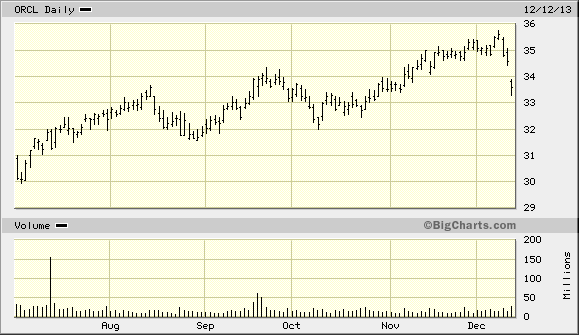
Oracle’s last earnings report was pretty good. Whenever I look at an earnings report, I like to dig into see the numbers below the surface. One key metric is free cash flow, and for Oracle that was a cool $6 billion last quarter, and about half of that went to share buybacks. Actually, the earnings would have been even better this time if it weren’t for those meddling currency effects. I was also pleased to see Oracle double its dividend in June. That’s always a strong sign of confidence from management.
Three months ago, Oracle told us to expect Q2 earnings to range between 64 and 69 cents per share. They should be able to top that, but I’m curious to see what guidance they’ll offer for fiscal Q3. I suspect Oracle enjoys low-balling Wall Street. For this fiscal year, I think Oracle has a chance to earn as much as $3 per share, which means the stock is going for about 11 times forward earnings. That’s a good deal. Don’t let this week’s downdraft rattle you. Oracle is a good buy up to $36 per share.
Buy List Updates
Now here are a few updates to some of our other Buy List stocks. This week, AFLAC ($AFL), our favorite duck stock, gave a presentation at a Goldman Sachs conference. One of things I like about AFLAC, besides its being very well run, is that it’s a fairly transparent company. They’re up front about what’s going on, which is frustratingly rare. Supplemental health insurance can be rather opaque, but AFLAC tries to bring some clarity. If you remember, when the stock dropped over concerns about its European investments, management kept investors in the loop.
While I like AFLAC a lot, it’s no secret what one of their major problems is: Bond yields around the world are pitifully low, and that’s not fun if you’re running a $100 billion fixed-income portfolio. At the Goldman conference, the company explained that they want to diversify their portfolio outside of Japanese government bonds. They even hired a top manager away from Goldman to run their portfolio. AFLAC said they want to start buying other assets, including more U.S. corporate debt. I think this is a smart move. The company has strong cash flow, so they have to keep plowing that coin back into suitable fixed income. Right now, AFLAC is going for about 10 times next year’s earnings. My take: It’s a solid buy up to $70 per share.
A few months ago, there was some mindless chatter that Google ($GOOG) was about to buy the very lucrative NFL Sunday ticket away from DirecTV. Suddenly, everybody thought that football was going to be broadcast over YouTube. Oh brother. At the time, I said this was complete nonsense. The truth is that the NFL is very happy with DTV, and vice versa. Of course whenever a contract is up, you want to hear offers from other parties. What’s the word for that? Oh right, business.
Sure enough, the latest word is that DTV and the NFL are close to reaching a deal to keep the NFL Sunday Ticket at DirecTV. The Sunday Ticket has two million subscribers, and the package starts at $49.99 per month. On Thursday, shares of DirecTV gapped up to a new all-time high. DirecTV is a buy up to $70 per share.
Ford Motor ($F) continues to be a bargain hidden in plain sight. The company has impressive plans for the future. Ford said they’re hiring 11,000 new people next year, 5,000 in the U.S. and 6,000 in Asia. This will be the most people they’ve hired since 2000. Ford plans to introduce 23 new vehicles next year, 16 of which will be in the U.S. The stock is now going for less than nine times next year’s estimate. I rate Ford a buy up to $18 per share.
Finally Fiserv ($FISV) splits 2 for 1 next Tuesday. Don’t be surprised when you see the lower share price. The stock remains a buy up to $112 per share, and post-split, the Buy Below will be $56 per share. This is a good stock.
That’s all for now. Next week is the last full trading week of the year. We’ll get earnings reports from FactSet on Tuesday and Oracle on Wednesday. The Fed meets on Tuesday and Wednesday, and Bernanke will hold his last post-meeting press conference, but I doubt we’ll see a taper announcement. Next week, we’ll also get an important report on Industrial Production, plus we’ll see another revision to Q3 GDP. Be sure to keep checking the blog for daily updates. I’ll have more market analysis for you in the next issue of CWS Market Review!
– Eddy
P.S. Here’s a segment I did earlier this week on CNBC’s “Fast Money.”
-
Morning News: December 13, 2013
Posted by Eddy Elfenbein on December 13th, 2013 at 7:03 amIreland’s Tough Economic Policies ‘To Continue’, Says Finance Minister
Goldman Sachs Goes Against Consensus in Dollar Call
Ukraine Riots Flash Buy Signal to Foreigners as Bonds Scooped Up
Indian Court Lifts Obstacle to Microsoft-Nokia Merger
Stronger U.S. Retail Sales Point to Spending Rebound
Retailers Extending Black Friday Deals Amid Lukewarm Demand
With $25 Million Bet, Silicon Valley Officially Claims Bitcoin as Its Own
A Surprise From Hilton: Big Profit for Blackstone
Peugeot Shares Fall as General Motors Sells Its Shareholding
Dan Akerson: The CEO Who Took GM From the Wake of Bankruptcy to Profitability
Instagram Introduces Private Messaging
JPMorgan Said to Near $2 Billion Settlement of Madoff Probes
Cisco Cuts Long-term Revenue, Earnings Targets
Credit Writedowns: What Do Negative Interest Rates Do?
Why Buyouts Are Stalled in the Middle Market
Be sure to follow me on Twitter.
-
Rosenberg: “a better U.S. economy is at hand”
Posted by Eddy Elfenbein on December 12th, 2013 at 10:10 amDavid Rosenberg, who has been a long-time bear, has shifted his stance and now sees reasons for optimism:
With this in mind, the most fascinating statistic this past week was not ISM or nonfarm payrolls, but the number of times the Beige Book commented on wage pressures: 26. That’s not insignificant. Again, when I talked about this at the Thursday night dinner, eyeballs rolled.
There was much discussion about the lacklustre holiday shopping season thus far, with November sales below plan. There was little talk, however, about auto sales hitting a seven-year high in November even with lower incentives. And what’s a greater commitment to the economy — a car or a cardigan?
As I sifted through the Beige Book to see which areas of the economy were posting upward wage pressure and growing skilled labour shortages, I could see it cut a large swath: technology, construction, transportation services, restaurants, durable goods manufacturing.
Of the 115 million people currently working in the private sector, roughly 40 million of them are going to be reaping some benefits in the form of a higher stipend and that is 35% of the jobs pie right there.
That isn’t everyone, but it is certainly enough of a critical mass to spin the dial for higher income growth (and spending) in the coming year. Macro surprises are destined to be on the high side — take it from a former bear who knows how to identify stormy clouds.
-
The Santa Claus Rally Season Is About To Begin
Posted by Eddy Elfenbein on December 12th, 2013 at 8:23 amWe’re getting close to what is historically the best time of the year for stocks.
I took all of the historical data for the Dow Jones from 1896 through 2010 and found that the streak from December 22nd to January 6th is the best time of the year for stocks. (December 21st and January 7th have also been positive days for the market but only by a tiny bit.)
Over the 16-day run from December 22nd to January 6th, the Dow has gained an average of 3.23%. That’s 41% of the Dow’s average annual gain of 7.87% occurring over less than 5% of the year. (It’s really even less than 5% since the market is always closed on December 25th and January 1st. The Santa Claus Stretch has made up just 3.8% of all trading days.)
Here’s a look at the Dow’s average performance in December and January (December 21st is based at 100):
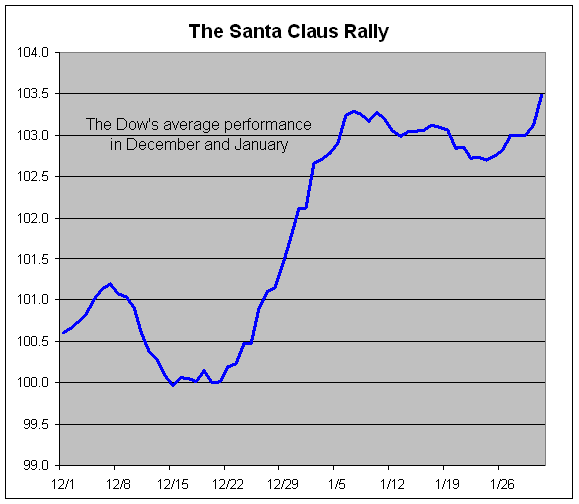
You should note how small the vertical axis is. Ultimately, we’re not talking about a very large move.
-
Morning News: December 12, 2013
Posted by Eddy Elfenbein on December 12th, 2013 at 6:57 amEuro Zone Industrial Output Unexpectedly Falls in October
Draghi Builds Stress-Test Credibility in ECB Bank Review
Hardships Linger for a Mending Ireland
Mexico Lower House Passes Oil Overhaul to End State Monopoly
Fischer Seen Bringing Crisis-Fighting Skills to No. 2 Fed Post
Foreclosures Drop to Eight-Year Low as Crisis Wanes
IATA Boosts Profit Forecast 10% But Warns Returns Still Weak
Blackstone’s Hilton Raises $2.35 Billion in Record Hotel IPO
Korea Aerospace Seals $1.1 Billion Jet Deal
Peugeot Shares Sink 10% on Capital Hike Worries
Snapchat Confirms $50 Million Investment
Criminal Action Is Expected for JPMorgan in Madoff Case
Cullen Roche: Some Thoughts on Economic and Market Forecasting
Howard Lindzon: Google and Goldman Sachs…The Enteroctopus and The Vampire Squid
Be sure to follow me on Twitter.
-
Some Guy on TV
Posted by Eddy Elfenbein on December 11th, 2013 at 6:53 pmYep, that was me on CNBC’s Fast Money talking about the 2-10 spread. Here’s the 2-10 Spread going back 30 years. Notice how it turns negative before each recession (the shaded parts). It’s got a great track record, and it’s been more bullish lately.
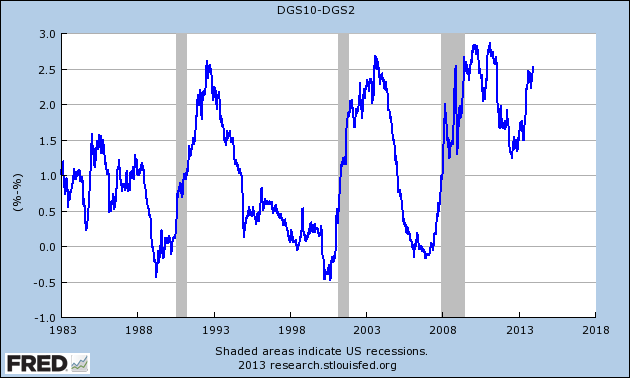
Eddy: It’s looking good for the economy. A lot of people on Wall Street are paid a lot of money to predict the economy and a lot of them don’t have very good track records. One of the best is one of the cheapest, and that is the difference between the 2 and the 10. And it’s been going up over the last few weeks and it’s now at a two-year high.
Josh Brown: Eddy, I see in the chart that you’re showing that we kind of had a false start toward the end of 2010, and we actually know how that’s worked out for momentum stocks and cyclicals ever since then. Is there anything in your reading of this or elsewhere that could tell you that “this time is different” from the false start in 2010 when we were all faked out?
Eddy: Absolutely. I think there are two good confirmations. One is the ISM report for November which was also a two-year high. It is the exact same time frame as the 2-10 spread. Another one is that if we look at the relative strength of the Cyclical Index, the CYC, that is also at a two-year high. It’s confirming these trends almost perfectly.
Melissa Lee: Were you surprised, actually, that you had these other two indicators also confirm this trend given that the Fed has essentially been manipulating the yield curve for so long?
Eddy: The difference is what we saw earlier in this year when the 2-10 spread got wider, but it was a different underlying trend driving it: the middle part of the yield curve is what was driving it, and that was the fear of taper. This time it’s very different because the middle part really hasn’t moved much at all. In fact, the two-year part is lower than where it was on Labor Day. The real driver of the growing steepness of the spread has been on the ten-year. And that’s driven up so that we’re about 260 basis points wide right now.
-
Morning News: December 11, 2013
Posted by Eddy Elfenbein on December 11th, 2013 at 7:34 amEU States Move Toward Clash With Parliament on Bank Plan
Yen Rises From Six-Month Low as Asian Stocks Fall; Aussie Slides
The Volcker Rule Is Tough. It’s Complicated. Will It Be Effective?
Time to Take the Bitcoin Bubble Seriously
Costco Profit Misses Estimates
Advice for GM’s CEO Mary Barra
Lloyds Fined £28 Million For ‘Serious Failings’ in Sales Practices
GE Capital to Pay $34 Million to Credit Card Customers
Zara Parent Inditex’s Profit Edges Higher
Twitter Rises Most Since IPO on Advertising Product Optimism
What Exactly is Imgur, and Why is Yahoo Trying to Buy It?
Joshua Brown: The Wizard of Oz Was About the Gold Standard
Roger Nusbaum: Yahoo Finance: Could You Be Oversaving for Retirement?
Be sure to follow me on Twitter.
-
Investing Isn’t Rocket Science
– No, It’s Harder than That!
Posted by Eddy Elfenbein on December 10th, 2013 at 5:23 pmOn December 10, 1896, Alfred Nobel died. He left a lot of money for scientific prizes named after him. In honor of his death date, the Nobel Prize ceremony is usually held on this day, December 10. The first ceremony was in 1901 when the first Nobel Peace Prize was awarded to the Swiss founder of the Red Cross, Jean Henri Durant. The 1901 Physics prize went to Wilhelm Roentgen for the “remarkable rays” named after him. The 1903 Physics prize went to Pierre Curie and Marie Curie – the first female winner.
Three “hard” sciences have been awarded Nobel Prizes since 1901, namely physics, chemistry and physiology or medicine. The softer, more subjective awards are for Literature and Peace. Since 1968, the Nobel commission has added the “Nobel Memorial Prize in Economic Sciences,” but the question facing us today is whether economics is more of a hard science, like Physics, or a creative art, like Literature.
Since the days of John Maynard Keynes, economists have tried to turn their profession into a science, using calculus to create complex mathematical models, which they call “econometrics.” Alas, in the end, as Alan Greenspan unburdened himself in his recent tome, “The Map and the Territory,” economics is more about our “animal spirits” – greed, fear and mob behavior – than bloodless mathematical models.
That brings us to the three winners of the 2013 Nobel Prize for Economics. Each won the big prize for his work in how to apply mathematical models to asset values – like stock prices. The problem is that all three came to strikingly different conclusions. In Physics, this would be like Albert Einstein and Neils Bohr (the 1921 and 1922 winners) having divergent opinions about how gravity works, or the speed of light.
Meet the 2013 Nobel Prize Winners – Eugene Fama, Robert Shiller and Lars Hansen
Here are the Nobel Prize winners and their divergent views.
Eugene Francis Fama, age 74, is Professor of Finance at the University of Chicago. He is often called the father of the “efficient market” hypothesis which stemmed from his doctoral thesis. He is best known for using exhaustive market databases to formulate theoretical and empirical (real life) portfolio decisions.
Robert James Shiller, 67, often appears on CNBC in connection with his famous housing index, as well as his market predictions. He is currently Professor of Economics at Yale, after holding key positions in the National Bureau of Economic Research and the American Economic Association. He is also co-founder and chief economist for an investment management firm, MacroMarkets LLC. Unlike Fama, Shiller is noted for pointing out market inefficiencies and price anomalies within the major markets.
Lars Peter Hansen, 61, is perhaps lesser known to investors than the other two. Like Fama, he teaches at the University of Chicago as the David Rockefeller Distinguished Service Professor of Economics. He is best known for his studies on the interface between the financial and the “real” sectors of the economy.
All three plow the same field – asset valuation – but they emerge with different answers. Fama says that most markets are “informationally efficient,” since most investors revalue prices almost instantaneously to reflect any new information. In shorthand, the news is rapidly reflected, or baked into, the market price.
Shiller doesn’t think investors are that smart or rational. Investors are subject to animal spirits, prisoners of their human nature and subject to mob psychology. Shiller proved in the 1980s that stock prices move in much wider swings than their underlying dividends, which are far more predictable than stock prices.
A famous case in point is Shiller’s book, “Irrational Exuberance,” which was first published in March of 2000, the exact month of the peak in NASDAQ and S&P 500. In his 2005 update to that book, Shiller added a section on how overvalued the U.S. housing market had become. He showed that housing was a case of greed fueled by unrealistic previous price increases. His predictions were once again right on the money, as real estate prices soon peaked and began to fall precipitously over the next few years, as reflected in the housing index that Shiller pioneered – now called the S&P Case-Shiller home price index.
The tie-breaker in this argument comes from Lars Hansen, who studies the causes of market volatility. He seems to lean more toward Shiller’s view, that the wide variations in asset prices within a short time cannot be caused by slight changes in valuation measures. Such swings are not explainable by normal valuation models, so Hansen focuses on those “moments” of change, when investors vacillate from manic to depressive. This seems to be the origin of the recent fixation with the terms “risk on” and “risk off.”
While Shiller and Hansen seem to dispute Fama’s conclusions, Fama has won the allegiance of armies of index fund managers, who deny the value of individual stock selection in favor of exchange-traded funds (ETFs) and various index funds, which try to reflect the movement of indexes by constantly rejiggering the funds’ contents to reflect the market capitalization of each stock in the index, thereby exacerbating the size of the market’s swings, as index fund managers are forced to chase the “hottest” stocks in the index.
Successful Investing Differs from Econometric Modelling
My father was a rocket scientist, of sorts. During my college years (1963-67), he was a Boeing engineer and project manager in Huntsville, Alabama, and New Orleans, helping build the Saturn booster rockets. In retirement, dad applied his scientific skills to the stock market. He kept elaborate graphs of each stock he followed – by price, dividend, P/E and other ratios. It was all very mathematical, but his track record was unsatisfactory, so he asked for my advice. Looking at all his charts, I said, “Dad, investing isn’t like rocket science. It’s harder than that.” He wasn’t sure if had lost my marbles, so I explained: “Investing involves real people making emotional decisions, usually bad decisions. In rocket science, you can project a missile into space with known variables, with almost exact precision. With investing, you have to work with human beings. The numbers have some limited value, but they won’t be able to predict stock prices.”
Justin Fox’s 2009 book, “The Myth of the Rational Market” covered how physicists from the Los Alamos National Laboratory launched the Santa Fe Institute, which attempted to apply chaos theory to markets. Fox wrote: “Physicists struggled with the reality that sentient beings are harder to work with than, say, subatomic particles.” One physicist, J. Doyne Farmer, said economics is “a harder field than physics.”
In my 30+ years of working with financial newsletter editors, I’ve run into many former engineers who became investment advisors, lured by the fascination of seeking scientific formulas for profits. These advisors became successful, but only by accounting for investor sentiment and other emotional elements.
Prices will always swing in wide arcs – due to human excesses, not just logic. That fact will always give investors a chance to beat the markets. After all, it’s almost un-American to strive to be just “average.”
– Gary Alexander
Navellier Market Mail
-
Archives
- October 2026
- September 2026
- August 2026
- July 2026
- June 2026
- May 2026
- April 2026
- March 2026
- February 2026
- January 2026
- December 2025
- November 2025
- October 2025
- September 2025
- August 2025
- July 2025
- June 2025
- May 2025
- April 2025
- March 2025
- February 2025
- January 2025
- December 2024
- November 2024
- October 2024
- September 2024
- August 2024
- July 2024
- June 2024
- May 2024
- April 2024
- March 2024
- February 2024
- January 2024
- December 2023
- November 2023
- October 2023
- September 2023
- August 2023
- July 2023
- June 2023
- May 2023
- April 2023
- March 2023
- February 2023
- January 2023
- December 2022
- November 2022
- October 2022
- September 2022
- August 2022
- July 2022
- June 2022
- May 2022
- April 2022
- March 2022
- February 2022
- January 2022
- December 2021
- November 2021
- October 2021
- September 2021
- August 2021
- July 2021
- June 2021
- May 2021
- April 2021
- March 2021
- February 2021
- January 2021
- December 2020
- November 2020
- October 2020
- September 2020
- August 2020
- July 2020
- June 2020
- May 2020
- April 2020
- March 2020
- February 2020
- January 2020
- December 2019
- November 2019
- October 2019
- September 2019
- August 2019
- July 2019
- June 2019
- May 2019
- April 2019
- March 2019
- February 2019
- January 2019
- December 2018
- November 2018
- October 2018
- September 2018
- August 2018
- July 2018
- June 2018
- May 2018
- April 2018
- March 2018
- February 2018
- January 2018
- December 2017
- November 2017
- October 2017
- September 2017
- August 2017
- July 2017
- June 2017
- May 2017
- April 2017
- March 2017
- February 2017
- January 2017
- December 2016
- November 2016
- October 2016
- September 2016
- August 2016
- July 2016
- June 2016
- May 2016
- April 2016
- March 2016
- February 2016
- January 2016
- December 2015
- November 2015
- October 2015
- September 2015
- August 2015
- July 2015
- June 2015
- May 2015
- April 2015
- March 2015
- February 2015
- January 2015
- December 2014
- November 2014
- October 2014
- September 2014
- August 2014
- July 2014
- June 2014
- May 2014
- April 2014
- March 2014
- February 2014
- January 2014
- December 2013
- November 2013
- October 2013
- September 2013
- August 2013
- July 2013
- June 2013
- May 2013
- April 2013
- March 2013
- February 2013
- January 2013
- December 2012
- November 2012
- October 2012
- September 2012
- August 2012
- July 2012
- June 2012
- May 2012
- April 2012
- March 2012
- February 2012
- January 2012
- December 2011
- November 2011
- October 2011
- September 2011
- August 2011
- July 2011
- June 2011
- May 2011
- April 2011
- March 2011
- February 2011
- January 2011
- December 2010
- November 2010
- October 2010
- September 2010
- August 2010
- July 2010
- June 2010
- May 2010
- April 2010
- March 2010
- February 2010
- January 2010
- December 2009
- November 2009
- October 2009
- September 2009
- August 2009
- July 2009
- June 2009
- May 2009
- April 2009
- March 2009
- February 2009
- January 2009
- December 2008
- November 2008
- October 2008
- September 2008
- August 2008
- July 2008
- June 2008
- May 2008
- April 2008
- March 2008
- February 2008
- January 2008
- December 2007
- November 2007
- October 2007
- September 2007
- August 2007
- July 2007
- June 2007
- May 2007
- April 2007
- March 2007
- February 2007
- January 2007
- December 2006
- November 2006
- October 2006
- September 2006
- August 2006
- July 2006
- June 2006
- May 2006
- April 2006
- March 2006
- February 2006
- January 2006
- December 2005
- November 2005
- October 2005
- September 2005
- August 2005
- July 2005
 Eddy Elfenbein is a Washington, DC-based speaker, portfolio manager and editor of the blog Crossing Wall Street. His