-
Back Above the 50-DMA
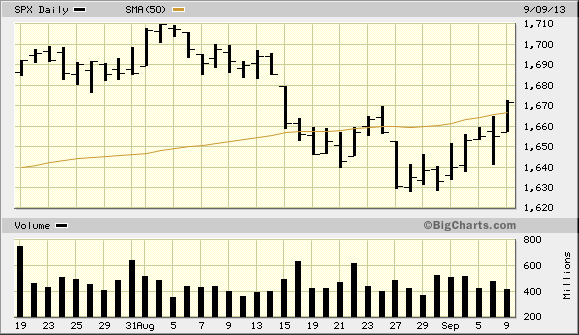
Posted by Eddy Elfenbein on September 9th, 2013 at 9:50 pmWe closed higher again today. This was our fifth-straight rally. Today was the best day for the S&P 500 since August 1st. The index is now above its 50-day moving average.
-
The Economy and the Stock Market Aren’t the Same
Posted by Eddy Elfenbein on September 9th, 2013 at 2:40 pmDon’t read too much into this chart, but I think it’s interesting for investors to take note of. This is a scatterplot of the annual change in nominal GDP (horizontal) along with the annual change in the S&P 500 (vertical):
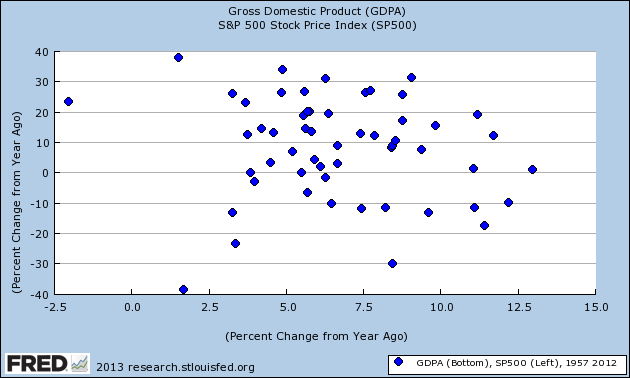
Just looking at it, there’s no correlation. In fact, it almost appears to be slightly negative.
I think there are a few important takeaways. The first is that the stock market is not the economy. They are different animals though closely related. For one, the stock market tries to anticipate the economy so it will often lead it by a few months.
Also, the stock market is concerned with corporate profits which is only a small part of the overall economy. Over the past few years, for example, corporate profits have grown quite well, but the overall economy has not.
You should always hold economic news, good or bad, at a slight distance when considering your investments.
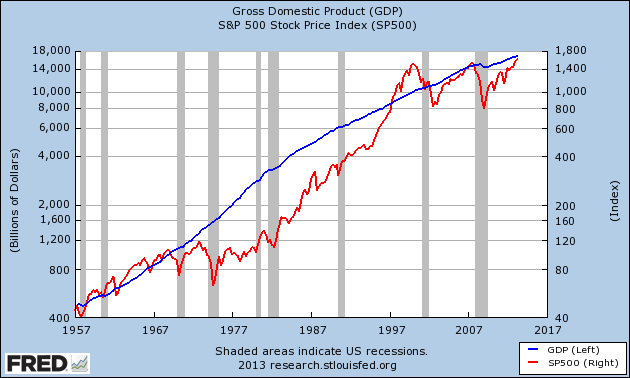
Here’s nominal GDP (blue, left) along with the S&P 500 (right, red). Both are in log scale.
-
Cyclical-S&P 500 Ratio Hits Two-Year High
Posted by Eddy Elfenbein on September 9th, 2013 at 11:37 amCyclical leadership continues. The Morgan Stanley Cyclical Index ($CYC) divided by the S&P 500 is at another two-year high.

-
On Track for Five Straight Up Days
Posted by Eddy Elfenbein on September 9th, 2013 at 11:31 amThe stock market is up again in early trading this morning. This could be our fifth-straight rally this September, but that includes a microscopic gain on Friday. The Dow crossed back over 15,000. More importantly, the S&P 500 is inching closer towards its 50-DMA which is currently 1,666.50.
The market appears to like the very strong GDP numbers from Japan. A report on Chinese exports was also better than expected. Cyclicals are doing well again today. Energy, Industrials and Materials are leading the rally. Finance, Utilities and Healthcare are in the rear, but still up for the day.
Once again, the issue of Syria is weighing on the market. I don’t think any action in Syria would impact the markets or economy very much, but without other news, it will take on outsized influence. The Senate will vote on a resolution later this week. On our Buy List, shares of CR Bard ($BCR) have been as high as $118.47 today which is a new 52-week high. Ford Motor ($F) is also doing well.
The Fed, of course, meets again next Tuesday and Wednesday. The current consensus on the Street is that they’ll taper their bond purchases by $10 billion per month.
-
Morning News: September 9, 2013
Posted by Eddy Elfenbein on September 9th, 2013 at 6:17 amFinancial Crisis: Lessons of the Rescue, A Drama in Five Acts
Economy in China Benefits from Stronger U.S. Demand
China’s Inflation Slows to 2.6% in August
Now or Never for Japan Reforms
Mexico Tax Plan Adds Sweeping New Social Programs
Russia to Brazil Intervention Adds to U.S. Debt Distress
Here’s What Obamacare Will Actually Cost
Investors Are Poised to Pay $6 Billion for Neiman Marcus
Japan’s Suntory to Buy GSK Drink Brands Lucozade and Ribena for $2.7 Billion
Kabel Deutschland Shareholders Fear Falling Shy Of Vodafone Goal
Worries That Microsoft Is Growing Too Tricky To Manage
Deloitte Fined 14 Million Pounds Over MG Rover Advice
Nomura: These 6 Companies Are Set To Make A Fortune On The 2020 Olympics
Jeff Miller: Weighing the Week Ahead: What Does the Syrian Crisis Mean for Stocks?
Epicurean Dealmaker: I, Fembot
Be sure to follow me on Twitter.
-
The Most Important Economic Chart in the U.S. Right Now
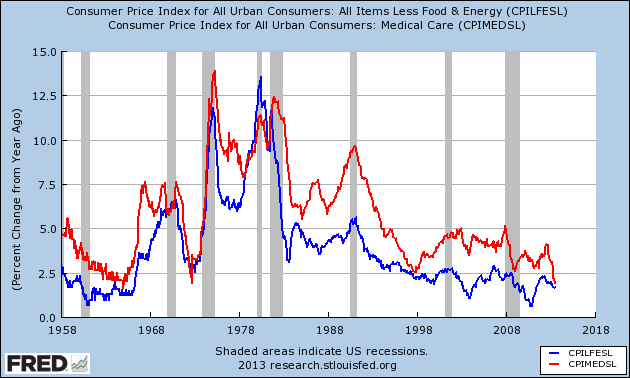
Posted by Eddy Elfenbein on September 6th, 2013 at 11:58 pmHealthcare price index divided by the core inflation index:
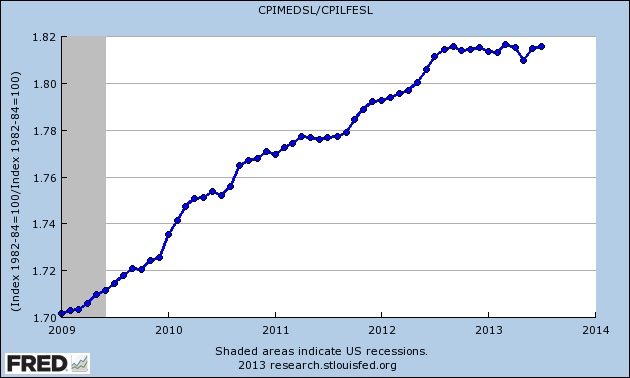
The trend is still young, but after decades of outpacing inflation, healthcare costs have been acting like everybody else.
If this holds up, it’s a game-changer.
Very soon, year-over-over healthcare inflation may come in below core inflation. That hasn’t happened in 32 years.
-
Pictures from Life’s Other Side
Posted by Eddy Elfenbein on September 6th, 2013 at 5:00 pm -
August NFP = 169k, Unemployment Falls to 7.3%
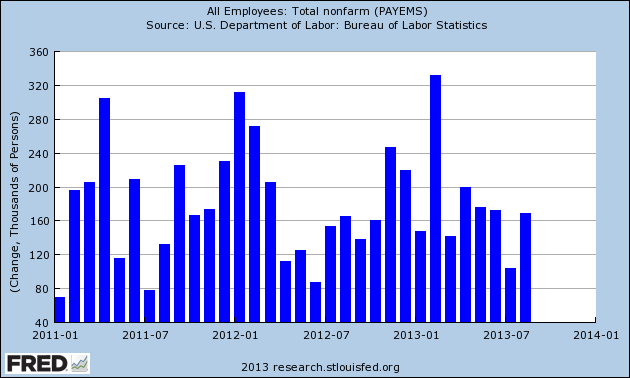
Posted by Eddy Elfenbein on September 6th, 2013 at 8:42 amThe August jobs report is out and it showed that 169,000 jobs were created last month. The weak part is that only 152,000 jobs were created in the private sector. The number for July was revised downward from 162,000 to 104,000. That’s a big revision. June was also lowered from 188,000 to 172,000.
The unemployment rate actually ticked down from 7.4% to 7.3%.
-
CWS Market Review – September 6, 2013
Posted by Eddy Elfenbein on September 6th, 2013 at 6:58 am“Sometimes your best investments are the ones you don’t make.” – Donald Trump
The Labor Day weekend is behind us, and the stock market has so far shaken off its August blues. The S&P 500 has rallied for three straight days this week and is back over 1,655. In fact, the index is getting close to breaking above its 50-day moving average. Since August 16th, we’ve closed below the 50-DMA every day but one.

Now all eyes are on the Federal Reserve and what it will do at its next meeting on September 17-18. Make no mistake, this is the most-anticipated FOMC meeting in years. The bigwigs inside the central bank have more than hinted to us that we can expect a paring back in the Fed’s asset-buying program. Of course, no decision has been made yet. Plus, even if there is a tapering announcement, we still don’t know how much it will be. Either way, over the next two weeks, you can expect a lot of opinion-makers opining on what the Fed’s opinion ought to be.
Fortunately for us, we don’t have to fret over such decisions. Our strategy remains the same. We’re focusing on high-quality stocks going for good prices, and it’s working. Despite the August slump, our Buy List holds a nice 4.7% lead over the S&P 500 for the year. By the way, did you notice the nice rebound in Ford ($F)? The automaker just reported its best sales months since 2006.
In this week’s CWS Market Review, we’ll preview the upcoming Fed meeting. I also want to cover the terrible deal Microsoft ($MSFT) just struck with Nokia ($NOK). (I really wish awful dealmakers like Steve Ballmer were in my fantasy football league.) I also want to share with you some names that I’m considering for next year’s Buy List. Plus, I want to touch on the very good ISM reports from this week. But first, let’s look at what Ben Bernanke and his crew at the Fed have in store for the economy, Wall Street and our Buy List.
Countdown to the September FOMC Meeting
The Federal Reserve meets again in two weeks, and this meeting is a biggie. Without making anything definite, Fed officials have used speeches and the media to hint that an announcement of tapering bond purchases is on the table.
Here’s where we stand. Since short-term interest rates are already close to 0%, the Fed has had to use its bond buying as an extra-special tool to help the economy get back on its feet. The Fed has also said that it will stop the bond buying first before it considers raising short-term interest rates. The Fed’s policy is that it won’t raise short-term rates until unemployment falls to 6.5%, which they don’t see happening until the middle of 2015 at the earliest.
So has the bond-buying program worked? That’s hard to say, and to some extent, I don’t care. At the least, we can say that the program has correlated with a recovery in the housing market and a surge in U.S. auto sales. The big winners in the stock market for the last year have been anything at the intersection of consumer finance and large-ticket consumer items. In plainer words, stuff people buy with borrowed money. That’s why the Consumer Discretionary ETF ($XLY) and stocks like Visa ($V) have done so well.
The stock market has been gradually rewarding riskier investments lately at the expense of safer areas. For example, utilities and consumer staples have been rather weak, but industrials have been strong. While financial stocks have been big winners since late 2011, they’ve been underperforming lately. I think this market shift is in anticipation of improved economic growth.
I think it’s a mistake to assume that the entire economy has been aided by steroids from the Fed. More than a few folks on Wall Street think that once the Fed’s assistance is gone, stock prices are due to crash. I disagree. The economy appears to have reached escape velocity, where every improvement builds on what came before. Analysts on Wall Street expect to see earnings growth of over 12% for Q3, and over 25% for Q4. If those forecasts are in the ballpark, the stock market is still cheap.
What’s really shocked people, including myself, is the rout in the bond market. As we look back at the 2013 investing year, May 2nd may turn out to be the key date. That’s when the bond market started to turn south in a big way. Except for very short-term rates which haven’t budged, most Treasury yields are at two-year highs, and they continue to rise. On Thursday, the yield on the ten-year Treasury broke 3% for the first time since July 2011.
Consider that the yield on the five-year jumped from a measly 0.65% in early May to 1.85% by Thursday’s close. Of course, in absolute terms, that’s still a puny yield, but it’s a big turnaround from what we’ve seen. It’s hard to believe that in the spring of 2011, the five-year was inching up over 2.35%.
The rise in yields has been greatest with the seven- and ten-year bonds (more than 130 basis points for each). Interestingly, short-term yields haven’t moved. What’s also caught my eye is that the spread among the longer-dated bonds has actually narrowed a bit. In early May, the 30-year yield was 116 basis points higher than that of the 10-year; now it’s down to 90 basis points. The biggest impact on the yield curve is happening in the middle.
As I explained in last week’s issue, I don’t believe the downturn in the bond market is due to fears of inflation or of the Fed’s shutting off the spigots. Instead, the higher yields are actually in anticipation of an improving economy. We got more evidence of that this week with a very strong ISM report on Tuesday. Then on Thursday, we learned that the ISM Services Index hit its highest level since 2005. We should also add the great sales report from Ford to the positive economic news pile.
So what’s all this mean? It seems that in May, the market saw Fed rate increases as being a long way off. Now it doesn’t. In May, the futures contract for the Fed funds in July 2015 rates got to $99.72. Recently, it’s been as low as $99.13. That’s a big shift.
I suspect that traders are probably getting ahead of themselves in predicting any rate increases. The Fed has said it wants to see unemployment down to 6.5% before it starts raising rates. I’m writing this early on Friday, ahead of the August jobs report, so I don’t know what the results will be (check the blog for updates), but we’re still a long way from 6.5%. The key for investors to understand is that the Fed isn’t going away anytime soon.
We don’t have much hard evidence yet on how the economy has performed during the third quarter. The ISM reports offer some clues, and the August jobs report will shed some light. The ADP report on Thursday showed an increase of 176,000 jobs last month, which nearly hit consensus on the nose.
Investors should continue to favor high-quality stocks. Our own Harris Corp. ($HRS) got off to a shaky start this year, but it has been impressive lately. We recently got a 13.5% dividend increase, and the stock hit a new 52-week high on Thursday. Later this month, three of our Buy List stocks are set to report: Oracle ($ORCL), FactSet ($FDS) and Bed Bath & Beyond ($BBBY). I’ll preview these reports in greater detail in next week’s issue, but the one that’s concerning me is Oracle. The last two reports have been duds, and I’m very reluctant to go against Larry Ellison, but I want to see solid performance in this report. Speaking of large-cap tech stocks, let’s look at the big story from this past week.
Microhard: The Awful $7.2-Billion Deal with Nokia
On Labor Day, Microsoft ($MSFT) announced that it’s buying Nokia’s ($NOK) devices and services unit for $7.2 billion in a deal that includes Nokia’s patents. I think this is another one of Steve Ballmer’s lousy deals, and traders agreed with me. Shares of MSFT dropped more than 4.5% on Tuesday (see chart below), which erased the entire surge from Ballmer’s retirement announcement. The stock has lost more than $18 billion in market value since the $7.2 billion deal was announced.
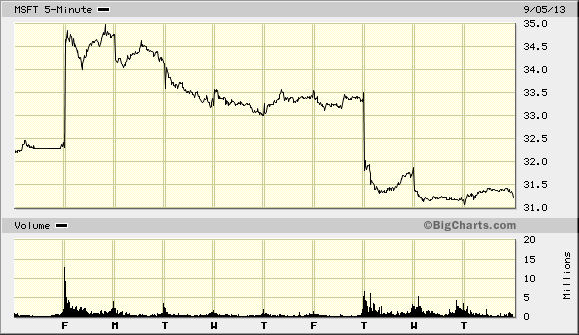
To quote myself, it’s usually a bad sign when news of your resignation causes a market-value increase of $24 billion. This latest deal shows us why the market so distrusts Ballmer. I’m afraid this is another in a long line of bad deals for Microsoft. Ballmer wasn’t joking around when he said he wants MSFT to be a devices company. You have to wonder how much longer the “soft” will be a part of Microsoft.
The Nokia deal is a deal made from weakness, and that’s usually a bad sign. On one level, it makes sense in that it brings together Windows 8 with its biggest hardware supporter. I suppose they think they can replicate the Google-Apple model. I’m not sure what was going to happen. Perhaps Nokia was going to ditch MSFT and go with Android, or maybe NOK was going to declare bankruptcy. That’s not unthinkable. The stock is still down more than 90% from its tech-bubble high. It’s very probable that Microsoft saw only bad scenarios unfolding and decided to make a move. Most importantly, I’m not sure why MSFT can succeed where Nokia has failed.
Microsoft is still on my Buy List, and will be until the end of the year. I’m very unhappy with this recent decision. The only positive thing I can say is that the Nokia deal isn’t that big relative to MSFT’s overall position. It comes to about 86 cents per share. Microsoft is sitting on a cash position of $61 billion, so this doesn’t exactly stretch their finances.
I added MSFT to the Buy List this year, and I’m not sorry I did. I still think the stock was going for a discount relative to its fair value. I also expect to see Microsoft raise its quarterly dividend later this month. The current dividend is 23 cents per share. I’m expecting an increase to 26 cents. Going by Thursday’s closing price of $31.24, that comes to an annual yield of 3.33%. I’m going to lower my Buy Below price on Microsoft to $34 per share.
Ten Candidates for Next Year’s Buy List
Now that we’re in the final third of 2013, I wanted to pass along a few names that I’m looking at as candidates for next year’s Buy List. As usual, I’ll add five new stocks and delete five current ones.
Please understand, this is just a preliminary list, and I won’t finalize next year’s Buy List until mid-December. There are currently ten stocks that I’m keeping a close eye on; IBM ($IBM), CVS Caremark ($CVS), Tupperware ($TUP), Express Scripts ($ESRX), DaVita ($DVA), Varian Medical Systems ($VAR), AutoZone ($AZO), United Stationers ($USTR), Bio-Reference Labs ($BRLI) and St. Jude Medical ($STJ).
Honestly, that list is heavier on healthcare than I would prefer, but that’s where I’ve been seeing high-quality bargains. I plan to have another list of next year’s candidates before the official list comes out in December.
Before I go, I want to make a few small adjustments to our Buy Below prices. In addition to lowering Microsoft’s ($MSFT) Buy Below to $34 per share, I also want to drop WEX’s ($WEX) down to $89. Nothing’s wrong with the stock. I simply want our buy ranges to reflect last month’s pullback. I also want to raise Ross Stores’s ($ROST) Buy Below by $1 to $71 per share. ROST has been doing very well for us.
Lastly, I’m raising CR Bard’s ($BCR) Buy Below to $119. The company just picked up Rochester Medical for a cool $262 million. Bard is paying $20 per share for Rochester, which is a 44% premium. This looks to be a smart deal, and BCR rallied on the news. Bard looks very good here.
That’s all for now. Next week, we’ll get important reports on retail sales and consumer credit. On Thursday, the Treasury Department will update us on how the budget deficit looks for this fiscal year, which concludes at the end of this month. This looks to be the government’s lowest budget deficit in five years. Of course, that’s comparing apples to trillion-dollar oranges. Still, this year’s deficit is projected to come in at a mere $680 billion. That’s nearly 38% below last year’s red ink. I want to see this trend continue. Be sure to keep checking the blog for daily updates. I’ll have more market analysis for you in the next issue of CWS Market Review!
– Eddy
-
Morning News: September 6, 2013
Posted by Eddy Elfenbein on September 6th, 2013 at 6:41 amPlan at G-20 Is to Tighten Global Rules on Taxes
European Central Bank Chief Tamps Down Optimism
Bogged-Down Banking Fight Leaves EU Vulnerable to Relapse
Cyprus Lawmakers Adopt Key Terms For EU/IMF Bailout
The Next Emerging Market Crisis
Wall Street’s Most Bullish Forecast For Today’s Jobs Report
Behold The Bounty That Shale Oil And Natural Gas Have Wrought
Summers’s Fed Put Beats Bernanke’s for Potency: Cutting Research
Treasury Yields Pierce 3% With Employment Data Ahead
J.P. Morgan to End Student-Loan Business
Yahoo Needs a Lifeboat Not a Logo
Hearsay Social Raises $30 Million to Give Bankers an Online Presence
Hundreds Protest Against Wal-Mart In 15 Cities, Demanding Higher Wages
Jeff Carter: Commitment, Decision Making and Fear In Entrepreneurship
Cullen Roche: 3 Things I Think I Think
Be sure to follow me on Twitter.
-
Archives
- August 2026
- July 2026
- June 2026
- May 2026
- April 2026
- March 2026
- February 2026
- January 2026
- December 2025
- November 2025
- October 2025
- September 2025
- August 2025
- July 2025
- June 2025
- May 2025
- April 2025
- March 2025
- February 2025
- January 2025
- December 2024
- November 2024
- October 2024
- September 2024
- August 2024
- July 2024
- June 2024
- May 2024
- April 2024
- March 2024
- February 2024
- January 2024
- December 2023
- November 2023
- October 2023
- September 2023
- August 2023
- July 2023
- June 2023
- May 2023
- April 2023
- March 2023
- February 2023
- January 2023
- December 2022
- November 2022
- October 2022
- September 2022
- August 2022
- July 2022
- June 2022
- May 2022
- April 2022
- March 2022
- February 2022
- January 2022
- December 2021
- November 2021
- October 2021
- September 2021
- August 2021
- July 2021
- June 2021
- May 2021
- April 2021
- March 2021
- February 2021
- January 2021
- December 2020
- November 2020
- October 2020
- September 2020
- August 2020
- July 2020
- June 2020
- May 2020
- April 2020
- March 2020
- February 2020
- January 2020
- December 2019
- November 2019
- October 2019
- September 2019
- August 2019
- July 2019
- June 2019
- May 2019
- April 2019
- March 2019
- February 2019
- January 2019
- December 2018
- November 2018
- October 2018
- September 2018
- August 2018
- July 2018
- June 2018
- May 2018
- April 2018
- March 2018
- February 2018
- January 2018
- December 2017
- November 2017
- October 2017
- September 2017
- August 2017
- July 2017
- June 2017
- May 2017
- April 2017
- March 2017
- February 2017
- January 2017
- December 2016
- November 2016
- October 2016
- September 2016
- August 2016
- July 2016
- June 2016
- May 2016
- April 2016
- March 2016
- February 2016
- January 2016
- December 2015
- November 2015
- October 2015
- September 2015
- August 2015
- July 2015
- June 2015
- May 2015
- April 2015
- March 2015
- February 2015
- January 2015
- December 2014
- November 2014
- October 2014
- September 2014
- August 2014
- July 2014
- June 2014
- May 2014
- April 2014
- March 2014
- February 2014
- January 2014
- December 2013
- November 2013
- October 2013
- September 2013
- August 2013
- July 2013
- June 2013
- May 2013
- April 2013
- March 2013
- February 2013
- January 2013
- December 2012
- November 2012
- October 2012
- September 2012
- August 2012
- July 2012
- June 2012
- May 2012
- April 2012
- March 2012
- February 2012
- January 2012
- December 2011
- November 2011
- October 2011
- September 2011
- August 2011
- July 2011
- June 2011
- May 2011
- April 2011
- March 2011
- February 2011
- January 2011
- December 2010
- November 2010
- October 2010
- September 2010
- August 2010
- July 2010
- June 2010
- May 2010
- April 2010
- March 2010
- February 2010
- January 2010
- December 2009
- November 2009
- October 2009
- September 2009
- August 2009
- July 2009
- June 2009
- May 2009
- April 2009
- March 2009
- February 2009
- January 2009
- December 2008
- November 2008
- October 2008
- September 2008
- August 2008
- July 2008
- June 2008
- May 2008
- April 2008
- March 2008
- February 2008
- January 2008
- December 2007
- November 2007
- October 2007
- September 2007
- August 2007
- July 2007
- June 2007
- May 2007
- April 2007
- March 2007
- February 2007
- January 2007
- December 2006
- November 2006
- October 2006
- September 2006
- August 2006
- July 2006
- June 2006
- May 2006
- April 2006
- March 2006
- February 2006
- January 2006
- December 2005
- November 2005
- October 2005
- September 2005
- August 2005
- July 2005
 Eddy Elfenbein is a Washington, DC-based speaker, portfolio manager and editor of the blog Crossing Wall Street. His