-
Day Trading Is a Sucker’s Game
Posted by Eddy Elfenbein on August 8th, 2013 at 2:20 pmI’ve got bad news for all you day traders out there. Just like assembly-line workers, switchboard operators, copy clerks, and hand weavers before you, you’ve now been automated out of existence.
Why, you ask in dismay? The latest issue of Wired explains everything.
It would appear that yet another exotic breed has been spotted in the thickets of the Wall Street jungle—or more accurately, in suburban New Jersey, which is where all the high-speed servers and fiber-optic cables that are their lifeblood are located. This new breed, the high-frequency trader, or HFT, is a scientifically engineered, ultra-streamlined version of the financial sharks of yesteryear.
Or rather they’re not, since they’re not really like investment bankers, stock analysts, junk-bond dealers, corporate raiders, sellers of complex derivatives, or any other species we’ve seen before. In fact, they’re not really interested in the stock business at all, if by “business” one means the furnishing of capital to companies so that the latter may profitably market their goods and services and go on to share the resultant bounty with investors.
What they are interested in is numbers. Streams and streams of numbers. Their approach is to develop algorithms that detect minute changes in stock prices and then to have computers place buy or sell orders on the basis of the patterns in the fluctuations. If an algorithm notices, for example, that a particular stock’s price has gone up for several minutes consecutively, it might decide to hop on the gravy train, buying up lots of shares, only to dump them a second later. Each individual sale might only net the user a fraction of a cent, but multiply that by several hundred shares a day, and by tens of thousands of iterations between 9:30 a.m. and 4 p.m., and you have, in theory at least, the possibility of some serious positive cashflow.
These HFTs (also known as “Quants”) draw their ranks not from MBAs but from former physicists, engineers, IT geeks, and even pro poker players, and they seem to share a curiously abstract view of the stock market, regarding it as a kind of abstract mathematical puzzle akin to Sudoku—you can imagine them getting together on Saturday nights to discuss Fibonacci sequences or proofs for Fermat’s Last Theorem. They don’t bother to concern themselves with p/e ratios, quarterly dividends, or earnings per share, let alone with the companies they trade in or the products made by those companies. Instead, they focus on evermore complex methods of data mining, as well as the hope of ever-faster modes of information transmission, since their profits derive from their ability to stay ahead of the curve, however infinitesimally. Their One Great Hope is the Perfect Transmission Network, one that would enable their remote transactions to be executed on Wall Street at the speed of light—in other words, without the lag time, sometimes several excruciating microseconds in length, currently imposed by technological limitations.
If all this sounds slightly insane, it’s because it is. Especially when one learns just how small the profits involved are. One HFT at a recent conference in London hypothesized that under ideal conditions—famous last words—his latest algorithm would be able to execute 64,000 trades per day, at an average profit of $0.0001 per trade, for a grand total of $600. Not shabby, by any means, but at that rate, he might as well get an honest job. Another researcher speculated that by buying up all the Tweets issued during a given time period—say, six months—and then aggregating them and analyzing them for words with emotional content (“calm,” “happy,” “relaxed,” and the like), it would be possible to divine America’s financial mood and thus predict the course the Dow will take a few days down the line.
Interesting? Sure. Sound investing strategy? Highly debatable.
What all this means for you is that now more than ever, day trading is a fool’s errand. If you were ever tempted to enter the fray, recognize once and for all that those banks of computers chugging away at their algorithms have you hopelessly outclassed. There’s simply no way an individual human being can compete against a fleet of CPUs that rivals NASA’s. Do not, I repeat, do not try it. You will lose.
The good news is that this means that our formula for investing is now at an even greater premium. The ingredients of that formula are the same as ever: (1) Find good-quality companies; (2) Buy said companies’ stock at good prices; (3) Be patient. You don’t need to be the fastest trader, or have the most gizmos working for you. You don’t have to make the perfect trade every time. What you do have to do is research the companies thoroughly, and focus on the long term.
The cult of the financial analyst was laid in its tomb ten years ago. Now the much-vaunted figure of the day trader is headed for the same scrap heap. But the intelligent investor is left standing, even if a robot beats him out of a fraction of a penny. And we’ll still be here even when all those transmissions actually take place at the speed of light, thus depriving the HFTs of their modus vivendi.
In the meantime, it’s best to remember those haunting words by T.S. Eliot, himself a Lloyd’s Bank employee:
Between the order
And the confirmation
Between the bid
And the ask
Falls the shadow. -
Personal Finance 101
Posted by Eddy Elfenbein on August 8th, 2013 at 2:17 pmIt’s easy to laugh at the comic books put out by the Fed.
No, you didn’t read that wrong. The New York Fed really does have a series of comics, and they’re available both in free print versions and on its website. Included are such titles as “The Story of Banks,” “The Story of the Federal Reserve System,” “The Story of Foreign Trade,” “The Story of Monetary Policy”—you get the idea.
Not all the materials are technical, of course. “A Kid’s Guide to Money” attempts to teach budgeting to whatever generation is now replacing the Millennials in the long parade of evermore-entitled American self-seekers, while “Wishes and Rainbows” is more philosophical: A little girl finds the secret to raising colorful flowers in a black-and-white world. How to distribute them? Allow the market to dictate the price of scarce resources? Sell off the community’s wealth to more-developed neighbors with superior technology? From each according to his abilities, to each according to his means?
Granted, the Fed is making the satirist’s job pretty easy here. You don’t need to be super-hip to take campy delight in the books’ stodgy, unconsciously-patronizing-to-the-kids tone and cheesy graphics, which are pretty much what you’d expect from educational materials mandated by bureaucratic fiat. (Reading through them, you can almost hear the fluorescent lights humming in some grim federal building in the most forlorn corner of L’Enfant Plaza.) One activity book opens, “An old rock group called the Rolling Stones once sang….” Another features characters whose similarity to the stars of Hanna-Barbera’s Scooby-Doo franchise is just this side of legally actionable. Still another features two not-fun videogames (here and here).
But quickly the laughs give way to chagrin. And a dawning sense of alarm.
Why alarm? Because what quickly becomes apparent is that for all their lameness, these materials are trying to address a real need. Specifically, the need for financial literacy, which, on the evidence of certain events in the housing and credit markets of not too long ago, would appear to be sorely lacking in today’s America.
The Fed isn’t alone in throwing its hat into this educational ring. In 2011, Virginia’s public schools made a combined economics/financial-literacy class mandatory for graduation. Other states have similar requirements on the books. Meanwhile, many colleges now mandate that their charges take Personal Finance 101 immediately upon enrolling.
These curriculum changes may, of course, be motivated by whatever fad is now sweeping the graduate schools of Education and so filtering down to the state bureaucracies. But I prefer to reject such cynicism, however justified. I really want to believe that America’s public officials are indeed finally waking up to reality, that they recognize that in an increasingly post-pension world, a world where people are living longer and where Social Security cannot be relied upon to maintain one’s standard of living after retirement, the good citizens of the republic must, sad to say, learn to make intelligent decisions with their money. Nowadays this has become even more imperative, given that the country’s financial-services sector has become ever more aggressive—and ever more devious—in its strategies to separate folks from their hard-earned dollars.
Whatever the case, the teachers would appear to have their work cut out for them. A 2010 study by the University of Arizona found that college students all too frequently indulge in “risky coping strategies.” Among these “strategies”: postponing necessary health care and using one credit card to pay off another. Meanwhile, a financial-literacy workshop hosted by a community-outreach association in the Bronx tries to render its participants “work-ready.” Its activities include teaching 22-year-olds how to read their paychecks and explaining that check-cashing counters are frequently not the best option for those in need of funds. One attendee confessed she’d bought two pairs of headphones the day before the workshop, for reasons unclear even to herself. Several students were surprised to learn that credit cards are not a form of free money.
Astonishing, I know. But lest you come to the conclusion that such cluelessness could only flourish between East Tremont Avenue and the Bruckner Expressway, there is abundant evidence of its pervasiveness in all sectors of American society. Annamaria Lusardi, a Dartmouth economist who heads up the Financial Literacy center, has found that a majority of Americans do not understand the idea of compound interest. And Broke, U.S.A., journalist Gary Rivlin’s ground-level view of the Great Housing Scam of the 2000s, describes scores of people—rich, poor, and everything in between—who refinanced out of low-interest mortgages, or who thought they had signed fixed-rate agreements when they had really signed adjustable-rate ones.
When you combine this total lack of comprehension with Americans’ ever-growing sense of entitlement—our sense that not being able to pay for the things we want should be no impediment to our buying them—you have a disturbing sense that our culture that is in deep trouble.
Maybe the Fed is onto something, after all.
“A Kid’s Guide to Money,” page 4:
“We all have a limited amount of money that we can use to buy things. Sure, it would be nice to have whatever we want whenever we want it, but because money is scarce, we have to make choices. When you make a choice, you give up one thing in exchange for another thing. This is how adult life works.”
A sobering lesson. Would that we had learned it back in 2004.
-
Morning News: August 7, 2013
Posted by Eddy Elfenbein on August 8th, 2013 at 6:18 amEvery Country in Europe Should Be Glad It’s Not Greece
China Trade Rebounds in Further Sign Economy Stabilizing
Forget ‘Taper’ Risk: China is a Bigger Threat
BOJ Beat: 5 Takeaways From Kuroda News Conference
Every Country in Europe Should Be Glad It’s Not Greece
Tesla Motors Stock Soars After Operating Profit Beats Expectations
Facebook and Groupon Win Back Investors, Spur Rally
Silicon Valley Optimistic About Jeff Bezos Buying Washington Post
Turner, HBO and Warner Bros. Drive Time Warner to Strong Quarter
JPMorgan Reveals It Faces Civil and Criminal Inquiries
AOL to Buy Adap.tv, a Video Ad Platform, for $405 Million
Commerzbank Sees Signs of Growth
Deutsche Telekom Tops Sales Estimates, Boosts U.S. Spending
Cullen Roche: Japanese Sales Growth is Surging
Credit Writedowns: The Changing Debate Over China’s Economy
Be sure to follow me on Twitter.
-
What if the Stock Market Were a Bond?
Posted by Eddy Elfenbein on August 7th, 2013 at 2:52 pmHere’s an update to one of my more off-the-wall ideas. I was curious to see what the historical performance of the stock market looks like, but in the form of a bond.
Crazy? Let me explain.
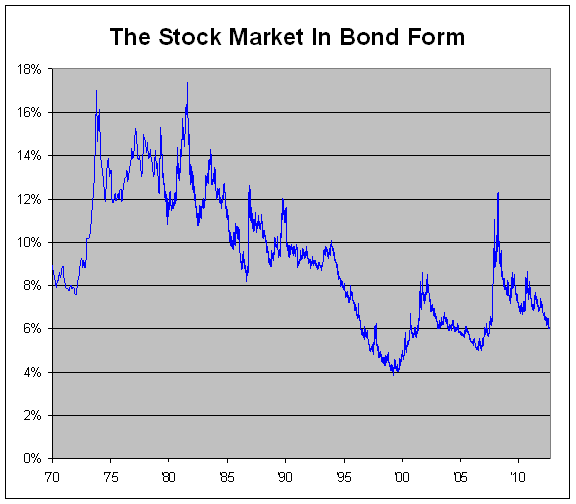
I took all of the historical market performance of the Wilshire 5000 (including dividends) and invented a hypothetical long-term bond that matched the market’s daily gains step-for-step.
I assumed that it’s a bond of infinite maturity and pays a fixed coupon.
There’s one hitch, though. I have to choose a starting yield-to-maturity for the beginning of the data series in December 1970. So this isn’t a completely kosher experiment because the starting point is based on my guess.
If I choose a number that’s too high, the historical performance won’t be able to keep up, and the yield-to-maturity would grow higher and higher and soon leave orbit. Conversely, if my starting YTM is too low, the yield would gradually get pushed down to microscopic levels.
Fortunately, the data makes my job easy. After four decades, the window I have to work with is pretty narrow. Starting with 10% is too high, and 8% is too low. After playing with the numbers, I finally settled on 8.93%.
Even though this “bond” is completely make-believe, it reflects what the actual stock market really did for the past 42-1/2 years. Through yesterday, the “bond’s” yield stood at 6.01%.
Here’s what the actual stock market looks like, expressed in the form of a bond:
-
“It’s Getting Crowded in Here”
Posted by Eddy Elfenbein on August 7th, 2013 at 11:17 amFord ($F) is hiring even more people:
Ford is expanding again.
This time, the country’s second-largest automaker is adding 800 jobs, primarily in vehicle development.
The move means Ford will add a total of 3,000 white collar jobs this year, with most of them located at the company’s headquarters in Dearborn, Mich.
“It’s getting crowded in here,” one Ford worker said at company headquarters. “I remember when there used to be a lot of empty desks and a lot of long faces.”
Not anymore. As Ford has expanded, it has filled those desks and turned massive losses into record profits.
-
The Legend That Is Starbucks
Posted by Eddy Elfenbein on August 7th, 2013 at 10:25 amWhenever I look at it, I always come away thinking that Starbucks ($SBUX) is insanely over-priced, yet the stock keeps proving me wrong. Roben Farzad of Bloomberg has some fascinating facts on SBUX:
More than 19,000 stores and four decades since it started up, Starbucks (SBUX) is still managing to bust out of its balance sheet, defying the law of large numbers.
In the coffee giant’s latest quarter, net income shot up 25 percent from a year ago, on a 13 percent gain in sales, hitting $3.74 billion. Global same-store sales gained 8 percent, well ahead of analysts’ average estimate of 5.8 percent, according to Consensus Metric. Free cash flow—money available to be reinvested in the enterprise, to retire debt, and to pay dividends or repurchase stock—will grow an enormous 50 percent in the year ending September 30, according to a Bloomberg survey of Wall Street analysts.
Consider: Starbucks’s revenue gain of 11.5 percent in the 12 months ended June 30 exceeded that of McDonald’s (MCD) by more than nine times. Consider also: Adjusted for splits, Starbucks was a 73¢ stock in 1992. It’s now worth $73 and sports a $55 billion market cap.
Bloomberg’s Charles Mead reports that Starbucks throws off more free cash relative to its debt than any U.S. restaurant chain. So flush is the Seattle company that it can more than double its debt, to reward shareholders, without hurting its credit. The company plans to add $750 million of debt to the $550 million of bonds it has outstanding—and could take out as as much as $1 billion without materially affecting its credit profile, according to Morningstar (MORN).
Starbucks, which carries an A- credit rating from Standard & Poor’s (MHP), would still have a safer debt-to-equity ratio than about 90 percent of indebted S&P 500 index companies. “They’re happy with that A- rating, but they do recognize that they do have some room to lever up,” Joscelyn Mackay of Morningstar told Mead. “This is a company where their balance sheet has gotten away from them in a positive sense, in that they’ve continued to grow and earnings have continued to grow, and they haven’t kept pace with it.”
“We’ve long recognized that there’s opportunity with an extremely conservative balance sheet to bring a bit of debt on,” Chief Financial Officer Troy Alstead said on a July 25 conference call. Indeed, of the 11 consumer-discretionary companies in the S&P 500 with market values bigger than $50 billion, Starbucks has the least debt. The No. 1 coffee chain is “in the early innings of a global expansion that may last for decades” and is set to benefit from lower coffee costs and higher-margin food sales, Goldman Sachs analysts led by Michael Kelter wrote in a July 26 report.
Props to Howard Schultz for turning around Starbucks since it announced his return to the CEO job in January 2008, after a year in which the share price was cut in half. It has since quadrupled.
The stock is currently going for more than nine times earnings and 27 times next year’s earnings. The dividend yield is just below 1.2%.
It’s a great company, but I think it’s just too pricey.
-
Morning News: August 6, 2013
Posted by Eddy Elfenbein on August 7th, 2013 at 6:16 amSteep Learning Curve Ahead for Next RBI Governor Raghuram Rajan
Under Carney, Bank Of England Moves To Forward Guidance
Easy Cash Ebbs for $300 Billion Asean Port-to-Rail Cost
Tapering of Stimulus Could Start as Soon as September, 2 Fed Presidents Hint
Obama Sketches Goals for Retooled Mortgage Market
SEC’s Hunt for Crisis-Era Wrongdoing Loses Steam
BofA Sued by U.S. Over Mortgage Securities
Gold Price Crash Will Not Hurt Our Plans, Says Highland Gold
Chevy Proves It Has Learned A Crucial Rule For Selling Electric Cars
In American Greetings Deal, Echoes of Larger Buyout for Dell
’Washington Post’ Needs Bezos’ Digital Midas Touch
Walt Disney to Lose Millions on Lone Ranger Film
Jeff Carter: Change Management, as it Relates to Startups
Phil Pearlman: how Do You Know When a Stock is Broken?
Be sure to follow me on Twitter.
-
Muppets Most Wanted
Posted by Eddy Elfenbein on August 6th, 2013 at 10:53 pm -
Buy List Earnings Calendar
Posted by Eddy Elfenbein on August 6th, 2013 at 2:47 pm
 Eddy Elfenbein is a Washington, DC-based speaker, portfolio manager and editor of the blog Crossing Wall Street. His