-
Morning News: September 6, 2013
Posted by Eddy Elfenbein on September 6th, 2013 at 6:41 amPlan at G-20 Is to Tighten Global Rules on Taxes
European Central Bank Chief Tamps Down Optimism
Bogged-Down Banking Fight Leaves EU Vulnerable to Relapse
Cyprus Lawmakers Adopt Key Terms For EU/IMF Bailout
The Next Emerging Market Crisis
Wall Street’s Most Bullish Forecast For Today’s Jobs Report
Behold The Bounty That Shale Oil And Natural Gas Have Wrought
Summers’s Fed Put Beats Bernanke’s for Potency: Cutting Research
Treasury Yields Pierce 3% With Employment Data Ahead
J.P. Morgan to End Student-Loan Business
Yahoo Needs a Lifeboat Not a Logo
Hearsay Social Raises $30 Million to Give Bankers an Online Presence
Hundreds Protest Against Wal-Mart In 15 Cities, Demanding Higher Wages
Jeff Carter: Commitment, Decision Making and Fear In Entrepreneurship
Cullen Roche: 3 Things I Think I Think
Be sure to follow me on Twitter.
-
Even When You’re Right, It Takes Time
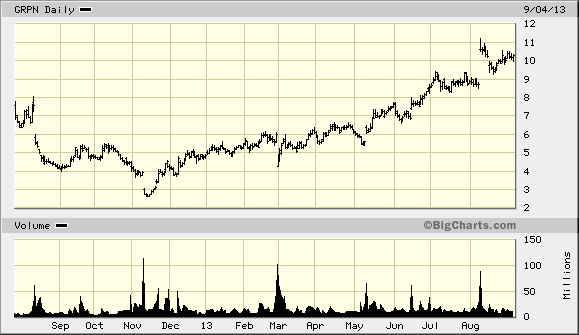
Posted by Eddy Elfenbein on September 5th, 2013 at 12:17 pmAt one point in 2011, shares of Groupon ($GRPN) got as high as $31. But by late July 2012, the stock had fallen down to $6.90 per share.
That’s when I jumped in and tweeted.
I can't believe I'm saying this but $GRPN really isn't that absurd at this price.
— Eddy Elfenbein (@EddyElfenbein) July 31, 2012
The only problem is that the stock kept falling. By November, it hit $2.60 per share. That’s a 62% drop from what I thought wasn’t a bad price.
Since then, Groupon has rallied is currently close to $11 per share. Even if you think you’ve spotted a good value, you’ll never know when your bargain will materialize. Even if you’re right, the ride can be a lot rougher and longer than you think.
-
Ford’s Joe Hinrichs on Growth
Posted by Eddy Elfenbein on September 5th, 2013 at 11:52 amHere’s Ford’s Joe Hinrichs who has my favorite job title — President of the Americas:
-
Morning News: September 5, 2013
Posted by Eddy Elfenbein on September 5th, 2013 at 6:20 amKey Euribor Rate Steady As ECB Seen On Hold
BOJ Gov Kuroda: To Take Necessary Steps if Sales Tax Hike Makes Inflation Goal Difficult
Investors Seek Balance Between Central Banks, Syria And Rebounding Economy
Emerging Stocks Rise to Two-Week High as Indian Banks Rally
Salmon: Larry Summers and the Politicization of the Fed
Fed Says ‘Modest to Moderate’ Growth Aided by Homes, Cars
U.S. Car Sales Soar to Pre-Slump Level
Schwab Case Casts Spotlight on Securities Arbitration and Its Flaws
LinkedIn: Endorsed for Financial Acumen
With Chances Dimmer for Sale to Microsoft, BlackBerry May Have To Do The Splits
Samsung Has Hobbled Its Smart Watch Before It Even Launches
P&G to Test Waters Again on a Bargain Tide
How Yahoo Picked a New Look For An 18-Year-Old Brand
Credit Writedowns: Corporate Profits: In the Long Run, Valuation Means Everything
John Hempton: We Interrupt For a Brief Herbalife Update
Be sure to follow me on Twitter.
-
The Limits of Fundamental Analysis
Posted by Eddy Elfenbein on September 4th, 2013 at 1:17 pm
With my investment approach, I try to be as rational as is possible. If things had never worked out for Mr. Spock at Star Fleet Academy, he probably would have made a decent money manager. Sure, some work would have been needed on client relations, but you get my point. Still, it’s amazing to me how irrational people can be when they go about investing their money.
Being a rational investor, I rely on a great deal of numbers. But here’s the tricky part: even numbers can be deceiving. I’ve discussed this many times before. For example, your classic P/E Ratio doesn’t always work well with cyclical stocks. In fact, the market’s P/E Ratio is often elevated during the early phases of a bull market.
Also, not all earnings are created equal. When a company borrows money, they’re sacrificing near-term earnings for (hopeful) long-term success. Companies that have high assets relative to their profits tend to report ersatz earnings. Or a company with significant equity exposure in an overvalued stock will have its return-on-equity distorted.
All of these issues can confuse the job of attaching a proper valuation to a stock. I rely on numbers because that’s all I have. If I had prices ten years from now, I’d surely go on those. Because I don’t, I’m left with a bunch of flawed statistics. The hard part is knowing what’s flawed. But even fundamental analysis runs up against its own limitations.
I’d say there’s about 10% of stocks, maybe even just 5%, where fundamental analysis is totally useless. Take Tesla ($TSLA) for example. By any conventional metric, the stock is absurdly overvalued. Unfortunately, I’m not considered a genius for pointing that out. Everyone knows that. The reason is that conventional metrics don’t work on unconventional stocks. If a technology comes along which changes the entire ballgame, all those ratios go out the window.
Consider the case of Amazon.com ($AMZN). At its peak during the tech bubble, the stock was going for a ridiculous valuation. As it turns out, the stock was actually cheap. Since the turn of the century, Amazon has greatly outperformed the S&P 500. AMZN has more than tripled while the S&P 500 has had meager returns. The reason is that Amazon was a new business that changed the marketplace. Valuation didn’t tell you that.
How should someone have valued Eastman Kodak twenty years ago? The stock was a long-recognized stalwart of American business. It was a classic Nifty 50 stock and it paid a good dividend. As late as 2007, shares of EK were over $30. While all seemed calm on the surface, the company was quickly being made obsolete. Today, a share of EK goes for three cents. The dynamics changed and just by following the numbers, you would have been left in the dust.
I live in Washington D.C. and you can see the beautiful canal that runs through Georgetown. Where the canal hits the Potomac is the water’s gate hence the name of the Watergate complex and all the “scandal-gates” that followed.
What impresses me is that the canal was an astounding feat of engineering. It took a lot of men and a lot of money to dig this thing. Yet as soon as the canal was built, it was economically obsolete. The canal was done in by the railroad. The entire effort turned out to be a waste of time and money. This is the process of Creative Destruction identified by the economist Joseph Schumpeter. There’s always some innovation going on somewhere that threatens to upend the entire game, and fundamental analysis won’t see it coming.
-
Morning News: September 4, 2013
Posted by Eddy Elfenbein on September 4th, 2013 at 5:32 amGlobal Competitiveness Report: India Slips To 60th Rank, Switzerland On Top
Man Who Saw Japan’s 0.5% 10-Year Yield Now Predicts 0.25%
Spanish Services Post Jobless Growth With First Gain Since 2011
Ryanair Warns on Profit Expectations
S&P Calls U.S. Lawsuit ‘Retaliation’ for U.S. Downgrade
Fracking Boom Seen Raising Household Incomes by $1,200
Microsoft Jettisons Windows Playbook With Nokia Devices
Kodak Moments Just a Memory as Company Exits Bankruptcy
Hedge Funds Load Up on J.C. Penney Shares
Jarden Buying Yankee Candle for $1.75 Billion
LinkedIn Cashing In: Social Network To Raise $1 Billion In Share Offering As Stock Flies High
KitKat Revamped Its Entire Website In A Hilarious Parody Announcing Its New Partnership With Google
H&R Block Declines After Saying Bank Sale Possibly Delayed
Howard Lindzon: CNBC Ratings at New Lows…How? …and Why Can’t Business TV Do What ESPN Does?
Phil Pearlman: Sunk Costs: Microsoft Throws Good Money After Bad
Be sure to follow me on Twitter.
-
The Bad Time of the Year for Stocks
Posted by Eddy Elfenbein on September 3rd, 2013 at 11:11 amWe’re nearing the bad time of the year for the stock market. I crunched all the numbers going back to the start of the Dow in 1896, and I found that the index has historically peaked on September 6th. From there, it pulls back an average of 2.51% to October 29th.
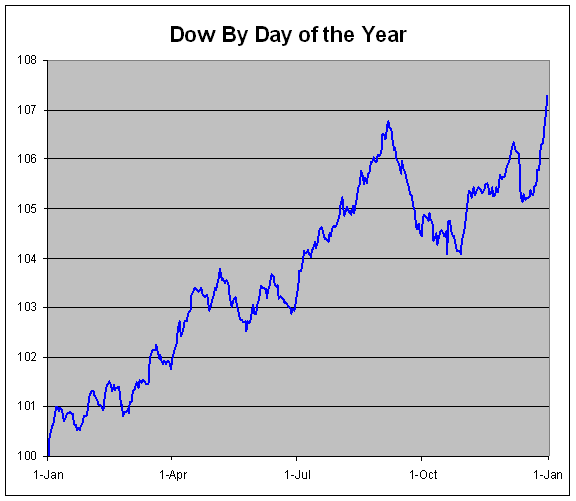
Historically, there’s some sluggishness in May, and a drop in early December, but nothing comes close to the September-October slowdown.
As usual, I caution against basing any investment decision on this type of data. I simply think these are interesting trends.
-
Microsoft Buys Nokia Handset Business
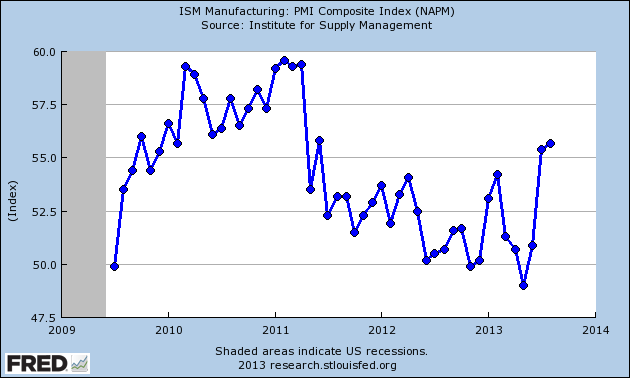
Posted by Eddy Elfenbein on September 3rd, 2013 at 10:14 amI hope everyone had a nice three-day weekend. The day after Labor Day always feels like a giant “reset” on Wall Street. All the major players are back from their summer retreats. This is also a big week for economic news. This morning, the August ISM was 55.7 which is a very good reading. This is the highest ISM in more than two years.
Thanks to some lessening of the tensions regarding Syria, the stock market is doing well today. The S&P 500 briefly broke 1,650 this morning which is more than 1% higher than Friday’s close.
The big news today is that Microsoft ($MSFT) is buying Nokia’s ($NOK) handset business for $7.2 billion. Many observers think this is the marriage of two companies desperately behind the times. Under Ballmer, Microsoft has wasted billions of dollars on overpriced deals so it’s easy to see this as just one more. Interestingly, the deal also includes NOK’s patents.
Traders are not pleased with the deal. While the rest of the market is rallying, shares of MSFT are currently down more than 4%. Consider that since December 31, 1999, shares of Microsoft are down more than 42% while shares of Nokia are down 91%. The deal is huge for Nokia, but works out to about 86 cents per share for Microsoft. Henry Blodget calls this a smart deal for MSFT but notes that it has a low probability of succeeding.
-
Morning News: September 3, 2013
Posted by Eddy Elfenbein on September 3rd, 2013 at 6:16 amOECD Warns Global Growth Could Weaken
ECB’s Draghi Tries To Shepherd Markets Fixated On Fed
RBA Leaves Rates On Hold At 2.5% Amid Fractious Election Campaign
Abe All Ears on Growth Proposals
Phablets a Big Hit With Asian Consumers
Belarus Charges Kerimov in Potash Probe
As Summers’s Odds Rise, Stimulus Easing Is Seen
Microsoft to Buy Nokia’s Devices Unit for $7.2 Billion
Nokia Sale Marks End of an Era
Verizon-Vodafone Talked Merger Before Agreeing to Stake Sale
How Velti, One Of The Largest Mobile Ad Companies On The Planet, Lost $130 Million
Steve Ballmer Tells Employees: ‘Stephen Elop Will Be Coming back to Microsoft’
Roger Nusbaum: Barron’s Interviews Cliff Asness
Joshua Brown: The Number One Threat to the Market
Be sure to follow me on Twitter.
-
RIP: Ronald Coase
Posted by Eddy Elfenbein on September 2nd, 2013 at 7:47 pmThe great economist has died at the age of 102. His famous line, from his Nobel Lecture, was “and it is a strange experience to be praised in my eighties for work I did in my twenties.” That line is 22 years old.
Here’s an interview with Coase:
-
Archives
- September 2026
- August 2026
- July 2026
- June 2026
- May 2026
- April 2026
- March 2026
- February 2026
- January 2026
- December 2025
- November 2025
- October 2025
- September 2025
- August 2025
- July 2025
- June 2025
- May 2025
- April 2025
- March 2025
- February 2025
- January 2025
- December 2024
- November 2024
- October 2024
- September 2024
- August 2024
- July 2024
- June 2024
- May 2024
- April 2024
- March 2024
- February 2024
- January 2024
- December 2023
- November 2023
- October 2023
- September 2023
- August 2023
- July 2023
- June 2023
- May 2023
- April 2023
- March 2023
- February 2023
- January 2023
- December 2022
- November 2022
- October 2022
- September 2022
- August 2022
- July 2022
- June 2022
- May 2022
- April 2022
- March 2022
- February 2022
- January 2022
- December 2021
- November 2021
- October 2021
- September 2021
- August 2021
- July 2021
- June 2021
- May 2021
- April 2021
- March 2021
- February 2021
- January 2021
- December 2020
- November 2020
- October 2020
- September 2020
- August 2020
- July 2020
- June 2020
- May 2020
- April 2020
- March 2020
- February 2020
- January 2020
- December 2019
- November 2019
- October 2019
- September 2019
- August 2019
- July 2019
- June 2019
- May 2019
- April 2019
- March 2019
- February 2019
- January 2019
- December 2018
- November 2018
- October 2018
- September 2018
- August 2018
- July 2018
- June 2018
- May 2018
- April 2018
- March 2018
- February 2018
- January 2018
- December 2017
- November 2017
- October 2017
- September 2017
- August 2017
- July 2017
- June 2017
- May 2017
- April 2017
- March 2017
- February 2017
- January 2017
- December 2016
- November 2016
- October 2016
- September 2016
- August 2016
- July 2016
- June 2016
- May 2016
- April 2016
- March 2016
- February 2016
- January 2016
- December 2015
- November 2015
- October 2015
- September 2015
- August 2015
- July 2015
- June 2015
- May 2015
- April 2015
- March 2015
- February 2015
- January 2015
- December 2014
- November 2014
- October 2014
- September 2014
- August 2014
- July 2014
- June 2014
- May 2014
- April 2014
- March 2014
- February 2014
- January 2014
- December 2013
- November 2013
- October 2013
- September 2013
- August 2013
- July 2013
- June 2013
- May 2013
- April 2013
- March 2013
- February 2013
- January 2013
- December 2012
- November 2012
- October 2012
- September 2012
- August 2012
- July 2012
- June 2012
- May 2012
- April 2012
- March 2012
- February 2012
- January 2012
- December 2011
- November 2011
- October 2011
- September 2011
- August 2011
- July 2011
- June 2011
- May 2011
- April 2011
- March 2011
- February 2011
- January 2011
- December 2010
- November 2010
- October 2010
- September 2010
- August 2010
- July 2010
- June 2010
- May 2010
- April 2010
- March 2010
- February 2010
- January 2010
- December 2009
- November 2009
- October 2009
- September 2009
- August 2009
- July 2009
- June 2009
- May 2009
- April 2009
- March 2009
- February 2009
- January 2009
- December 2008
- November 2008
- October 2008
- September 2008
- August 2008
- July 2008
- June 2008
- May 2008
- April 2008
- March 2008
- February 2008
- January 2008
- December 2007
- November 2007
- October 2007
- September 2007
- August 2007
- July 2007
- June 2007
- May 2007
- April 2007
- March 2007
- February 2007
- January 2007
- December 2006
- November 2006
- October 2006
- September 2006
- August 2006
- July 2006
- June 2006
- May 2006
- April 2006
- March 2006
- February 2006
- January 2006
- December 2005
- November 2005
- October 2005
- September 2005
- August 2005
- July 2005
 Eddy Elfenbein is a Washington, DC-based speaker, portfolio manager and editor of the blog Crossing Wall Street. His