-
The S&P 500 Smashes 1,700
Posted by Eddy Elfenbein on August 1st, 2013 at 10:13 amThe stock market is up again today. For the first time ever, the S&P 500 broke 1,700. Our Buy List is also doing well, except for DirecTV ($DTV), which is down about 3% after a disappointing earnings report.
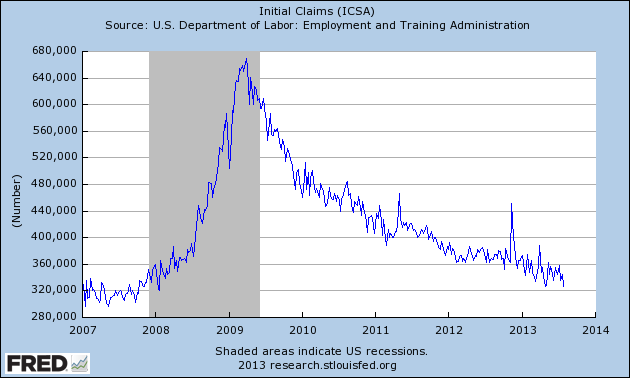
The big jobs report is tomorrow, but today we learned that initial jobless claims dropped to a 67-month low. A total of 326,000 Americans filed for first time jobless claims last week.
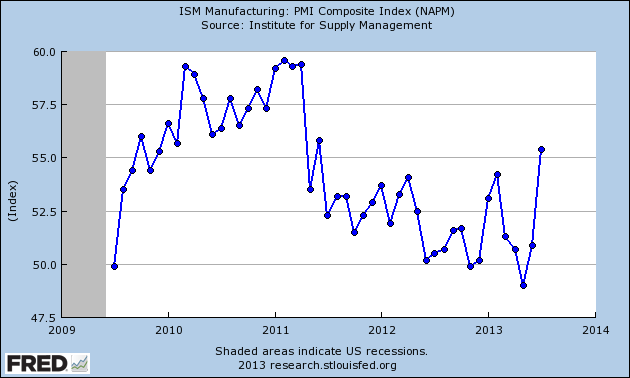
Since it’s the first trading day of the month, the ISM report came out this morning and the number was an impressive 55.4. The Street had been expecting 52.0. Any reading above 50 indicates the factory sector of the economy is expanding. Below 50 is a contraction. July was the best month in more than two years.
Ford ($F) reported that sales rose 11% in July. It seems that a lot of contractors have been running out to replace their trucks they’ve had since before the recession. The AP reports, “F-Series truck sales rose 23 percent to 60,449, or one of every three vehicles Ford sold.” The stock is currently up to $17.10 per share.
-
Morning News: August 1, 2013
Posted by Eddy Elfenbein on August 1st, 2013 at 6:39 amECB’s Draghi Can’t Afford To Sound All-Clear Yet
Italy Banks Bad Loans Underline Southern Europe Malaise
China Pledges to Keep Growth Within ‘Reasonable Zone’
Shell to Chevron Move Offshore as Nigerian Risks Mount
FOMC Keeps QE Juice Flowing At $85 Billion, Bernanke Taper Should Come Later This Year
Obama to Nominate Raskin as First Female U.S. Treasury Deputy
Swipe-Fee Rule Rejection to Help Merchants at Banks’ Cost
Shell’s Earnings Fall in 2nd Quarter
Dell Takeover Bid in Peril as a Voting Rule Remains
Sony Reports $35 Million Net Profit For First Quarter
Lloyds to Start Dividend Talks After Swinging Into Profit
Sanofi CEO: Lower Earnings Won’t Affect Shareholder Return Policy
ArcelorMittal Q2 Results Show Fall In Earnings
Howard Lindzon: The Future is Messy…That is How You Make Money!
Roger Nusbaum: Currency ETF Palooza
Be sure to follow me on Twitter.
-
New Highs on Strong Earnings
Posted by Eddy Elfenbein on July 31st, 2013 at 9:28 pmToday was another good day for the Buy List. Our 20 stocks gained 0.45% today compared with a 0.01% loss for the S&P 500. This is the fourth day in a row that we’ve beaten the market. Our Buy List is now up 22.93% for the year compared with 18.20% for the S&P 500. Interestingly, this is the third day in a row that the S&P 500 closed with a 1,685 handle.
Our big winner today was obviously Fiserv ($FISV) which closed the day at $96.24 or 4.03% higher. At one point today, Fiserv came within 12 cents of $100 per share which was a gain of 8% on the day. This is what a good earnings report will do.
AFLAC ($AFL) also rallied on its earnings report, although I feared the stock was going to lose ground today. Shares of AFL got as high as $62.55 today which was a new 52-week high. At the close, AFLAC finished at $61.68 for a 1.36% gain. The AP noted that analysts are still favorable on the stock.
WEX Inc. (WEX) also hit a new high today thanks to its earnings report. WEX got as high as $88.59 today before it closed at $86.94 for a 1.25% gain. In the last three months, WEX has gained 28%.
We also had new highs from CR Bard ($BCR), Harris ($HRS) and Bed Bath & Beyond ($BBBY), plus Stryker ($SYK) and Medtronic ($MDT) came very close to new highs.
-
“We’ve been the best performing tech company in Europe”
Posted by Eddy Elfenbein on July 31st, 2013 at 9:11 pmMark Hurd was on CNBC:
-
Today’s Fed Statement
Posted by Eddy Elfenbein on July 31st, 2013 at 2:01 pmHere’s today’s Fed statement:
Information received since the Federal Open Market Committee met in June suggests that economic activity expanded at a modest pace during the first half of the year. Labor market conditions have shown further improvement in recent months, on balance, but the unemployment rate remains elevated. Household spending and business fixed investment advanced, and the housing sector has been strengthening, but mortgage rates have risen somewhat and fiscal policy is restraining economic growth. Partly reflecting transitory influences, inflation has been running below the Committee’s longer-run objective, but longer-term inflation expectations have remained stable.
Consistent with its statutory mandate, the Committee seeks to foster maximum employment and price stability. The Committee expects that, with appropriate policy accommodation, economic growth will pick up from its recent pace and the unemployment rate will gradually decline toward levels the Committee judges consistent with its dual mandate. The Committee sees the downside risks to the outlook for the economy and the labor market as having diminished since the fall. The Committee recognizes that inflation persistently below its 2 percent objective could pose risks to economic performance, but it anticipates that inflation will move back toward its objective over the medium term.
To support a stronger economic recovery and to help ensure that inflation, over time, is at the rate most consistent with its dual mandate, the Committee decided to continue purchasing additional agency mortgage-backed securities at a pace of $40 billion per month and longer-term Treasury securities at a pace of $45 billion per month. The Committee is maintaining its existing policy of reinvesting principal payments from its holdings of agency debt and agency mortgage-backed securities in agency mortgage-backed securities and of rolling over maturing Treasury securities at auction. Taken together, these actions should maintain downward pressure on longer-term interest rates, support mortgage markets, and help to make broader financial conditions more accommodative.
The Committee will closely monitor incoming information on economic and financial developments in coming months. The Committee will continue its purchases of Treasury and agency mortgage-backed securities, and employ its other policy tools as appropriate, until the outlook for the labor market has improved substantially in a context of price stability. The Committee is prepared to increase or reduce the pace of its purchases to maintain appropriate policy accommodation as the outlook for the labor market or inflation changes. In determining the size, pace, and composition of its asset purchases, the Committee will continue to take appropriate account of the likely efficacy and costs of such purchases as well as the extent of progress toward its economic objectives.
To support continued progress toward maximum employment and price stability, the Committee today reaffirmed its view that a highly accommodative stance of monetary policy will remain appropriate for a considerable time after the asset purchase program ends and the economic recovery strengthens. In particular, the Committee decided to keep the target range for the federal funds rate at 0 to 1/4 percent and currently anticipates that this exceptionally low range for the federal funds rate will be appropriate at least as long as the unemployment rate remains above 6-1/2 percent, inflation between one and two years ahead is projected to be no more than a half percentage point above the Committee’s 2 percent longer-run goal, and longer-term inflation expectations continue to be well anchored. In determining how long to maintain a highly accommodative stance of monetary policy, the Committee will also consider other information, including additional measures of labor market conditions, indicators of inflation pressures and inflation expectations, and readings on financial developments. When the Committee decides to begin to remove policy accommodation, it will take a balanced approach consistent with its longer-run goals of maximum employment and inflation of 2 percent.
Voting for the FOMC monetary policy action were: Ben S. Bernanke, Chairman; William C. Dudley, Vice Chairman; James Bullard; Elizabeth A. Duke; Charles L. Evans; Jerome H. Powell; Sarah Bloom Raskin; Eric S. Rosengren; Jeremy C. Stein; Daniel K. Tarullo; and Janet L. Yellen. Voting against the action was Esther L. George, who was concerned that the continued high level of monetary accommodation increased the risks of future economic and financial imbalances and, over time, could cause an increase in long-term inflation expectations.
Phil Izzo at the WSJ has the changes from the last statement.
-
The Government Revises All GDP Data
Posted by Eddy Elfenbein on July 31st, 2013 at 12:37 pmDo you feel wealthier today? According to the government, the economy is about 3% larger than originally reported. The reason is that the number collectors are now looking at intangibles in the economy. The Bureau of Economic Analysis revised the entire NIPA data series today.
Here’s a look at real GDP growth since 1947 (in trillions of dollars). The Old Series is based on 2005 prices. The new one is based on 2009 prices.
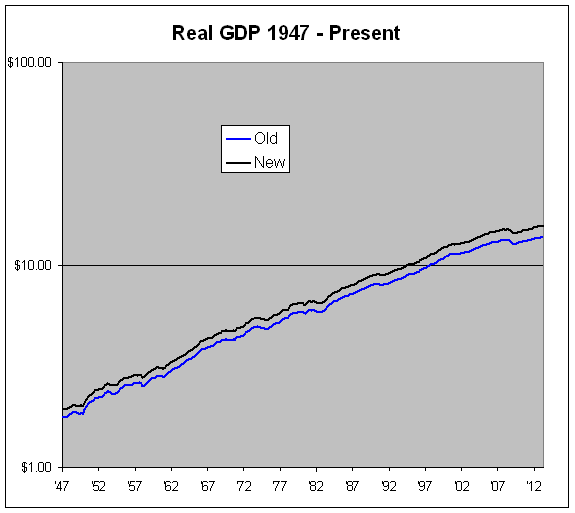
It turns out that the recent recession wasn’t as severe as originally believed. From Q4 2007 to Q2 of 2009, the economy shrank by -4.26% instead of the original -4.69%. The recovery was a bit stronger as well. Interestingly, the first-quarter of 2011 previously had shown very meager growth. It turns out, the economy slightly receded.
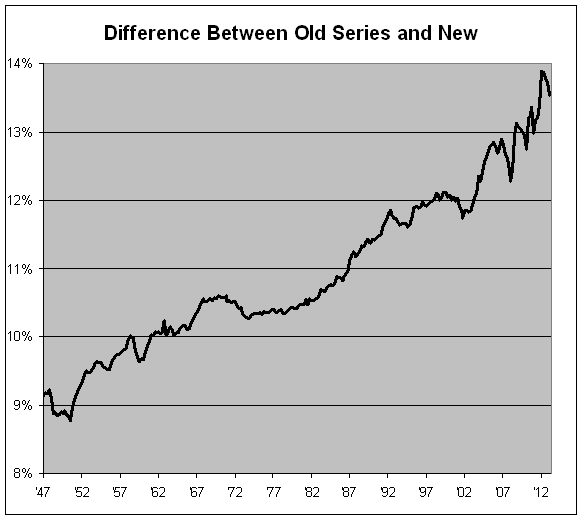
Here’s a comparison between the two data series. The increase in the adjustment has been pretty continuous over the last 65 years. Note that 2005 is used for the old series and 2009 is for the new, so the chart below is not a 1-to-1 comparison. There’s a difference of about 9% due to inflation between the data series.
-
Fiserv Jumps 5% in Early Trading
Posted by Eddy Elfenbein on July 31st, 2013 at 9:54 amBig market day today. The S&P 500 is above 1,692 this morning. The big winner on our Buy List is Fiserv ($FISV) which is currently up 5.44% thanks to its strong earnings report. While AFLAC’s ($AFL) earnings were above expectations, that guidance was below the Street. Still, the reasons are understandable and the shares are only down 64 cents which is about 1%.
Reuters ran the numbers and found that Ford Motor ($F) could close its pension gap by the end of next year. That was unthinkable not that long ago.
The government reported that the U.S. economy grew by 1.7% last quarter. That was actually faster than expected. Economists were expecting an increase of less than 1%. Growth for Q1 was revised downward from 1.8% to 1.1%.
ADP, the private payroll firm, said that the economy created 200,000 new jobs last month. That’s right inline with what the economy has done for the last three months. On Friday, we get the official report from the Feds.
-
Dan Amos on CNBC
Posted by Eddy Elfenbein on July 31st, 2013 at 9:28 amHere’s AFLAC’s CEO on CNBC:
-
Morning News: July 31, 2013
Posted by Eddy Elfenbein on July 31st, 2013 at 6:50 amGerman Unemployment Rises to 6.8% in July
Beijing Offers Growth Assurance In Its Economic Balancing Act
Following Bernanke Means Using Precedent of Unprecedented Policy
Obama Offers New Deal on Corporate Taxes, Jobs
Consumer Confidence Dips a Bit
Schneider Electric to Buy Invensys for $5.2 Billion
BNP Paribas Quarterly Net Falls 4.7% on Loan Provisions
Panasonic’s Quarterly Profit Soars to $1.1 Billion
Tough Times for the ‘Biggest Victim’ in Smartphone War
Potash Sector Rocked as Russia’s Uralkali Quits Cartel
AB InBev Profits From Premium Lagers, Price Hikes
Bill Ackman’s Herbalife Nightmare Gets 100 Percent Worse
Credit Writedowns: House Price Inflation Causing Problems for Many in the U.S.
Cullen Roche: Why Didn’t QE Cause High Inflation?
Be sure to follow me on Twitter.
-
Strong Earnings from Fiserv and AFLAC
Posted by Eddy Elfenbein on July 30th, 2013 at 9:23 pmThanks to a very good earnings report from Harris Corp. ($HRS), our Buy List had another market-beating day. Shares of HRS eventually closed at $56.97 which is a gain of 7.84% for the day. While the broader indexes are just shy of their all-time highs, the Nasdaq closed today at its highest level since September 29, 2000.
The market was also excited that Facebook ($FB) climbed all the way back its IPO price. So IPO investors are back up to…nothing!
After the closing bell, we had two more Buy List earnings reports; Fiserv ($FISV) and AFLAC ($AFL). For the second quarter, Fiserv earned $1.50 per share which was six cents better than Wall Street’s consensus. That’s a very good number. Quarterly revenues rose 11.8% to $1.14 billion which was a bit short of consensus.
Our strong second quarter results included revenue and earnings acceleration in-line with our full-year expectations,” said Jeffery Yabuki, President and Chief Executive Officer of Fiserv. “Performance was led by 7 percent adjusted internal revenue growth in our Payments segment, solid sales and excellent free cash flow.
Fiserv reiterated its full-year guidance of earnings ranging between $5.84 and $6.03 per share. For the first six months of 2013, Fiserv had earned $2.83 per share so I think they’re well on their way to hitting that guidance. Earnings are up 16% so far this year, and cash flow is up 22%. This company is clearly doing well. The stock is up 3.55% in the after-hours market.
AFLAC reported Q2 operating earnings of $1.62 per share which was 11 cents better than estimates. Three months ago, the company gave us a range of $1.41 to $1.56 per share, so business is going better-than-expected. Plus, we have to consider that the yen/dollar exchange rate knocked 22 cents off earnings. Without that, operating earnings rose by 14.3%.
For Q3, AFLAC sees operating earnings ranging between $1.41 and $1.51 per share. That’s less than the $1.56 per share Wall Street had been expecting. For the full-year guidance, AFLAC lowered the low-end of their range. The previous range was $5.99 to $6.37 per share. Now it’s $5.83 to $6.37 per share.
Dan Amos, the CEO, said:
Our objective for 2013 is to increase operating earnings per diluted share 4% to 7%, excluding the impact of the yen. Although we are above that range for the first half of the year, we plan on increasing spending in the second half of 2013. In Japan, we will increase expenditures on advertising and promotion for our new product launch in August. In the United States, we anticipate increased costs associated with initiatives related to health care reform. As such, we expect operating earnings to increase approximately 5% for the full year, before the impact of foreign currency. We will face a difficult comparison in the third quarter due to the tax benefit of $.10 per diluted share recognized in the same period last year. If the yen averages 95 to 105 to the dollar for the third quarter, we would expect earnings in the third quarter to be approximately $1.41 to $1.51 per diluted share. Using that same exchange rate assumption, we would expect full-year reported operating earnings to be about $5.83 to $6.37 per diluted share.
-
Archives
- July 2026
- June 2026
- May 2026
- April 2026
- March 2026
- February 2026
- January 2026
- December 2025
- November 2025
- October 2025
- September 2025
- August 2025
- July 2025
- June 2025
- May 2025
- April 2025
- March 2025
- February 2025
- January 2025
- December 2024
- November 2024
- October 2024
- September 2024
- August 2024
- July 2024
- June 2024
- May 2024
- April 2024
- March 2024
- February 2024
- January 2024
- December 2023
- November 2023
- October 2023
- September 2023
- August 2023
- July 2023
- June 2023
- May 2023
- April 2023
- March 2023
- February 2023
- January 2023
- December 2022
- November 2022
- October 2022
- September 2022
- August 2022
- July 2022
- June 2022
- May 2022
- April 2022
- March 2022
- February 2022
- January 2022
- December 2021
- November 2021
- October 2021
- September 2021
- August 2021
- July 2021
- June 2021
- May 2021
- April 2021
- March 2021
- February 2021
- January 2021
- December 2020
- November 2020
- October 2020
- September 2020
- August 2020
- July 2020
- June 2020
- May 2020
- April 2020
- March 2020
- February 2020
- January 2020
- December 2019
- November 2019
- October 2019
- September 2019
- August 2019
- July 2019
- June 2019
- May 2019
- April 2019
- March 2019
- February 2019
- January 2019
- December 2018
- November 2018
- October 2018
- September 2018
- August 2018
- July 2018
- June 2018
- May 2018
- April 2018
- March 2018
- February 2018
- January 2018
- December 2017
- November 2017
- October 2017
- September 2017
- August 2017
- July 2017
- June 2017
- May 2017
- April 2017
- March 2017
- February 2017
- January 2017
- December 2016
- November 2016
- October 2016
- September 2016
- August 2016
- July 2016
- June 2016
- May 2016
- April 2016
- March 2016
- February 2016
- January 2016
- December 2015
- November 2015
- October 2015
- September 2015
- August 2015
- July 2015
- June 2015
- May 2015
- April 2015
- March 2015
- February 2015
- January 2015
- December 2014
- November 2014
- October 2014
- September 2014
- August 2014
- July 2014
- June 2014
- May 2014
- April 2014
- March 2014
- February 2014
- January 2014
- December 2013
- November 2013
- October 2013
- September 2013
- August 2013
- July 2013
- June 2013
- May 2013
- April 2013
- March 2013
- February 2013
- January 2013
- December 2012
- November 2012
- October 2012
- September 2012
- August 2012
- July 2012
- June 2012
- May 2012
- April 2012
- March 2012
- February 2012
- January 2012
- December 2011
- November 2011
- October 2011
- September 2011
- August 2011
- July 2011
- June 2011
- May 2011
- April 2011
- March 2011
- February 2011
- January 2011
- December 2010
- November 2010
- October 2010
- September 2010
- August 2010
- July 2010
- June 2010
- May 2010
- April 2010
- March 2010
- February 2010
- January 2010
- December 2009
- November 2009
- October 2009
- September 2009
- August 2009
- July 2009
- June 2009
- May 2009
- April 2009
- March 2009
- February 2009
- January 2009
- December 2008
- November 2008
- October 2008
- September 2008
- August 2008
- July 2008
- June 2008
- May 2008
- April 2008
- March 2008
- February 2008
- January 2008
- December 2007
- November 2007
- October 2007
- September 2007
- August 2007
- July 2007
- June 2007
- May 2007
- April 2007
- March 2007
- February 2007
- January 2007
- December 2006
- November 2006
- October 2006
- September 2006
- August 2006
- July 2006
- June 2006
- May 2006
- April 2006
- March 2006
- February 2006
- January 2006
- December 2005
- November 2005
- October 2005
- September 2005
- August 2005
- July 2005
 Eddy Elfenbein is a Washington, DC-based speaker, portfolio manager and editor of the blog Crossing Wall Street. His