-
The Government Revises All GDP Data
Posted by Eddy Elfenbein on July 31st, 2013 at 12:37 pmDo you feel wealthier today? According to the government, the economy is about 3% larger than originally reported. The reason is that the number collectors are now looking at intangibles in the economy. The Bureau of Economic Analysis revised the entire NIPA data series today.
Here’s a look at real GDP growth since 1947 (in trillions of dollars). The Old Series is based on 2005 prices. The new one is based on 2009 prices.
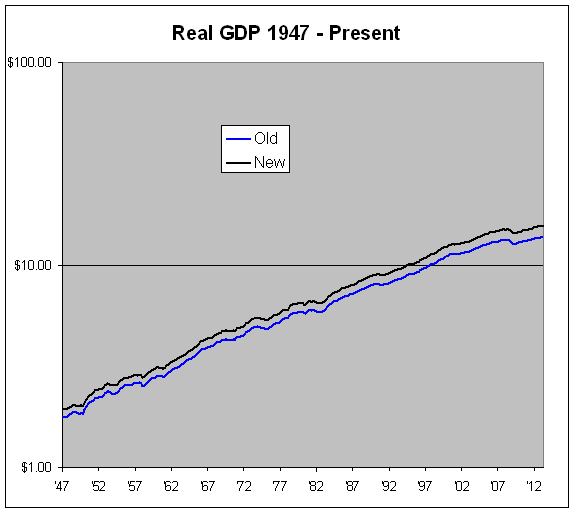
It turns out that the recent recession wasn’t as severe as originally believed. From Q4 2007 to Q2 of 2009, the economy shrank by -4.26% instead of the original -4.69%. The recovery was a bit stronger as well. Interestingly, the first-quarter of 2011 previously had shown very meager growth. It turns out, the economy slightly receded.
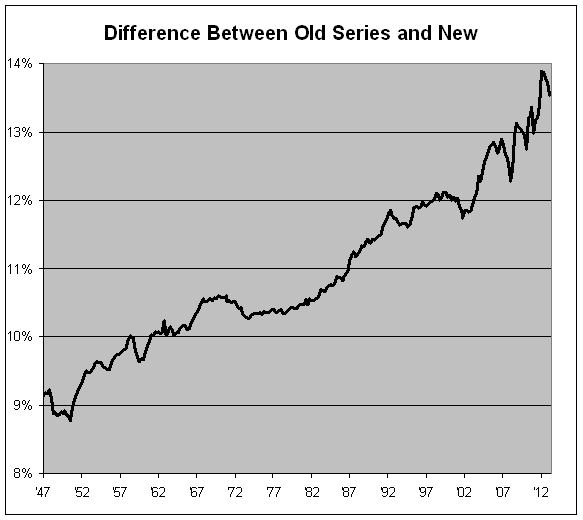
Here’s a comparison between the two data series. The increase in the adjustment has been pretty continuous over the last 65 years. Note that 2005 is used for the old series and 2009 is for the new, so the chart below is not a 1-to-1 comparison. There’s a difference of about 9% due to inflation between the data series.
-
Fiserv Jumps 5% in Early Trading
Posted by Eddy Elfenbein on July 31st, 2013 at 9:54 amBig market day today. The S&P 500 is above 1,692 this morning. The big winner on our Buy List is Fiserv ($FISV) which is currently up 5.44% thanks to its strong earnings report. While AFLAC’s ($AFL) earnings were above expectations, that guidance was below the Street. Still, the reasons are understandable and the shares are only down 64 cents which is about 1%.
Reuters ran the numbers and found that Ford Motor ($F) could close its pension gap by the end of next year. That was unthinkable not that long ago.
The government reported that the U.S. economy grew by 1.7% last quarter. That was actually faster than expected. Economists were expecting an increase of less than 1%. Growth for Q1 was revised downward from 1.8% to 1.1%.
ADP, the private payroll firm, said that the economy created 200,000 new jobs last month. That’s right inline with what the economy has done for the last three months. On Friday, we get the official report from the Feds.
-
Dan Amos on CNBC
Posted by Eddy Elfenbein on July 31st, 2013 at 9:28 amHere’s AFLAC’s CEO on CNBC:
-
Morning News: July 31, 2013
Posted by Eddy Elfenbein on July 31st, 2013 at 6:50 amGerman Unemployment Rises to 6.8% in July
Beijing Offers Growth Assurance In Its Economic Balancing Act
Following Bernanke Means Using Precedent of Unprecedented Policy
Obama Offers New Deal on Corporate Taxes, Jobs
Consumer Confidence Dips a Bit
Schneider Electric to Buy Invensys for $5.2 Billion
BNP Paribas Quarterly Net Falls 4.7% on Loan Provisions
Panasonic’s Quarterly Profit Soars to $1.1 Billion
Tough Times for the ‘Biggest Victim’ in Smartphone War
Potash Sector Rocked as Russia’s Uralkali Quits Cartel
AB InBev Profits From Premium Lagers, Price Hikes
Bill Ackman’s Herbalife Nightmare Gets 100 Percent Worse
Credit Writedowns: House Price Inflation Causing Problems for Many in the U.S.
Cullen Roche: Why Didn’t QE Cause High Inflation?
Be sure to follow me on Twitter.
-
Strong Earnings from Fiserv and AFLAC
Posted by Eddy Elfenbein on July 30th, 2013 at 9:23 pmThanks to a very good earnings report from Harris Corp. ($HRS), our Buy List had another market-beating day. Shares of HRS eventually closed at $56.97 which is a gain of 7.84% for the day. While the broader indexes are just shy of their all-time highs, the Nasdaq closed today at its highest level since September 29, 2000.
The market was also excited that Facebook ($FB) climbed all the way back its IPO price. So IPO investors are back up to…nothing!
After the closing bell, we had two more Buy List earnings reports; Fiserv ($FISV) and AFLAC ($AFL). For the second quarter, Fiserv earned $1.50 per share which was six cents better than Wall Street’s consensus. That’s a very good number. Quarterly revenues rose 11.8% to $1.14 billion which was a bit short of consensus.
Our strong second quarter results included revenue and earnings acceleration in-line with our full-year expectations,” said Jeffery Yabuki, President and Chief Executive Officer of Fiserv. “Performance was led by 7 percent adjusted internal revenue growth in our Payments segment, solid sales and excellent free cash flow.
Fiserv reiterated its full-year guidance of earnings ranging between $5.84 and $6.03 per share. For the first six months of 2013, Fiserv had earned $2.83 per share so I think they’re well on their way to hitting that guidance. Earnings are up 16% so far this year, and cash flow is up 22%. This company is clearly doing well. The stock is up 3.55% in the after-hours market.
AFLAC reported Q2 operating earnings of $1.62 per share which was 11 cents better than estimates. Three months ago, the company gave us a range of $1.41 to $1.56 per share, so business is going better-than-expected. Plus, we have to consider that the yen/dollar exchange rate knocked 22 cents off earnings. Without that, operating earnings rose by 14.3%.
For Q3, AFLAC sees operating earnings ranging between $1.41 and $1.51 per share. That’s less than the $1.56 per share Wall Street had been expecting. For the full-year guidance, AFLAC lowered the low-end of their range. The previous range was $5.99 to $6.37 per share. Now it’s $5.83 to $6.37 per share.
Dan Amos, the CEO, said:
Our objective for 2013 is to increase operating earnings per diluted share 4% to 7%, excluding the impact of the yen. Although we are above that range for the first half of the year, we plan on increasing spending in the second half of 2013. In Japan, we will increase expenditures on advertising and promotion for our new product launch in August. In the United States, we anticipate increased costs associated with initiatives related to health care reform. As such, we expect operating earnings to increase approximately 5% for the full year, before the impact of foreign currency. We will face a difficult comparison in the third quarter due to the tax benefit of $.10 per diluted share recognized in the same period last year. If the yen averages 95 to 105 to the dollar for the third quarter, we would expect earnings in the third quarter to be approximately $1.41 to $1.51 per diluted share. Using that same exchange rate assumption, we would expect full-year reported operating earnings to be about $5.83 to $6.37 per diluted share.
-
Harris Jumps Nearly 8%
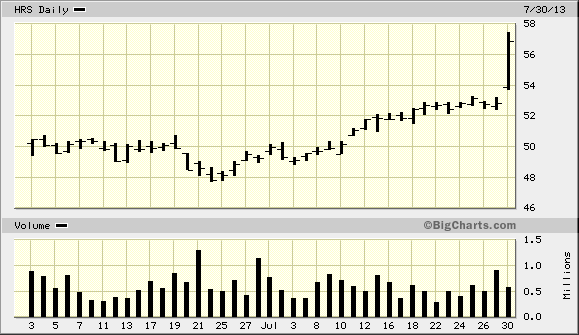
Posted by Eddy Elfenbein on July 30th, 2013 at 10:04 amThe S&P 500 broke above 1,693 this morning. Thanks to its great earnings report, Harris Corp. ($HRS) has jumped to $56.95 which is a 7.8% gain. After the close, we’ll get earnings reports from AFLAC ($AFL) and Fiserv ($FISV).
Second-quarter earnings season is going well so far. Exactly 300 of the 500 stocks in the S&P 500 have reported, and 73% have beaten on sales while 55% have beaten on earnings. Of course, expectations for Q2 had been falling for more than a year.
Today is the first day of the Fed’s two-day meeting. The policy statement will come out tomorrow. This is interesting because this meeting isn’t expected to be very important but the following meeting, in September, is expected to be very important. A growing number of Fed watchers think the central bank will announce its first tapering of its bond buying program. There may be some hints in tomorrow’s statement, but I doubt it will contain much.
In March, I noted that Coach ($COH) had dropped to $48.43 per share which was cheap on a valuation basis, but there were good reasons for the low valuation. Since then, the stock has rallied to $60 per share. Today, however, the shares are getting slammed thanks to poor results in North America. Profits for the quarter fell 12%. Shares of COH are currently down $5 or 8.7%. I don’t think the problems are close to being fixed.
-
Harris Reports Great Earnings
Posted by Eddy Elfenbein on July 30th, 2013 at 9:05 amThis morning, Harris Corp. ($HRS) reported fiscal fourth-quarter earnings of $1.41 per share which was 26 cents better than expectations. That’s a huge beat. Quarterly revenue dropped 5.3% to $1.36 billion which still topped estimates of $1.31 billion.
Harris also had very good guidance for next year. For fiscal 2014, which ends in June of 2014, Harris sees earnings ranging between $4.65 to $4.85 per share on revenues of $4.95 to $5.05 billion. The Street had been expecting earnings of $4.62 per share on revenues of $5.03 billion. For the year, Harris earned $4.90 per share compared with $5.20 per share last year. Much of the decline was due to the government sequester.
Fourth quarter results were solid in a tough government spending environment,” said William M. Brown, president and chief executive officer. “Performance benefited from our commitment to operational excellence and ongoing cost-reduction efforts, including restructuring actions announced in April that were executed faster than expected and generated fourth quarter cost savings. As we enter fiscal 2014, we now expect that restructuring and other actions will generate net annualized cost savings of approximately $60 million.”
“We were particularly encouraged by the strong new orders momentum in the international tactical radio market. With a tactical book-to-bill of 1.49 and greater than one in both international and U.S. markets, tactical backlog increased substantially in the fourth quarter.”
Harris is another good example of a high-quality stock delivering results after sluggish performance of its stock. Shares of Harris are only up 8% YTD which makes it one of the poorer performers on our Buy List. But what hasn’t changed is that it’s still a very well-run outfit.
-
Morning News: July 30, 2013
Posted by Eddy Elfenbein on July 30th, 2013 at 6:59 amWe Don’t Know Where Larry Summers Stands On The Most Important Issue Facing The Fed
Barclays to Raise $12 Billion in New Capital
Fiat Profit Rises as Spending Cuts Narrow European Losses
JPMorgan Accused of Gaming Energy Bids as FERC Deal Looms
Sony Earnings Face Setback as Loeb Criticizes Movie Unit
BP Profit Misses Estimates as Gulf Spill Estimate Raised
UBS Profit Rose 32% in Second Quarter
Alcatel Posts Strong Second-Quarter, Signs Qualcomm Partnership
Pfizer Earnings Beat Forecasts As Drugmaker Plans Split
Hudson’s Bay Buying Saks for About $2.4 Billion
7-Eleven Adds Bento Rigor to Slurpee Appeal in U.S. Push
Icahn Rips Apart Dell’s Push For Deal Changes In Open Letter
Jeff Carter: Who Raises Their Standard of Living in the Sharing Economy?
Joshua Brown: Remember When Sequestration Was Going To Crush The Defense Stocks?
Be sure to follow me on Twitter.
-
The NIPA Revisions
Posted by Eddy Elfenbein on July 29th, 2013 at 1:03 pmThis week, the government will revise the entire NIPA dataset which includes GDP. The GDP figures will be revised about 3% higher. Of course, it’s just on paper but it reflects how we think about the economy.
Good news, Americans—you’re about to get richer.
Well, not you, personally. But you in your capacity as a citizen of the mightiest economic empire the world has ever known. The Commerce Department’s Bureau of Economic Analysis is prepared to announce that America’s gross domestic product is 3 percent larger than previously estimated—about $1,500 extra worth of goods and services per person. What did we do to get so lucky?
Nothing. We did nothing. But we’re getting richer anyway. As Robin Harding first reported over the weekend, we’re getting richer on paper because the BEA is changing how it calculates the national income and product accounts (NIPA) to bring it into line with recommendations promulgated by the United Nations back in 2008. The main idea is that in an economy that increasingly depends on the production of intangible goods, we need to recognize that the production of ideas is an important form of investment. So in the future, the BEA is going to count a company’s research and development as a form of investment just like the purchase of a new office building. And the creation of a durable work of art—a film, a season of television—that can be sold year after year will, likewise, be treated as a capital investment. These new calculations will also be applied retroactively, and thus, like magic, we’ll all be richer. Or, at a minimum, learn that we’ve been richer all along.
-
Banks Are Powering Earnings Growth
Posted by Eddy Elfenbein on July 29th, 2013 at 10:41 amThe stock market is down slightly in early trading this week. There isn’t much movement on the Buy List so far, except that Nicholas Financial ($NICK) has given back a big chunk of its Friday surge. NICK closed last week at $15.94. Interestingly, that was on very heavy volume. There’s only been 800 shares today, but the last trade went off at $15.29.
On Thursday, Ford Motor ($F) lost a big part of its Wednesday rally. But the stock is currently back above $17 per share. We have a bunch more earnings this week, plus a Fed meeting and a jobs report. The government will also revised the entire set of its NIPA data. This means we will have entirely new numbers for the GDP data series. There’s nothing so surprising as the past.
The latest numbers show that 265 companies in the S&P 500 have reported Q2 earnings so far. Of that, 73% have beaten on earnings and 56% have beaten on sales. That’s not bad. Of course, banks have been doing the heavy lifting:
Earnings for companies in the S&P 500 are projected to climb 3.3 percent, led by a 27 percent increase in bank profits, based on more than 11,000 analyst projections compiled by Bloomberg. Without the financial industry, S&P 500 income would contract 1.2 percent.
The National Association of Realtors said that pending home sales fell 1% in June. This is interesting to watch because rising mortgage rates have impacted the housing market, but I don’t think the damage will be long-lasting.
-
Archives
- October 2026
- September 2026
- August 2026
- July 2026
- June 2026
- May 2026
- April 2026
- March 2026
- February 2026
- January 2026
- December 2025
- November 2025
- October 2025
- September 2025
- August 2025
- July 2025
- June 2025
- May 2025
- April 2025
- March 2025
- February 2025
- January 2025
- December 2024
- November 2024
- October 2024
- September 2024
- August 2024
- July 2024
- June 2024
- May 2024
- April 2024
- March 2024
- February 2024
- January 2024
- December 2023
- November 2023
- October 2023
- September 2023
- August 2023
- July 2023
- June 2023
- May 2023
- April 2023
- March 2023
- February 2023
- January 2023
- December 2022
- November 2022
- October 2022
- September 2022
- August 2022
- July 2022
- June 2022
- May 2022
- April 2022
- March 2022
- February 2022
- January 2022
- December 2021
- November 2021
- October 2021
- September 2021
- August 2021
- July 2021
- June 2021
- May 2021
- April 2021
- March 2021
- February 2021
- January 2021
- December 2020
- November 2020
- October 2020
- September 2020
- August 2020
- July 2020
- June 2020
- May 2020
- April 2020
- March 2020
- February 2020
- January 2020
- December 2019
- November 2019
- October 2019
- September 2019
- August 2019
- July 2019
- June 2019
- May 2019
- April 2019
- March 2019
- February 2019
- January 2019
- December 2018
- November 2018
- October 2018
- September 2018
- August 2018
- July 2018
- June 2018
- May 2018
- April 2018
- March 2018
- February 2018
- January 2018
- December 2017
- November 2017
- October 2017
- September 2017
- August 2017
- July 2017
- June 2017
- May 2017
- April 2017
- March 2017
- February 2017
- January 2017
- December 2016
- November 2016
- October 2016
- September 2016
- August 2016
- July 2016
- June 2016
- May 2016
- April 2016
- March 2016
- February 2016
- January 2016
- December 2015
- November 2015
- October 2015
- September 2015
- August 2015
- July 2015
- June 2015
- May 2015
- April 2015
- March 2015
- February 2015
- January 2015
- December 2014
- November 2014
- October 2014
- September 2014
- August 2014
- July 2014
- June 2014
- May 2014
- April 2014
- March 2014
- February 2014
- January 2014
- December 2013
- November 2013
- October 2013
- September 2013
- August 2013
- July 2013
- June 2013
- May 2013
- April 2013
- March 2013
- February 2013
- January 2013
- December 2012
- November 2012
- October 2012
- September 2012
- August 2012
- July 2012
- June 2012
- May 2012
- April 2012
- March 2012
- February 2012
- January 2012
- December 2011
- November 2011
- October 2011
- September 2011
- August 2011
- July 2011
- June 2011
- May 2011
- April 2011
- March 2011
- February 2011
- January 2011
- December 2010
- November 2010
- October 2010
- September 2010
- August 2010
- July 2010
- June 2010
- May 2010
- April 2010
- March 2010
- February 2010
- January 2010
- December 2009
- November 2009
- October 2009
- September 2009
- August 2009
- July 2009
- June 2009
- May 2009
- April 2009
- March 2009
- February 2009
- January 2009
- December 2008
- November 2008
- October 2008
- September 2008
- August 2008
- July 2008
- June 2008
- May 2008
- April 2008
- March 2008
- February 2008
- January 2008
- December 2007
- November 2007
- October 2007
- September 2007
- August 2007
- July 2007
- June 2007
- May 2007
- April 2007
- March 2007
- February 2007
- January 2007
- December 2006
- November 2006
- October 2006
- September 2006
- August 2006
- July 2006
- June 2006
- May 2006
- April 2006
- March 2006
- February 2006
- January 2006
- December 2005
- November 2005
- October 2005
- September 2005
- August 2005
- July 2005
 Eddy Elfenbein is a Washington, DC-based speaker, portfolio manager and editor of the blog Crossing Wall Street. His