-
Morning News: June 7, 2013
Posted by Eddy Elfenbein on June 7th, 2013 at 7:03 amEurope Continues Wrestling With Online Privacy Rules
German Industrial Production Increases Most in a Year
Japan Public Pension Cuts Government Bond Weighting, Lifts Stocks
Hiring Seen Pointing To Economy In Need Of Fed’s Help
Feeling Like Gatsby? Net Worth Hits Another Record
Is an FHA Loan Still a Good Idea?
Is Big Data Turning Government Into ‘Big Brother’?
In Drive To Simplify, Facebook Will Ditch Half Its Ad Formats
Wal-Mart Board Seen at Risk of Losing Independent Voices
Apple to Yahoo Deny Providing Direct Access to Spy Agency
McDonald’s Testing New Late-Night Value Menu
Dimon, Other Wall St. Titans Make Time for Ma Ahead of Alibaba IPO
Forest Braces For Third Bout With Icahn
Cullen Roche: The One Chart That Bodes Very Poorly For Job Growth
Stone Street: Quick Observations on JOSB, GPS
Be sure to follow me on Twitter.
-
The S&P 500 Nears Its 50-DMA
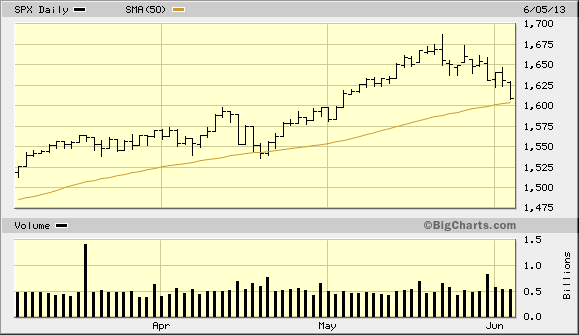
Posted by Eddy Elfenbein on June 6th, 2013 at 12:10 pmThe S&P 500 has moved very close to its 50-day moving average. The 50-DMA is currently at 1,604.
-
Morning News: June 6, 2013
Posted by Eddy Elfenbein on June 6th, 2013 at 6:59 amEuro Rises to Four-Week High Before ECB Decision; Pound Advances
London Should Hand Libor Supervision to EU, Says Brussels
IMF Says Greece May Need Faster Debt Relief, Cites Own Mistakes
Yen Strengthens as Fed Easing Debate Intensifies; Aussie Slides
Financial Fears Gain Credence as Unrest Shakes Turkey
Fed Grants Foreign Banks Leeway in Dodd-Frank Swap Pushout Rule
SEC Unites Opponents on Money Fund Rule With Floating-Share Plan
How Rising Mortgage Rates Could Affect the Housing Recovery
ADP Report Shows 135,000 New Private-Sector Jobs
Entitlement Changes to Put Seniors at Financial Risk
PepsiCo in Talks to Buy SodaStream for $2 Billion
Microsoft And The FBI Are Teaming Up To Take Down A Global Cyber Crime Ring
Jeff Miller: The Most Expensive Investment Research is Free
Joshua Brown: Defending 15,000
Be sure to follow me on Twitter.
-
Biggest Selloff of the Year
Posted by Eddy Elfenbein on June 5th, 2013 at 12:23 pmSee that little spot of trouble in mid-April?
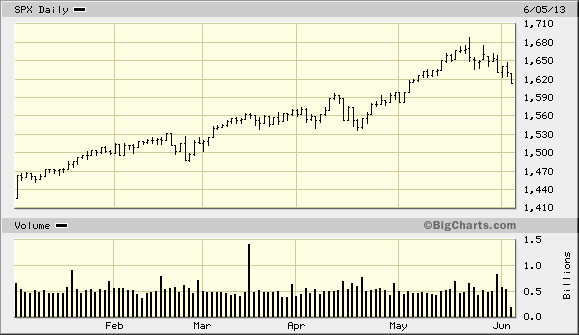
The recent drop just surpassed that as our biggest drop of the year. Measuring from the intra-day high to intra-day low, the S&P 500 lost 3.84% between April 12 and April 18.
On May 22, the S&P 500 reached a high of 1,687.18. So to have a larger drop than the one in April, the S&P 500 had to break below 1,622.41. We hovered just above that mark earlier this week. The Monday intra-day low was 1,622.72 and on Tuesday it was 1,623.62.
Today, however, is a different story. So far, the S&P 500 has been as low as 1,612.29. This is the the biggest drop of the year.
-
The Graham Number
Posted by Eddy Elfenbein on June 5th, 2013 at 11:25 amEver heard of the Graham Number? This was a formula developed by Ben Graham, the father of securities analysis, to determine the fair value for a stock.
The Graham Number is:
The square root of [earnings-per-share * book-value-per-share * 22.5]
(Take note that earnings-per-share divided by book-value-per-share is our good friend return on equity.)
Let’s run an example: Nicholas Financial ($NICK) earned $1.63 per share in the four quarters ending March 31, 2013. The book value per share is $10.46.
So…if we multiply $1.63 * $10.46 * $22.5, that gives us $383.62.
The square root of $383.62 gives us $19.59. So by the Graham Number, NICK is going for a hefty 25% discount to its fair value.
-
Q1 Productivity Revised Down to 0.5%
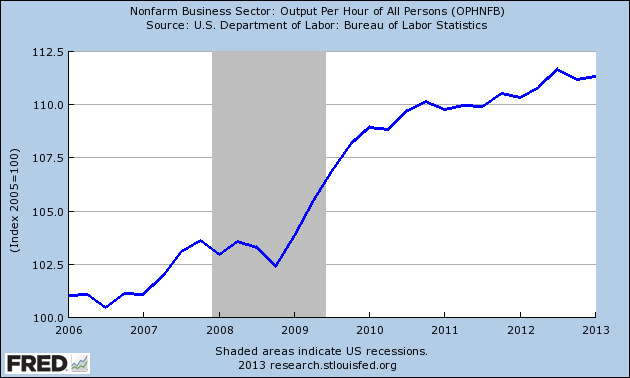
Posted by Eddy Elfenbein on June 5th, 2013 at 10:38 amThe productivity report for Q4 was terrible. Fortunately, productivity improved in Q1. The government’s initial report said that productivity rose by 0.7% for the first three months of the year. Today that was revised down to 0.5% growth.
-
Higher Rates Are Good for Wells Fargo
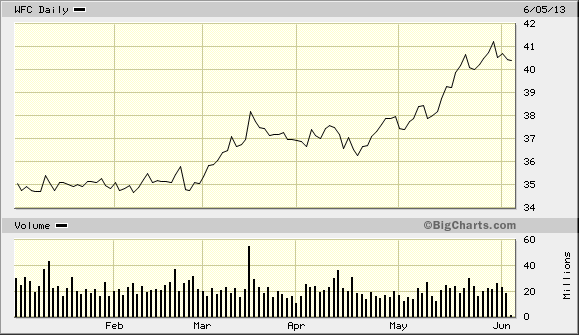
Posted by Eddy Elfenbein on June 5th, 2013 at 10:01 amNot everything about higher rates is bad. The CFO of Wells Fargo ($WFC) said that higher rates will actually help them:
Wells Fargo, the biggest U.S. home lender, is well-positioned for rising interest rates because the firm will benefit from higher returns, said Chief Financial Officer Timothy Sloan.
“The current backup in rates we think is attractive and will allow us to invest,” Sloan, 53, said today at a New York investor conference in response to a question about rising Treasury note yields. One drawback is that “it makes some consumers who were thinking about refinancing their mortgage probably think twice.”
Managing through a rise in interest rates is the biggest challenge facing bankers today, Sloan’s boss, Chief Executive Officer John Stumpf, said last week. While the San Francisco-based firm erred by prematurely keeping money on the sidelines in anticipation of rising rates, the shift may finally be coming, he said.
Analysts and investors have expressed concern that banks will be stuck with loans and other assets that will lose value because they were created when rates were near record lows.
“We’re very well-poised for an increase in interest rates,” Sloan said. “If rates go up, we can operate successfully.”
-
ADP Misses By 30,000, Look for Lower Open
Posted by Eddy Elfenbein on June 5th, 2013 at 9:29 amThe great Tuesday winnings streak finally came to an end yesterday. Note that it was only a winning streak for the Dow, not for the S&P 500. Despite how much news the winning streak got, it’s really not important for investors.
What is important for us is to see the fundamentals of the market improve which means corporate earnings. This Friday will be the big jobs report. Each month’s jobs report is by far the biggest economic report. On the Wednesday before each jobs report, ADP, which is a private payroll firm, releases its estimate. This morning, ADP said that the economy created 135,000 jobs in May which was less than what economists were expecting. The consensus was for a gain of 165,000. The stock market looks to pull back in early trading today.
I was impressed to see that Ford ($F) reported 45% sales growth in China. This is good news, but Ford is still way behind its rivals in China.
-
Morning News: June 5, 2013
Posted by Eddy Elfenbein on June 5th, 2013 at 7:15 amEurozone Recovery Signs Few And Far Between
Japanese Shares Suffer Another Setback After Speech By Prime Minister Abe
Euro Endorsement Key to Igniting Delayed Latvian Debt Rally
China Hits Back at EU With Wine Probe
Dow’s Record Tuesday Streak Comes to an End
Jefferson County, Creditors Reach Deal to End Bankruptcy
Apple Faces Limited Ban As U.S. Trade Panel Backs Samsung On Patents
IBM Buying Cloud Computing Company SoftLayer
Wilson Sonsini Advises Salesforce on ExactTarget Takeover
Supermarkets Beware: Amazon is Coming
Uncertain Outlook for Tesco Shares After Sales Fall Around the World
Bill Gates Gets in on ‘Nerd Facebook’
Warren Buffett Lunch Bids Quickly Top Apple CEO Cook’s Coffee
John Hempton: Short Selling and Misrepresenting the Truth – Infitalis Edition
Jeff Carter: 7 Things Kitchen Nightmares Can Teach a Business
Be sure to follow me on Twitter.
-
Gundlach on Interest Rates
Posted by Eddy Elfenbein on June 4th, 2013 at 4:44 pm
-
Archives
- August 2026
- July 2026
- June 2026
- May 2026
- April 2026
- March 2026
- February 2026
- January 2026
- December 2025
- November 2025
- October 2025
- September 2025
- August 2025
- July 2025
- June 2025
- May 2025
- April 2025
- March 2025
- February 2025
- January 2025
- December 2024
- November 2024
- October 2024
- September 2024
- August 2024
- July 2024
- June 2024
- May 2024
- April 2024
- March 2024
- February 2024
- January 2024
- December 2023
- November 2023
- October 2023
- September 2023
- August 2023
- July 2023
- June 2023
- May 2023
- April 2023
- March 2023
- February 2023
- January 2023
- December 2022
- November 2022
- October 2022
- September 2022
- August 2022
- July 2022
- June 2022
- May 2022
- April 2022
- March 2022
- February 2022
- January 2022
- December 2021
- November 2021
- October 2021
- September 2021
- August 2021
- July 2021
- June 2021
- May 2021
- April 2021
- March 2021
- February 2021
- January 2021
- December 2020
- November 2020
- October 2020
- September 2020
- August 2020
- July 2020
- June 2020
- May 2020
- April 2020
- March 2020
- February 2020
- January 2020
- December 2019
- November 2019
- October 2019
- September 2019
- August 2019
- July 2019
- June 2019
- May 2019
- April 2019
- March 2019
- February 2019
- January 2019
- December 2018
- November 2018
- October 2018
- September 2018
- August 2018
- July 2018
- June 2018
- May 2018
- April 2018
- March 2018
- February 2018
- January 2018
- December 2017
- November 2017
- October 2017
- September 2017
- August 2017
- July 2017
- June 2017
- May 2017
- April 2017
- March 2017
- February 2017
- January 2017
- December 2016
- November 2016
- October 2016
- September 2016
- August 2016
- July 2016
- June 2016
- May 2016
- April 2016
- March 2016
- February 2016
- January 2016
- December 2015
- November 2015
- October 2015
- September 2015
- August 2015
- July 2015
- June 2015
- May 2015
- April 2015
- March 2015
- February 2015
- January 2015
- December 2014
- November 2014
- October 2014
- September 2014
- August 2014
- July 2014
- June 2014
- May 2014
- April 2014
- March 2014
- February 2014
- January 2014
- December 2013
- November 2013
- October 2013
- September 2013
- August 2013
- July 2013
- June 2013
- May 2013
- April 2013
- March 2013
- February 2013
- January 2013
- December 2012
- November 2012
- October 2012
- September 2012
- August 2012
- July 2012
- June 2012
- May 2012
- April 2012
- March 2012
- February 2012
- January 2012
- December 2011
- November 2011
- October 2011
- September 2011
- August 2011
- July 2011
- June 2011
- May 2011
- April 2011
- March 2011
- February 2011
- January 2011
- December 2010
- November 2010
- October 2010
- September 2010
- August 2010
- July 2010
- June 2010
- May 2010
- April 2010
- March 2010
- February 2010
- January 2010
- December 2009
- November 2009
- October 2009
- September 2009
- August 2009
- July 2009
- June 2009
- May 2009
- April 2009
- March 2009
- February 2009
- January 2009
- December 2008
- November 2008
- October 2008
- September 2008
- August 2008
- July 2008
- June 2008
- May 2008
- April 2008
- March 2008
- February 2008
- January 2008
- December 2007
- November 2007
- October 2007
- September 2007
- August 2007
- July 2007
- June 2007
- May 2007
- April 2007
- March 2007
- February 2007
- January 2007
- December 2006
- November 2006
- October 2006
- September 2006
- August 2006
- July 2006
- June 2006
- May 2006
- April 2006
- March 2006
- February 2006
- January 2006
- December 2005
- November 2005
- October 2005
- September 2005
- August 2005
- July 2005
 Eddy Elfenbein is a Washington, DC-based speaker, portfolio manager and editor of the blog Crossing Wall Street. His