-
Is Healthcare Inflation Simmering Down?
Posted by Eddy Elfenbein on February 19th, 2013 at 11:03 pmOn Thursday, the government will release the CPI numbers for January. I’m not worried about overall inflation which has been extremely tame. But deep within the report, I’m very curious to see how healthcare costs are doing.
As you’re probably aware, healthcare costs continue to rise every year. Here’s a look at the relative inflation of healthcare. This is the healthcare component of the CPI divided by core CPI. In other words, this isn’t just inflation — it’s the healthcare inflation that’s on top of inflation.

This is a very important. Nearly every issue facing our economy and finances at some point intersects with the problem of rising healthcare costs. If that is somehow brought under control, the outlook completely changes.
There’s some emerging evidence for optimism on the cost containment front (NYT: “Slower Growth of Health Costs Eases Budget Deficit“). Here’s the same chart above, but I’ve zoomed in to show the last few years.
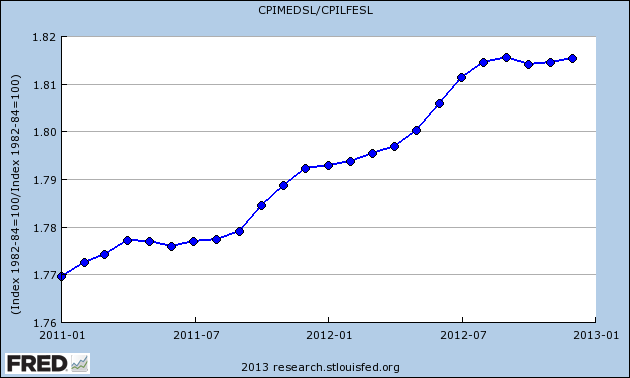
The line is still rising, but the last few dots are rather flattish. This is obviously far too early to call a trend, but it’s something worth keeping our eyes on.
-
Nicholas Financial to Pay 12 Cent Dividend
Posted by Eddy Elfenbein on February 19th, 2013 at 8:05 pmPerhaps I misinterpreted this, but I was under the assumption that Nicholas Financial‘s ($NICK) monster dividend was in place of its dividends for 2013. Apparently not. NICK announced another 12 cent quarterly dividend today. The dividend will be paid on March 29th to shareholders of record as of March 22nd.
Peter L. Vosotas, Chairman and CEO noted, “Our capital position and continued confidence in our earnings capability played a large part in the Board of Director’s decision to declare a cash dividend.” Subject to market conditions and profitability targets, the Company anticipates it will continue to declare quarterly cash dividends in the future, however no assurances can be given.
The stock rose to $13.25 today. That’s a yield of 3.62%.
-
Berkshire Hathaway Breaks $150,000
Posted by Eddy Elfenbein on February 19th, 2013 at 7:56 pmOn Friday, for the first time ever, shares of Berkshire Hathaway ($BRKA) closed over $150,000. In December 2007, the stock popped its head above $150K a few times, but was never able to hang on by the close. Then came bad times. Not that long ago, September 2011 to be precise, BRKA dropped below $100,000.
Since 1998, Berkshire has lost a lot of its historical super mojo. Still, it’s been a good performer. Berkshire first closed at $15,000 on May 27, 1993 — almost 20 years ago. The stock first broke $1,500 only eight years before that on March 19, 1985.
-
Total Investor Yield
Posted by Eddy Elfenbein on February 19th, 2013 at 12:40 pmI mentioned this before but Shawn Tully has an interesting article on the concept of total yield — the dividend yield plus buybacks.
As I’ve written many times before, I’m not a fan stock buybacks. As a shareholder, I’d much rather have the cash in hand. A major issue is that too many companies wash away any benefit of share buybacks with massive executive stock compensation.
In theory, I really like the idea of total shareholder yield, but I’m afraid that it needs to be adjusted to benefit companies that primarily use share repurchases to benefit shareholders. By the way, DirecTV ($DTV) is a good exmaple of a company that truly lowers its outstanding shares.
-
Inflation Is a Tax on Capital
Posted by Eddy Elfenbein on February 19th, 2013 at 11:36 amRoben Farzad writes at Bloomberg Businessweek:
Longtime readers of BusinessWeek (now Bloomberg Businessweek) will recall its Dewey-Defeats-Truman moment: A 1979 A 1979 cover story that heralded the “Death of Equities: How Inflation is Destroying the Stock Market.” Inflation was the bogeyman of the late 1970s and early ’80s, an oft-cursed scourge to the average family’s buying power. The problem with BusinessWeek’s headline declaration is that it came shortly before the Paul Volcker Federal Reserve vanquished runaway inflation, setting up an 18-year bull market.
Since that bull maxed out 13 years ago, the market has pretty much gone to hell and back, twice. While inflation has been consistently in the low single digits, it hasn’t been as irrelevant as many investors imagine. Indeed, like termites coring out a wooden house, rising prices have already set them back a long way.
“Inflation,” says Crossing Wall Street‘s Eddy Elfenbein, “is a tax on capital and it slowly eats away at your portfolio. Even a low rate of inflation—say, 3 percent per year—compounds to 50 percent in less than 14 years. It’s proverbial running to stand still.”
In simple terms, if you were to take the Standard & Poor’s 500-stock index’s fin de siècle high and factor in the subsequent growth in the consumer price index, the market is 27 percent below its inflation (as the government defines it)-adjusted high. So much for the few percent we need to hit that market record you’re hearing so much about of late.
-
Is the Sequester Really Going to Happen?
Posted by Eddy Elfenbein on February 19th, 2013 at 10:51 amWe’re getting down to the wire and if nothing is done, automatic spending cuts will go into effect. The conventional wisdom seems to think the cuts will happen.
Fortunately, I have a better tool than the conventional wisdom and that’s the stock market. Here’s a look at the Spade Defense Index divided by the S&P 500. This is a key metric because much of the cuts will hurt the Pentagon.
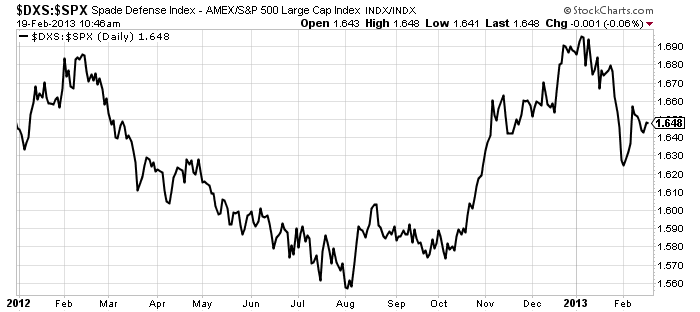
Defense stocks started to lag the market at the beginning of the year, but have reversed course somewhat this month.
-
Medtronic Earns 93 Cents Per Share
Posted by Eddy Elfenbein on February 19th, 2013 at 10:35 amThe stock market is doing well this morning. The S&P 500 has been as high as 1,526.82, which is yet another multi-year high. The market is trying to extend its weekly winning streak to eight. This is a good way to start.
Investors have impressively run past a lot of minor negatives that easily could have hurt stocks in previous markets. The earnings news continues to be decent. The latest numbers show that 388 companies in the S&P 500 have reported Q4 earnings. Of that, 69.8% have beaten expectations. Compare that with the long-run average of 62%. Earnings are up 5.6% from one year ago, and 1.9% above expectations.
Our latest Buy List stock to report earnings was Medtronic ($MDT). For their fiscal third quarter, Medtronic earned 93 cents per share which was two cents better than Wall Street’s forecast. That’s an increase from 84 cents per share a year ago. Sales rose 2.8% to $4.03 billion which was $10 million below forecasts.
Medtronic once again reiterated their full-year earnings forecast of $3.66 to $3.70 per share. For clarity, Medtronic’s fiscal year ends in April. MDT is our first Buy List stock in the January-April-July-October cycle to report earnings. The shares are currently down about 3.3% although I don’t see why. In today’s earnings release, the CEO said:
“We are playing a leading role in transforming global healthcare by implementing our long-term strategies of economic value and globalization,” said Ishrak. “We are only at the beginning of establishing our track record, but we believe that crisp execution of both our baseline and long-term growth strategies, combined with strong and disciplined capital allocation, will enable us to create long-term dependable value in healthcare.”
Shawn Tully at CNN/Money makes a good point about Medtronic. The dividend yield is 2.3% and the repurchases come to 3.7% for a total shareholder yield of 6.0%.
-
Morning News: February 19, 2013
Posted by Eddy Elfenbein on February 19th, 2013 at 6:50 amMerkel Cites East German Lessons for EU’s Problem States
German February Investor Confidence Jumps to Three-Year High
Draghi Seeks to Ease Talk of Global Currency War
Yen Rises After Aso Rules Out Japan’s Foreign-Debt Buying
Chinese Army Unit Is Seen as Tied to Hacking Against U.S.
Japan’s Orix Buys Dutch Asset Manager
Swelling U.S. Labor Force Keeps Fed at Ease
Get A Social Security Check? Treasury Says It’s Time To Go Electronic
Buffett Cash Makes General Mills to Grainger Target
Reader’s Digest Brand is Key to Strategy in Bankruptcy
Xstrata Unit Wins Environmental Approval For $5.9 Billion Philippine Mine
Novartis Scraps Non-Compete Payment to Departing Chairman
Paulson Leads Funds to Bermuda Tax Dodge Aiding Billionaires
Cullen Roche: Barron’s Doesn’t Do Monetary Realism
Credit Writedowns: Will The Corporate Sector Expansion Peak In Spring Once Again?
Be sure to follow me on Twitter.
-
Morning News: February 18, 2013
Posted by Eddy Elfenbein on February 18th, 2013 at 6:46 amGerman Banks’ Use Of ECB Funds Drops Sharply In January
In Europe’s Tax Race, It’s The Base, Not The Rate, That Counts
Debt Bubble Born of Easy Cash Prompts Swedish Rule Review
China’s Yen For Currency Appreciation
“Nothing To Hide” In Helicopter Deal, India’s Prime Minister Says
Obama Faces Risks in Pipeline Decision
American Airlines Bankruptcy, Merger Deals Were Complex, Expensive
Independent News Plans $226 Million South Africa Disposal
Facebook, The Coolest Cutest Corporate Welfare Queen Of Them All
Tech Industry Sets Its Sights on Gambling
Danone Dairy Woes a Challenge for Peltz’s Heinz Playbook
Carlsberg Slumps as Brewer Scraps Medium-Term Margin Goal
Howard Lindzon: My Kingdom For A Hedge!
Jeff Miller: Weighing the Week Ahead: Is the Housing Rebound for Real?
Be sure to follow me on Twitter.
-
Paperman
Posted by Eddy Elfenbein on February 15th, 2013 at 4:02 pm
-
Archives
- August 2026
- July 2026
- June 2026
- May 2026
- April 2026
- March 2026
- February 2026
- January 2026
- December 2025
- November 2025
- October 2025
- September 2025
- August 2025
- July 2025
- June 2025
- May 2025
- April 2025
- March 2025
- February 2025
- January 2025
- December 2024
- November 2024
- October 2024
- September 2024
- August 2024
- July 2024
- June 2024
- May 2024
- April 2024
- March 2024
- February 2024
- January 2024
- December 2023
- November 2023
- October 2023
- September 2023
- August 2023
- July 2023
- June 2023
- May 2023
- April 2023
- March 2023
- February 2023
- January 2023
- December 2022
- November 2022
- October 2022
- September 2022
- August 2022
- July 2022
- June 2022
- May 2022
- April 2022
- March 2022
- February 2022
- January 2022
- December 2021
- November 2021
- October 2021
- September 2021
- August 2021
- July 2021
- June 2021
- May 2021
- April 2021
- March 2021
- February 2021
- January 2021
- December 2020
- November 2020
- October 2020
- September 2020
- August 2020
- July 2020
- June 2020
- May 2020
- April 2020
- March 2020
- February 2020
- January 2020
- December 2019
- November 2019
- October 2019
- September 2019
- August 2019
- July 2019
- June 2019
- May 2019
- April 2019
- March 2019
- February 2019
- January 2019
- December 2018
- November 2018
- October 2018
- September 2018
- August 2018
- July 2018
- June 2018
- May 2018
- April 2018
- March 2018
- February 2018
- January 2018
- December 2017
- November 2017
- October 2017
- September 2017
- August 2017
- July 2017
- June 2017
- May 2017
- April 2017
- March 2017
- February 2017
- January 2017
- December 2016
- November 2016
- October 2016
- September 2016
- August 2016
- July 2016
- June 2016
- May 2016
- April 2016
- March 2016
- February 2016
- January 2016
- December 2015
- November 2015
- October 2015
- September 2015
- August 2015
- July 2015
- June 2015
- May 2015
- April 2015
- March 2015
- February 2015
- January 2015
- December 2014
- November 2014
- October 2014
- September 2014
- August 2014
- July 2014
- June 2014
- May 2014
- April 2014
- March 2014
- February 2014
- January 2014
- December 2013
- November 2013
- October 2013
- September 2013
- August 2013
- July 2013
- June 2013
- May 2013
- April 2013
- March 2013
- February 2013
- January 2013
- December 2012
- November 2012
- October 2012
- September 2012
- August 2012
- July 2012
- June 2012
- May 2012
- April 2012
- March 2012
- February 2012
- January 2012
- December 2011
- November 2011
- October 2011
- September 2011
- August 2011
- July 2011
- June 2011
- May 2011
- April 2011
- March 2011
- February 2011
- January 2011
- December 2010
- November 2010
- October 2010
- September 2010
- August 2010
- July 2010
- June 2010
- May 2010
- April 2010
- March 2010
- February 2010
- January 2010
- December 2009
- November 2009
- October 2009
- September 2009
- August 2009
- July 2009
- June 2009
- May 2009
- April 2009
- March 2009
- February 2009
- January 2009
- December 2008
- November 2008
- October 2008
- September 2008
- August 2008
- July 2008
- June 2008
- May 2008
- April 2008
- March 2008
- February 2008
- January 2008
- December 2007
- November 2007
- October 2007
- September 2007
- August 2007
- July 2007
- June 2007
- May 2007
- April 2007
- March 2007
- February 2007
- January 2007
- December 2006
- November 2006
- October 2006
- September 2006
- August 2006
- July 2006
- June 2006
- May 2006
- April 2006
- March 2006
- February 2006
- January 2006
- December 2005
- November 2005
- October 2005
- September 2005
- August 2005
- July 2005
 Eddy Elfenbein is a Washington, DC-based speaker, portfolio manager and editor of the blog Crossing Wall Street. His